Ottoia
Ottoia prolifica
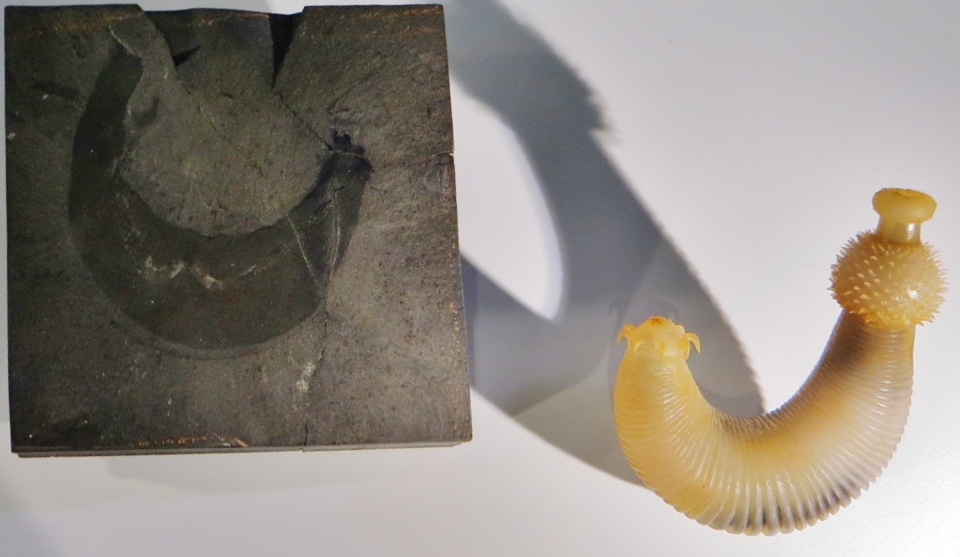
Image: File:Ottoia prolifica fossil and model.jpg - Wikimedia Commons (CC BY-SA)
About Ottoia
Ottoia prolifica was a carnivorous, burrowing priapulid worm that thrived during the Middle Cambrian period, approximately 508 million years ago. As one of the most abundant and exceptionally preserved organisms found within the famous Burgess Shale lagerstatte of British Columbia, Canada, this ancient marine invertebrate provides an unparalleled window into the complexity of early animal ecosystems. Its remarkable fossil record has made it a cornerstone species for understanding the rapid diversification of life during the Cambrian explosion and the establishment of complex predator-prey dynamics in primordial seas.
The physical anatomy of Ottoia prolifica is known in extraordinary detail due to the exceptional soft-tissue preservation of the Burgess Shale. Averaging about eight centimeters in length, though some specimens reached up to fifteen centimeters, Ottoia possessed a plump, bilaterally symmetrical, and cylindrical body that is most frequently preserved in a characteristic U-shape. This curvature is thought to reflect the shape of the burrows it inhabited in the soft seafloor mud. The body of Ottoia was divided into two primary sections: a posterior trunk and an anterior eversible proboscis. The trunk was heavily annulated, meaning it was marked by numerous external ring-like grooves that gave it a segmented appearance, although it lacked true internal segmentation. This flexible, muscular trunk allowed the worm to anchor itself in the sediment and move through the substrate using peristaltic contractions, much like modern earthworms. At the posterior end, Ottoia possessed a small, bulbous bursa, which may have served a respiratory function or aided in anchoring the animal within its burrow. However, the most formidable and distinctive feature of Ottoia was its large, eversible proboscis. When retracted, this structure rested inside the anterior portion of the gut, but it could be rapidly turned inside out and extended outward to capture prey. The surface of this proboscis was heavily armed with an intricate array of chitinous hooks, spines, and scalids. These spines were arranged in precise, symmetrical rings and varied in shape, with some being robust and pronged for grasping struggling prey, while others were finer and used for sensory purposes or moving through the sediment. In comparison to modern priapulid worms, often called penis worms, Ottoia exhibits a remarkable degree of morphological similarity, demonstrating a highly successful body plan that has remained largely unchanged for over half a billion years.
The paleobiology of Ottoia reveals a highly active and specialized marine predator. Its primary feeding strategy involved ambushing prey from the safety of its U-shaped burrows in the soft benthic sediment. Paleontologists have been able to reconstruct its diet with incredible precision because the Burgess Shale fossils frequently preserve the actual gut contents of the worms. The most common prey item found within the digestive tracts of Ottoia is the hyolithid Haplophrentis, a small, conical, shelled invertebrate. Fossil evidence shows that Ottoia almost always swallowed Haplophrentis head-first, indicating a sophisticated and deliberate feeding behavior rather than indiscriminate scavenging. The eversible proboscis would shoot out, grasp the shell with its array of hooks, and pull the prey whole into the worm's muscular pharynx and gut, where powerful enzymes would digest the soft tissues, eventually leaving the indigestible shell to be excreted. Beyond hyolithids, Ottoia also preyed upon small arthropods and various soft-bodied organisms. Perhaps most fascinating is the definitive fossil evidence of cannibalism within the species. Several larger specimens of Ottoia have been discovered with smaller individuals of their own kind preserved within their digestive tracts. This cannibalistic behavior suggests a highly competitive benthic environment where food resources were fiercely contested, and opportunistic predation was a key survival strategy. Locomotion for Ottoia was primarily restricted to burrowing through the mud using the hydrostatic pressure of its fluid-filled body cavity, combined with the rhythmic contraction of its longitudinal and circular muscles. The spines on its proboscis would grip the sediment, allowing the worm to pull its body forward. Growth patterns inferred from the vast number of collected specimens indicate that Ottoia grew continuously throughout its life, likely molting its chitinous cuticle periodically to accommodate its increasing size, a defining characteristic of the superphylum Ecdysozoa to which it belongs.
During the Middle Cambrian, the ecological context of Ottoia was situated in a vibrant, shallow marine environment located near the equator on the ancient continent of Laurentia. The climate was generally warm and tropical, with high sea levels creating extensive continental shelf seas. The specific habitat of Ottoia was the muddy seafloor at the base of a massive underwater limestone cliff known as the Cathedral Escarpment. This environment was teeming with a diverse array of early animal life, representing the sudden burst of evolutionary innovation known as the Cambrian explosion. Ottoia shared its benthic habitat with a multitude of fascinating creatures, including the heavily armored slug-like Wiwaxia, the delicate lace crab Marrella, and various species of trilobites like Olenoides. Above them in the water column swam formidable apex predators such as the anomalocaridids. Within this complex food web, Ottoia occupied a crucial middle-tier position. It was a dominant predator of the infaunal and epifaunal micro-benthos, keeping populations of hyolithids and small arthropods in check. Simultaneously, Ottoia itself served as a vital food source for larger, more mobile predators and scavengers that patrolled the seafloor. The frequent preservation of Ottoia in dense clusters suggests that it lived in large populations, heavily bioturbating the upper layers of the sediment. This constant burrowing activity would have oxygenated the mud and altered the chemical and physical properties of the seafloor, making Ottoia an important ecosystem engineer that shaped the habitat for other benthic organisms. The sudden burial of these communities by underwater mudslides, sweeping them from the oxygen-rich shelf into the anoxic depths of the adjacent basin, is what ultimately preserved this intricate ecological web in such stunning detail.
The discovery history of Ottoia is inextricably linked to the legendary American paleontologist Charles Doolittle Walcott, who first discovered the Burgess Shale in 1909. Walcott formally described and named Ottoia prolifica in 1911 during his extensive excavations of the site on the slopes of Mount Field in British Columbia. The genus name Ottoia was derived from Otto Creek, a small geographical feature located near the discovery site, while the specific epithet prolifica was chosen to reflect the sheer abundance of these fossils in the rock layers. Walcott recognized the worm-like nature of the fossils but initially struggled to classify them accurately within the broader context of invertebrate zoology, a common challenge given the bizarre morphology of many Cambrian organisms. Over the course of his field seasons between 1909 and 1924, Walcott and his team collected thousands of Ottoia specimens, hauling them by packhorse down the mountain to be shipped to the Smithsonian Institution in Washington, D.C. For decades, these specimens remained somewhat enigmatic, until the Burgess Shale fauna underwent a massive reinvestigation in the 1970s by Harry Whittington, Simon Conway Morris, and Derek Briggs. It was during this period that the true biological affinities and complex paleoecology of Ottoia were brought to light. Conway Morris, in particular, conducted exhaustive studies on the functional morphology of Ottoia, meticulously dissecting the fossilized proboscis and gut contents to reveal its predatory nature and its relationship to modern priapulids. The Walcott Quarry, the specific layer of the Burgess Shale where Ottoia is most abundant, remains one of the most important paleontological sites in the world, and the thousands of Ottoia specimens housed in museum drawers continue to yield new insights as imaging technologies advance.
The evolutionary significance of Ottoia cannot be overstated, as it provides a critical anchor point for understanding the early evolution of the Ecdysozoa, a massive superphylum of animals that includes arthropods, nematodes, and priapulids, all characterized by their shared trait of molting a cuticle. Ottoia is firmly placed within the phylum Priapulida, a group of unsegmented marine worms that are relatively rare and obscure today but were highly diverse and ecologically dominant during the Cambrian period. By comparing the anatomy of Ottoia to modern priapulids, such as Priapulus caudatus, scientists have identified a profound example of morphological stasis. The basic body plan of the priapulid worm, including the eversible, spine-covered proboscis and the muscular, annulated trunk, was already fully developed and optimized 508 million years ago. This suggests that the priapulid lineage experienced a rapid burst of evolutionary innovation during the early Cambrian, followed by hundreds of millions of years of conservative evolution. Ottoia also exhibits transitional features that help paleontologists map the deep evolutionary relationships between different worm-like phyla that emerged during the Cambrian explosion. The intricate arrangement of the scalids on its proboscis, for example, shares developmental similarities with the mouthparts of early arthropods and the grasping structures of kinorhynchs and loriciferans. By studying the well-preserved nervous system and musculature traces in Ottoia fossils, researchers can reconstruct the ancestral traits of the entire ecdysozoan clade, shedding light on how complex sensory and motor functions evolved in early bilateral animals. Ottoia essentially serves as a deep-time reference point, proving that the fundamental genetic and developmental toolkits required to build complex, predatory animals were already firmly established by the Middle Cambrian.
Despite the abundance of fossil material, Ottoia has been the subject of several scientific debates and controversies over the decades. One of the earliest debates centered on its feeding behavior. While Walcott initially assumed it was a simple mud-eater, later researchers debated whether it was primarily an active predator or a scavenger. The discovery of intact Haplophrentis shells in the gut strongly supported the predator hypothesis, but some scientists argued that Ottoia might have scavenged dead hyolithids. However, the consistent head-first orientation of the prey eventually solidified the consensus that Ottoia was an active ambush predator. Another significant debate involves the taxonomy of the genus itself. For over a century, Ottoia prolifica was considered the sole species within its genus in the Burgess Shale. However, in 2015, a detailed morphometric analysis by paleontologist Martin Smith utilizing advanced electron microscopy revealed subtle but distinct differences in the microscopic teeth and hooks on the proboscis of various specimens. This led to the identification of a second species, Ottoia tricuspida, which lived alongside Ottoia prolifica but possessed uniquely three-pronged spines. This discovery highlighted that the diversity of Cambrian priapulids was even greater than previously recognized and demonstrated that cryptic species could be hidden within historically established fossil collections. Debates also continue regarding the exact function of the posterior bursa, with some researchers suggesting it was a reproductive organ, while others maintain it was primarily respiratory or used for anchoring in the mud.
The fossil record of Ottoia is one of the richest and most detailed of any Cambrian soft-bodied organism. The vast majority of specimens originate from the Burgess Shale in British Columbia, specifically from the Walcott Quarry, where it is one of the most frequently encountered fossils. To date, paleontologists have collected well over fifteen thousand individual specimens of Ottoia, making it a statistically robust subject for population studies and taphonomic analysis. The preservation quality of these fossils is extraordinary, representing a specific type of fossilization known as Burgess Shale-type preservation. In this process, the soft tissues of the worm were rapidly buried in fine-grained, anoxic mud, preventing decay by scavengers and bacteria. Over millions of years, the organic material was replaced by thin films of aluminosilicate minerals, leaving highly detailed, two-dimensional carbonaceous compressions on the shale surfaces. This unique mode of preservation has captured microscopic details of Ottoia, including individual muscle fibers, the delicate chitinous teeth of the proboscis, and the three-dimensional structure of the gut tract. While the Burgess Shale remains the primary source of Ottoia fossils, similar priapulid worms have been found in other Cambrian lagerstatten around the world, such as the Chengjiang biota in China and the Sirius Passet in Greenland, indicating that this type of predatory worm had a widespread global distribution during the period.
The cultural impact of Ottoia extends far beyond the confines of academic paleontology. As one of the flagship organisms of the Burgess Shale, Ottoia is prominently featured in natural history museums worldwide, including the Royal Ontario Museum in Toronto and the Smithsonian National Museum of Natural History in Washington, D.C. It is a staple of paleontology textbooks and educational documentaries, frequently used to illustrate the concept of soft-tissue preservation and the bizarre nature of Cambrian life. In popular culture, Ottoia often appears in artistic reconstructions and dioramas of the Cambrian seafloor, usually depicted emerging from its burrow to snatch a passing prey item. Its distinct, somewhat fearsome appearance, characterized by its toothy proboscis, has captured the imagination of the public, serving as a visceral reminder of the ancient and alien-looking creatures that once ruled the Earth's primordial oceans. Through its extensive fossil record and prominent educational role, Ottoia continues to inspire curiosity about the deep history of life and the evolutionary origins of modern animal ecosystems.
Classification
Time Period
Discovery
Location
Burgess Shale, British Columbia, Canada
Formation
Burgess Shale
Frequently Asked Questions
What is Ottoia?
Ottoia prolifica was a carnivorous, burrowing priapulid worm that thrived during the Middle Cambrian period, approximately 508 million years ago. As one of the most abundant and exceptionally preserved organisms found within the famous Burgess Shale lagerstatte of British Columbia, Canada, this anci...
When did Ottoia live?
Ottoia lived during the cambrian period of the paleozoic era approximately 508 million years ago.
Where was Ottoia discovered?
Fossils of Ottoia were discovered in Burgess Shale, British Columbia, Canada in the Burgess Shale.
What did Ottoia eat?
Ottoia was a carnivore. It lived in marine habitats.
What type of fossil is Ottoia?
Ottoia is preserved as a carbonized fossil. The preservation quality is exceptional.
Related Specimens
From the paleozoic era · carbonized fossils