Nyctosaurus
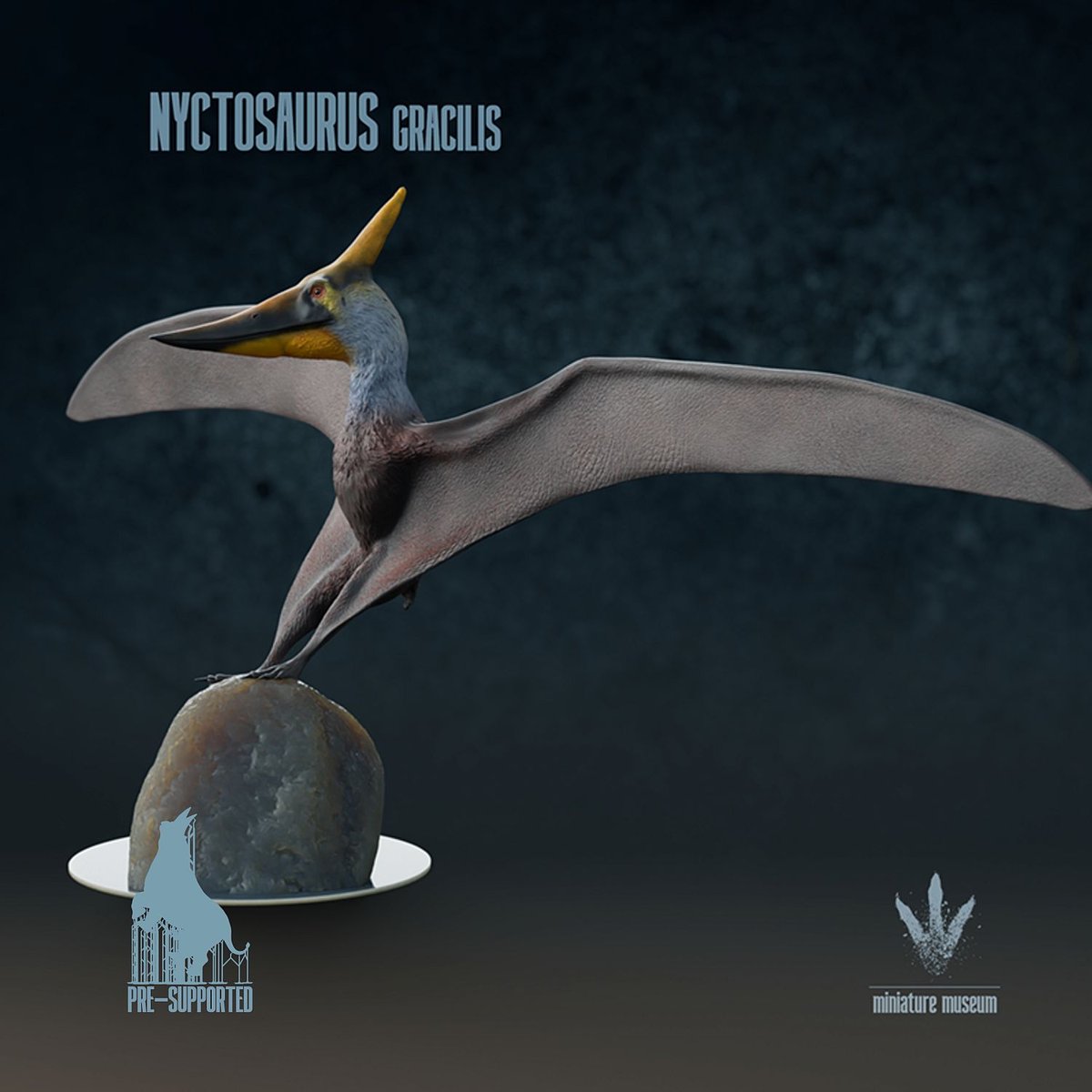
Nyctosaurus gracilis
Image: Image sourced via web search (Fair use / Educational)
About Nyctosaurus
Nyctosaurus, meaning 'night lizard' or 'bat lizard,' was a genus of highly specialized pterodactyloid pterosaur that thrived during the Late Cretaceous period, approximately 86 to 82 million years ago. Inhabiting the shallow, warm waters of the Western Interior Seaway that split North America during the Mesozoic era, this remarkable flying reptile is celebrated for its extraordinary cranial anatomy and extreme adaptations to a pelagic lifestyle. Its discovery and subsequent study have provided paleontologists with crucial insights into the aerodynamic limits and evolutionary plasticity of pterosaurs, cementing its status as one of the most bizarre and fascinating vertebrates to have ever taken to the skies.
The physical anatomy of Nyctosaurus gracilis represents a masterclass in evolutionary specialization for sustained, dynamic soaring. While relatively small compared to its colossal contemporary Pteranodon, Nyctosaurus possessed a respectable wingspan measuring approximately 2 meters (6.5 feet), though its body was remarkably diminutive, likely weighing no more than 1.5 to 2 kilograms (3.3 to 4.4 pounds). The most visually arresting feature of Nyctosaurus, present in fully mature adults, was an enormous, antler-like cranial crest. This crest was composed of a towering vertical spar that swept upward and slightly backward, intersected by a shorter, backward-pointing horizontal spar, creating an immense 'L' or 'T' shape that could exceed the length of the animal's entire body. Unlike many other crested pterosaurs, there is no direct fossil evidence to suggest this bony scaffold supported a keratinous or membranous sail, though this remains a point of contention. Post-cranially, Nyctosaurus was entirely unique among known pterosaurs due to the complete loss of its first three wing digits (the 'fingers' typically used by pterosaurs for quadrupedal walking and climbing). The wing was supported entirely by the hyper-elongated fourth digit. This extreme reduction in skeletal elements further minimized the animal's weight, resulting in an incredibly high aspect ratio wing perfectly tailored for gliding over open ocean waters, much like a modern albatross, though with a completely different underlying skeletal architecture.
The paleobiology of Nyctosaurus is deeply intertwined with its extreme anatomical adaptations, pointing toward a life spent almost entirely on the wing over the open ocean. The complete absence of functional forelimb claws strongly suggests that Nyctosaurus was incapable of the typical quadrupedal locomotion seen in other pterosaurs; it could not climb, cling to cliffs, or walk efficiently on land. Instead, it likely spent the vast majority of its life soaring dynamically above the waves, utilizing ocean updrafts and wind shear to stay aloft with minimal metabolic cost. Its diet consisted almost exclusively of small fish and cephalopods, which it likely caught by plunge-diving or skimming the water's surface, snatching prey with its long, needle-like, toothless beak. The jaw mechanics indicate a rapid snapping motion, ideal for capturing slippery, fast-moving aquatic prey. Given its awkwardness on land, it is hypothesized that Nyctosaurus only returned to terra firma to mate and lay eggs, perhaps nesting on isolated, predator-free islands or sandy beaches where it could easily launch itself back into the air by facing into strong coastal headwinds. The massive crest of mature individuals likely played a significant role in sexual selection and species recognition, growing rapidly as the animal reached sexual maturity, a pattern observed in many modern birds with elaborate display structures.
During the Late Cretaceous, the environment inhabited by Nyctosaurus was vastly different from the modern North American landscape. The continent was bisected by the Western Interior Seaway, a vast, shallow, and warm epicontinental sea that teemed with marine life. The climate was globally much warmer, with high sea levels and no permanent polar ice caps. The skies above this seaway were dominated by pterosaurs, most notably the giant Pteranodon, which shared the airspace with Nyctosaurus. Beneath the waves, the ecosystem was incredibly rich and highly dangerous. The waters were ruled by massive marine reptiles, including fearsome mosasaurs like Tylosaurus, long-necked plesiosaurs, and fast-swimming polycotylids. The fish population was equally diverse, featuring the massive, predatory Xiphactinus, as well as vast schools of smaller fish that formed the primary food source for Nyctosaurus. In this complex food web, Nyctosaurus occupied the niche of a specialized aerial piscivore. While it was an apex predator of small fish, it was also potential prey for larger marine predators. If a Nyctosaurus lingered too long on the water's surface or was injured, it could easily fall victim to a breaching mosasaur or a large predatory fish. The competition with Pteranodon may have been mitigated by niche partitioning, with the smaller, more agile Nyctosaurus targeting different prey species or utilizing different hunting strategies in the dynamic marine environment.
The discovery history of Nyctosaurus is rooted in the fiercely competitive era of 19th-century American paleontology known as the Bone Wars. The first fossil remains were discovered in 1876 by Othniel Charles Marsh, one of the era's most prominent paleontologists, in the Smoky Hill Chalk member of the Niobrara Formation in Kansas. Marsh initially named the fragmentary specimen Pteranodon gracilis, but later that same year, recognizing its distinct anatomical differences—particularly the lack of teeth and different wing proportions—he reassigned it to a new genus, Nyctosaurus, meaning 'night lizard.' For over a century, Nyctosaurus was primarily known from relatively incomplete and crestless specimens, leading scientists to believe it was simply a smaller, less spectacular cousin of Pteranodon. This perception was shattered in 2001 when an amateur fossil hunter discovered two extraordinary specimens in the Niobrara Formation. These specimens, later designated KJ1 and KJ2, were acquired by a private collector but made available for scientific study by paleontologist Christopher Bennett in 2003. These astonishingly well-preserved fossils revealed the magnificent, towering cranial crest for the first time, fundamentally altering our understanding of the genus. The discovery of KJ1 and KJ2 stands as a watershed moment in pterosaur paleontology, demonstrating how new fossil finds can completely rewrite the biological and morphological profile of an animal that had been known to science for over a century.
In the grand tapestry of pterosaur evolution, Nyctosaurus occupies a unique and highly derived position within the suborder Pterodactyloidea. It is the type genus of the family Nyctosauridae, a group of specialized marine pterosaurs closely related to the Pteranodontidae. The evolutionary trajectory of Nyctosaurus represents a pinnacle of adaptation for marine soaring. The most significant evolutionary leap is the complete loss of the first three manual digits. In the evolutionary history of tetrapods, the loss of digits is a common theme associated with extreme specialization—such as the single toe of a horse or the flippers of cetaceans—but Nyctosaurus is the only known pterosaur to have entirely discarded these climbing and walking appendages. This radical evolutionary step suggests a selective pressure that heavily favored weight reduction and aerodynamic efficiency over terrestrial mobility. Furthermore, the development of the extreme cranial crest highlights the powerful role of sexual selection in pterosaur evolution, driving the development of bizarre and metabolically costly structures that pushed the boundaries of biomechanical stability. Studying Nyctosaurus helps paleontologists understand the absolute limits of vertebrate flight and the extraordinary evolutionary plasticity of the pterosaur lineage before their sudden extinction at the end of the Cretaceous period.
The most prominent scientific debate surrounding Nyctosaurus centers on its spectacular cranial crest. Following the description of the crested specimens in 2003, a major controversy erupted over whether the bony spars supported a soft-tissue membrane, effectively creating a giant head sail. Some researchers argued that a sail would provide aerodynamic advantages, acting as a rudder or a forward-placed stabilizer for dynamic soaring. However, aerodynamic modeling by Christopher Bennett and others suggested that a large sail would actually be a severe hindrance, catching crosswinds and causing catastrophic instability in flight. Current consensus leans heavily toward the crest being a bare bony structure used exclusively for intraspecific display, though without soft-tissue preservation, the debate cannot be entirely closed. Additionally, the exact mechanics of how Nyctosaurus launched itself from the water or the ground remains highly contested, given its lack of forelimb claws. Some biomechanists propose it could still vault into the air using its knuckles, while others suggest it relied entirely on strong winds and elevated launch points.
The fossil record of Nyctosaurus is relatively sparse, especially when compared to its contemporary, Pteranodon. The vast majority of Nyctosaurus fossils have been recovered from the Smoky Hill Chalk member of the Niobrara Formation in Kansas, USA, a geological deposit famous for its exceptional preservation of Late Cretaceous marine life. Because pterosaur bones were hollow and extremely fragile, with walls sometimes less than a millimeter thick, they are rarely preserved intact. Most Nyctosaurus specimens consist of crushed, flattened, and disarticulated postcranial elements, primarily wing bones. Skulls are exceedingly rare, and complete skulls with the delicate crest intact are known from only a handful of specimens, most notably the privately held KJ1 and KJ2. The rarity of Nyctosaurus fossils compared to Pteranodon in the same deposits suggests that it may have been a less common animal in the ecosystem, or perhaps its primary habitat and nesting grounds were located further out to sea, reducing the likelihood of its remains sinking into the anoxic bottom waters of the seaway where fossilization could occur.
Despite its bizarre and fascinating appearance, Nyctosaurus has historically been overshadowed in popular culture by the larger Pteranodon. However, the discovery of the giant-crested specimens in the early 2000s propelled the 'night lizard' into the public eye. It gained significant cultural prominence through its appearance in the 2006 documentary series 'Prehistoric Park,' where its massive crest and dynamic soaring abilities were beautifully animated, capturing the imagination of a new generation of dinosaur enthusiasts. Today, casts of the spectacular crested specimens are highly sought after for museum displays, serving as powerful educational tools to illustrate the concepts of sexual selection, extreme evolutionary adaptation, and the diverse, alien nature of Mesozoic ecosystems.
Classification
Time Period
Discovery
Location
United States
Formation
Niobrara Formation
Frequently Asked Questions
What is Nyctosaurus?
Nyctosaurus, meaning 'night lizard' or 'bat lizard,' was a genus of highly specialized pterodactyloid pterosaur that thrived during the Late Cretaceous period, approximately 86 to 82 million years ago. Inhabiting the shallow, warm waters of the Western Interior Seaway that split North America during...
When did Nyctosaurus live?
Nyctosaurus lived during the cretaceous period of the mesozoic era approximately 86-82 million years ago.
Where was Nyctosaurus discovered?
Fossils of Nyctosaurus were discovered in United States in the Niobrara Formation.
What did Nyctosaurus eat?
Nyctosaurus was a carnivore. It lived in marine habitats.
What type of fossil is Nyctosaurus?
Nyctosaurus is preserved as a body fossil. The preservation quality is excellent.
Related Specimens
From the mesozoic era · body fossils