Merycoidodon
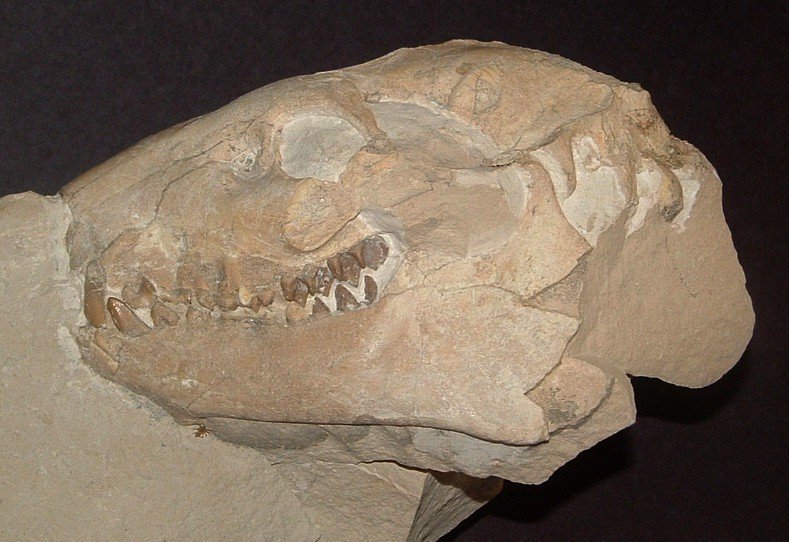
Merycoidodon culbertsonii
Image: Image sourced via web search (Fair use / Educational)
About Merycoidodon
Merycoidodon culbertsonii is an extinct genus of artiodactyl mammal that thrived across the plains of North America during the late Eocene and Oligocene epochs, approximately 34 to 23 million years ago. As a member of the highly successful and diverse family Merycoidodontidae, commonly known as oreodonts, Merycoidodon represents one of the most abundant fossil mammals ever discovered in the American West. Its remarkable fossil record has provided paleontologists with an unparalleled window into the paleoecology and evolution of terrestrial herbivores following the demise of the non-avian dinosaurs.
Merycoidodon was a medium-sized herbivore, roughly comparable in size and build to a modern sheep or a small pig, leading to early, though misleading, nicknames like 'ruminating hog.' An average adult Merycoidodon culbertsonii measured approximately 1.2 meters (about 4 feet) in length from snout to tail and stood about 60 centimeters (2 feet) high at the shoulder. Weight estimates typically range from 80 to 130 kilograms (175 to 285 pounds). Its skeleton was robust and stoutly built, suggesting a creature adapted for a terrestrial, grazing lifestyle rather than for speed. The skull is one of its most distinctive features: it was relatively short and deep with a short facial region, a prominent sagittal crest for strong jaw muscle attachment, and a complete postorbital bar enclosing the eye socket. Its dentition was unspecialized but formidable, featuring a full set of 44 teeth. Most notably, the anterior canines were large and tusk-like, particularly in males, while the first lower premolar was modified to be canine-like, shearing against the upper canine. This created a formidable, self-sharpening slicing mechanism, the function of which is still debated. The molars were brachydont (low-crowned), suitable for browsing on softer vegetation. Its limbs were relatively short and stout, ending in four-toed feet, indicating it was not a cursorial (running) specialist like contemporary horses or later artiodactyls.
The paleobiology of Merycoidodon is richly detailed thanks to the sheer volume of fossil evidence. Its brachydont dentition strongly suggests a diet of soft, leafy vegetation, classifying it as a browser rather than a grazer of tough, abrasive grasses, which had not yet become dominant. The powerful jaw musculature, inferred from the sagittal crest, and the sharp, tusk-like canines have led to various interpretations. While some early paleontologists speculated they were used for digging up roots and tubers, the modern consensus leans toward their use in intraspecific competition, such as territorial disputes or fights between males for mating rights, similar to the canines of modern musk deer or water deer. Locomotion was plantigrade or semi-plantigrade, meaning it walked on the soles of its feet, a posture that provides stability but limits speed. This, combined with its stocky build, indicates it likely relied on hiding in vegetation or confronting threats rather than fleeing. The discovery of entire family groups preserved together in volcanic ash beds provides compelling evidence for complex social behavior. These fossil assemblages often include males, females, and juveniles of various ages, suggesting that Merycoidodon lived in herds or family units, a strategy that would have offered protection against predators and facilitated raising young. Growth patterns inferred from bone histology show a relatively rapid maturation rate, reaching adult size within a few years.
Merycoidodon lived in a world undergoing significant climatic and environmental change. During the late Eocene and Oligocene, the global climate was cooling and drying, leading to the retreat of subtropical forests and the expansion of more open woodlands, savannas, and scrublands across North America. The environment of the White River Formation, where Merycoidodon is most famously found, was a vast, well-watered floodplain with gallery forests along rivers and more open country in between. This habitat supported a diverse and abundant fauna. Merycoidodon shared its ecosystem with a wide array of other mammals, placing it firmly in the middle of the food web. It was a primary consumer, browsing on the available vegetation alongside other herbivores like the early three-toed horse Mesohippus, the hornless rhinoceros Subhyracodon, and various protoceratids (deer-like artiodactyls with bizarre horns). As a common, medium-sized herbivore, Merycoidodon was a crucial prey item for the era's top predators. These included the formidable hyaenodonts, such as Hyaenodon horridus, and the 'false saber-toothed cats' or nimravids, like Hoplophoneus, whose fossils are sometimes found in close association with Merycoidodon remains, occasionally bearing puncture marks that match their saber-like canines.
The discovery history of Merycoidodon is deeply intertwined with the 'Bone Wars' of the 19th century and the westward expansion of the United States. The first scientifically described fossils were collected from the White River Badlands of what is now South Dakota. In 1847, Hiram A. Prout, a St. Louis physician and amateur fossil collector, published a description of a jaw fragment. However, it was the renowned paleontologist Joseph Leidy who formally studied and named the genus in 1848. Leidy initially named it Oreodon ('mountain tooth'), but this name was already preoccupied by a genus of fish. He later established the name Merycoidodon ('ruminant-like tooth') in 1852 for the type species, Merycoidodon culbertsonii. The species name honors Alexander Culbertson, an agent for the American Fur Company who collected the type specimen and sent it to the Smithsonian Institution. Leidy's meticulous work on Merycoidodon and its relatives laid the foundation for North American vertebrate paleontology. The vast fossil beds of the White River Formation, particularly in Nebraska's Agate Fossil Beds National Monument and South Dakota's Badlands National Park, have since yielded tens of thousands of Merycoidodon specimens, making it one of the most completely known fossil mammals.
Merycoidodon holds immense evolutionary significance as a representative of the Merycoidodontidae, a uniquely North American family of artiodactyls that was incredibly successful for over 20 million years. This family is part of the suborder Tylopoda, which also includes modern camels and llamas, making these South American and Afro-Asian animals Merycoidodon's closest living relatives. Oreodonts represent a highly successful but ultimately extinct side-branch of tylopod evolution. They demonstrate an early experiment in herbivorous adaptation within the artiodactyls, evolving a body plan and lifestyle convergent with later groups like pigs, sheep, and peccaries. Their unspecialized dentition and four-toed feet represent a more primitive state compared to the highly specialized teeth and two-toed feet of modern ruminants and camelids. The long-term success of the oreodonts, persisting from the Eocene to the late Miocene, showcases their remarkable adaptability to the changing environments of ancient North America, even as other groups like horses and rhinos were undergoing rapid evolutionary changes. Their eventual extinction is thought to be linked to increasing competition from more advanced ruminants and significant climatic cooling and aridification in the late Miocene.
Despite its abundance, Merycoidodon has not been without scientific debates. The primary controversy has revolved around its lifestyle and the function of its prominent canines. Early interpretations, influenced by its pig-like build, suggested it was an omnivore that used its tusks to dig for roots. However, detailed dental microwear analysis has consistently shown patterns consistent with a diet of soft leaves, refuting the omnivory hypothesis. The debate over the canines now centers on their role in social signaling and combat versus a secondary feeding function. Another area of discussion involves taxonomy. The family Merycoidodontidae is incredibly diverse, with dozens of genera and species, and the exact relationships between them, including the placement of Merycoidodon itself, have been revised multiple times. For a period, the name Oreodon was used more commonly in popular literature, leading to confusion, but Merycoidodon is the scientifically valid name. Recent studies focus on using its vast fossil record to understand population dynamics and responses to environmental change during the Eocene-Oligocene transition.
The fossil record of Merycoidodon is nothing short of extraordinary, earning it the nickname 'sheep of the Badlands' due to its sheer abundance. Fossils are found almost exclusively in North America, with the highest concentration in the White River Formation of South Dakota, Nebraska, and Wyoming. Other significant finds come from the John Day Formation in Oregon. Tens of thousands of specimens are known, ranging from isolated teeth to complete, articulated skeletons. The preservation quality is often excellent, with many skulls remaining uncrushed and skeletons fully intact. The most remarkable finds are the mass mortality assemblages, such as those at Agate Fossil Beds National Monument, where hundreds of individuals are preserved together. These lagerstätten-like deposits, likely the result of flash floods or volcanic ash falls, preserve entire social groups, providing invaluable, direct evidence of herd structure and demographics. This makes Merycoidodon one of the best-understood fossil mammals in terms of its anatomy, population structure, and life history.
Due to its abundance and the completeness of its fossils, Merycoidodon is a staple exhibit in natural history museums across the world. Institutions like the American Museum of Natural History in New York, the Field Museum in Chicago, and the Smithsonian National Museum of Natural History in Washington, D.C., all feature prominent displays of Merycoidodon skeletons, often depicted in lifelike dioramas of the Oligocene plains. Its commonness makes it a key educational tool for teaching concepts of evolution, extinction, and paleoecology. While it has not achieved the celebrity status of dinosaurs or saber-toothed cats in popular culture, it is a well-known and recognizable figure to anyone with a keen interest in the Age of Mammals, representing a story of incredible evolutionary success in a bygone world.
Classification
Time Period
Discovery
Location
South Dakota, USA
Formation
White River Formation
Frequently Asked Questions
What is Merycoidodon?
Merycoidodon culbertsonii is an extinct genus of artiodactyl mammal that thrived across the plains of North America during the late Eocene and Oligocene epochs, approximately 34 to 23 million years ago. As a member of the highly successful and diverse family Merycoidodontidae, commonly known as oreo...
When did Merycoidodon live?
Merycoidodon lived during the paleogene period of the cenozoic era approximately 34-23 million years ago.
Where was Merycoidodon discovered?
Fossils of Merycoidodon were discovered in South Dakota, USA in the White River Formation.
What did Merycoidodon eat?
Merycoidodon was a herbivore. It lived in terrestrial habitats.
What type of fossil is Merycoidodon?
Merycoidodon is preserved as a body fossil. The preservation quality is excellent.
Related Specimens
From the cenozoic era · body fossils