Australopithecus afarensis
Image: Image sourced via web search (Fair use / Educational)
About Australopithecus afarensis
Australopithecus afarensis is one of the longest-lived and best-known early human species, an extinct hominin that thrived in Eastern Africa between approximately 3.9 and 2.9 million years ago during the Pliocene Epoch. This species is of paramount importance in the study of human evolution, primarily because its extensive fossil record provides undeniable evidence of one of the most fundamental human adaptations: habitual bipedalism. The discovery of iconic specimens like 'Lucy' has made A. afarensis a cornerstone for understanding the complex mosaic of ape-like and human-like traits that characterized our early ancestors, offering a detailed window into a critical transitionary period before the emergence of the genus Homo.
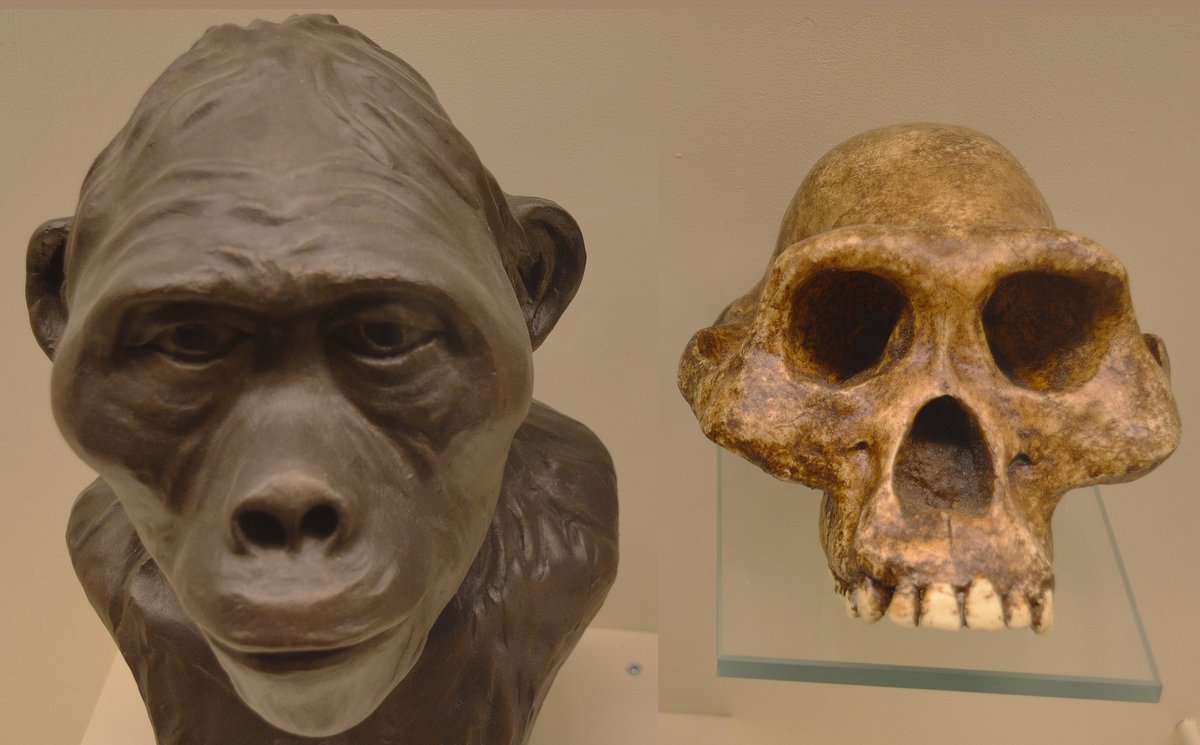
Australopithecus afarensis was a small-bodied hominin exhibiting significant sexual dimorphism, a trait where males were considerably larger than females. Males stood approximately 151 cm (4 ft 11 in) tall and weighed around 42 kg (93 lb), while females were much smaller, averaging about 105 cm (3 ft 5 in) in height and 29 kg (64 lb) in weight. This size difference is more pronounced than in modern humans but comparable to modern gorillas. The species possessed a fascinating blend of anatomical features. Its cranium was distinctly ape-like, with a low, sloping forehead, a pronounced brow ridge over the eyes, and a prognathic (projecting) face. The braincase was small, with an endocranial volume of about 420 cubic centimeters, roughly one-third the size of a modern human brain and comparable to that of a chimpanzee. Its dental arcade was intermediate between the U-shape of modern apes and the parabolic shape of humans, with canines that were smaller and less dagger-like than those of apes but still larger than in modern humans. Below the neck, however, the skeleton revealed a suite of adaptations for walking upright. The pelvis was short and broad, similar to a human pelvis, providing stability for bipedal locomotion. The femur angled inward from the hip to the knee, a valgus angle that positioned the feet directly under the body's center of gravity, crucial for efficient walking. The feet had a developed arch and a non-opposable big toe, further confirming a terrestrial, bipedal gait. Yet, it retained some primitive, ape-like features suggestive of arboreal activity, including long, powerful arms relative to leg length, and long, curved finger and toe bones, which would have been advantageous for climbing trees to forage or escape predators.
The paleobiology of Australopithecus afarensis reflects its transitional nature, adapting to life both on the ground and in the trees. Its primary mode of locomotion was bipedalism, famously confirmed by the 3.6-million-year-old Laetoli footprints in Tanzania, which show a clear human-like gait with a heel-strike and toe-off. However, the combination of its bipedal lower body with its ape-like upper body suggests a dual-locomotion strategy. It likely spent its days foraging on the ground in open woodland and savanna environments but may have retreated to the safety of trees at night to sleep or to escape predators. Its diet was primarily plant-based, consisting of leaves, fruits, seeds, roots, nuts, and insects. Microwear analysis of their teeth indicates they consumed a wide variety of foods, including tough, fibrous vegetation, especially during drier seasons. They were likely omnivores, possibly supplementing their diet with small vertebrates or scavenging meat when available, though they lacked the sophisticated stone tools associated with later hominins for butchery. The high degree of sexual dimorphism suggests a polygynous social structure, similar to modern gorillas, where larger males may have competed for access to multiple females. This social dynamic would have influenced group composition and behavior, likely involving small, multi-male, multi-female groups roaming the landscape. Growth patterns, inferred from dental development, were more akin to those of apes than modern humans, indicating a faster maturation rate and a shorter childhood period.
During the Pliocene, the world of Australopithecus afarensis was a dynamic mosaic of environments. Eastern Africa was undergoing significant climatic change, shifting from dense forests to more open woodlands and savannas interspersed with riverine forests and lakes. This environmental variability likely drove the evolution of adaptable traits like bipedalism, which is more energy-efficient for covering long distances between scattered food resources. A. afarensis shared this landscape with a diverse array of fauna. Herbivores such as ancient elephants (e.g., Deinotherium), three-toed horses (Hipparion), various antelope species, and giraffes were common. These grazers and browsers were hunted by a formidable suite of predators, which would have also posed a significant threat to A. afarensis. These predators included saber-toothed cats like Dinofelis and Megantereon, giant hyenas (Pachycrocuta), and crocodiles in the waterways. As a small-bodied hominin, A. afarensis occupied a middle position in the food web. It was not an apex predator but a resourceful forager and potential prey item. Its ability to climb trees would have been a critical survival strategy to escape predation. It coexisted with other hominins, such as Kenyanthropus platyops, and its evolutionary success over a million-year span demonstrates its remarkable ability to adapt to the challenging and changing Pliocene African ecosystem.
The history of Australopithecus afarensis is punctuated by several landmark discoveries. The species was formally named in 1978 by Donald Johanson, Tim White, and Yves Coppens, following a series of remarkable finds in the Afar Depression of Ethiopia. The story began in 1973 when Johanson discovered the fossilized knee joint (AL 129-1a/1b) at Hadar, which showed a clear valgus angle, providing the first strong evidence of Pliocene bipedalism. The following year, on November 24, 1974, Johanson and his student Tom Gray made the discovery of a lifetime: the partial skeleton of a single individual, cataloged as AL 288-1 and nicknamed 'Lucy'. This specimen, which was about 40% complete, was revolutionary because it preserved both cranial and postcranial elements, unequivocally linking an ape-sized brain with an upright-walking body. Another crucial discovery occurred in 1975 at Hadar, with the unearthing of the 'First Family' (AL 333), a collection of remains from at least thirteen individuals who may have perished together in a single event, offering invaluable insight into population variation, dimorphism, and social grouping. Meanwhile, in Laetoli, Tanzania, a team led by Mary Leakey in 1978 uncovered the famous fossilized footprint trackway, providing indisputable behavioral evidence of the bipedal locomotion of early hominins, almost certainly A. afarensis, which is the only hominin species known from the area at that time.
Australopithecus afarensis holds a pivotal position in the human evolutionary tree. It is widely considered a direct ancestor of the genus Homo, including our own species, Homo sapiens, or at least a very close relative of that ancestor. Its unique mosaic of primitive (ape-like) and derived (human-like) traits makes it a classic example of a transitional fossil. The species demonstrates that bipedalism evolved millions of years before the significant expansion of the brain and the development of stone tool technology, which were the hallmarks of the later genus Homo. This finding fundamentally reshaped our understanding of human origins, overturning the earlier 'brain-first' hypothesis. A. afarensis shows that the initial catalyst for the hominin lineage was a change in locomotion, not intelligence. Its success, spanning nearly a million years and a wide geographical range in East Africa, suggests that this early adaptation was highly effective. It represents a crucial evolutionary stage after the split from the last common ancestor shared with chimpanzees, setting the anatomical and behavioral stage from which more human-like hominins, such as Homo habilis, would eventually emerge. The species provides a vital baseline for tracking the subsequent evolutionary trends in the hominin lineage, such as decreasing arboreal adaptations, increasing brain size, and changes in diet and tool use.
Despite its well-established status, Australopithecus afarensis is not without scientific debates. One long-standing controversy revolves around its locomotor capabilities: was it exclusively bipedal, or did it practice a mix of terrestrial bipedalism and significant arboreal climbing? Proponents of the latter view, such as Randall Susman and Jack Stern, point to its long, curved fingers, upward-oriented shoulder joint, and long arms as clear evidence for proficient climbing. Others, like C. Owen Lovejoy, argue these are merely retained primitive traits and that the pelvic and lower limb anatomy points to a fully committed bipedalism, with any climbing ability being rudimentary. Another area of debate concerns the level of variation within the species. Some researchers have argued that the fossils assigned to A. afarensis, which span a vast time period and geographical area, may represent more than one species. The 3.5-million-year-old Kenyanthropus platyops, with its flatter face, is sometimes seen as evidence of hominin diversity during this period, potentially challenging the idea of A. afarensis as the sole ancestor to later hominins. The discovery of the 'Burtele foot' in Ethiopia, dated to 3.4 million years ago and showing a grasping big toe, has also fueled speculation that another, more arboreal hominin species coexisted with A. afarensis.
The fossil record for Australopithecus afarensis is one of the most extensive for any extinct hominin, with remains of over 300 individuals recovered to date. The primary fossil sites are located along the East African Rift Valley, most notably in Hadar, Ethiopia; Laetoli, Tanzania; and Koobi Fora, Kenya. The Hadar region has been particularly fruitful, yielding not only 'Lucy' and the 'First Family' but also the 'Selam' specimen (DIK-1-1), the remarkably complete skeleton of a three-year-old female discovered by Zeresenay Alemseged, which includes a hyoid bone similar to that of an ape. The preservation quality of these fossils varies, but the sheer number of specimens provides a comprehensive view of the entire skeleton. While complete skeletons are exceptionally rare, many parts are well-represented in the fossil record, including skulls, jaws, teeth, vertebrae, ribs, and limb bones. This wealth of material allows for detailed studies of growth, variation, sexual dimorphism, and biomechanics that are not possible for many other early hominin species. The Laetoli footprints represent a different, but equally important, type of fossil evidence—trace fossils that preserve a moment of behavior from millions of years ago.
Australopithecus afarensis, and particularly the fossil 'Lucy', has had a profound cultural impact, transcending the scientific community to become a global icon of human origins. Lucy's name, famously inspired by the Beatles' song 'Lucy in the Sky with Diamonds', has made her story accessible and memorable to the public. She is a central figure in museum exhibits on human evolution worldwide, with famous displays at the Cleveland Museum of Natural History (where the original fossils were first studied), the American Museum of Natural History in New York, and the National Museum of Ethiopia in Addis Ababa. Her discovery is a staple of biology and anthropology textbooks, serving as the primary example of an early bipedal ancestor. The species represents a tangible link to our deep evolutionary past, capturing the public imagination and symbolizing the long, complex journey of human emergence from our ape-like ancestors. Its discovery continues to inspire new generations of paleontologists and fuels a universal curiosity about where we come from.
Classification
Time Period
Discovery
Location
Ethiopia
Formation
Hadar Formation, Laetoli Beds
Frequently Asked Questions
What is Australopithecus afarensis?
Australopithecus afarensis is one of the longest-lived and best-known early human species, an extinct hominin that thrived in Eastern Africa between approximately 3.9 and 2.9 million years ago during the Pliocene Epoch. This species is of paramount importance in the study of human evolution, primari...
When did Australopithecus afarensis live?
Australopithecus afarensis lived during the neogene period of the cenozoic era approximately 3.9-2.9 million years ago.
Where was Australopithecus afarensis discovered?
Fossils of Australopithecus afarensis were discovered in Ethiopia in the Hadar Formation, Laetoli Beds.
What did Australopithecus afarensis eat?
Australopithecus afarensis was a omnivore. It lived in terrestrial habitats.
What type of fossil is Australopithecus afarensis?
Australopithecus afarensis is preserved as a body fossil. The preservation quality is good.
Related Specimens
From the cenozoic era · body fossils