Zuul
Zuul crurivastator
Image: Image sourced via web search (Fair use / Educational)
About Zuul
Zuul crurivastator was a heavily armored, herbivorous dinosaur that roamed the coastal plains of what is now North America during the Late Cretaceous period, approximately 76 to 75 million years ago. As a member of the ankylosaurid family, it is renowned for its formidable body armor and a massive, weaponized tail club, making it one of the most complete and best-preserved examples of its kind ever discovered. Its discovery has provided paleontologists with an unprecedented window into the anatomy, biology, and evolution of these iconic armored dinosaurs.
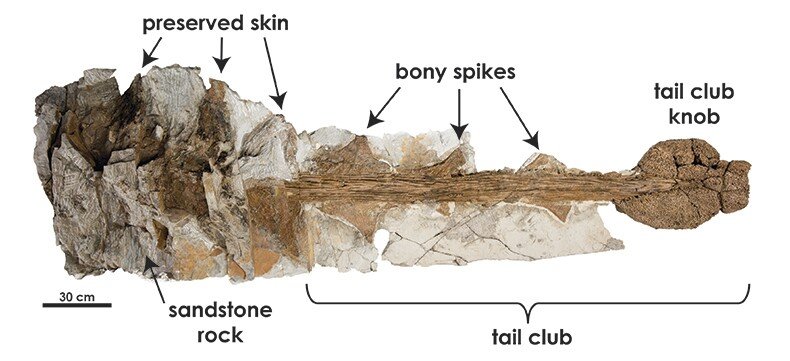
Zuul was a medium-to-large sized ankylosaurid, reaching an estimated length of around 6 meters (about 20 feet) from snout to tail tip and weighing approximately 2.5 tonnes (5,500 pounds). Its body was low-slung and broad, built like a living tank. The most striking feature was its extensive osteoderm coverage—bony plates and spikes embedded in the skin, forming a comprehensive suit of armor. The skull was short, wide, and triangular when viewed from above, itself covered in fused bony plates that protected the brain and eyes. Its nostrils were complex and convoluted, suggesting a highly developed sense of smell. Along its flanks ran rows of large, sharp, blade-like scutes that would have provided a formidable defense against predators. The tail was particularly remarkable; the posterior half was stiffened by interwoven, ossified tendons, creating a rigid handle for a massive, bony club at its terminus. This club, composed of several large, fused osteoderms, was a powerful defensive weapon. The specific name, *crurivastator*, meaning 'destroyer of shins,' directly references the presumed function of this tail club in low-swinging attacks against the legs of large theropod predators like tyrannosaurs. For scale, Zuul was roughly the size of a modern white rhinoceros, but significantly wider and more heavily armored.
As a herbivore, Zuul's paleobiology was centered around processing tough plant matter. Its broad, shovel-like beak was well-suited for cropping low-lying vegetation, while its small, leaf-shaped teeth were designed for slicing rather than grinding. It likely possessed a complex digestive system with a large gut to ferment the fibrous plants it consumed, a common trait among ornithischian dinosaurs. Locomotion was quadrupedal and ponderous, with strong, stout limbs supporting its immense weight. Its heavily armored body and defensive tail suggest it was not a fast runner, relying on its passive and active defenses for survival. While direct evidence of social behavior is scarce, some ankylosaur trackways suggest they may have occasionally moved in small groups, though many may have been solitary. The exceptional preservation of the holotype specimen, ROM 75860, includes soft tissues like keratinous sheaths on its spikes and impressions of skin scales, confirming that the bony armor was covered in a tough, horny layer, making its defensive capabilities even more robust. Isotopic analysis of its bones could in the future reveal more about its specific diet and migratory patterns, if any.
Zuul lived in the lush, subtropical coastal plain environment of the Judith River Formation in Montana during the Campanian stage of the Late Cretaceous. This region was part of the western coast of the Western Interior Seaway, a vast inland sea that divided North America into two landmasses, Laramidia and Appalachia. The climate was warm and humid, supporting a rich ecosystem of diverse flora, including ferns, cycads, and flowering plants. Zuul shared this habitat with a remarkable array of other dinosaurs. Its primary predators would have been large tyrannosaurids, such as *Daspletosaurus* or *Gorgosaurus*, against which its armor and tail club were its main defense. The ecosystem was teeming with other herbivores, creating a complex food web. Zuul would have competed for resources with numerous hadrosaurids (duck-billed dinosaurs) like *Brachylophosaurus*, and various ceratopsians (horned dinosaurs) such as *Judiceratops* and *Medusaceratops*. Smaller dinosaurs, crocodiles, turtles, and early mammals also populated this vibrant landscape. Zuul occupied the niche of a large, low-browsing herbivore, likely playing a significant role in shaping the local vegetation through its feeding habits and serving as a well-defended prey item for the apex predators of its time.
The discovery of Zuul is a story of commercial paleontology leading to a major scientific breakthrough. In 2014, a nearly complete ankylosaur skeleton was unearthed by a commercial fossil company, Theropoda Expeditions, in the badlands of Hill County, northern Montana. The specimen was found within a sandstone layer of the Judith River Formation. Recognizing its scientific importance, the company contacted the Royal Ontario Museum (ROM) in Toronto, Canada. In 2016, the ROM acquired the fossil, which was given the specimen number ROM 75860. The paleontologists at the ROM, led by David Evans and Victoria Arbour, were astonished by its completeness. The fossil included a complete skull, torso, and a fully intact tail club, along with preserved soft tissues—a rarity for ankylosaurs. The specimen was nicknamed 'Sherman' by the excavation crew. The official scientific name, *Zuul crurivastator*, was bestowed in 2017. The genus name, *Zuul*, was a clever pop-culture reference to the demigod and 'Terror Dog' from the 1984 film *Ghostbusters*, owing to the striking resemblance between the dinosaur's horned, short-snouted head and the fictional monster. The species name, *crurivastator*, as previously noted, translates to 'destroyer of shins,' a vivid descriptor of its likely combat style.
In the grand scheme of evolution, Zuul crurivastator is a highly significant member of the Ankylosauridae family, a group nested within the larger clade Ankylosauria. Ankylosaurs are part of the Ornithischia, or 'bird-hipped' dinosaurs, a major branch that also includes stegosaurs, ceratopsians, and hadrosaurs. Zuul's exceptional completeness helps to solidify the evolutionary relationships among North American ankylosaurids. It is considered a close relative of other Late Cretaceous genera like *Ankylosaurus* and *Euoplocephalus*. The detailed anatomy preserved in Zuul allows for more precise comparisons, helping to resolve long-standing debates about the diversity and classification of these animals. For instance, the unique arrangement of its cranial and tail osteoderms provides distinct characteristics that help differentiate it from its contemporaries, suggesting a higher degree of ankylosaur diversity in Laramidia than previously thought. It demonstrates the culmination of ankylosaurid evolution, showcasing a highly specialized body plan focused on herbivory and defense. It has no direct modern descendants, as all non-avian dinosaurs perished in the Cretaceous-Paleogene extinction event, but its place in the dinosaur family tree is now firmly and clearly established thanks to the quality of its remains.
Despite its recent discovery, Zuul has already been central to several scientific discussions. One key area of study focuses on the function of its tail club. While its use as a defensive weapon against predators is widely accepted, the exceptional preservation of ROM 75860 has allowed for more detailed biomechanical modeling. Research by Victoria Arbour has investigated the potential for intraspecific combat—that is, Zuul using their tails to fight each other for territory or mates, similar to how modern giraffes use their necks. Pathologies, or signs of injury, on the flanks of some ankylosaur specimens (including Zuul) are consistent with being struck by a tail club, lending support to this hypothesis. Another point of discussion is the exact species diversity within the Judith River Formation. The discovery of such a complete and distinct specimen like Zuul challenges previous assumptions that most ankylosaur material from this formation belonged to the genus *Euoplocephalus*. Zuul proves that multiple large ankylosaurid species co-existed, raising new questions about niche partitioning and resource competition among these armored herbivores.
The fossil record for Zuul is currently limited but spectacular. To date, the only definitively identified specimen is the holotype, ROM 75860, found in the Judith River Formation of Montana, USA. However, this single specimen is one of the most complete ankylosaur skeletons ever found anywhere in the world, with over 99% of the skeleton recovered. It is particularly noteworthy for the articulation of its skeleton—the bones were found largely in their life positions—and the unprecedented preservation of soft tissue elements. This includes keratinous sheaths on the tail spikes, dermal armor in its original arrangement, and impressions of scales. This level of preservation is exceptionally rare for any dinosaur, let alone a large one. While other fragmentary ankylosaur remains from the same formation might eventually be assigned to Zuul, for now, our entire understanding of this remarkable animal hinges on this one extraordinary fossil, which continues to be a subject of intensive study at the Royal Ontario Museum.
Zuul's memorable name and fierce appearance have quickly propelled it into the public consciousness. The *Ghostbusters* connection, endorsed by actor Dan Aykroyd, generated significant media attention upon its announcement, making it an instant fan favorite. The Royal Ontario Museum has capitalized on this interest, creating a major exhibit centered on the holotype specimen. The exhibit, 'Zuul: Life of an Armoured Dinosaur,' showcases the actual fossil, along with detailed reconstructions and interactive displays that explain its discovery, anatomy, and the world it inhabited. This has made Zuul a powerful tool for public outreach and science education, effectively communicating complex paleontological concepts to a broad audience. Its image is beginning to appear in books, documentaries, and other media, cementing its status as one of the most iconic dinosaur discoveries of the 21st century.
Classification
Time Period
Discovery
Location
Montana, USA
Formation
Judith River Formation
Frequently Asked Questions
What is Zuul?
Zuul crurivastator was a heavily armored, herbivorous dinosaur that roamed the coastal plains of what is now North America during the Late Cretaceous period, approximately 76 to 75 million years ago. As a member of the ankylosaurid family, it is renowned for its formidable body armor and a massive, ...
When did Zuul live?
Zuul lived during the cretaceous period of the mesozoic era approximately 76-75 million years ago.
Where was Zuul discovered?
Fossils of Zuul were discovered in Montana, USA in the Judith River Formation.
What did Zuul eat?
Zuul was a herbivore. It lived in terrestrial habitats.
What type of fossil is Zuul?
Zuul is preserved as a body fossil. The preservation quality is exceptional.
Related Specimens
From the mesozoic era · body fossils