Pterygotus
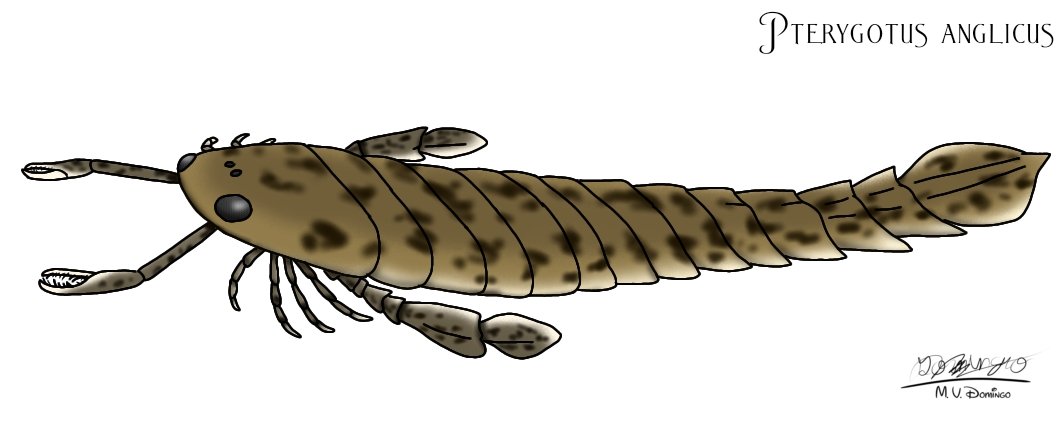
Pterygotus anglicus
Image: Image sourced via web search (Fair use / Educational)
About Pterygotus
Pterygotus was a colossal genus of eurypterid, an extinct group of aquatic arthropods often called 'sea scorpions,' that dominated the shallow seas of the Silurian and Devonian periods. As one of the largest arthropods ever to have lived, it was an apex predator of its time, a formidable hunter in the Paleozoic oceans. Its fossils provide a crucial window into the evolution of early marine ecosystems and the incredible diversity of life that flourished long before the dinosaurs.
Pterygotus was a truly gigantic arthropod, with the type species, Pterygotus anglicus, estimated to have reached lengths of around 1.6 meters (5.2 feet). Other species within the genus, such as P. grandidens, may have been even larger, with some estimates suggesting maximum lengths approaching 2.3 meters (7.5 feet), making it one of the largest known arthropods in Earth's history. For comparison, this is longer than most adult humans are tall. Its body was segmented and flattened, a typical eurypterid form, but highly specialized for its predatory lifestyle. The body was divided into two main parts: the prosoma (head/thorax region) and the opisthosoma (abdomen). The prosoma was covered by a large, subquadrate carapace bearing two large compound eyes on the sides and a pair of smaller simple eyes (ocelli) near the center. Attached to the underside of the prosoma were six pairs of appendages. The first pair, the chelicerae, were greatly enlarged into formidable pincers, or chelae, armed with sharp, pointed teeth. These claws were its primary weapons for grasping and dismembering prey. The subsequent four pairs were walking legs, likely used for maneuvering on the seabed, while the final pair was modified into large, paddle-like appendages used for swimming and propulsion through the water. The opisthosoma consisted of twelve segments, tapering towards a flattened, blade-like telson, or tail spine. This telson was not a stinger like a modern scorpion's but likely functioned as a rudder for steering during swimming, providing stability and control as it pursued prey. The entire body was encased in a tough exoskeleton of chitin, which would have been molted periodically as the animal grew, and it is often these molted exuviae that are found as fossils.
The anatomy of Pterygotus points to an active and powerful predatory lifestyle. Its large, forward-facing compound eyes would have provided excellent stereoscopic vision, crucial for judging distance to moving prey in the often-murky waters of Silurian estuaries and coastal seas. The massive, toothed chelicerae were clearly adapted for seizing and tearing apart other animals. Unlike some eurypterids that may have been bottom-dwelling scavengers, Pterygotus was likely an ambush or pursuit predator. Its streamlined body and large swimming paddles suggest it was a capable swimmer, able to generate powerful bursts of speed to catch its prey. Its diet would have consisted of a wide range of contemporary marine life, including early jawless fish (agnathans) like Cephalaspis, other arthropods such as trilobites, and possibly even smaller eurypterids. The powerful claws could have easily crushed the shells and exoskeletons of its victims. Fossil evidence, including coprolites (fossilized feces) containing fish scales and trilobite fragments found in the same formations, supports this carnivorous diet. There is little evidence for complex social behavior, and like most arthropods, Pterygotus was likely a solitary hunter. Its growth would have occurred through ecdysis (molting), a vulnerable period where the animal would shed its old exoskeleton and wait for its new, larger one to harden, likely hiding in sheltered areas to avoid predation during this time.
During the Silurian period (approximately 443 to 419 million years ago), the world of Pterygotus was vastly different from today. The continents were arranged into the supercontinent of Gondwana in the south and several smaller continents, including Laurentia (ancestral North America) and Baltica (ancestral Northern Europe), clustered around the equator. Sea levels were high, creating vast, shallow epicontinental seas that teemed with life. The climate was generally warm and stable. Pterygotus inhabited these nearshore marine, brackish, and possibly even freshwater environments, such as deltas and estuaries. It shared this world with a diverse array of organisms. The seas were dominated by invertebrates like trilobites, brachiopods, crinoids, and vast coral-stromatoporoid reefs. This was also a critical time for vertebrate evolution, with the rise of jawless fish (ostracoderms) and the first appearance of jawed fish (acanthodians and placoderms). As an apex predator, Pterygotus sat at the top of the food web. Its only potential rivals or predators would have been other large eurypterids or the very largest of the newly evolving placoderms. Its presence would have exerted significant evolutionary pressure on its prey, potentially driving the development of heavier armor in fish and more sophisticated escape behaviors in other arthropods.
The discovery of Pterygotus dates back to the early days of paleontology. The genus was first described by the renowned Swiss-American naturalist Louis Agassiz in 1839. The name 'Pterygotus' means 'winged one' or 'finned one,' a reference to its large, paddle-like swimming appendages. The type species, Pterygotus anglicus, was based on fragmentary fossils, primarily pieces of the appendages and body segments, discovered in the Silurian-aged rocks of England. Agassiz initially misinterpreted some of the fragments, believing them to be the remains of a giant fish. It was only later, as more complete specimens were unearthed, that its true identity as a colossal eurypterid was established. One of the most important figures in understanding Pterygotus was the Scottish geologist and writer Hugh Miller, who discovered and described numerous well-preserved eurypterid fossils from the Old Red Sandstone of Scotland in the mid-19th century. These Scottish discoveries, along with finds from Lesmahagow, provided a much clearer picture of the animal's complete anatomy. Unlike dinosaurs with famous individual specimens like 'Sue,' Pterygotus fossils are typically more fragmentary, so its reconstruction has been a composite effort based on numerous partial remains from various global localities rather than a single, iconic skeleton.
Pterygotus holds a significant position in the evolutionary history of life. As a member of the Eurypterida, it belongs to the Chelicerata, a major group of arthropods that also includes modern arachnids (spiders, scorpions) and horseshoe crabs. Eurypterids represent a highly successful, entirely extinct branch of this lineage. The sheer size achieved by Pterygotus and its relatives like Jaekelopterus demonstrates the peak of arthropod gigantism in the Paleozoic seas, a feat enabled by higher atmospheric oxygen levels and the absence of large vertebrate predators. The evolution of its large, specialized chelicerae from simple ancestral appendages showcases a classic example of adaptive radiation, where a body part is modified for a new, highly effective function—in this case, predation. The Pterygotidae family, to which Pterygotus belongs, represents the pinnacle of eurypterid evolution in terms of size and predatory adaptation. While eurypterids left no direct descendants, their closest living relatives are the horseshoe crabs (Xiphosura), which provide some anatomical clues, though their lifestyles are vastly different. Studying Pterygotus helps paleontologists understand the ecological dynamics of Paleozoic marine communities and the evolutionary pathways that led to the dominance of large, active predators long before sharks or marine reptiles ruled the oceans.
While the general anatomy and predatory nature of Pterygotus are well-established, some aspects remain subjects of scientific discussion. One long-standing debate concerns its exact habitat tolerance. While traditionally viewed as fully marine, the frequent discovery of Pterygotus fossils in sedimentary rocks indicative of brackish or even freshwater environments, such as river deltas, has led to a hypothesis that they were euryhaline—capable of tolerating a wide range of salinities. This would have given them a significant advantage, allowing them to hunt in estuaries where marine fish might be less common. Another area of debate involves the function of the telson. While most paleontologists agree it was used as a rudder, some older interpretations suggested it could have been used offensively, though its flattened shape makes this unlikely. The precise classification and number of valid species within the genus Pterygotus have also been revised over the years, with some species previously assigned to it now placed in other genera, like Erettopterus, based on more detailed analysis of their chelicerae and telson shape. New discoveries continue to refine our understanding of these ancient giants and their complex world.
The fossil record of Pterygotus is geographically widespread, reflecting its success during the Silurian and Early Devonian. Significant fossils have been found in North America (notably New York State and Ontario), Europe (especially Scotland, England, and the Czech Republic), and South America. The fossils are most commonly found in fine-grained sedimentary rocks like shales and waterlimes, which are ideal for preserving the delicate details of their exoskeletons. Famous fossil sites include the Silurian Bertie Formation of New York and the Lesmahagow Lagerstätte in Scotland, both of which have yielded exceptionally well-preserved eurypterid fossils. However, complete, articulated specimens of a giant like Pterygotus are extremely rare. The fossil record is dominated by disarticulated parts—isolated segments of the body, telsons, legs, and especially the robust, toothed claws (chelicerae), which are more resistant to decay and transport. Molted exoskeletons (exuviae) are also a common source of fossil material. The quality of preservation can range from simple impressions to three-dimensionally preserved cuticles that allow for detailed study of surface ornamentation and fine anatomical structures.
As one of the largest and most fearsome-looking predators of the Paleozoic, Pterygotus has captured the public imagination and has become a staple of paleontological reconstructions and museum exhibits. It is frequently featured in documentaries about prehistoric life, such as the BBC's 'Walking with Monsters,' where it was depicted as a formidable apex predator of the Silurian seas. Major natural history museums, including the American Museum of Natural History in New York and the National Museum of Scotland, often feature impressive life-sized models or fossil displays of Pterygotus and its relatives. Its alien yet vaguely familiar scorpion-like appearance, combined with its immense size, makes it a compelling and slightly terrifying symbol of the ancient world, serving as an excellent educational tool to introduce the public to the strange and wonderful life that existed long before the age of dinosaurs.
Classification
Time Period
Discovery
Location
England, United Kingdom
Formation
Temeside Shale Formation, Downton Castle Sandstone Formation
Frequently Asked Questions
What is Pterygotus?
Pterygotus was a colossal genus of eurypterid, an extinct group of aquatic arthropods often called 'sea scorpions,' that dominated the shallow seas of the Silurian and Devonian periods. As one of the largest arthropods ever to have lived, it was an apex predator of its time, a formidable hunter in t...
When did Pterygotus live?
Pterygotus lived during the silurian period of the paleozoic era approximately 428-412 million years ago.
Where was Pterygotus discovered?
Fossils of Pterygotus were discovered in England, United Kingdom in the Temeside Shale Formation, Downton Castle Sandstone Formation.
What did Pterygotus eat?
Pterygotus was a carnivore. It lived in marine, brackish, estuarine habitats.
What type of fossil is Pterygotus?
Pterygotus is preserved as a body fossil. The preservation quality is good.
Related Specimens
From the paleozoic era · body fossils
/bed7088e21a4.png)