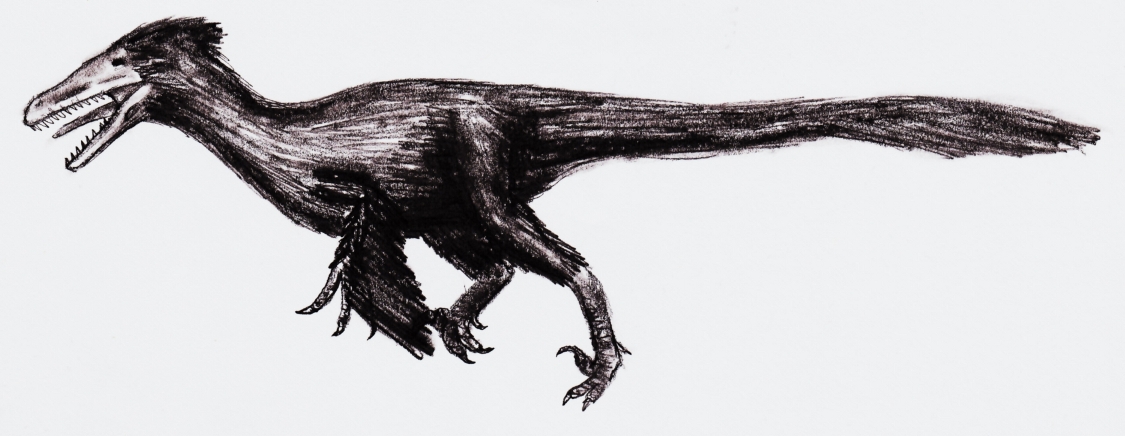
Velociraptor
Velociraptor mongoliensis
Image: File:Velociraptor-MONGOLIENSIS.jpg - Wikimedia Commons (CC BY-SA)
About Velociraptor
Velociraptor mongoliensis was a small, agile, and feathered dromaeosaurid dinosaur that inhabited the arid landscapes of Late Cretaceous Asia, specifically between 75 and 71 million years ago during the Campanian stage. As one of the most iconic and intensely studied non-avian dinosaurs, its fossil remains have provided profound insights into the biology, behavior, and evolution of theropods, particularly highlighting the close ancestral link between dinosaurs and modern birds. Despite its formidable reputation in popular culture, Velociraptor was a creature of modest size, whose true scientific importance far outweighs the cinematic exaggerations that have made its name famous worldwide.
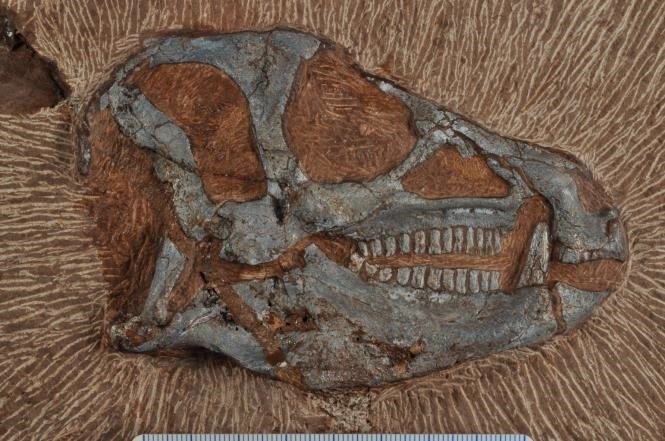
Contrary to its depiction as a human-sized predator in popular media, Velociraptor mongoliensis was a relatively small dinosaur, comparable in stature to a large turkey or a medium-sized dog. A mature adult measured approximately 2 meters (about 6.5 feet) in total length, though more than half of this length was comprised of its long, slender tail. Standing at a hip height of roughly 0.5 meters (1.6 feet), its body mass is estimated to have been around 15 to 20 kilograms (33 to 44 pounds). Its skull, which was long, low, and narrow, measured up to 25 centimeters (9.8 inches) in length and was uniquely upturned at the snout. This cranium housed a relatively large brain, suggesting a high degree of intelligence and keen sensory perception. Its jaws were lined with approximately 26 to 28 serrated, recurved teeth on each side, perfectly adapted for gripping and tearing flesh. The most defining feature of Velociraptor was its specialized hind feet. While it walked on the third and fourth toes, the second toe was held retracted off the ground and bore an enlarged, sickle-shaped claw, or ungual, that could reach over 6.5 centimeters (2.5 inches) in length along its outer curve. This formidable weapon, combined with a lightweight, hollow-boned skeleton akin to that of modern birds, and a long, stiffened tail acting as a dynamic stabilizer, created the profile of a swift, highly specialized, and agile predator. Furthermore, direct fossil evidence in the form of quill knobs—attachment points for large, pennaceous feathers—discovered on the ulna of a specimen in 2007 by Alan H. Turner, Peter J. Makovicky, and Mark Norell, confirms that Velociraptor possessed a well-developed feathered integument, including complex, winged forelimbs, further cementing its avian affinities.
The paleobiology of Velociraptor reveals a highly active and specialized carnivorous lifestyle. Its diet likely consisted of small to medium-sized vertebrates, including lizards, mammals, and other dinosaurs. The famous "Fighting Dinosaurs" specimen, which preserves a Velociraptor locked in combat with a Protoceratops, provides direct evidence of its predatory behavior. In this remarkable fossil, the Velociraptor's sickle claw is embedded in the neck region of the herbivore, suggesting it was used as a precise, piercing weapon to target vital areas like the carotid artery or jugular vein. This find has led to the "Raptor Prey Restraint" (RPR) model proposed by Denver Fowler and colleagues, which posits that the dromaeosaurid would use its body weight to pin down its struggling victim, flapping its feathered arms for stability while dispatching the prey with its claws and teeth, a behavior analogous to that seen in modern birds of prey. Its long legs and lightweight build indicate it was a fast runner, capable of high-speed pursuits, with its stiff tail acting as a counterbalance for making sharp turns. While often depicted as a pack hunter, there is no direct fossil evidence to support this behavior in Velociraptor; most specimens have been found isolated. It is more likely that it was a solitary or small-group ambush predator, using its intelligence and agility to stalk and overwhelm its prey.
Velociraptor lived within the Djadochta Formation environment of the Gobi Desert, a vast, arid to semi-arid ecosystem characterized by large sand dune fields, intermittent streams, and sparse vegetation. The climate was continental, with hot, dry seasons and significant temperature fluctuations, similar to modern desert environments. This habitat supported a unique and well-documented faunal assemblage. Velociraptor occupied the niche of a mid-sized terrestrial predator, sharing its world with a variety of other organisms. Its primary prey likely included the abundant sheep-sized herbivore Protoceratops andrewsi, as well as smaller dinosaurs like the pachycephalosaur Prenocephale and the small ankylosaur Pinacosaurus. It also would have competed for resources with other theropods, such as the closely related dromaeosaurid Tsaagan and the troodontid Saurornithoides, which had a similar size and diet. The ecosystem also included small, bird-like oviraptorosaurs such as Oviraptor and Citipati, which were likely omnivores, and a variety of small mammals, lizards, and other reptiles that would have constituted a secondary food source for Velociraptor. The predator-prey dynamics of this formation are exceptionally well-preserved, with fossils like the "Fighting Dinosaurs" offering a rare and direct window into the ecological interactions that defined this ancient desert food web.
The history of Velociraptor's discovery began during the influential American Museum of Natural History expeditions to the Gobi Desert in the early 1920s. On August 11, 1923, a museum preparator named Peter Kaisen recovered the first known specimen from the red sandstone beds of the Flaming Cliffs (also known as Bayn Dzak) in Mongolia. This fossil, cataloged as AMNH 6515, consisted of a crushed but complete skull and the iconic sickle claw. The following year, in 1924, the museum's president, Henry Fairfield Osborn, officially named the dinosaur Velociraptor mongoliensis. The generic name, derived from the Latin words 'velox' (swift) and 'raptor' (robber or plunderer), was chosen to reflect its presumed agility and carnivorous nature, while the specific name 'mongoliensis' honors the country of its discovery. Subsequent expeditions, particularly the joint Polish-Mongolian paleontological expeditions of the late 1960s and early 1970s, uncovered several more significant specimens. The most famous of these was the "Fighting Dinosaurs" specimen (GIN 100/25), discovered in 1971 by a Polish-Mongolian team. This unparalleled fossil, which captures a Velociraptor and Protoceratops in their final moments, has become one of the most celebrated paleontological finds in history, offering indisputable proof of a predator-prey interaction.
Velociraptor holds immense evolutionary significance as a key member of the Dromaeosauridae, a family of theropod dinosaurs that shares a very close common ancestry with Avialae, the group that includes modern birds. Its anatomy displays a mosaic of classic dinosaurian traits and remarkably bird-like features, making it a crucial transitional fossil for understanding the dinosaur-to-bird evolutionary pathway. Skeletally, it possessed a furcula (wishbone), a feature once thought to be exclusive to birds, as well as hollow, pneumatized bones and bird-like wrist joints that allowed for a flexible, folding motion of the forelimbs. The discovery of quill knobs on its ulna provided the definitive evidence that it had complex, pennaceous feathers, similar in structure to the flight feathers of modern birds, even though Velociraptor itself was flightless. These feathered forelimbs may have been used for display, nest brooding, or providing stability while restraining prey. The sum of these features strongly supports the theory that birds are not just related to dinosaurs but are, in fact, a surviving lineage of theropod dinosaurs. The study of Velociraptor and its relatives has been instrumental in reshaping our understanding of dinosaur biology, physiology, and appearance, moving away from the outdated image of slow, scaly reptiles to one of dynamic, feathered, and highly active animals.
Despite being a well-studied genus, Velociraptor is still the subject of scientific debate, primarily concerning its taxonomy and behavior. For many years, other dromaeosaurid species from North America, such as Deinonychus, were sometimes informally referred to as "Velociraptors," a confusion amplified by popular media. However, paleontologists firmly classify them in separate genera. Within the Dromaeosauridae family, the subfamily Velociraptorinae has been a subject of taxonomic revision, with researchers debating the inclusion of various Asian and North American species and refining their interrelationships based on new fossil discoveries. The question of pack hunting remains a significant point of contention. While the idea is popular, the fossil evidence for Velociraptor is scant; most finds are of solitary individuals, and a trackway attributed to a group of larger dromaeosaurids in China is the closest, albeit indirect, evidence for gregarious behavior in the family. The exact function of the sickle claw also continues to be debated, with hypotheses ranging from a disemboweling tool to a climbing aid or, most recently and compellingly, a prey-restraining device used to pin and pierce victims, much like the talons of an eagle or hawk.
The fossil record of Velociraptor mongoliensis is geographically restricted but scientifically rich, with all known specimens originating from the Djadochta Formation and the slightly younger Barun Goyot Formation of southern Mongolia and the Inner Mongolia region of China. Since its initial discovery in 1923, more than a dozen well-preserved skeletons have been unearthed, making it one of the best-represented dromaeosaurids in the world. The quality of preservation in the fine-grained sandstones of these formations is often exceptional, with many specimens being nearly complete and articulated. The arid environment led to rapid burial in sand, which protected the delicate bones from scavenging and weathering. Famous fossil sites like the Flaming Cliffs and Tugrik Shireh have yielded not only adult skeletons but also remains of subadults, providing valuable data on the growth and development of the species. The "Fighting Dinosaurs" specimen stands as the pinnacle of this exceptional preservation, offering a behavioral snapshot frozen in time that is virtually unique in the entire fossil record of dinosaurs.
Beyond its scientific importance, Velociraptor has made a profound cultural impact, largely due to its prominent, albeit scientifically inaccurate, role in the 1993 film "Jurassic Park" and its sequels. The film depicted the animals as human-sized, hyper-intelligent, scaly pack hunters, an image based more on its larger North American relative, Deinonychus, but which nonetheless cemented the name "Velociraptor" in the public consciousness. This fame has made it a staple exhibit in natural history museums worldwide, where it serves as a powerful educational tool to engage the public with concepts of evolution, paleobiology, and the feathered nature of dinosaurs. It has become a symbol of the modern dinosaur renaissance, representing the shift from sluggish monsters to intelligent, agile, and bird-like animals.
Classification
Time Period
Discovery
Location
Gobi Desert, Mongolia
Formation
Djadochta Formation
Frequently Asked Questions
What is Velociraptor?
Velociraptor mongoliensis was a small, agile, and feathered dromaeosaurid dinosaur that inhabited the arid landscapes of Late Cretaceous Asia, specifically between 75 and 71 million years ago during the Campanian stage. As one of the most iconic and intensely studied non-avian dinosaurs, its fossil ...
When did Velociraptor live?
Velociraptor lived during the cretaceous period of the mesozoic era approximately 75-71 million years ago.
Where was Velociraptor discovered?
Fossils of Velociraptor were discovered in Gobi Desert, Mongolia in the Djadochta Formation.
What did Velociraptor eat?
Velociraptor was a carnivore. It lived in terrestrial habitats.
What type of fossil is Velociraptor?
Velociraptor is preserved as a permineralized fossil. The preservation quality is exceptional.
Related Specimens
From the mesozoic era · permineralized fossils
/12d285016704.png)