Taung Child
Australopithecus africanus
Image: Image sourced via web search (Fair use / Educational)
About Taung Child
The Taung Child represents one of the most pivotal discoveries in the history of paleoanthropology, serving as the type specimen for the species Australopithecus africanus. Living approximately 2.8 million years ago during the late Pliocene to early Pleistocene epochs, this remarkable fossilized skull belonged to a young hominin who roamed the prehistoric landscapes of what is now South Africa. The discovery of the Taung Child in 1924 fundamentally shifted the scientific community's understanding of human evolution, providing the first concrete evidence that the cradle of humankind was located in Africa rather than Asia or Europe. This specimen, consisting of a face, mandible, and a natural endocranial cast of the brain, offered an unprecedented glimpse into the early stages of hominin bipedalism and brain development. By bridging the anatomical gap between modern apes and humans, the Taung Child established a crucial baseline for the study of our ancient ancestors, cementing its status as a cornerstone of evolutionary biology and a testament to the complex, branching bush of human origins.
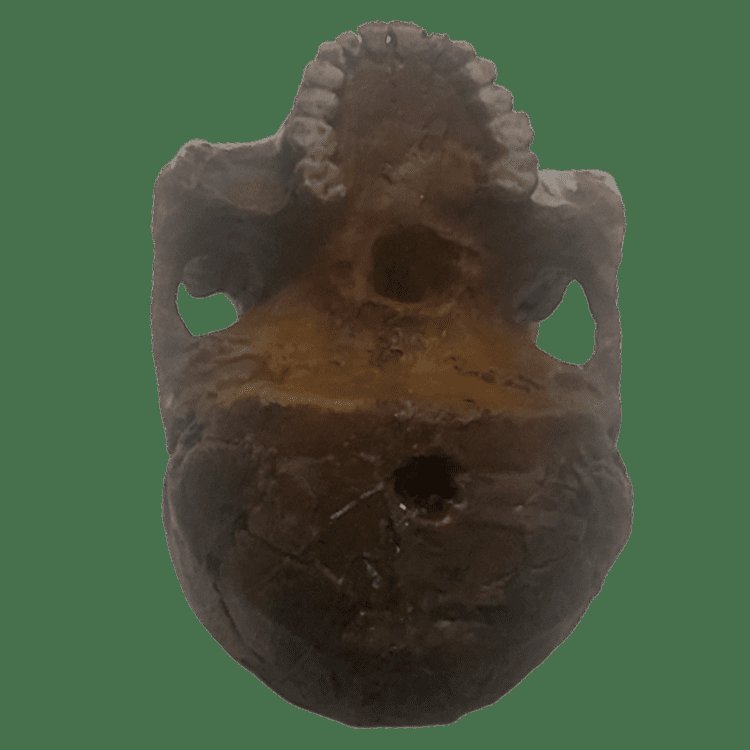
In terms of physical description, the Taung Child exhibits a fascinating mosaic of ape-like and human-like anatomical features that perfectly encapsulate its transitional evolutionary status. The fossil itself consists of a remarkably well-preserved facial skeleton, a lower jaw complete with teeth, and a natural limestone endocast that perfectly preserves the shape and size of the brain's exterior. Based on dental eruption patterns, particularly the presence of deciduous (baby) teeth and the first permanent molars just beginning to erupt, paleoanthropologists estimate that the Taung Child was approximately three to four years old at the time of death. If this individual had reached adulthood, it would have stood roughly 115 to 138 centimeters (about 3 feet 9 inches to 4 feet 6 inches) tall and weighed between 30 to 40 kilograms, comparable in size to a modern chimpanzee. However, its anatomy diverged significantly from that of chimpanzees. The foramen magnum, the hole at the base of the skull through which the spinal cord passes, is positioned far more forward and centrally than in quadrupedal apes. This inferior placement is a definitive hallmark of obligate bipedalism, indicating that the Taung Child walked upright on two legs. The facial structure is relatively prognathic (projecting forward) compared to modern humans, but less so than in extant apes. The dental arch is parabolic, a distinctly human trait, rather than the U-shaped arcade seen in chimpanzees and gorillas. Furthermore, the canine teeth are notably reduced in size and lack the honing complex typical of other primates. The endocast reveals a brain volume of approximately 340 cubic centimeters, which would have expanded to about 400 to 440 cubic centimeters in adulthood. While this brain size is only slightly larger than that of a chimpanzee, the structural organization of the brain, particularly the expansion of the parietal and frontal lobes and the posterior shift of the lunate sulcus, suggests early neurological reorganization toward a more complex, human-like cognitive capacity.
Turning to paleobiology, the life of Australopithecus africanus was characterized by a versatile and adaptive approach to survival in a challenging environment. The diet of the Taung Child and its conspecifics was primarily omnivorous, heavily reliant on the foraging of plant materials such as fruits, nuts, seeds, roots, and tubers. Dental microwear and isotopic analyses of A. africanus specimens indicate a diet that included both C3 (trees and shrubs) and C4 (grasses and sedges) plant resources, suggesting they exploited a wide variety of ecological niches. This dietary flexibility was likely supplemented by the opportunistic consumption of small animals, insects, and bird eggs, providing essential proteins and fats for their developing brains. Locomotion was primarily bipedal on the ground, allowing for efficient travel across open distances and the freeing of hands for carrying food or rudimentary tools. However, their postcranial anatomy, including relatively long arms and curved finger bones found in other A. africanus specimens, indicates they retained significant arboreal capabilities. Climbing trees would have been essential for foraging, escaping predators, and perhaps constructing sleeping nests. Socially, it is inferred that A. africanus lived in multi-male, multi-female groups, similar to modern baboons or chimpanzees, which provided safety in numbers and facilitated complex social interactions. The growth and development patterns of the Taung Child, analyzed through the micro-structure of its tooth enamel, suggest a faster maturation rate than modern humans but slightly slower than modern apes, placing them on an intermediate life-history trajectory. Their metabolism would have been adapted to the energetic demands of bipedalism and a fluctuating food supply, requiring efficient fat storage and energy utilization.
During the time of the Taung Child, approximately 2.8 million years ago, the ecological context of southern Africa was undergoing significant climatic and environmental transformations. The global climate was gradually cooling and drying, leading to the fragmentation of dense forests and the expansion of open woodlands, savannas, and grasslands. This mosaic environment provided a diverse array of habitats, forcing early hominins to adapt to both closed and open ecosystems. The landscape around the Taung region was characterized by limestone caves, subterranean rivers, and a mix of gallery forests along waterways transitioning into drier bushland. The Taung Child shared this dynamic ecosystem with a rich megafauna, including extinct species of elephants, rhinos, giraffes, and various bovids. The predator-prey dynamics were intense and perilous for a small, relatively slow-moving hominin. Apex predators such as saber-toothed cats (Dinofelis and Megantereon), large hyenas, and leopards prowled the landscape. The hominins occupied a precarious position in the food web, acting as both opportunistic foragers and potential prey. In fact, the specific ecological interactions of the Taung Child are tragically highlighted by the circumstances of its demise. Extensive taphonomic research has revealed damage to the skull, including puncture marks in the eye sockets and specific fracture patterns, that are consistent with predation by a large bird of prey. It is now widely accepted that the Taung Child was killed or scavenged by a massive eagle, similar to the modern African crowned eagle, which swooped down, killed the child, and carried the remains to its nest situated above the limestone cave.
The discovery history of the Taung Child is a dramatic and foundational narrative in the field of paleoanthropology. In the autumn of 1924, workers at the Northern Lime Company's quarry in Taung, a small town in the North West Province of South Africa, uncovered a fossilized natural brain cast during their blasting operations. The quarry manager, E.G. Josephine, recognized the unusual nature of the find and brought it to the attention of Josephine Salmons, a student at the University of the Witwatersrand, who in turn showed it to her professor, the Australian anatomist Raymond Dart. Dart immediately recognized the immense significance of the specimen. He painstakingly spent weeks using his wife's knitting needles to chip away the hard limestone breccia obscuring the face and jaw. When the face of the Taung Child was finally revealed, Dart was astounded by its unique blend of ape and human traits. In February 1925, Dart published a paper in the journal Nature, naming the new species Australopithecus africanus, meaning 'southern ape of Africa.' He boldly claimed it was the 'missing link' between apes and humans, directly challenging the prevailing scientific consensus of the time. The discovery was met with intense skepticism and outright rejection by the British scientific establishment, which was heavily influenced by the fraudulent Piltdown Man skull that suggested human evolution began with a large brain in Europe. It took decades, and the subsequent discoveries of adult A. africanus specimens by Robert Broom at Sterkfontein in the 1930s and 1940s, for Dart's initial assessment of the Taung Child to be vindicated and universally accepted by the scientific community.
The evolutionary significance of the Taung Child cannot be overstated, as it provided the critical evidence needed to reorient the search for human origins back to the African continent, fulfilling Charles Darwin's 1871 prediction. Before Taung, the scientific establishment believed that encephalization (brain expansion) preceded bipedalism, a view supported by the Piltdown hoax and the discovery of Homo erectus (Java Man) in Asia. The Taung Child completely inverted this paradigm. It demonstrated that early hominins walked upright on two legs while still possessing relatively small, ape-sized brains. This established bipedalism as the defining, foundational adaptation of the hominin lineage, occurring millions of years before significant brain expansion. Taxonomically, Australopithecus africanus sits near the base of the hominin family tree. While it is generally considered a descendant of the earlier East African species Australopithecus afarensis (famous for the 'Lucy' skeleton), its exact relationship to the genus Homo remains a subject of intense study. Some researchers view A. africanus as a direct ancestor to early Homo (such as Homo habilis), while others consider it a sister taxon or part of a lineage that eventually led to the robust australopithecines (Paranthropus) and went extinct. Regardless of its exact phylogenetic placement, the Taung Child serves as the ultimate transitional fossil, showcasing the piecemeal, mosaic nature of evolution where different traits evolve at different rates.
Scientific debates surrounding the Taung Child and Australopithecus africanus have been vigorous and continuous since 1924. The initial controversy over its status as a hominin versus a juvenile ape dominated the first few decades following its discovery. Once its hominin status was secured, debates shifted to its phylogenetic position. Is A. africanus the direct ancestor of the genus Homo, or does that title belong to an East African species like A. afarensis or A. garhi? The discovery of Australopithecus sediba in South Africa in 2008 further complicated this picture, with some arguing that A. sediba is a transitional form between A. africanus and Homo. Another major area of debate involves the interpretation of hominin behavior and taphonomy. Raymond Dart originally proposed the 'osteodontokeratic' (bone, tooth, and horn) culture, suggesting that A. africanus were bloodthirsty, weapon-wielding killer apes. This theory was thoroughly debunked in the 1970s and 1980s by taphonomist C.K. Brain, who demonstrated that the accumulation of bones in South African caves was the result of carnivore activity, primarily leopards and hyenas, and that hominins were the hunted, not the hunters. The specific hypothesis regarding the Taung Child's death by eagle predation, proposed by Lee Berger and Ron Clarke in 1995, was initially met with skepticism but has since gained widespread acceptance due to compelling comparative evidence with modern primate predation by raptors.
The fossil record for Australopithecus africanus is entirely confined to the limestone cave systems of South Africa, collectively known as the Cradle of Humankind. Unlike the open-air sedimentary deposits of East Africa, the South African fossils are typically found encased in hard, concrete-like breccia within ancient subterranean caverns. This makes extraction incredibly difficult but often results in excellent, three-dimensional preservation. Following the initial discovery at Taung, hundreds of A. africanus fossils have been recovered from sites such as Sterkfontein, Makapansgat, and Gladysvale. Sterkfontein has been particularly prolific, yielding famous specimens like 'Mrs. Ples' (STS 5), a nearly complete adult skull discovered by Robert Broom in 1947, and 'Little Foot' (StW 573), a remarkably complete skeleton whose exact taxonomic assignment is still debated but is closely related. The fossil assemblage includes numerous skulls, jaws, isolated teeth, and postcranial elements like pelvises, femurs, and vertebrae. The quality of preservation is generally very good to exceptional, allowing for detailed morphometric and biomechanical analyses. However, the complex stratigraphy of the cave deposits makes precise radiometric dating challenging, relying heavily on biochronology, paleomagnetism, and uranium-lead dating of flowstones to establish the 3.3 to 2.1 million-year timeline for the species.
The cultural impact of the Taung Child extends far beyond the confines of academic paleontology. As one of the most famous fossils ever discovered, it has become an enduring icon of human evolution and a symbol of Africa's central role in our shared heritage. The original Taung Child skull is securely housed at the University of the Witwatersrand in Johannesburg, South Africa, where it remains an object of intense scientific study and national pride. Replicas of the skull are prominently displayed in natural history museums worldwide, serving as a vital educational tool to illustrate the concepts of bipedalism, brain evolution, and the deep antiquity of the human lineage. The discovery site at Taung, along with the broader Cradle of Humankind, has been designated a UNESCO World Heritage site, attracting tourists and scholars alike. The story of the Taung Child—from its accidental discovery by quarrymen to its vindication of Darwin's theories against the backdrop of scientific prejudice—continues to captivate the public imagination, featuring in numerous documentaries, books, and educational curricula as a testament to the enduring quest to understand where we come from.
Classification
Time Period
Discovery
Location
Taung, South Africa
Formation
Buxton Limeworks
Frequently Asked Questions
What is Taung Child?
The Taung Child represents one of the most pivotal discoveries in the history of paleoanthropology, serving as the type specimen for the species Australopithecus africanus. Living approximately 2.8 million years ago during the late Pliocene to early Pleistocene epochs, this remarkable fossilized sku...
When did Taung Child live?
Taung Child lived during the quaternary period of the cenozoic era approximately 2.8-2.8 million years ago.
Where was Taung Child discovered?
Fossils of Taung Child were discovered in Taung, South Africa in the Buxton Limeworks.
What did Taung Child eat?
Taung Child was a omnivore. It lived in terrestrial habitats.
What type of fossil is Taung Child?
Taung Child is preserved as a body fossil. The preservation quality is exceptional.
Related Specimens
From the cenozoic era · body fossils