Cacops
Cacops aspidephorus
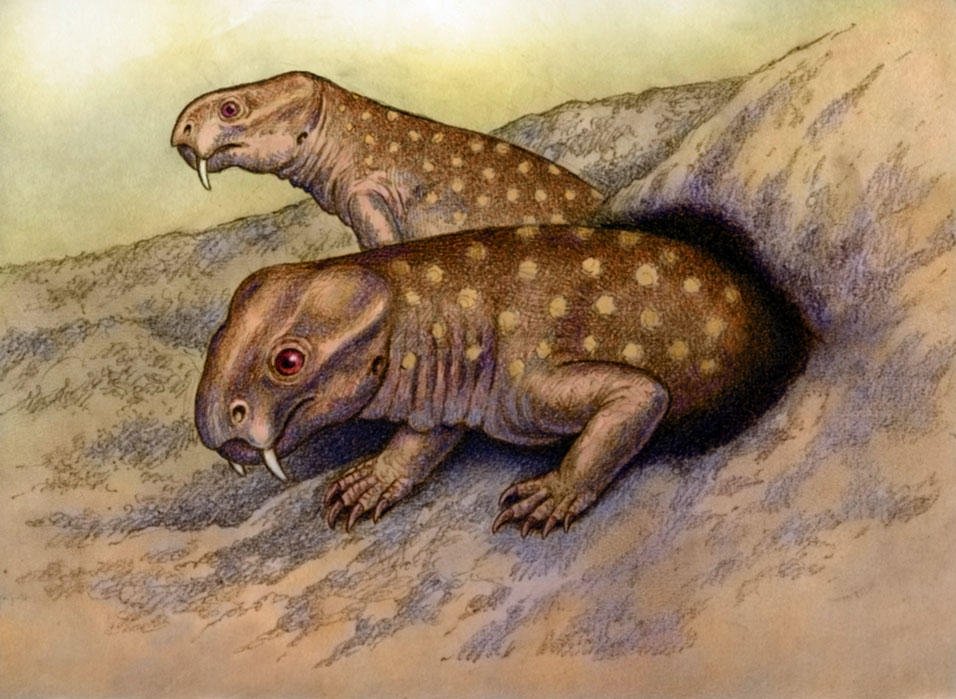
Image: Image sourced via web search (Fair use / Educational)
About Cacops
Cacops aspidephorus represents a pivotal genus of dissorophid temnospondyl amphibian that thrived during the Early Permian period, approximately 284 to 275 million years ago. Its fossils, primarily unearthed from the rich red beds of Texas, provide a crucial window into the evolution of terrestrial adaptations among early tetrapods. As a highly specialized predator, Cacops is significant for its robust build, defensive armor, and advanced auditory structures, showcasing the diversification of amphibians into fully land-based ecological niches long before the rise of the dinosaurs.
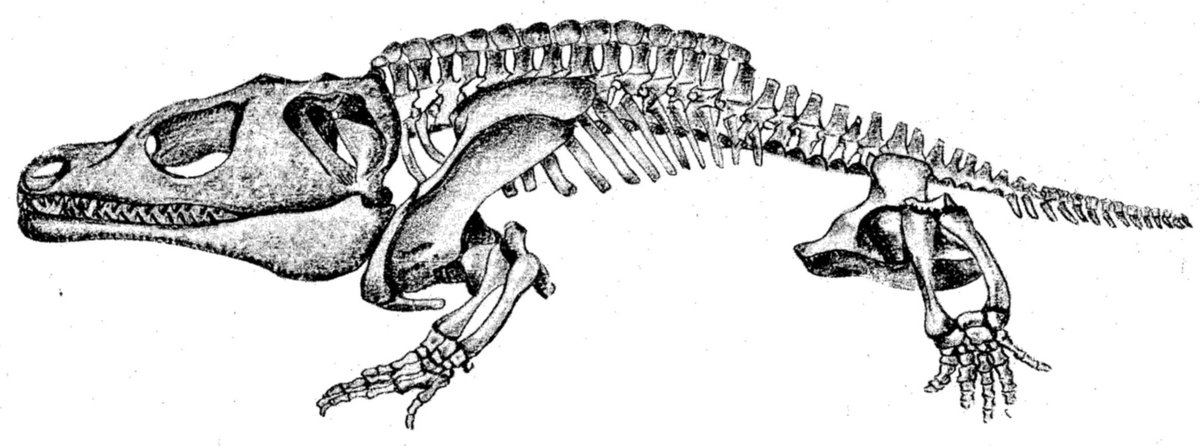
Cacops was a small but powerfully built amphibian, reaching an approximate body length of 40 to 50 centimeters, comparable in size to a modern Gila monster or a large iguana. Its most striking feature was its disproportionately large and heavily ornamented skull, which could measure up to 15 centimeters long. The skull was broad, triangular, and flattened, with a short snout and enormous orbital openings, suggesting it possessed large eyes for keen vision. The skull roof was covered in a dense pattern of pits and ridges, a texture that likely supported a tough, keratinous skin. A defining characteristic was the presence of a large otic notch at the back of the skull, which in life housed a sophisticated tympanum, or eardrum. This structure, supported by a slender stapes bone, indicates that Cacops had an advanced sense of hearing for airborne sounds, a critical adaptation for a terrestrial lifestyle. The body was stocky and well-muscled, supported by short, robust limbs. Its most distinctive postcranial feature was a double row of bony plates, or osteoderms, fused to the neural spines of its vertebrae. This dorsal armor, with each plate articulating with the one before and after it, would have formed a flexible but protective carapace, shielding it from the powerful bites of larger predators like Dimetrodon.
Paleobiological analysis of Cacops points to a highly active, terrestrial predatory lifestyle. Its robust limbs, well-developed joints, and strong vertebral column were clear adaptations for supporting its weight and moving efficiently on land, a significant departure from the more sprawling, semi-aquatic locomotion of many of its temnospondyl relatives. The large, forward-facing eyes and advanced hearing system suggest it was an ambush predator or an active hunter that relied on sharp senses to detect small prey. Its diet likely consisted of insects, other arthropods, and smaller vertebrates such as reptiles and other amphibians. The wide gape of its jaw, lined with numerous small, sharp, conical teeth, was well-suited for seizing and holding onto struggling prey. Unlike its aquatic ancestors, Cacops shows little evidence of a lateral line system, further reinforcing its commitment to a life on land. Growth studies based on bone histology are limited, but the heavily ossified skeleton suggests a relatively slow but steady growth rate, reaching skeletal maturity over several years. Its metabolism was likely ectothermic, similar to modern amphibians and reptiles, meaning it would have relied on external heat sources to regulate its body temperature, possibly basking in the Permian sun.
Cacops inhabited the hot, semi-arid floodplain environments of the Early Permian of North America, which was then part of the supercontinent Pangaea. The climate was seasonal, with distinct wet and dry periods, creating a mosaic of river channels, ponds, and terrestrial uplands. This ecosystem, preserved in the Clear Fork Group of Texas, was dominated by a diverse assemblage of fauna. Cacops shared its world with the famous sail-backed pelycosaurs Dimetrodon and Edaphosaurus, the large amphibian Eryops, and the boomerang-headed Diplocaulus. Within this complex food web, Cacops occupied the role of a mid-sized terrestrial carnivore, or mesopredator. It would have hunted smaller animals while simultaneously being prey for larger apex predators like Dimetrodon, which could have been several meters long. Its formidable dorsal armor was almost certainly a direct evolutionary response to the intense predation pressure in its environment. The competition for resources would have been fierce, driving the specialization seen in animals like Cacops, which carved out a niche as a well-defended, land-based hunter in a world teeming with giants.
The discovery and study of Cacops are intrinsically linked to the early days of American vertebrate paleontology. The genus was first described in 1910 by the prominent paleontologist Samuel Wendell Williston, based on remarkably complete and articulated skeletons collected from the Arroyo Formation in Baylor County, Texas. Williston, working with fossil collector Charles H. Sternberg, unearthed several specimens that would become the foundation for our understanding of the entire Dissorophidae family. The holotype specimen, AMNH 4340, housed at the American Museum of Natural History, remains one of the best-preserved examples of a dissorophid. Williston chose the name Cacops, derived from the Greek 'kakos' (bad) and 'ops' (face or eye), likely referring to its somewhat grotesque, heavily armored appearance. The species name, 'aspidephorus', means 'shield-bearer' in Greek, a direct reference to its prominent dorsal osteoderms. The quality of these initial finds was so exceptional that they allowed Williston to conduct a detailed anatomical study, including the first clear interpretation of the temnospondyl ear, which remains a cornerstone of amphibian paleontology to this day. Subsequent discoveries in Texas and Oklahoma have added to the fossil material, but Williston's original specimens remain the most scientifically important.
Cacops holds a crucial position in the evolutionary history of tetrapods, particularly within the diverse and widespread order Temnospondyli. It is the type genus for the family Dissorophidae, a group of temnospondyls that are considered among the most terrestrial of all Paleozoic amphibians. This family is characterized by its robust skeletal features, dorsal armor, and adaptations for hearing, all of which point to a major evolutionary shift away from an aquatic lifestyle. Dissorophids like Cacops are often placed within a clade called Lissamphibia, which includes all modern amphibians (frogs, salamanders, and caecilians), or as a very close sister group. This phylogenetic placement makes Cacops and its relatives vital for understanding the origins of modern amphibians. The well-developed tympanic ear in Cacops is a key transitional feature, representing an early stage in the evolution of the complex middle ear structure seen in anurans (frogs). Its heavily ossified skeleton and armor demonstrate an evolutionary experiment in terrestrial defense and locomotion that paralleled the rise of early reptiles, showcasing that amphibians were highly successful and diverse land-dwellers during the Permian.
Despite being a well-studied genus, Cacops is not without its scientific debates. One of the primary areas of ongoing discussion revolves around the precise phylogenetic relationship between dissorophids and modern lissamphibians. While many paleontologists support the hypothesis that lissamphibians evolved from within the Dissorophidae, or a closely related group, the exact lineage remains contentious, with some researchers proposing alternative origins among other Paleozoic amphibian groups like the lepospondyls. Another debate concerns the function of the dorsal armor. While its defensive role against large predators is widely accepted, some scientists have proposed secondary functions, such as thermoregulation, species recognition, or providing structural support for terrestrial locomotion. Furthermore, the number of valid Cacops species has been a subject of revision. While C. aspidephorus is the type species, other species like C. morrisi and C. woehri have been named, but their validity and relationship to the type species are periodically re-evaluated as new analytical techniques and fossil materials become available.
The fossil record of Cacops is geographically restricted but locally significant. The vast majority of specimens have been recovered from the Lower Permian red beds of the Clear Fork Group in north-central Texas, particularly the Arroyo Formation. Additional material has been found in the equivalent Garber and Wellington Formations of Oklahoma. While not exceedingly common, dozens of individuals are known, ranging from isolated bones to several nearly complete, articulated skeletons. The preservation quality of the Texas material is often good to excellent, with skulls and postcranial skeletons found intact, allowing for detailed anatomical study. The fine-grained mudstone and siltstone in which they were buried were conducive to preserving the three-dimensional structure of the bones. The most famous fossil sites are located in Baylor and Archer counties in Texas, which have been prolific sources of Permian tetrapod fossils for over a century. These sites continue to be important for understanding the paleoecology of the Early Permian.
Cacops has not achieved the widespread fame of dinosaurs or large megafauna, but it holds a significant place in paleontological education and museum displays. Its striking appearance, with its oversized head and bony back-plates, makes it a memorable example of Paleozoic life. Reconstructions and skeletal mounts of Cacops are featured in several major natural history museums, including the American Museum of Natural History in New York and the Field Museum in Chicago. It serves as a key educational tool for illustrating the diversity of ancient amphibians and the critical evolutionary steps that tetrapods took to conquer the land. While it rarely appears in popular media like films or television shows, it is a staple in paleontological textbooks and documentaries covering the Permian period, representing a successful and highly adapted terrestrial predator from a time before the dinosaurs ruled the Earth.
Classification
Time Period
Discovery
Location
Texas, USA
Formation
Clear Fork Group (Arroyo Formation)
Frequently Asked Questions
What is Cacops?
Cacops aspidephorus represents a pivotal genus of dissorophid temnospondyl amphibian that thrived during the Early Permian period, approximately 284 to 275 million years ago. Its fossils, primarily unearthed from the rich red beds of Texas, provide a crucial window into the evolution of terrestrial ...
When did Cacops live?
Cacops lived during the permian period of the paleozoic era approximately 284-275 million years ago.
Where was Cacops discovered?
Fossils of Cacops were discovered in Texas, USA in the Clear Fork Group (Arroyo Formation).
What did Cacops eat?
Cacops was a carnivore. It lived in terrestrial habitats.
What type of fossil is Cacops?
Cacops is preserved as a body fossil. The preservation quality is good.
Related Specimens
From the paleozoic era · body fossils