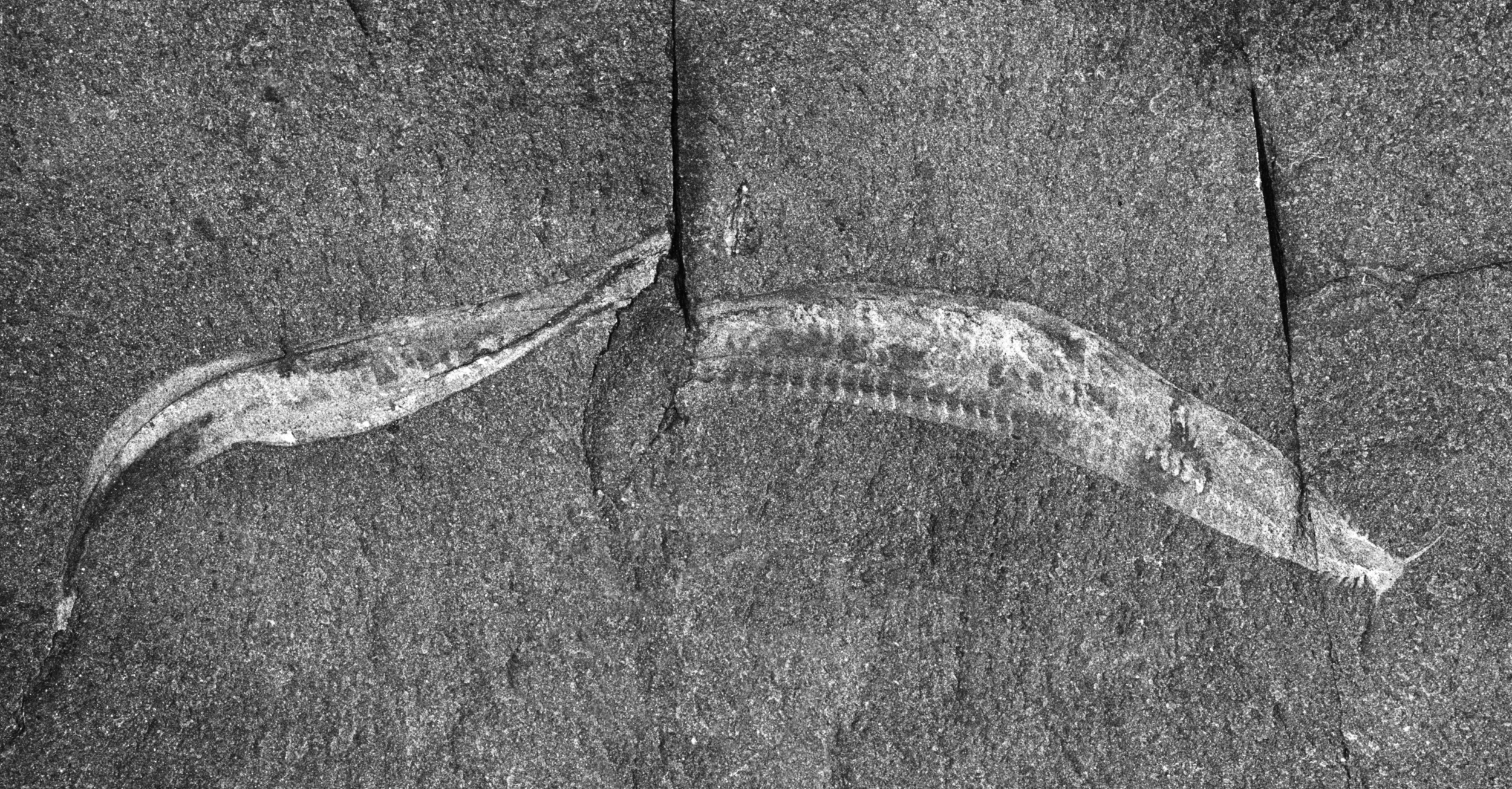
Pikaia
Pikaia gracilens
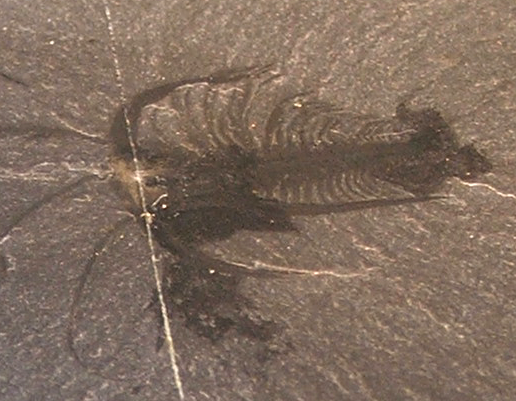
Image: File:USNM PAL 57628 Pikaia gracilens.jpg - Wikimedia Commons (CC BY-SA)
About Pikaia
Pikaia gracilens is an extinct, primitive marine organism that lived approximately 505 million years ago during the Middle Cambrian period, representing one of the most significant discoveries in the history of paleontology. Recognized as an early member of the phylum Chordata, this small, unassuming creature holds a foundational place in the evolutionary lineage that eventually gave rise to all vertebrates, including modern humans. Its exceptionally preserved fossil remains, found exclusively in the famous Burgess Shale deposits of British Columbia, Canada, provide an unprecedented window into the anatomical innovations that emerged during the Cambrian explosion, a pivotal era of rapid biological diversification.
The physical anatomy of Pikaia gracilens is a fascinating study in early evolutionary engineering, showcasing the foundational body plan upon which all future vertebrate life would be built. Measuring a mere four to five centimeters in length, the organism possessed a laterally compressed, elongated body that closely resembled a modern eel or a lancelet. Despite its diminutive size and an estimated weight of only a few grams, its internal architecture was remarkably complex for its time. The most defining characteristic of Pikaia was the presence of a stiff yet flexible rod running longitudinally along its dorsal side, definitively identified by paleontologists as a notochord. This structure provided the necessary internal support for the body and served as the precursor to the vertebral column found in later animals. Flanking this notochord were distinct, V-shaped zigzag blocks of muscle tissue known as myomeres. These myomeres are a hallmark of chordate anatomy, allowing for coordinated, powerful muscular contractions. The head region of Pikaia was notably small and lacked well-defined sensory organs such as true eyes, jaws, or a distinct braincase. Instead, the anterior end featured a pair of short, tentacle-like appendages that likely served a sensory function, helping the animal navigate its environment and locate food. Additionally, a thin dorsal fin extended along the upper edge of its body, which would have aided in stabilization during movement. When compared to modern animals, Pikaia bears a striking resemblance to the extant lancelet, or amphioxus, sharing a similar overall morphology and basic structural organization, though Pikaia retains unique primitive features that distinguish it from any living creature today.
In terms of paleobiology, Pikaia gracilens was a benthic organism that spent the majority of its life navigating the muddy substrates of the Cambrian seafloor. Based on its anatomical features, paleontologists have deduced that Pikaia was a detritivore, sustaining itself by sifting through the marine sediment to consume microscopic organic particles, decaying matter, and perhaps tiny microorganisms. Lacking jaws or specialized grasping appendages, it likely utilized a filter-feeding or deposit-feeding strategy, drawing water and sediment into its simple mouth and extracting nutrients as the material passed through its digestive tract. The presence of the notochord and the highly organized myomeres provides clear evidence of its method of locomotion. Pikaia swam using an undulating, sinusoidal motion, contracting its muscle blocks sequentially from head to tail to propel itself through the water column. This fish-like swimming style was highly efficient for forward propulsion, though Pikaia was likely not a particularly fast or agile swimmer compared to the more advanced predators of its time. Instead, it probably hovered just above the seafloor or rested on the soft mud, using its swimming abilities primarily to move between feeding patches or to escape immediate threats. The growth patterns of Pikaia remain somewhat obscure due to the limitations of the fossil record, but the consistency in size among the recovered specimens suggests a determinate growth cycle, reaching its maximum length of five centimeters relatively quickly in its lifespan before focusing its energy on reproduction and foraging.
The ecological context in which Pikaia lived was a vibrant, highly competitive marine ecosystem situated along the continental shelf of the ancient landmass of Laurentia, which was located near the equator during the Middle Cambrian. The climate was generally warm and tropical, supporting a rich diversity of life in the shallow seas. The specific habitat of the Burgess Shale was characterized by a steep submarine cliff known as the Cathedral Escarpment. Pikaia inhabited the muddy, oxygen-rich waters near the base of this reef, an environment teeming with an astonishing array of bizarre and wonderful creatures. It shared its habitat with heavily armored arthropods, spiky slug-like animals such as Wiwaxia, and the fearsome apex predators of the Cambrian seas, like the formidable Anomalocaris and the five-eyed Opabinia. Within this complex food web, Pikaia occupied a relatively low trophic level. As a small, soft-bodied detritivore, it was undoubtedly a primary food source for many of the larger, actively hunting carnivores that patrolled the waters. Its survival depended not on armor or weaponry, which it entirely lacked, but on its ability to remain inconspicuous among the bottom debris and its capacity to quickly dart away using its muscular undulations when a predator approached. The frequent underwater mudslides that characterized the Burgess Shale environment were a constant hazard, ultimately burying thousands of these creatures alive in anoxic mud, which paradoxically preserved their delicate forms for hundreds of millions of years.
The history of the discovery of Pikaia is a compelling narrative of scientific exploration and shifting paradigms. The first specimens were unearthed in 1911 by the eminent American paleontologist Charles Doolittle Walcott during his legendary expeditions to the Burgess Shale in the Canadian Rockies. Walcott named the creature Pikaia gracilens, deriving the genus name from the nearby Pika Peak, a mountain in Alberta, and the species name from the Latin word for slender. At the time of its discovery, Walcott, operating under the taxonomic frameworks of his era, misidentified Pikaia as a polychaete worm. He believed the myomeres were segments typical of annelids and categorized it alongside other worm-like fossils. For decades, Pikaia languished in museum drawers, largely ignored and misunderstood. It was not until the late 1970s that the British paleontologist Simon Conway Morris undertook a comprehensive re-examination of the Burgess Shale fauna. Using new techniques and a fresh perspective, Conway Morris recognized the V-shaped muscle blocks and the dorsal stiffening rod not as worm segments, but as myomeres and a notochord. This groundbreaking revelation fundamentally shifted the scientific understanding of Pikaia, elevating it from an obscure ancient worm to one of the earliest known representatives of the chordate lineage. In 2012, a meticulous study by Jean-Bernard Caron and Conway Morris utilizing advanced imaging techniques on over a hundred specimens further solidified its chordate status, revealing previously unseen details of its vascular system and nerve cord.
The evolutionary significance of Pikaia gracilens cannot be overstated, as it occupies a critical junction in the tree of life. As a basal chordate, Pikaia provides tangible fossil evidence for the deep evolutionary origins of the vertebrate lineage, a massive group that encompasses modern fish, amphibians, reptiles, birds, and mammals, including humans. Before the reclassification of Pikaia, the origins of chordates during the Cambrian explosion were largely theoretical, inferred from the embryology and genetics of modern animals. Pikaia demonstrated that the fundamental chordate body plan, characterized by a notochord, dorsal nerve cord, and myomeres, had already evolved and stabilized by 505 million years ago. It serves as a vital transitional figure, bridging the gap between simpler invertebrate ancestors and the more complex craniates and vertebrates that would eventually dominate the planet's ecosystems. While Pikaia is not necessarily the direct, linear ancestor of all modern vertebrates, it represents a very close relative to that ancestral population, a surviving offshoot of the early chordate radiation. Its existence proves that the genetic and morphological toolkit required for vertebrate life was present during the initial burst of animal diversification, setting the stage for the incredible evolutionary journey that would follow over the next half-billion years.
Despite its established importance, Pikaia remains the subject of ongoing scientific debates and taxonomic disputes. The primary controversy centers on its exact placement within the chordate family tree. While most paleontologists agree that it is a chordate, there is intense discussion over whether it is a stem-group chordate, meaning it branched off before the last common ancestor of all living chordates, or a crown-group cephalochordate, closely related to modern lancelets. Some researchers have pointed to the presence of its anterior tentacles and the specific arrangement of its myomeres to argue that it might be more closely related to the ancestors of vertebrates than lancelets are. Conversely, others argue that certain primitive features, such as the lack of distinct pharyngeal gill slits in some interpretations of the fossils, suggest a more basal position. The 2012 comprehensive review by Caron and Conway Morris argued strongly for its position as a basal chordate, but the interpretation of highly compressed, two-dimensional fossils always leaves room for alternative hypotheses. Debates also continue regarding its specific feeding behaviors and whether its vascular system indicates a more active lifestyle than traditionally assumed. As imaging technologies improve and new analytical methods are developed, the precise phylogenetic position of Pikaia will likely continue to be refined.
The fossil record of Pikaia is almost entirely restricted to the Burgess Shale in British Columbia, making it a rare and geographically isolated find. To date, paleontologists have recovered slightly over a hundred well-preserved specimens, the vast majority of which were excavated from the Walcott Quarry, the original site discovered by Charles Doolittle Walcott. The preservation quality of these fossils is extraordinary, a hallmark of the Burgess Shale's unique taphonomic conditions. The organisms were buried rapidly in fine, anoxic mud sweeps, which prevented scavenging and bacterial decay. Over millions of years, the soft tissues of Pikaia were replaced by complex carbonaceous films and aluminosilicate minerals, leaving behind dark, highly detailed silhouettes pressed into the shale. These fossils preserve not just the outline of the animal, but the intricate internal details of its musculature, its notochord, and even traces of its vascular and digestive systems. While a few similar chordate-like fossils, such as Haikouichthys and Myllokunmingia, have been found in the slightly older Chengjiang deposits of China, Pikaia remains one of the most thoroughly studied and iconic examples of Cambrian soft-tissue preservation in the world.
The cultural impact of Pikaia extends far beyond the confines of academic paleontology, largely due to its symbolic status as a distant proxy for human ancestry. It gained widespread public recognition through Stephen Jay Gould's seminal 1989 book, Wonderful Life, which chronicled the history of the Burgess Shale. Gould used Pikaia to illustrate the contingent nature of evolution, famously arguing that if the tape of life were rewound and replayed, the survival of this fragile, unassuming chordate was not guaranteed, and without it, the entire history of vertebrate life, including humanity, might never have occurred. Today, Pikaia is a prominent feature in museum exhibits worldwide, most notably at the Royal Ontario Museum in Toronto, which houses the largest collection of Burgess Shale fossils. It frequently appears in educational documentaries and popular science literature, serving as a powerful teaching tool to explain the concepts of deep time, the Cambrian explosion, and the humble, fragile beginnings of the vertebrate lineage.
Classification
Time Period
Discovery
Location
British Columbia, Canada
Formation
Burgess Shale
Frequently Asked Questions
What is Pikaia?
Pikaia gracilens is an extinct, primitive marine organism that lived approximately 505 million years ago during the Middle Cambrian period, representing one of the most significant discoveries in the history of paleontology. Recognized as an early member of the phylum Chordata, this small, unassumin...
When did Pikaia live?
Pikaia lived during the cambrian period of the paleozoic era approximately 505 million years ago.
Where was Pikaia discovered?
Fossils of Pikaia were discovered in British Columbia, Canada in the Burgess Shale.
What did Pikaia eat?
Pikaia was a detritivore. It lived in marine habitats.
What type of fossil is Pikaia?
Pikaia is preserved as a impression fossil. The preservation quality is exceptional.
Related Specimens
From the paleozoic era · impression fossils
/bf5239087f6c.png)