Cameroceras
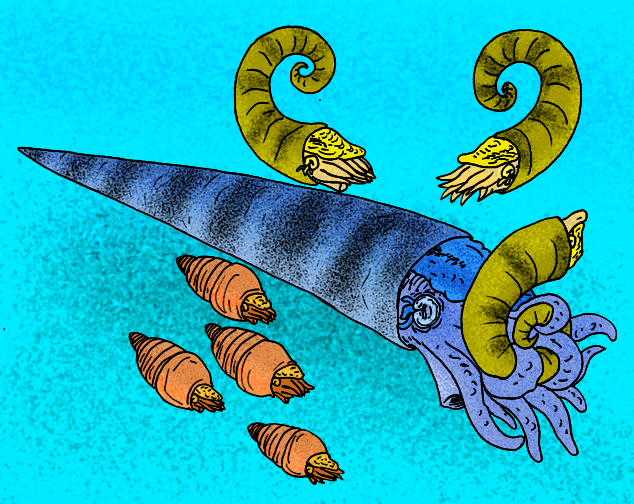
Cameroceras trentonense
Image: File:Cameroceras trentonese.jpg - Wikimedia Commons (CC BY-SA)
About Cameroceras
Cameroceras was a genus of giant, extinct orthoconic nautiloid cephalopods that dominated the marine ecosystems of the Middle to Late Ordovician period, approximately 470 to 443 million years ago. As one of the largest apex predators of the Paleozoic era, this magnificent invertebrate prowled the shallow, warm seas of what is now North America, leaving a profound impact on our understanding of early marine food webs. Its fossil remains, primarily discovered in the rich geological formations of New York State, continue to provide paleontologists with invaluable insights into the biological limits of shell-bearing marine organisms and the evolutionary trajectory of early cephalopods.
The physical description of Cameroceras is defined by its staggering proportions and its highly specialized anatomy, which set it apart from almost all other invertebrates of its time. The most striking physical characteristic of Cameroceras was its massive, straight, cone-shaped shell, known as an orthocone. Paleontologists estimate that the largest species, such as Cameroceras trentonense, reached astonishing lengths of up to 600 centimeters, or nearly twenty feet. This immense structure was divided into two primary sections: the phragmocone, which consisted of numerous gas-filled chambers used for buoyancy, and the body chamber at the forward-most open end, where the living animal resided. The soft tissue anatomy of Cameroceras, while not preserved in the fossil record, is inferred through comparative anatomy with modern cephalopods like the nautilus, squid, and octopus. The head of the creature would have been equipped with a mass of powerful, grasping tentacles used to ensnare prey and manipulate it toward a formidable, parrot-like chitinous beak capable of crushing the hard exoskeletons of contemporaneous arthropods. Furthermore, Cameroceras likely possessed large, highly developed camera-type eyes, granting it excellent vision in the photic zones of the Ordovician seas. When compared to modern animals, Cameroceras was somewhat analogous to a giant squid encased in a rigid, telephone-pole-like shell. Despite its massive size, the animal was not overly heavy in the water; the gas chambers within its shell offset the weight of the calcium carbonate, allowing it to maintain neutral buoyancy. The sheer size of this creature made it a true leviathan of its era, dwarfing nearly all other forms of marine life that existed during the Ordovician period.
The paleobiology of Cameroceras reveals a highly specialized predator perfectly adapted to its environment. Behaviorally, Cameroceras was an apex carnivore, utilizing a combination of ambush tactics and slow cruising to hunt its prey. Its diet consisted primarily of the heavily armored creatures that shared its habitat, including large eurypterids, commonly known as sea scorpions, massive trilobites, and early, jawless armored fish known as ostracoderms. Because of the long, cumbersome nature of its straight shell, Cameroceras was likely not a fast or agile swimmer. Instead, it relied on jet propulsion, drawing water into its mantle cavity and expelling it forcefully through a muscular funnel, or hyponome, to propel itself backward. To control its position in the water column, Cameroceras utilized a complex internal tube called a siphuncle. This organ ran longitudinally through the center of the septa, the walls dividing the chambers of the phragmocone. The siphuncle allowed the animal to actively regulate its buoyancy by pumping fluids out of the chambers and replacing them with gases, a biological mechanism still utilized by the modern chambered nautilus. In the case of Cameroceras, the siphuncle was exceptionally large and robust, often containing heavy calcareous deposits known as endocones at the apical end of the shell. These deposits served as a crucial counterweight, balancing the heavy mass of the living animal's body and tentacles at the front of the shell, allowing Cameroceras to maintain a horizontal orientation as it hovered above the sea floor. Growth patterns inferred from the spacing of the septa suggest that Cameroceras grew continuously throughout its life, adding new, larger chambers to the open end of its shell as its soft body increased in mass.
The ecological context in which Cameroceras thrived was a period of immense biological innovation and shifting global climates. During the Middle to Late Ordovician period, the Earth was experiencing the Great Ordovician Biodiversification Event, a massive radiation of marine life that established complex, multi-tiered ecosystems. The geography of the time was vastly different from today, with most of the world's landmasses concentrated in the southern hemisphere. Cameroceras inhabited the shallow, sunlit epicontinental seas that covered much of the paleocontinent of Laurentia, which corresponds to modern-day North America. The climate was generally warm and tropical, fostering the growth of extensive reef systems built by stromatoporoid sponges, rugose corals, and tabulate corals. In this vibrant underwater landscape, Cameroceras occupied the very top of the food web. It co-existed with a diverse array of marine organisms, including massive trilobites like Isotelus, predatory sea scorpions like Megalograptus, and dense forests of crinoids and brachiopods. As an apex predator, Cameroceras played a crucial ecological role in regulating the populations of these primary and secondary consumers. During this time, jawed fish had not yet evolved to become the dominant marine predators, leaving a vacant ecological niche that was readily filled by giant cephalopods. The presence of such a massive predator indicates that the Ordovician marine ecosystems were highly productive, capable of supporting the immense energetic requirements of a six-meter-long carnivore.
The discovery history of Cameroceras is deeply intertwined with the early days of North American paleontology. The genus was first described and named by the prominent American paleontologist Timothy Abbott Conrad in 1842. Conrad made his initial discoveries in the Trenton Limestone formations of New York State, a geological unit that has since become world-renowned for its exceptionally preserved Ordovician fossils. The name Cameroceras translates to chambered horn, a direct reference to the segmented nature of its massive orthoconic shell. Following Conrad's initial description, the prolific paleontologist James Hall further expanded upon the taxonomy and anatomy of these giant cephalopods during his extensive surveys of the paleontology of New York in the mid-to-late nineteenth century. Hall and his contemporaries unearthed numerous specimens from the limestone quarries of the Mohawk Valley and the Black River region. The key specimens that define the species Cameroceras trentonense consist primarily of massive, isolated siphuncles. Because the delicate outer shell and the thin septal walls of the phragmocone were often crushed by the weight of overlying sediments or dissolved by geological processes, paleontologists frequently only find the robust, heavily calcified siphuncles and their internal endocones. These historical discoveries were monumental at the time, as they provided the first tangible evidence that invertebrate life could reach such staggering proportions, challenging the nineteenth-century scientific understanding of biological limits in the ancient oceans.
The evolutionary significance of Cameroceras lies in its representation of the absolute peak of orthoconic cephalopod gigantism. Taxonomically, Cameroceras belongs to the order Endocerida, a highly successful group of early cephalopods characterized by their large, marginal or sub-central siphuncles and complex internal calcareous deposits. Within the broader tree of life, Cameroceras and its endoceratid relatives represent an early, highly specialized offshoot of the cephalopod lineage that flourished during the Ordovician but ultimately proved to be an evolutionary dead end. Unlike the ancestors of modern squid, octopuses, and cuttlefish, which internalized or completely lost their shells to prioritize speed and agility, the endoceratids committed entirely to the strategy of massive external armor and sheer size. While this strategy was incredibly successful in the predator-prey dynamics of the Ordovician seas, it left them highly vulnerable to environmental changes. The end-Ordovician mass extinction, driven by severe glaciation and plummeting sea levels, devastated the shallow epicontinental seas that Cameroceras called home. While the endoceratids survived into the Silurian period, they never regained the colossal sizes or ecological dominance they achieved with Cameroceras. Studying these giant orthocones provides evolutionary biologists with a critical understanding of the transitional features of early cephalopods, particularly regarding the development of buoyancy control mechanisms and the biomechanical constraints of external shells.
Despite over a century and a half of study, Cameroceras remains the subject of several ongoing scientific debates. The most prominent controversy surrounds the actual maximum size of the animal. In the early twentieth century, some paleontologists extrapolated the size of fragmented siphuncles and estimated that Cameroceras could have reached lengths of nine to eleven meters, or over thirty feet. However, more recent revisions by cephalopod experts, such as Curt Teichert in the late twentieth century, have significantly scaled down these estimates. By analyzing the taper rates of the shells and the proportions of more complete endoceratid specimens, modern consensus places the maximum length of Cameroceras closer to six meters. Another major debate involves the taxonomy of the genus itself. For many decades, Cameroceras functioned as a wastebasket taxon, a dumping ground for any large, poorly preserved orthoconic fossil found in Ordovician rocks. This led to dozens of species being incorrectly assigned to the genus. Recent taxonomic revisions have sought to clean up this classification, restricting the genus to specimens that clearly exhibit the specific siphuncular structures and endocone arrangements characteristic of Cameroceras trentonense. Furthermore, there is ongoing debate regarding its behavior, specifically whether it was an active, mid-water pursuit predator or a strictly benthic ambush hunter that rested on the sea floor, with biomechanical models currently favoring the latter due to the immense drag created by its shell.
The fossil record of Cameroceras is both extensive and frustratingly incomplete, characterized by a strong preservation bias. Fossils attributed to the genus and its close relatives have a wide geographic distribution, having been discovered not only in the Trenton Limestone of New York but also in Ordovician strata across the paleocontinents of Baltica and Siberia, corresponding to modern-day Europe and Russia. Despite the large number of specimens collected over the past two centuries, the preservation quality is highly variable. Complete shells are virtually non-existent. The vast majority of the fossil record consists of the internal molds of the siphuncle, which are often preserved in three dimensions due to their dense, solid nature. These siphuncle fossils frequently exhibit the intricate, cone-in-cone structure of the calcareous deposits that the animal used for ballast. Famous fossil sites yielding these remains include the Walcott-Rust Quarry in New York and various exposures along the shores of Lake Champlain. These sites continue to be vital to paleontology because they provide critical insights into the predator-prey dynamics of early Paleozoic marine ecosystems. By studying the bite marks and healed fractures on the shells of contemporaneous trilobites and smaller nautiloids, researchers can infer the immense crushing power of the Cameroceras beak, painting a vivid picture of life and death in the Ordovician seas.
The cultural impact of Cameroceras, while perhaps not as ubiquitous as that of dinosaurs, is significant within the realm of paleontology and science communication. The sheer concept of a twenty-foot-long, shelled squid has captured the imagination of the public, making Cameroceras a popular subject in documentaries and educational media. Most notably, the creature was prominently featured in the BBC television series Sea Monsters, where it was depicted as a terrifying apex predator of the ancient oceans, bringing the distant Ordovician period to life for millions of viewers. In natural history museums around the world, including the American Museum of Natural History in New York, life-sized models and massive fossil siphuncles of Cameroceras are frequently displayed to illustrate the concept of prehistoric gigantism. These exhibits serve an important educational purpose, demonstrating to the public that long before the age of reptiles or mammals, the oceans were ruled by massive, highly advanced invertebrates, thereby broadening our collective understanding of the deep history of life on Earth.
Classification
Time Period
Discovery
Location
New York, USA
Formation
Trenton Limestone
Frequently Asked Questions
What is Cameroceras?
Cameroceras was a genus of giant, extinct orthoconic nautiloid cephalopods that dominated the marine ecosystems of the Middle to Late Ordovician period, approximately 470 to 443 million years ago. As one of the largest apex predators of the Paleozoic era, this magnificent invertebrate prowled the sh...
When did Cameroceras live?
Cameroceras lived during the ordovician period of the paleozoic era approximately 470-443 million years ago.
Where was Cameroceras discovered?
Fossils of Cameroceras were discovered in New York, USA in the Trenton Limestone.
What did Cameroceras eat?
Cameroceras was a carnivore. It lived in marine habitats.
What type of fossil is Cameroceras?
Cameroceras is preserved as a permineralized fossil. The preservation quality is fair.
Related Specimens
From the paleozoic era · permineralized fossils