Jaekelopterus
Jaekelopterus rhenaniae
Image: Image sourced via web search (Fair use / Educational)
About Jaekelopterus
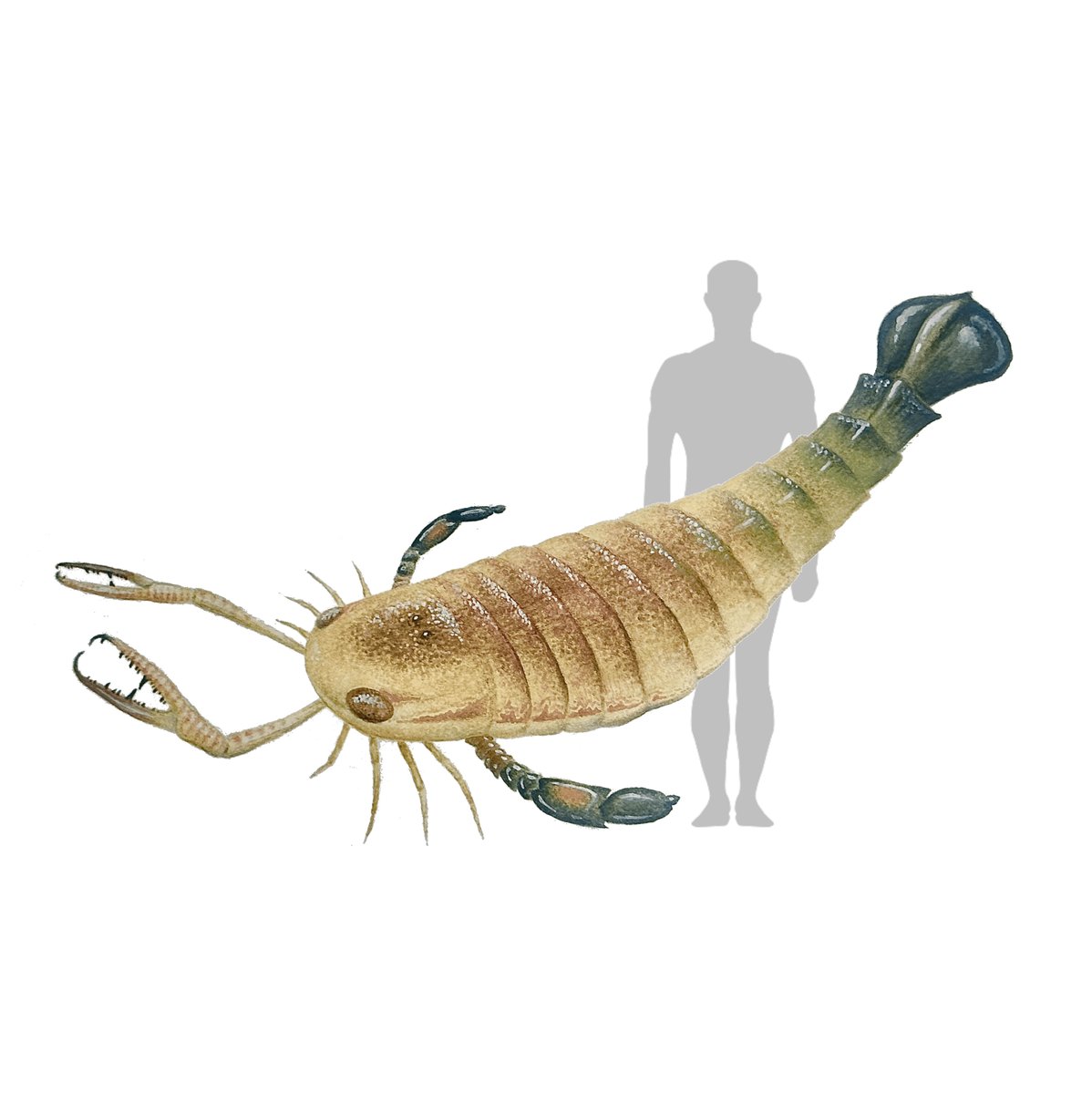
Jaekelopterus rhenaniae is an extinct species of eurypterid, a group of aquatic arthropods colloquially known as sea scorpions, that lived during the Early Devonian period, approximately 393 to 388 million years ago. Discovered primarily in the fossil-rich deposits of the Rhineland in Germany, this remarkable organism holds a legendary status in the annals of paleontology as one of the largest, if not the absolute largest, arthropods ever known to have existed on Earth. As an apex predator of its time, Jaekelopterus represents the pinnacle of arthropod gigantism, a phenomenon that occurred long before the rise of giant marine reptiles or massive predatory dinosaurs. Its existence provides crucial insights into the evolutionary dynamics of early aquatic ecosystems, demonstrating that before jawed vertebrates fully dominated the waters, giant invertebrates ruled the rivers, estuaries, and coastal margins of the Devonian world. The sheer scale of Jaekelopterus challenges our modern understanding of arthropod biological limits, making it a subject of intense scientific study and public fascination. The physical dimensions of Jaekelopterus rhenaniae are nothing short of staggering, with conservative estimates placing its maximum body length at approximately 2.5 meters (over 8 feet), and some extrapolations suggesting it could have grown even larger. To put this into perspective, this ancient sea scorpion was longer than a modern adult human and likely weighed upwards of 50 to 100 kilograms, depending on the thickness of its chitinous exoskeleton and internal musculature. Its most distinctive and terrifying features were its massive, enlarged chelicerae—the grasping claws located near its mouth. A single fossilized chelicera discovered in 2007 measured an astonishing 46 centimeters (18 inches) in length, which provided the basis for the 2.5-meter total body length estimate. These claws were armed with long, sharp, robust teeth designed for impaling and crushing heavily armored prey. The body of Jaekelopterus was flattened and streamlined, consisting of a broad prosoma (head shield), a segmented preabdomen, and a tapering postabdomen that terminated in a flattened, paddle-like telson (tail spine). Unlike modern scorpions, the telson was not a venomous stinger but rather a rudder used for precise maneuvering in the water. It possessed large, forward-facing compound eyes that granted it excellent binocular vision, a critical adaptation for an active predator. Its appendages included walking legs for navigating the substrate and large, oar-like swimming appendages that allowed it to propel its massive bulk through the water with surprising agility. The paleobiology of Jaekelopterus paints a picture of a highly specialized, formidable apex predator that dominated its environment. Its diet almost certainly consisted of early jawless fishes (agnathans), heavily armored placoderms, smaller eurypterids, and other invertebrates that shared its habitat. The morphology of its massive chelicerae suggests an ambush hunting strategy; Jaekelopterus likely lay in wait on the muddy bottom, possibly partially buried or camouflaged in the murky estuarine waters, before launching a rapid, explosive strike to seize passing prey. The robust teeth on its claws were perfectly adapted to puncture the tough dermal armor of early fishes. Once captured, the prey would be drawn toward the mouth, where the basal segments of its walking legs (gnathobases) would grind and tear the food into manageable pieces before ingestion. Locomotion was likely a combination of crawling along the riverbed and powerful bursts of swimming, utilizing its paddle-like appendages and undulating its flexible body. Like all arthropods, Jaekelopterus had to molt its rigid exoskeleton to grow, a perilous process that would leave it temporarily soft and vulnerable. It is highly probable that during these molting phases, these giants sought refuge in shallow, protected waters to avoid cannibalism from other eurypterids or attacks from large predatory fishes. The metabolic requirements to sustain such a massive arthropod body would have been significant, suggesting it thrived in warm, highly productive environments with abundant prey populations. The ecological context of the Early Devonian period, often referred to as the 'Age of Fishes,' was a time of dramatic evolutionary transition and ecological restructuring. The world of Jaekelopterus was characterized by a warm greenhouse climate, with high global sea levels and extensive shallow epicontinental seas. The fossils of Jaekelopterus are primarily found in the Klerf Formation of Germany, which during the Devonian was a complex network of coastal lagoons, estuaries, and river deltas. This indicates that rather than being a true marine 'sea scorpion,' Jaekelopterus actually inhabited brackish to freshwater environments. These transitional zones were incredibly rich ecosystems, serving as nurseries and feeding grounds for a diverse array of life. The flora of the time was undergoing its own revolution, with early vascular plants beginning to colonize the land, stabilizing riverbanks and contributing organic matter to the aquatic food webs. In these waters, Jaekelopterus shared its habitat with early sharks, spiny acanthodians, heavily armored placoderms, and a variety of jawless fishes like osteostracans and heterostracans. As an apex predator, Jaekelopterus sat at the very top of this food web. However, it was also part of an evolutionary arms race; the increasing size and armor of jawed fishes may have driven the gigantism seen in pterygotid eurypterids like Jaekelopterus, as they needed larger weapons to penetrate the defenses of their prey, while simultaneously needing larger body sizes to avoid becoming prey themselves to the rapidly evolving early sharks and arthrodire placoderms. The discovery history of Jaekelopterus is a fascinating journey that spans nearly a century of paleontological research. The first fragmentary remains of this giant were discovered in the early 20th century in the Rhineland of Germany, a region famous for its exceptionally preserved Devonian fossils. The eminent German paleontologist Otto Jaekel first described these remains in 1914, originally assigning them to the genus Pterygotus, naming the species Pterygotus rhenaniae. It wasn't until 1964 that the Scottish paleontologist Charles Waterston recognized distinct morphological differences in the reproductive organs and telson that warranted placing the species into a new genus, which he named Jaekelopterus in honor of Otto Jaekel. For decades, the true size of Jaekelopterus remained somewhat speculative due to the fragmentary nature of the fossils. However, a monumental breakthrough occurred in 2007 when paleontologists Markus Poschmann and Simon Braddy described a spectacularly preserved, isolated chelicera found in the Klerf Formation near Willwerath, Germany. This single claw measured 46 centimeters, providing the definitive evidence needed to calculate the animal's staggering 2.5-meter total length. This discovery made international headlines, cementing Jaekelopterus's reputation as the largest known arthropod and reigniting scientific interest in the evolutionary limits of the arthropod body plan. The evolutionary significance of Jaekelopterus lies in its position within the family Pterygotidae, a highly successful lineage of eurypterids characterized by their flattened bodies, large size, and modified chelicerae. Eurypterids as a whole are chelicerates, making them distant relatives of modern horseshoe crabs, scorpions, and spiders. Jaekelopterus represents the extreme endpoint of an evolutionary trend toward gigantism within the pterygotids. Studying this organism helps paleontologists understand the biomechanical and physiological constraints of the arthropod exoskeleton. Unlike vertebrates, whose internal skeletons can support massive weight on land and in water, arthropods are limited by the weight of their external armor and their respiratory systems. The fact that Jaekelopterus achieved such massive proportions suggests that the buoyancy of its aquatic environment was essential for supporting its bulk. Furthermore, its existence during the Devonian provides a critical data point for understanding the competitive dynamics between early arthropods and early vertebrates. The eventual extinction of the giant eurypterids by the end of the Devonian is often attributed to the rise of faster, more efficient jawed fishes, highlighting a major turning point in the evolutionary history of aquatic ecosystems where vertebrates permanently usurped the apex predator roles from invertebrates. Scientific debates surrounding Jaekelopterus continue to stimulate research and discussion within the paleontological community. One of the primary ongoing controversies involves the exact environmental conditions that facilitated such extreme gigantism. For many years, it was hypothesized that elevated atmospheric oxygen levels during the Paleozoic allowed arthropods to grow to massive sizes by overcoming the limitations of their passive respiratory systems. However, recent geochemical models suggest that oxygen levels during the Early Devonian were actually lower or comparable to modern levels, not elevated. This has led researchers to propose alternative drivers for gigantism, such as an evolutionary arms race with armored prey, a lack of vertebrate competitors in specific brackish environments, or the thermal advantages of a large body mass in fluctuating estuarine waters. Another area of debate concerns the exact maximum size of the animal. While the 2.5-meter estimate is widely accepted based on the proportions of smaller, more complete relatives, some scientists caution that allometric growth—where different parts of the body grow at different rates—could mean the animal had disproportionately large claws relative to its body, potentially reducing the overall length estimate slightly. Conversely, others argue that the 46-centimeter claw might not even represent the absolute maximum size the species could achieve. The fossil record of Jaekelopterus is primarily restricted to the Lower Devonian deposits of the Rhenish Massif in western Germany, specifically the Klerf Formation. Fossils of this giant are considered rare, and complete, articulated specimens are virtually unknown. The vast majority of the fossil record consists of disarticulated fragments—isolated claws, segments of the carapace, swimming paddles, and telsons. This fragmentary preservation is typical for large arthropods, as their exoskeletons tend to disarticulate rapidly after death or during the molting process. The fossils are typically preserved in fine-grained mudstones and siltstones, which represent the quiet, low-energy environments of ancient lagoons and river channels. Despite their fragmentary nature, the preservation quality of individual pieces can be exceptionally good, retaining microscopic details of the exoskeleton's surface texture, including scales and sensory pits. The famous fossil site near Willwerath, where the giant chelicera was discovered, has yielded numerous other eurypterid remains, providing a vital window into this ancient brackish ecosystem. The cultural impact of Jaekelopterus, while perhaps not as ubiquitous as that of Tyrannosaurus rex, is nonetheless significant, particularly in the realm of science communication and popular paleontology. The concept of a 'sea scorpion' larger than a human taps into a primal fascination—and often fear—of giant arthropods. Jaekelopterus frequently appears in documentaries, books, and articles discussing the largest animals of the prehistoric world. It was notably featured in the BBC series 'Walking with Monsters' (though often conflated with its close relative Pterygotus), which helped visualize its terrifying predatory behavior for a global audience. Museums around the world, such as the State Museum of Natural History in Stuttgart, feature life-sized models and fossil casts of Jaekelopterus, serving as powerful educational tools to illustrate the dramatic changes in Earth's biodiversity over deep time and to inspire awe in the sheer scale of prehistoric life.
Classification
Time Period
Discovery
Location
Germany
Formation
Klerf Formation
Frequently Asked Questions
What is Jaekelopterus?
Jaekelopterus rhenaniae is an extinct species of eurypterid, a group of aquatic arthropods colloquially known as sea scorpions, that lived during the Early Devonian period, approximately 393 to 388 million years ago. Discovered primarily in the fossil-rich deposits of the Rhineland in Germany, this ...
When did Jaekelopterus live?
Jaekelopterus lived during the devonian period of the paleozoic era approximately 393-388 million years ago.
Where was Jaekelopterus discovered?
Fossils of Jaekelopterus were discovered in Germany in the Klerf Formation.
What did Jaekelopterus eat?
Jaekelopterus was a carnivore. It lived in freshwater to brackish estuarine habitats.
What type of fossil is Jaekelopterus?
Jaekelopterus is preserved as a body fossil. The preservation quality is good.
Related Specimens
From the paleozoic era · body fossils