Kelenken
Kelenken guillermoi
Image: Image sourced via web search (Fair use / Educational)
About Kelenken
Kelenken guillermoi represents one of the most formidable avian predators ever to have walked the Earth, a true titan among the group colloquially known as "terror birds." This giant, flightless bird lived during the Middle Miocene epoch, approximately 15 to 14 million years ago, in what is now Patagonia, Argentina. As a member of the Phorusrhacidae family, Kelenken was a dominant terrestrial carnivore in South America, an island continent for much of the Cenozoic, and its discovery provided crucial insights into the peak of phorusrhacid evolution and the paleoecology of its time.
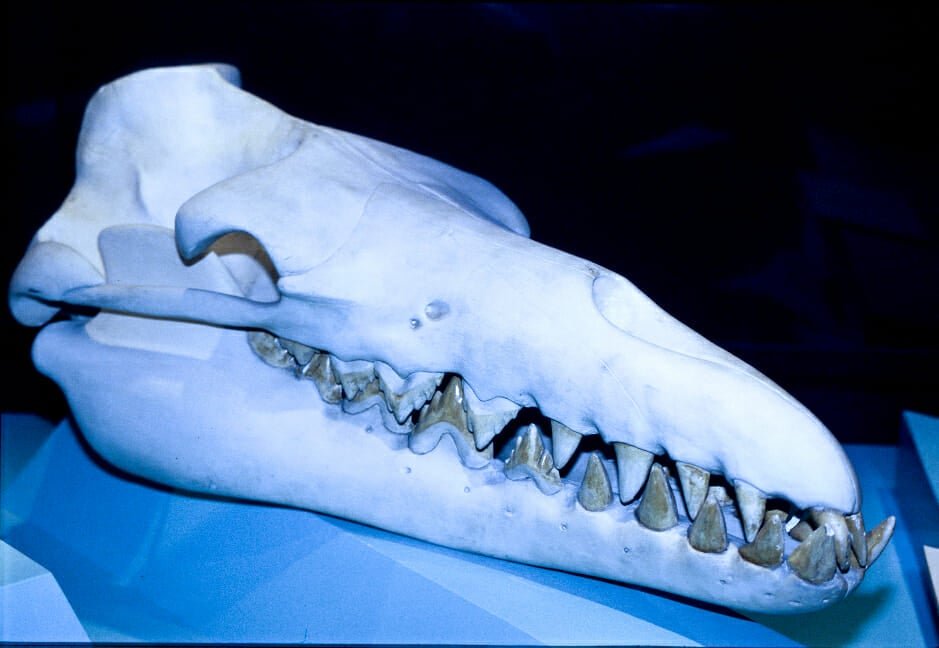
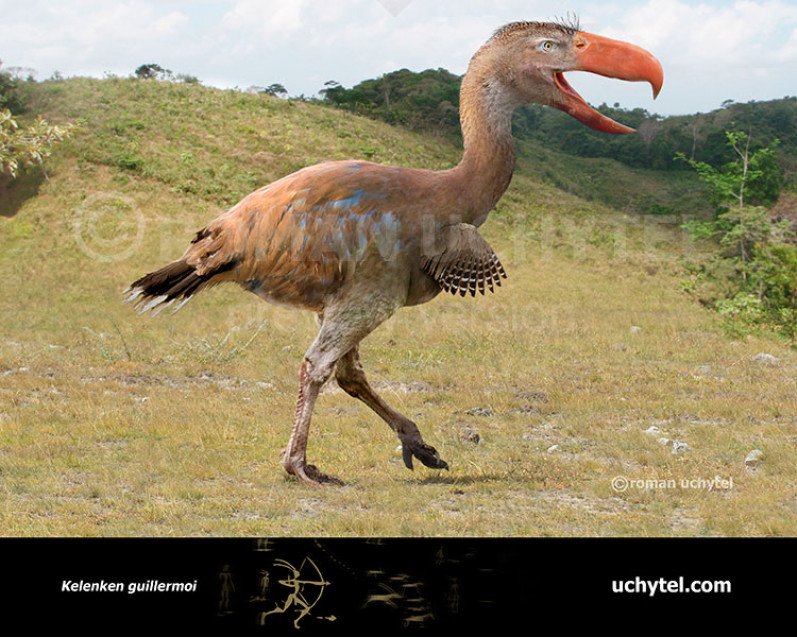
Kelenken was a truly gigantic bird, standing as the tallest known phorusrhacid. Height estimates place it at around 2.28 to 3 meters (7.5 to 10 feet) tall at the head, with a shoulder height comparable to that of a modern ostrich. Weight estimates are more varied, but most paleontologists suggest a mass between 150 and 250 kilograms (330 to 550 pounds), making it a heavyweight predator comparable to a large male lion. Its most defining and terrifying feature was its enormous skull, which, at 71.6 centimeters (28.2 inches) long including the beak, is the largest known skull of any bird, living or extinct. This massive head was armed with a deeply hooked, eagle-like beak, a formidable weapon for dispatching prey. The skull was proportionally narrow and tall, a structure that was both lightweight for its size and incredibly strong. Its legs were long and powerful, built for speed and endurance, ending in three-toed feet armed with sharp talons. Unlike its massive legs and head, its wings were vestigial, reduced to small, non-functional appendages, perhaps used for display or balance, but certainly not for flight. The overall skeletal structure suggests an animal that was both robust and agile, a perfect combination for an apex terrestrial predator.
The paleobiology of Kelenken paints a picture of a fearsome and efficient hunter. Its diet was strictly carnivorous, and its immense size meant it could prey on a wide range of contemporary South American mammals, including large notoungulates, litopterns, and potentially smaller ground sloths. Its hunting strategy has been a subject of intense study. Biomechanical analyses of its skull and neck musculature suggest it did not engage in prolonged struggles with large prey. Instead, it likely employed a swift, powerful, and precise killing method. One hypothesis suggests Kelenken used its long legs to chase down prey at high speeds, possibly reaching 50 kilometers per hour (31 mph), before delivering a devastating downward strike with its massive, hooked beak, akin to a hatchet or pickaxe. This blow could have fractured the skull or spine of its victim instantly. Another proposed feeding behavior involves using the beak to grasp smaller prey and violently shake or thrash it against the ground. The powerful neck muscles would have been crucial for this method. It is also plausible that Kelenken was an opportunistic scavenger, using its intimidating size to drive other predators away from their kills. Its metabolism was likely endothermic, similar to modern birds, allowing for the high energy output required for an active predatory lifestyle.
During the Middle Miocene, South America was an isolated island continent, fostering a unique and diverse fauna. The environment Kelenken inhabited in Patagonia was likely a mosaic of open woodlands, grasslands, and savannas, with a temperate to subtropical climate. This landscape supported a rich ecosystem of herbivores that formed Kelenken's prey base, such as the hippo-like notoungulate Homalodotherium and the camel-like litoptern Theosodon. As the apex predator of its ecosystem, Kelenken occupied the top of the food web, facing little to no competition from other large carnivores. The dominant mammalian predators of the time were sparassodonts, carnivorous metatherians like Borhyaena, which were significantly smaller than Kelenken and would have likely avoided direct conflict. The isolation of South America allowed phorusrhacids to evolve and diversify into these top predatory niches, which were occupied by large placental mammals like felids and canids on other continents. Kelenken's existence is a testament to the remarkable evolutionary radiations that can occur in geographic isolation, demonstrating that birds could, and did, evolve to become dominant terrestrial predators in the absence of mammalian competition.
The discovery of Kelenken is a relatively recent and significant event in paleontology. The holotype specimen (BAR 3877-11) was discovered in 1999 by a high school student named Guillermo Aguirre-Zabala during a fossil-hunting trip with the Museo Paleontológico de Bariloche near the town of Comallo, in the Río Negro Province of Argentina. The fossil, consisting of a nearly complete skull, a tarsometatarsus (a fused foot bone), and a phalanx, was found eroding from sediments of the Collón Curá Formation. Recognizing the importance of the find, Aguirre-Zabala and the museum staff carefully excavated the remains. The specimen was formally described in 2007 by a team of paleontologists led by Luis M. Chiappe. They named the new genus Kelenken, after a fearsome spirit in the mythology of the local Tehuelche people, and the species name, guillermoi, honors its discoverer, Guillermo Aguirre-Zabala. This discovery was monumental because the remarkably complete skull was far larger than any previously known phorusrhacid skull, confirming that these birds reached sizes previously only speculated upon and solidifying their status as apex predators.
Kelenken's position in the tree of life places it firmly within the family Phorusrhacidae, a diverse and successful clade of flightless carnivorous birds within the larger order Cariamiformes. The only living relatives of the phorusrhacids are the two species of seriemas found in South America today, which are much smaller, omnivorous birds. The evolutionary history of the phorusrhacids is a classic example of adaptive radiation on an isolated continent. They first appeared in the Paleocene and diversified throughout the Cenozoic, filling the ecological niche of large terrestrial predators. Kelenken, from the Middle Miocene, represents the pinnacle of this evolutionary trend in terms of sheer size. The study of Kelenken and its relatives provides invaluable information on how avian anatomy can be modified for a cursorial, predatory lifestyle. Its long, powerful legs are a case of convergent evolution with other large running animals like ostriches and horses, while its unique skull and killing technique demonstrate a predatory specialization not seen in any other vertebrate group. The eventual extinction of the phorusrhacids is linked to the Great American Biotic Interchange, when a land bridge formed between North and South America, allowing large placental carnivores like saber-toothed cats and bears to invade the continent, ultimately outcompeting the terror birds.
While the general understanding of Kelenken as a fast-running apex predator is widely accepted, some scientific debates persist regarding its specific behaviors and capabilities. One area of discussion revolves around its precise hunting technique. The "hatchet-strike" model proposed by Chiappe and colleagues is compelling, but other researchers have suggested that the skull, while strong vertically, may have been weaker against lateral (side-to-side) forces, making violent struggles with large prey risky. This has led to alternative hypotheses, such as a focus on smaller, more easily subdued prey or a greater reliance on scavenging. Another debate concerns its vocalizations. The structure of its skull suggests it may have had a well-developed syrinx and could have produced deep, powerful calls for communication or intimidation, but without soft tissue evidence, this remains speculative. Furthermore, the exact classification within the Phorusrhacidae family is subject to ongoing phylogenetic analysis, with Kelenken being placed within the subfamily Phorusrhacinae, which includes other large members like Phorusrhacos and Devincenzia. New fossil finds could further refine its relationship to other terror birds.
The fossil record for Kelenken guillermoi is currently limited, primarily based on the holotype specimen discovered in the Collón Curá Formation of Patagonia, Argentina. This single, yet exceptionally informative, specimen consists of the most complete skull of any giant phorusrhacid, a tarsometatarsus, and a toe bone. The preservation quality of the holotype is considered good, allowing for detailed anatomical and biomechanical studies that have been crucial to our understanding of the animal's life appearance and behavior. While other fragmentary phorusrhacid remains have been found in the same formation and across South America, fossils definitively assigned to Kelenken are very rare. The scarcity of complete skeletons for any large phorusrhacid means that much of their post-cranial anatomy is reconstructed based on composites of related species. The Collón Curá Formation continues to be an important site for understanding the Miocene fauna of South America, and future discoveries may yet yield more material from this incredible predator.
Despite its relatively recent scientific description, Kelenken has quickly captured the public imagination and made a significant cultural impact. As the largest and most impressive of the terror birds, it frequently appears in documentaries, books, and video games focusing on prehistoric life, often depicted as the ultimate avian predator. Its immense, hatchet-like skull is an iconic image of prehistoric ferocity. Museums, such as the Natural History Museum of Los Angeles County, have featured impressive skeletal mounts and life-sized models of Kelenken, showcasing its intimidating stature to the public. Its discovery highlights the fact that major paleontological finds are still being made, sometimes by amateurs and students, inspiring a new generation of fossil enthusiasts. Kelenken serves as a powerful educational tool, illustrating concepts of convergent evolution, adaptive radiation, and the dynamic nature of ecosystems through geologic time.
Classification
Time Period
Discovery
Location
Patagonia, Argentina
Formation
Collón Curá Formation
Frequently Asked Questions
What is Kelenken?
Kelenken guillermoi represents one of the most formidable avian predators ever to have walked the Earth, a true titan among the group colloquially known as "terror birds." This giant, flightless bird lived during the Middle Miocene epoch, approximately 15 to 14 million years ago, in what is now Pata...
When did Kelenken live?
Kelenken lived during the neogene period of the cenozoic era approximately 15-14 million years ago.
Where was Kelenken discovered?
Fossils of Kelenken were discovered in Patagonia, Argentina in the Collón Curá Formation.
What did Kelenken eat?
Kelenken was a carnivore. It lived in terrestrial habitats.
What type of fossil is Kelenken?
Kelenken is preserved as a body fossil. The preservation quality is good.
Related Specimens
From the cenozoic era · body fossils