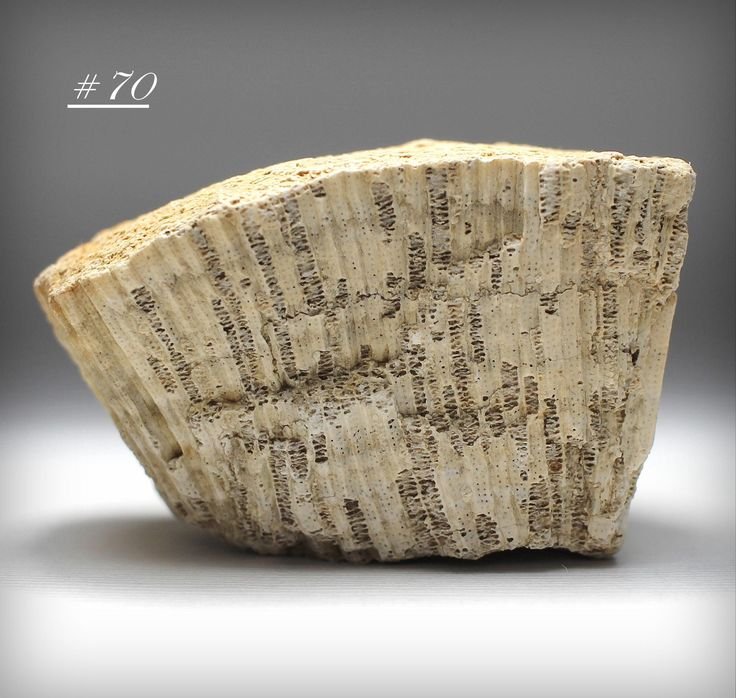
Favosites
Favosites gothlandicus
Image: Image sourced via web search (Fair use / Educational)
About Favosites
Favosites, commonly known as the honeycomb coral, was a widespread and ecologically significant colonial organism that thrived in the warm, shallow seas of the Paleozoic Era. First appearing in the Late Ordovician, it reached its peak diversity and abundance during the Silurian Period, approximately 444 to 419 million years ago, before ultimately becoming extinct during the Permian-Triassic extinction event. As a key reef-building organism, Favosites played a crucial role in constructing some of the earliest large-scale reef ecosystems, creating complex habitats that supported a burgeoning diversity of marine life.
The physical structure of a Favosites colony is its most defining characteristic and the source of its common name. Each colony was a calcareous, mound-like, branching, or sheet-like structure composed of hundreds to thousands of individual, tightly packed polygonal tubes called corallites. These corallites, typically hexagonal or pentagonal in shape, gave the fossilized colony a distinct honeycomb appearance. Each corallite housed a single, small, anemone-like animal known as a polyp. The corallites in Favosites are prismatic and share common walls, a key feature of the Tabulata order. These shared walls are perforated by small pores, known as mural pores, which allowed for the transfer of nutrients and communication between adjacent polyps, effectively integrating the colony into a single superorganism. The diameter of individual corallites was typically small, ranging from 1 to 5 millimeters. However, the overall colony could grow to impressive sizes, with some fossil specimens reaching over 50 centimeters in diameter, forming substantial structures comparable in scale to modern brain corals. Within each corallite, horizontal plates called tabulae were deposited as the polyp grew upwards, sealing off the lower, older sections of the tube. The spacing and structure of these tabulae are important diagnostic features for paleontologists distinguishing between different species of Favosites. The entire structure was a testament to efficient biological engineering, maximizing surface area for feeding while providing a robust, wave-resistant framework.
The paleobiology of Favosites reveals a successful strategy for life in Paleozoic seas. As a colonial cnidarian, each polyp within the colony was a filter-feeder. It would have extended tentacles, armed with stinging cells called nematocysts, into the water column to capture plankton and other suspended organic matter. The interconnectedness of the polyps via mural pores suggests a high degree of colonial integration, likely allowing for resource sharing that would buffer the colony against localized food shortages and support rapid, coordinated growth. Growth occurred through asexual budding, where new polyps would emerge and build their own corallites, expanding the colony's size. It is also presumed that Favosites reproduced sexually, releasing gametes into the water to form free-swimming planula larvae, which would eventually settle on a suitable hard substrate to found a new colony. The presence of tabulae indicates episodic upward growth, possibly linked to seasonal cycles or environmental fluctuations. While direct metabolic estimates are impossible, their role as major reef-builders in warm, sunlit waters has led some researchers to speculate that, like many modern corals, Favosites may have hosted symbiotic photosynthetic algae (zooxanthellae) within their tissues. This symbiosis would have provided the polyps with additional energy, fueling the rapid calcium carbonate secretion necessary to build their large skeletons.
During the Silurian Period, the world of Favosites was one of vast, shallow epicontinental seas covering much of the continental landmasses, which were clustered primarily in the Southern Hemisphere. The climate was generally warm and stable, creating ideal conditions for carbonate reef development. Favosites was a dominant frame-builder in these early reef ecosystems, particularly in the extensive reef complexes that formed around the paleocontinent of Laurentia (modern North America), Baltica (Northern Europe), and Siberia. These Silurian reefs were bustling metropolises of marine life. Favosites colonies, alongside other tabulate and rugose corals, stromatoporoid sponges, and calcareous algae, created a complex three-dimensional habitat. This framework provided shelter and attachment points for a diverse community of organisms, including brachiopods, crinoids (sea lilies), trilobites, gastropods, and early jawed fish. As a primary producer of habitat structure, Favosites occupied a foundational position in the food web. While the polyps themselves were small predators of plankton, the colony as a whole was likely prey for larger organisms equipped to break through its calcareous skeleton, such as certain types of nautiloids or early placoderm fish. The competition for space and light on the reef crest would have been intense, with Favosites competing against other colonial organisms for prime real estate.
The discovery and study of Favosites are intertwined with the very origins of paleontology. The genus was first formally described by the French naturalist Jean-Baptiste Lamarck in 1816. The type species, *Favosites gothlandicus*, was named for the island of Gotland, Sweden, a location renowned for its exceptionally well-preserved Silurian reef fossils. The Silurian strata of Gotland, particularly the Wenlock Limestone, have yielded countless spectacular specimens that have been central to our understanding of Paleozoic marine ecosystems for over two centuries. Early naturalists like Sir Roderick Murchison, who first defined the Silurian System in the 1830s, heavily relied on fossils like Favosites as index fossils to correlate rock layers across different regions of Europe. There are no single, famous named specimens of Favosites akin to individual vertebrate fossils, as their importance lies in their abundance and colonial nature. Instead, entire fossilized reef outcrops in places like Gotland, the Niagara Escarpment in North America, and the Ural Mountains in Russia serve as the key 'specimens' that have informed paleontological research. The distinctive and easily recognizable honeycomb pattern made Favosites one of the first invertebrate fossils to be widely collected and studied by both professional and amateur paleontologists.
Favosites holds immense evolutionary significance as a representative of the Tabulata, one of the major orders of Paleozoic corals. The Tabulata, along with the Rugosa, were the dominant reef-builders for over 200 million years, long before the appearance of the Scleractinian corals that build today's reefs. The success of Favosites and its relatives demonstrates a pivotal moment in Earth's history: the first time that animal skeletons were able to construct massive, geologically significant reef structures that fundamentally altered marine environments. The evolution of features like mural pores highlights the development of complex colonial integration, a strategy that allowed these organisms to function as a cohesive whole and dominate their ecosystems. Although the entire Tabulata order, including Favosites, went extinct at the end of the Permian period, their ecological niche was eventually re-occupied by the scleractinians. The study of Favosites provides a crucial window into the deep history of coral reefs, revealing that these vital ecosystems have ancient roots and have been shaped by different biological architects over geological time. They are a prime example of convergent evolution, where unrelated groups (Tabulata and Scleractinia) independently evolved similar colonial, reef-building lifestyles in response to similar environmental pressures.
Despite being a well-known and long-studied fossil, Favosites is not without its scientific debates. A primary area of ongoing research and discussion revolves around its potential relationship with symbiotic algae. While the analogy with modern corals is strong, direct evidence for Paleozoic-era symbiosis is exceptionally difficult to obtain. Isotopic analysis of the coral skeleton is one avenue being explored to find chemical signatures that might indicate the presence of photosynthesizing partners, but results remain inconclusive. Another area of debate concerns the fine details of taxonomy and species differentiation. Given the vast number of described Favosites species and their global distribution, distinguishing between true biological species and mere ecophenotypic variations (differences in growth form due to local environmental conditions) is a persistent challenge for paleontologists. Revisions of the Favositidae family are common as new analytical techniques, such as micro-computed tomography (micro-CT) scanning, allow for more detailed, non-destructive examination of the internal structures of the corallites, leading to reclassifications and a better understanding of their evolutionary relationships.
The fossil record of Favosites is both abundant and widespread, making it one of the most common Paleozoic fossils. Its fossils are found in Silurian and Devonian marine sedimentary rocks on every modern continent, a testament to its global distribution in the shallow seas of the past. Major fossil sites include the classic localities of Gotland, Sweden, and the Wenlock Edge in Shropshire, England. In North America, spectacular Favosites fossils are found throughout the Great Lakes region, particularly along the Niagara Escarpment in Ontario, New York, and Wisconsin, and in the famous Falls of the Ohio State Park in Indiana and Kentucky. Preservation quality is often excellent; the robust calcite skeleton is highly resistant to degradation, so entire colonies are frequently preserved in three dimensions with their fine honeycomb structure intact. Often, the fossils are silicified, where the original calcite has been replaced by silica, making them even more durable and allowing them to be etched out of their limestone matrix with acid, revealing exquisite detail.
Due to its distinctive and aesthetically pleasing honeycomb pattern, Favosites has a notable cultural impact, especially among fossil collectors and in regional geological education. It is often one of the first fossils that amateur collectors learn to identify and is a staple in museum collections and university teaching labs worldwide. In regions where it is particularly common, such as Michigan and Ohio in the USA, it is celebrated as a local natural treasure. The Petoskey stone, Michigan's state stone, is actually a fossil of a rugose coral (*Hexagonaria percarinata*), but it is often confused with Favosites by the public due to its similar colonial, hexagonal appearance, highlighting the general public fascination with these ancient 'stone honeycombs'. Displays of large Favosites colonies in museums like the Field Museum in Chicago or the Swedish Museum of Natural History in Stockholm serve as powerful visual aids for teaching the public about ancient marine life and the concept of 'deep time'.
Classification
Time Period
Discovery
Location
Gotland, Sweden
Formation
Wenlock Limestone (and others globally)
Frequently Asked Questions
What is Favosites?
Favosites, commonly known as the honeycomb coral, was a widespread and ecologically significant colonial organism that thrived in the warm, shallow seas of the Paleozoic Era. First appearing in the Late Ordovician, it reached its peak diversity and abundance during the Silurian Period, approximately...
When did Favosites live?
Favosites lived during the silurian period of the paleozoic era approximately 444-419 million years ago.
Where was Favosites discovered?
Fossils of Favosites were discovered in Gotland, Sweden in the Wenlock Limestone (and others globally).
What did Favosites eat?
Favosites was a filter-feeder. It lived in marine reef habitats.
What type of fossil is Favosites?
Favosites is preserved as a body fossil. The preservation quality is excellent.
Related Specimens
From the paleozoic era · body fossils
/cc86f4a1bc00.jpg)