Pteraspis
Pteraspis rostrata
Image: Image sourced via web search (Fair use / Educational)
About Pteraspis
Pteraspis rostrata represents a pivotal chapter in the history of life, an early jawless fish that navigated the rivers and estuaries of the Early Devonian period, approximately 419 to 393 million years ago. As a member of the class Pteraspidomorphi, it belonged to a diverse and successful group of armored, jawless vertebrates known as ostracoderms, which were among the first creatures to possess a bony skeleton. Its fossils, primarily found in the Old Red Sandstone deposits of Europe and North America, provide a crucial window into the 'Age of Fishes,' a time of radical evolutionary innovation when vertebrates began to diversify and establish dominance in aquatic ecosystems.
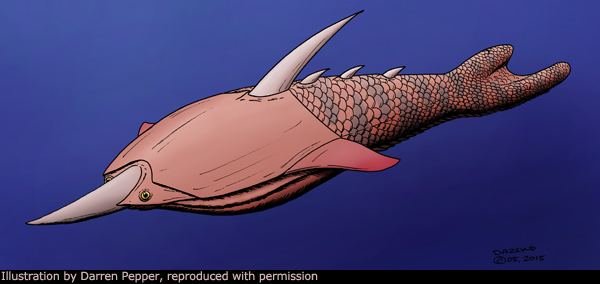
Pteraspis was a relatively small fish, typically reaching lengths of about 20 to 25 centimeters (8 to 10 inches), comparable in size to a modern-day trout or large goldfish. Its most striking feature was its heavily armored head region, a characteristic of the heterostracan ostracoderms. This armor, or cephalic shield, was not composed of individual scales but rather a series of fused bony plates that formed a rigid, streamlined carapace. The dorsal shield was a single, large plate, while the ventral side was covered by another large plate, with smaller plates connecting them along the sides. This bony exoskeleton would have provided significant protection against predators like the formidable eurypterids (sea scorpions) and early placoderms. Protruding from the front of this headshield was a long, pointed rostrum or spine, which gives the type species its name, 'rostrata' (beaked). The function of this rostrum is debated, but it likely served a hydrodynamic purpose, helping the fish maintain stability and maneuverability in flowing water, much like the bow of a ship. The eyes were small and positioned laterally on the headshield, suggesting a wide field of view. A single, median nostril was located between the eyes. Posterior to the headshield, the trunk and tail were more flexible, covered in smaller, diamond-shaped scales that allowed for movement. The tail was hypocercal, meaning the lower lobe was larger and more developed than the upper lobe, a feature that would have provided upward lift as it swam. Pteraspis lacked paired fins (pectorals and pelvics), a primitive trait among early vertebrates, but it did possess a small dorsal fin-like spine for stability.
The unique anatomy of Pteraspis provides significant clues about its paleobiology and lifestyle. As a jawless fish, it lacked the ability to bite or chew. Its mouth was a small, ventrally located opening, suggesting it was a bottom-feeder. It likely subsisted as a detritivore or microphagous feeder, sifting through mud and sediment on the riverbeds and estuary floors for organic debris, microorganisms, and small invertebrates. The rostrum may have been used to stir up the substrate to expose food particles. Its locomotion was likely characterized by bursts of speed rather than sustained swimming. The rigid headshield made the front of the body inflexible, meaning propulsion was generated entirely by sinuous movements of its muscular, scaled tail. The hypocercal tail would have created a downward force on the rear of the fish, causing the heavily armored head to pitch upwards. This upward lift would have helped it move off the bottom, but the lack of paired fins meant it had poor control over pitch, yaw, and roll, making it a less agile swimmer than its jawed contemporaries. It is inferred that Pteraspis was not a social, schooling fish in the modern sense, but large fossil assemblages suggest they may have gathered in significant numbers in certain favorable habitats, possibly for feeding or spawning. Its metabolism was likely ectothermic, similar to most fish today, with its activity levels dictated by ambient water temperatures.
Pteraspis lived in a world vastly different from our own. During the Early Devonian, the continents were coalescing into two supercontinents, Gondwana in the south and Euramerica (also known as Laurussia or the Old Red Sandstone Continent) in the north. Pteraspis inhabited the rivers, deltas, and estuaries of Euramerica, a landmass characterized by a warm, arid to semi-arid climate. The 'Old Red Sandstone' formations where its fossils are found represent the sediments eroded from the rising Caledonian Mountains, which formed as a result of the collision between the ancient continents of Laurentia and Baltica. The aquatic ecosystems were teeming with life. Pteraspis shared its freshwater and brackish habitats with a host of other ostracoderms, such as the flattened Cephalaspis, and the first jawed fishes (gnathostomes) were rapidly diversifying. These included the heavily armored placoderms like Coccosteus and the spiny acanthodians, often called 'spiny sharks'. The apex predators of these environments were likely large eurypterids, such as Pterygotus, which could grow to over two meters in length and would have posed a significant threat to the small, armored fish. Pteraspis occupied a low trophic level in the food web, serving as a primary consumer of detritus and, in turn, becoming prey for the larger, more mobile predators that were beginning to dominate the aquatic scene.
The discovery and study of Pteraspis are intrinsically linked to the pioneering days of geology and paleontology in the 19th century. Fossils from the Old Red Sandstone of the Welsh Borders and Scotland had been known for some time, often referred to as 'fossil fish' by quarrymen. The Swiss naturalist Louis Agassiz, a giant in the field of paleoichthyology, was the first to formally study and describe these remains. In his monumental work 'Recherches sur les Poissons Fossiles' (1833–1843), Agassiz described and named Pteraspis, coining the genus from the Greek words 'pteron' (wing) and 'aspis' (shield), referring to the wing-like cornua (corners) of the headshield. The type species, Pteraspis rostrata, was established based on well-preserved headshields from Herefordshire, England. Another key figure was the British geologist Sir Roderick Murchison, whose work on the Silurian and Devonian systems provided the stratigraphic context for these finds. Over the decades, numerous specimens have been unearthed, particularly from sites like the Dittonian series in the Anglo-Welsh Basin. While there are no individually famous specimens akin to 'Sue' the T. rex, the sheer abundance of Pteraspis plates in certain layers has made it a cornerstone for understanding Early Devonian vertebrate faunas and for biostratigraphy, helping to date rock layers across Europe and North America.
Pteraspis holds a crucial position in the evolutionary history of vertebrates. As an ostracoderm, it represents a successful early experiment in vertebrate design, showcasing the evolution of bone as a protective and structural material. It sits on the vertebrate family tree within the jawless fishes, or agnathans, a group whose only living descendants are the lampreys and hagfish. However, Pteraspis and its relatives, the heterostracans, are not direct ancestors of modern fish. They represent a distinct and ultimately extinct lineage that diverged before the evolution of jaws. The development of its complex dermal armor is a key evolutionary milestone, providing insights into the initial stages of skeletal formation in our distant ancestors. The study of Pteraspis and other ostracoderms helps paleontologists understand the ancestral vertebrate body plan and the environmental pressures, particularly predation, that drove the evolution of key features like armor and, eventually, jaws and paired fins. The success of jawed fishes, with their superior feeding capabilities and greater agility, ultimately led to the decline and extinction of most ostracoderm groups, including Pteraspis, by the end of the Devonian Period.
Despite being a well-known genus, Pteraspis is not without its scientific debates. For many years, the precise function of its prominent rostrum was a subject of speculation, with theories ranging from a defensive weapon to a sensory organ. The current consensus leans towards a hydrodynamic function, acting as a cutwater to improve stability, but some researchers still propose it may have been used for probing the sediment. Another area of ongoing research is the fine-tuning of its taxonomy and relationships with other pteraspidiforms. New discoveries and re-examinations of existing fossils using modern imaging techniques, like CT scanning, continue to reveal subtle details of the internal anatomy of the headshield, including the pathways of nerves and blood vessels, refining our understanding of its biology and its place within the broader group of heterostracans. The exact environmental tolerances of Pteraspis, whether it was strictly freshwater or could venture into more saline estuarine or marine environments, is also a topic of discussion, analyzed through geochemical studies of the fossil bone and surrounding rock matrix.
The fossil record of Pteraspis is robust, particularly in the Early Devonian strata of the United Kingdom (especially the Welsh Borders), Belgium, and Spitsbergen, Norway. Fossils are also known from other parts of Euramerica, including eastern Canada. The fossils are most commonly found as disarticulated but well-preserved bony plates of the headshield. Due to their durable nature, these plates often survived the processes of decay and transport before burial. Complete, articulated specimens showing the headshield attached to the scaled body and tail are much rarer but provide invaluable information about the animal's full anatomy and proportions. The exceptional preservation in some 'lagerstätten' within the Old Red Sandstone has preserved the fine ornamentation on the shield's surface, consisting of delicate ridges of dentine called 'odontodes'. The abundance of Pteraspis fossils in certain layers makes it an important index fossil, allowing geologists to correlate and date rock layers of the same age across different regions.
While not a household name like Tyrannosaurus or Stegosaurus, Pteraspis holds a significant place in paleontological education and museum displays. It is a classic textbook example of an ostracoderm and is frequently featured in exhibits on the 'Age of Fishes' and the evolution of vertebrates. Major natural history museums, such as the Natural History Museum in London and the National Museum of Scotland, often display well-preserved specimens of its distinctive headshield. Its alien, yet recognizably fish-like, appearance makes it a compelling subject for scientific illustrators and paleoartists, helping to bring the strange aquatic worlds of the Devonian period to life for the public. Its story is a fundamental part of the grand narrative of vertebrate evolution, representing a critical, albeit extinct, branch of our own deep family tree.
Classification
Time Period
Discovery
Location
United Kingdom (Welsh Borders)
Formation
Old Red Sandstone
Frequently Asked Questions
What is Pteraspis?
Pteraspis rostrata represents a pivotal chapter in the history of life, an early jawless fish that navigated the rivers and estuaries of the Early Devonian period, approximately 419 to 393 million years ago. As a member of the class Pteraspidomorphi, it belonged to a diverse and successful group of ...
When did Pteraspis live?
Pteraspis lived during the devonian period of the paleozoic era approximately 419-393 million years ago.
Where was Pteraspis discovered?
Fossils of Pteraspis were discovered in United Kingdom (Welsh Borders) in the Old Red Sandstone.
What did Pteraspis eat?
Pteraspis was a detritivore. It lived in freshwater, estuarine habitats.
What type of fossil is Pteraspis?
Pteraspis is preserved as a body fossil. The preservation quality is good.
Related Specimens
From the paleozoic era · body fossils