Ceratites
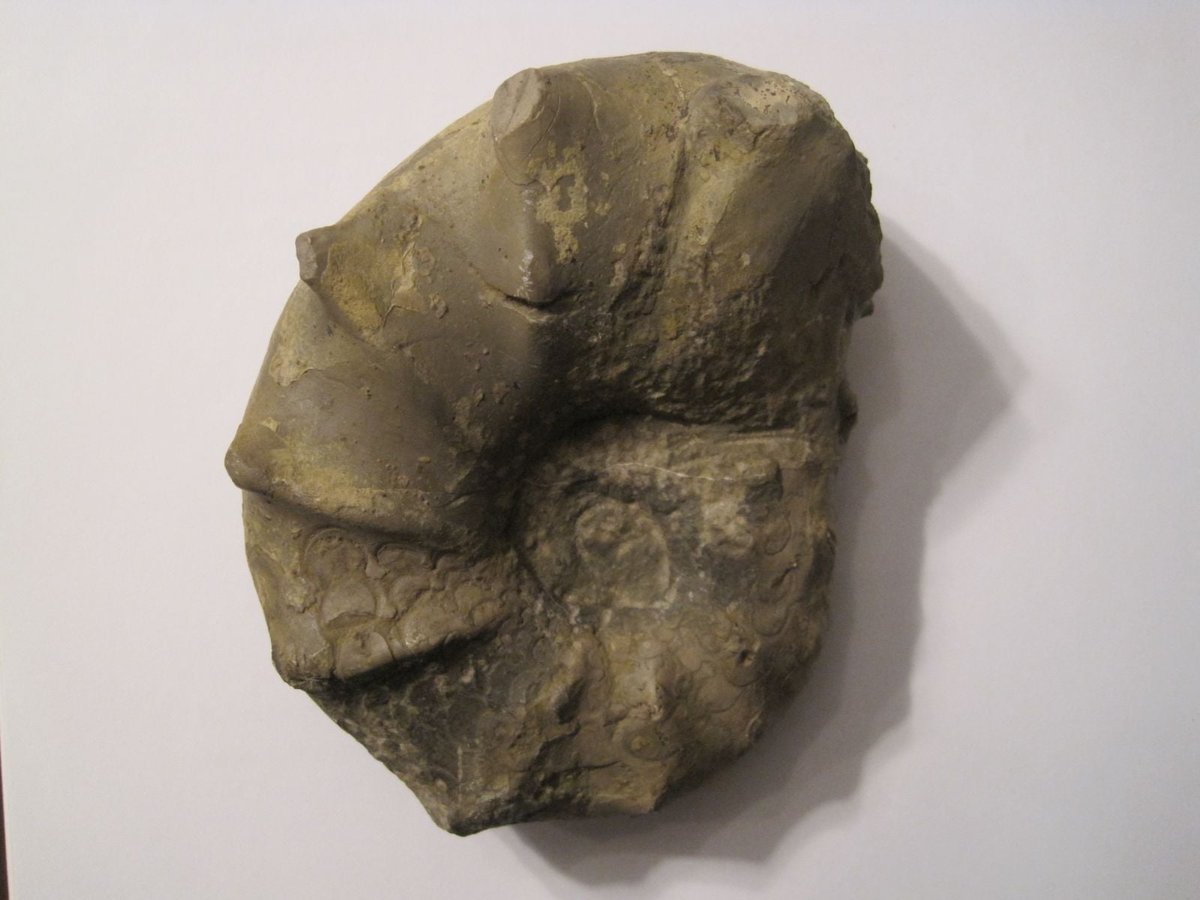
Ceratites nodosus
Image: Image sourced via web search (Fair use / Educational)
About Ceratites
Ceratites is an extinct genus of ammonoid cephalopod that lived during the Middle Triassic period, approximately 242 to 235 million years ago. As a key index fossil, its presence in rock strata is used by geologists and paleontologists to precisely date the surrounding sediments, particularly those of the Muschelkalk limestone deposits in central Europe. Its distinctive, ribbed shell and unique suture patterns make it one of the most recognizable and scientifically important invertebrates of the Mesozoic Era, offering critical insights into the recovery of marine ecosystems after the devastating Permian-Triassic extinction event.
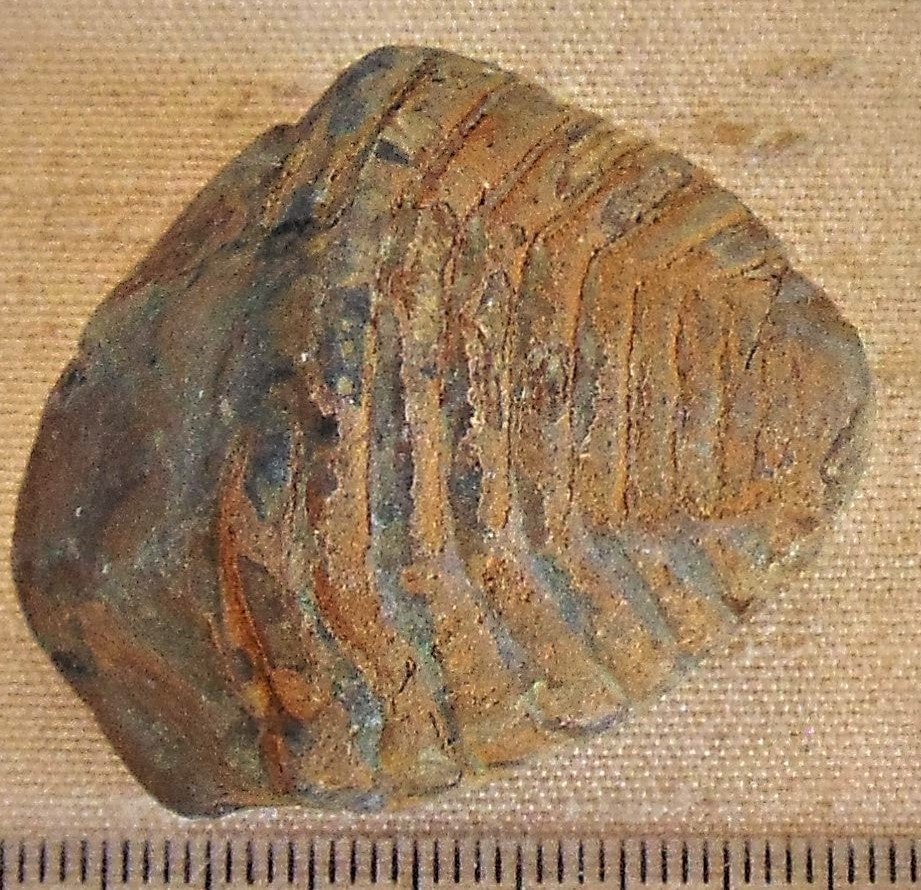
The physical form of Ceratites is defined by its external, coiled shell, which is the part most commonly preserved in the fossil record. These shells were typically discoidal and evolute, meaning the inner whorls were partially visible. The average shell diameter for Ceratites nodosus, the type species, ranged from 5 to 10 centimeters, though some specimens have been found reaching up to 15 centimeters. The shell's surface was adorned with prominent, simple ribs that were straight or slightly curved. A defining characteristic, and the source of the species name 'nodosus', is the presence of strong, blunt knobs or tubercles located on the ventrolateral shoulder—the outer edge of the shell's flank. These nodes gave the creature a horned or knobby appearance. Internally, the shell was divided into chambers by walls called septa. The complex, folded line where each septum met the inner shell wall is known as the suture line. Ceratites is named for its 'ceratitic' suture pattern, which is characterized by saddles (folds pointing towards the shell opening) that are smooth and rounded, and lobes (folds pointing away from the opening) that are frilled or serrated. This pattern is an intermediate form between the simpler goniatitic sutures of earlier ammonoids and the more complex ammonitic sutures of later Jurassic and Cretaceous ammonites. The living animal would have occupied the final, largest chamber of the shell, with its soft body, including tentacles and a head, extending from the aperture. Like modern nautiluses, it would have used the gas-filled inner chambers for buoyancy control.
As a cephalopod, Ceratites was an active marine carnivore, occupying a mid-level trophic position in the Triassic seas. Its primary diet likely consisted of small fish, crustaceans, and other invertebrates. It would have been a nektonic, or free-swimming, predator, using a form of jet propulsion for locomotion. By forcefully expelling water from a muscular funnel (or siphon), it could move through the water column, likely with considerable agility for hunting or evading predators. The robust, ornamented shell may have served multiple purposes beyond buoyancy. The prominent ribs and nodes could have provided structural reinforcement against the immense pressure of deeper water and, perhaps more importantly, offered a degree of protection against predation from marine reptiles like Nothosaurus or Placodus. Growth patterns, visible as lines on the shell, indicate that Ceratites grew by incrementally adding to the outer edge of its shell, creating new chambers as it matured. It is inferred that, like many modern cephalopods, Ceratites likely had a relatively short lifespan, characterized by rapid growth to sexual maturity. There is no direct fossil evidence of social behavior, but it is plausible they lived in shoals, a common strategy among modern squid and nautiluses for both hunting and defense.
Ceratites thrived in the warm, shallow epicontinental seas that covered much of central Europe during the Anisian and Ladinian stages of the Middle Triassic. This environment is famously preserved in the Muschelkalk Group of Germany, a sequence of limestone, marl, and dolomite deposits. The name 'Muschelkalk' itself means 'shell limestone', a testament to the sheer abundance of fossilized shells, including Ceratites, found within it. The climate was generally arid to semi-arid, leading to periods of high salinity in these semi-enclosed seas. Ceratites shared this habitat with a diverse array of marine life that characterized the 'Mesozoic Marine Revolution'. Its primary predators would have included early ichthyosaurs and nothosaurs, formidable marine reptiles that were apex predators of the time. Other potential threats included durophagous (shell-crushing) reptiles like Placodus, which possessed powerful, flattened teeth ideal for cracking open shelled prey. Ceratites, in turn, would have preyed upon a variety of smaller organisms, placing it as a crucial link in the food web. Its co-inhabitants included other mollusks like bivalves and gastropods, brachiopods, crinoids (sea lilies), and various species of fish. The abundance of Ceratites suggests it was a highly successful and integral component of this recovering post-extinction ecosystem.
The discovery and study of Ceratites are deeply intertwined with the foundational years of geology and paleontology in Europe. Fossils of Ceratites nodosus were known from the Germanic Basin for centuries, often collected as curiosities or 'serpent stones'. Their formal scientific description came in the early 19th century. The genus Ceratites was established by the Dutch-German naturalist Jean-Guillaume de Haan in his 1825 work 'Monographiae Ammoniteorum et Goniatiteorum'. The specific name, Ceratites nodosus, was coined by the German paleontologist Friedrich August von Quenstedt, though it was often attributed to Bruguière or Schlotheim in early literature. The primary location for these discoveries was, and remains, the Muschelkalk deposits of Germany, particularly in regions like Thuringia and Franconia. These fossils were so common and stratigraphically consistent that they became instrumental in the development of biostratigraphy. Paleontologists like Albert Oppel, in the mid-19th century, used the distinct, sequential forms of Ceratites and other ammonoids to subdivide the Triassic period into precise biozones, a practice that remains fundamental to geology today. There are no single, famous named specimens akin to dinosaurs, but vast collections in European museums, such as the Museum für Naturkunde in Berlin, hold thousands of exemplary Ceratites fossils that have collectively built our understanding of the genus.
Ceratites holds immense evolutionary significance as a prime example of an ammonoid in the order Ceratitida, which dominated the Triassic seas. This group represents a critical evolutionary link between the Paleozoic goniatites and the later, more complex ammonites of the Jurassic and Cretaceous. The defining feature illustrating this transition is its ceratitic suture line. This intermediate complexity—with its simple saddles and frilled lobes—demonstrates the evolutionary trend towards increasing septal convolution in ammonoids. This trend is thought to have provided greater structural strength to the shell, allowing ammonoids to withstand higher water pressures and potentially resist predation more effectively. The Ceratitida were one of the few ammonoid lineages to survive the Permian-Triassic extinction, the most severe mass extinction in Earth's history. The subsequent radiation of Ceratites and its relatives in the Triassic is a classic example of adaptive radiation, where a surviving group rapidly diversifies to fill vacant ecological niches. By the end of the Triassic, however, the Ceratitida too would fall victim to another mass extinction event, paving the way for the rise of the Ammonitida, which would flourish for the next 140 million years.
While the fundamental classification and biostratigraphic utility of Ceratites are well-established, scientific debate continues regarding the finer points of its paleobiology and evolution. One area of ongoing research is the precise function of the shell's ornamentation. While protection and structural integrity are widely accepted hypotheses for the ribs and nodes, some paleontologists propose they may have also played a role in hydrodynamics, affecting the animal's stability and maneuverability in the water. Another debate revolves around the mode of life and water depth preference. While generally considered a nektonic inhabitant of shallow seas, the exact range of depths it occupied is still under investigation through isotopic analysis of shell material. Furthermore, the high degree of morphological variation within Ceratites nodosus has led to taxonomic discussions about whether some variations represent distinct subspecies or are simply examples of ecophenotypic plasticity, where an organism's appearance changes in response to different environmental conditions. Recent studies using advanced imaging techniques are helping to better visualize the internal structures and suture patterns, refining our understanding of its growth and evolutionary relationships within the broader Ceratitida order.
The fossil record of Ceratites is exceptionally rich and geographically concentrated. The vast majority of specimens are found in the Middle Triassic Muschelkalk deposits of central Europe, especially Germany, but they are also found in related strata in France, Poland, and the Alpine regions. In these locations, Ceratites fossils are not just present; they are abundant, making them one of the most common Triassic invertebrates available to collectors and researchers. The preservation quality is often excellent, with the aragonitic shells typically preserved as internal molds (steinkerns) made of calcite or limestone, which perfectly capture the intricate details of the suture lines. Complete, three-dimensional shells are common finds. This abundance and high-quality preservation are why Ceratites was chosen as a premier index fossil; its evolutionary stages are so well-documented in successive rock layers that they form a high-resolution timeline for the Middle Triassic. Famous fossil sites include the quarries around Crailsheim and Würzburg in Germany, which have yielded countless museum-quality specimens over the past two centuries.
Due to its classic coiled shape and distinctive knobby texture, Ceratites is a visually appealing and popular fossil among collectors and the general public. It is a staple in museum exhibits on Triassic marine life and the evolution of cephalopods worldwide. Notable displays can be found in major European natural history museums, including those in Berlin, Stuttgart, and Vienna. As a key index fossil, it holds significant educational importance, serving as a textbook example in geology and paleontology courses to illustrate the principles of biostratigraphy, faunal succession, and the concept of transitional fossils. While it has not achieved the celebrity status of dinosaurs in popular culture, its recognizable form often appears in scientific illustrations, books, and documentaries depicting the Triassic period, symbolizing the strange and wonderful marine ecosystems that recovered from Earth's greatest extinction.
Classification
Time Period
Discovery
Location
Germany
Formation
Muschelkalk Group
Frequently Asked Questions
What is Ceratites?
Ceratites is an extinct genus of ammonoid cephalopod that lived during the Middle Triassic period, approximately 242 to 235 million years ago. As a key index fossil, its presence in rock strata is used by geologists and paleontologists to precisely date the surrounding sediments, particularly those ...
When did Ceratites live?
Ceratites lived during the triassic period of the mesozoic era approximately 242-235 million years ago.
Where was Ceratites discovered?
Fossils of Ceratites were discovered in Germany in the Muschelkalk Group.
What did Ceratites eat?
Ceratites was a carnivore. It lived in marine habitats.
What type of fossil is Ceratites?
Ceratites is preserved as a body fossil. The preservation quality is excellent.
Related Specimens
From the mesozoic era · body fossils