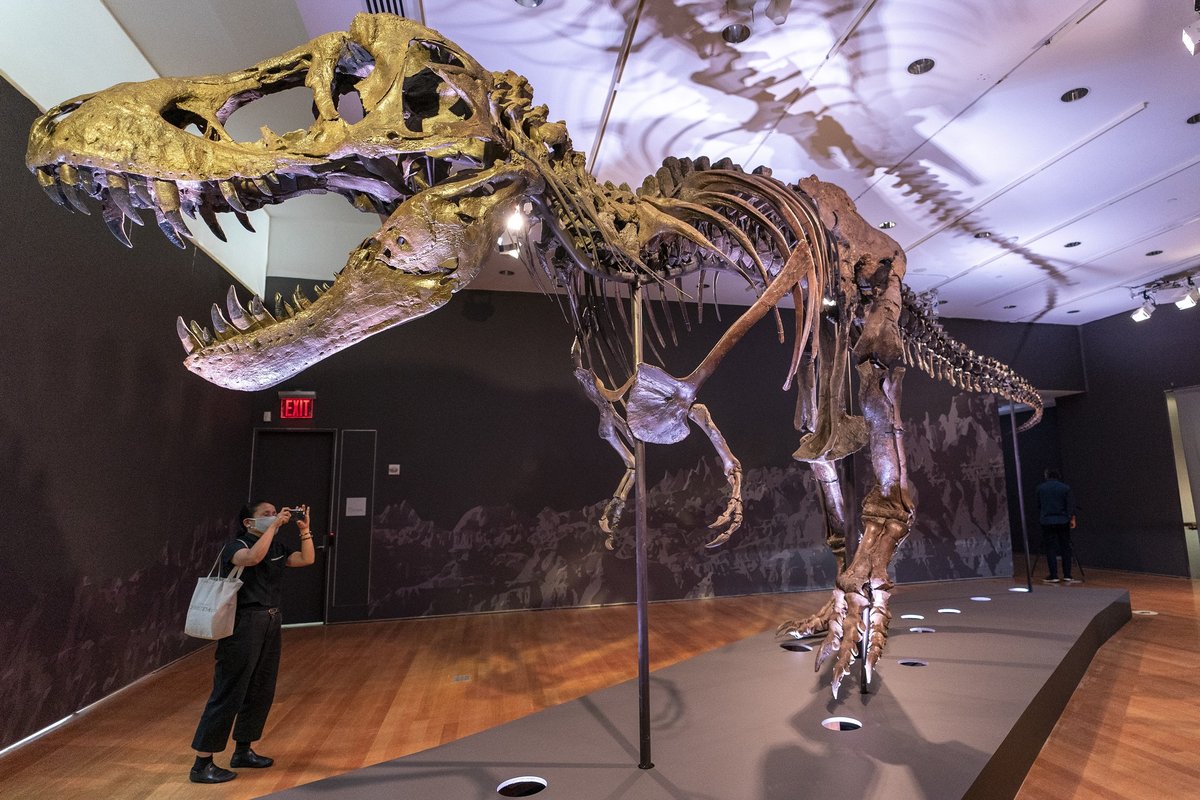
Scotty the T. rex (RSM P2523.8)
Tyrannosaurus rex
Image: Image sourced via web search (Fair use / Educational)
About Scotty the T. rex (RSM P2523.8)
Tyrannosaurus rex, the 'tyrant lizard king,' was a colossal theropod dinosaur that roamed western North America during the final two million years of the Cretaceous Period, approximately 68 to 66 million years ago. As the apex predator of its environment, its immense size, powerful build, and formidable jaws have cemented its status as one of the most iconic and extensively studied creatures in the history of life. The specimen known as 'Scotty' (RSM P2523.8) is particularly significant, as it represents not only the largest and most massive Tyrannosaurus rex discovered to date but also the oldest known individual, providing invaluable insights into the upper limits of this species' growth and longevity.
Scotty stands as a testament to the sheer scale of Tyrannosaurus rex, with an estimated body length of approximately 13 meters (42.7 feet) and a staggering weight estimate of around 8,870 kilograms (19,555 pounds). This makes it slightly heavier and more robust than other famous specimens like 'Sue' (FMNH PR 2081). The skeleton, though incomplete at roughly 65-70% recovered, includes critical elements that allow for these robust size calculations, such as a massive femur measuring 133 cm in length. Its skull, while not fully preserved, would have been immense, likely over 1.5 meters long, housing teeth the size of bananas designed for crushing bone. The skeleton of Scotty, like other T. rex, showcases a bipedal stance with a massive tail acting as a counterbalance to its enormous head. Its forelimbs were famously diminutive, possessing only two functional digits, a feature whose purpose remains a subject of intense scientific debate. Inferred soft tissues suggest a scaly hide, though some early tyrannosauroids possessed feathers, leaving open the possibility of limited feathering on T. rex, perhaps in its juvenile stages. The sheer bulk of Scotty, compared to a modern African elephant which weighs around 6,000 kg, underscores its position as one of the largest terrestrial carnivores to have ever lived.
As an apex predator, Tyrannosaurus rex's paleobiology was centered on active predation. Its diet consisted primarily of large herbivorous dinosaurs such as the ceratopsian Triceratops and the hadrosaurid Edmontosaurus. Evidence from fossilized bite marks on prey bones, healed T. rex-inflicted injuries on survivors, and coprolites (fossilized feces) containing bone fragments confirm its predatory role. Its powerful jaws, capable of exerting the strongest bite force of any known terrestrial animal (estimated at over 35,000 newtons), allowed it to employ a 'puncture-pull' feeding strategy, crushing bone to access the rich marrow inside. While its top speed is debated, with estimates ranging from a brisk walk of 17 km/h (11 mph) to a faster run of 29 km/h (18 mph), it was certainly capable of ambushing or pursuing its large, relatively slow-moving prey. The social behavior of T. rex is inferred from trackways and bonebeds, suggesting they may have lived in small family groups or hunted solitarily. Scotty's advanced age, estimated at over 30 years based on bone histology, reveals a long and arduous life. The specimen exhibits extensive paleopathologies, including a broken and healed rib, jaw infections, and tail injuries, painting a picture of a battle-scarred veteran that survived numerous violent encounters.
Scotty lived in the lush, subtropical floodplain environment of the Frenchman Formation in what is now Saskatchewan, Canada. During the Late Cretaceous, this region was part of the western coast of the Western Interior Seaway, an inland sea that divided North America. The climate was warm and humid, supporting dense forests of conifers, ferns, and flowering plants. This ecosystem was teeming with life, placing Tyrannosaurus rex at the pinnacle of a complex food web. Its primary prey included the heavily-armored Ankylosaurus, the three-horned Triceratops, and vast herds of the duck-billed Edmontosaurus. It shared this habitat with other dinosaurs, such as the ornithomimid 'ostrich-mimics,' the small predator Acheroraptor, and the pachycephalosaurid 'dome-headed' dinosaurs. The presence of such a diverse array of large herbivores was essential to support a mega-predator of Scotty's size. Its role as a keystone species would have been critical in regulating herbivore populations and shaping the overall structure of its ecosystem, preventing any single herbivore species from dominating the landscape and overgrazing the vegetation. The constant pressure from T. rex predation likely drove evolutionary adaptations in its prey, such as the development of horns, armor, and herding behaviors.
The discovery of Scotty is a story of patience and persistence. The initial fossils, a caudal vertebra and a jaw fragment, were unearthed in 1991 by high school principal Robert Gebhardt, who was accompanying paleontologists from the Royal Saskatchewan Museum on a prospecting trip in the Frenchman River Valley. The celebratory toast of Scotch whisky that evening earned the specimen its nickname, 'Scotty.' However, the excavation process was extraordinarily arduous. The bones were encased in incredibly hard, iron-rich sandstone, which required more than two decades of meticulous work to fully excavate and prepare. The team, led by paleontologists Tim Tokaryk and later Scott Persons and Philip J. Currie, painstakingly removed the surrounding rock to reveal the remarkably complete skeleton. It wasn't until the full extent of the recovered bones could be analyzed that its true significance became clear. In 2019, a comprehensive study led by W. Scott Persons officially declared Scotty the world's largest and oldest known Tyrannosaurus rex, a title previously held by 'Sue' from the Field Museum in Chicago. Today, a mounted cast of Scotty's skeleton is a centerpiece exhibit at the Royal Saskatchewan Museum's T.rex Discovery Centre in Eastend, Saskatchewan, near where it was found.
Tyrannosaurus rex represents the culmination of a long evolutionary lineage of tyrannosauroid theropods. This group originated in the Jurassic period as small, long-armed predators and gradually evolved into the colossal, short-armed apex predators of the Late Cretaceous. T. rex's immediate ancestors, such as Daspletosaurus and Tarbosaurus, shared many of its key characteristics but were generally smaller and less robust. Key evolutionary trends within the Tyrannosauridae family include a dramatic increase in body size, a shortening and strengthening of the neck, a reduction in forelimb size, and the development of a massively reinforced skull with forward-facing eyes for binocular vision, a crucial adaptation for a predator judging distance to its prey. As a member of the Saurischia ('lizard-hipped') order of dinosaurs, T. rex is more closely related to modern birds than to other reptiles like lizards or crocodiles. Birds are the direct descendants of small, feathered maniraptoran theropods, making Tyrannosaurus a distant cousin. The study of T. rex and its relatives provides critical data for understanding the evolution of gigantism, predatory adaptations, and the eventual transition from non-avian dinosaurs to birds.
Despite being one of the most studied dinosaurs, Tyrannosaurus rex remains a subject of vigorous scientific debate. One long-standing controversy is whether it was an active predator or primarily a scavenger. While the vast majority of evidence now points to it being an opportunistic hunter that would not pass up a free meal, the scavenger hypothesis, championed by paleontologist Jack Horner, forced a more rigorous examination of its biology. Another area of debate concerns its locomotion and maximum speed, with biomechanical models producing a wide range of estimates and ongoing discussion about whether such a massive bipedal animal could even run without risking fatal injury from a fall. The function of its tiny arms is perhaps the most famous puzzle, with hypotheses ranging from holding struggling prey, assisting in rising from a prone position, or being vestigial remnants with no significant function. The discovery of Scotty has also fueled discussions about the maximum potential size and lifespan of the species, suggesting that previous finds may not have represented the full spectrum of T. rex's growth potential.
The fossil record of Tyrannosaurus rex is geographically restricted to western North America, with significant finds in formations like the Hell Creek Formation of Montana, South Dakota, and Wyoming, and the Frenchman Formation of Saskatchewan. Over 50 partial skeletons have been discovered, making it one of the best-represented large theropods. These specimens range from juvenile individuals to mature adults like Scotty. The quality of preservation varies, but several skeletons, including 'Sue,' 'Stan,' and 'Scotty,' are remarkably complete, providing a comprehensive view of its anatomy. Skulls and teeth are the most commonly found elements due to their robust construction. Famous fossil sites in the Hell Creek Formation have yielded not only T. rex skeletons but also a rich assemblage of the flora and fauna of its ecosystem, allowing for detailed paleoecological reconstructions. The relative abundance of fossils has enabled detailed studies of its growth rates (ontogeny), biomechanics, and population structure, making T. rex a model organism for understanding dinosaur biology.
Tyrannosaurus rex holds an unparalleled position in global culture, symbolizing the power and majesty of the prehistoric world. Scotty's discovery as the 'king of the kings' has only enhanced this legacy. T. rex is the undisputed star of countless films, books, and documentaries, most famously in the 'Jurassic Park' franchise, which cemented its image as the ultimate predator in the public imagination. Major museums worldwide feature T. rex skeletons as their main attractions, drawing millions of visitors and inspiring new generations of scientists. The Royal Saskatchewan Museum's exhibit of Scotty provides a key educational and tourism draw for the region. This public fascination makes T. rex a powerful 'gateway' animal, introducing concepts of deep time, evolution, and extinction to a broad audience in an accessible and thrilling way.
Classification
Time Period
Discovery
Location
Saskatchewan, Canada
Formation
Frenchman Formation
Frequently Asked Questions
What is Scotty the T. rex (RSM P2523.8)?
Tyrannosaurus rex, the 'tyrant lizard king,' was a colossal theropod dinosaur that roamed western North America during the final two million years of the Cretaceous Period, approximately 68 to 66 million years ago. As the apex predator of its environment, its immense size, powerful build, and formid...
When did Scotty the T. rex (RSM P2523.8) live?
Scotty the T. rex (RSM P2523.8) lived during the cretaceous period of the mesozoic era approximately 68-66 million years ago.
Where was Scotty the T. rex (RSM P2523.8) discovered?
Fossils of Scotty the T. rex (RSM P2523.8) were discovered in Saskatchewan, Canada in the Frenchman Formation.
What did Scotty the T. rex (RSM P2523.8) eat?
Scotty the T. rex (RSM P2523.8) was a carnivore. It lived in terrestrial habitats.
What type of fossil is Scotty the T. rex (RSM P2523.8)?
Scotty the T. rex (RSM P2523.8) is preserved as a body fossil. The preservation quality is good.
Related Specimens
From the mesozoic era · body fossils
/929f881473a0.jpg)