Ceraurus
Ceraurus pleurexanthemus
Image: Image sourced via web search (Fair use / Educational)
About Ceraurus
Ceraurus pleurexanthemus is an iconic species of trilobite, an extinct group of marine arthropods that flourished during the Paleozoic Era. This particular organism lived during the Middle to Late Ordovician Period, approximately 460 to 445 million years ago, in the shallow tropical seas that covered what is now North America. Its distinctive, spiny appearance and the exceptional quality of its fossils have made it a subject of intense scientific study and a favorite among collectors, providing a crucial window into the complex marine ecosystems of the Ordovician.
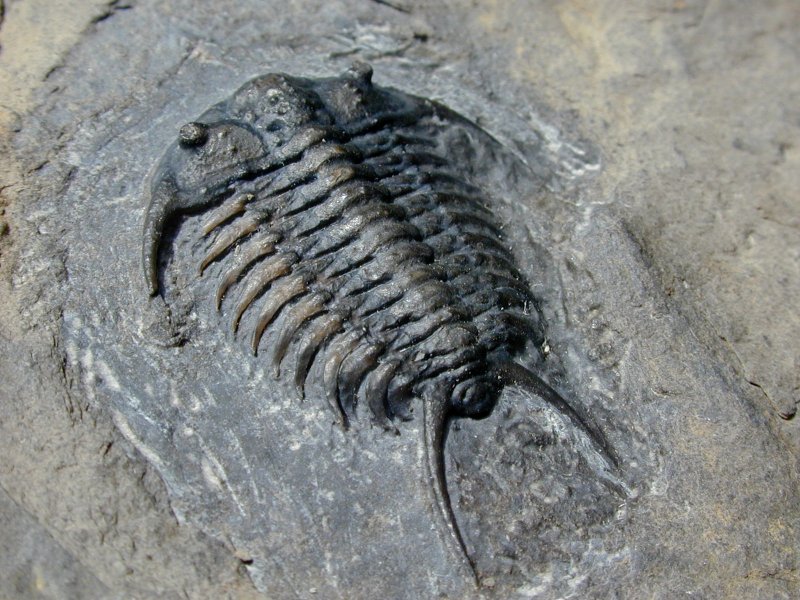
Ceraurus was a moderately sized trilobite, with most adult specimens reaching lengths between 2 and 7 centimeters, roughly the size of a large beetle or a small shrimp. Its most striking feature was its highly ornamented and spinose exoskeleton. The body was divided into the three classic trilobite lobes: a central axial lobe and two flanking pleural lobes. The head shield, or cephalon, was broad and semi-circular, dominated by large, crescent-shaped compound eyes positioned on elevated stalks, granting it a wide field of view. The central raised portion of the cephalon, the glabella, was inflated and bore distinct furrows. Perhaps its most recognizable characteristics were the long, curving genal spines that extended backward from the 'cheeks' of the cephalon, often reaching as far back as the tail shield. The thorax consisted of 11 articulating segments, each tipped with a sharp pleural spine, giving the animal a formidable, bristly appearance. The pygidium, or tail shield, was small but also featured a pair of prominent, backward-pointing spines. This elaborate spination is widely interpreted as a defensive adaptation against the period's burgeoning predators, such as large nautiloids and early jawed fish. Underneath this dorsal shield, Ceraurus possessed numerous pairs of jointed legs, typical of arthropods, used for walking on the seafloor. These delicate appendages are rarely preserved, but exceptional fossils from sites like the Walcott-Rust Quarry in New York have revealed their biramous (two-branched) structure, with one branch for walking and another bearing gills for respiration.
Based on its morphology and the sedimentary environments where its fossils are found, the paleobiology of Ceraurus is relatively well understood. It was a benthic, or bottom-dwelling, organism that likely spent its life crawling across the muddy and sandy substrates of shallow marine environments. Its diet is inferred to have been that of a detritivore or a scavenger, feeding on organic debris, microbial mats, and the carcasses of other small organisms on the seafloor. It would have used its numerous legs to sift through the sediment, bringing food particles toward its mouth, which was located on the underside of its cephalon. The placement of its eyes on stalks suggests an ability to survey its surroundings for both food and threats while partially buried in the substrate, a behavior common in many modern crustaceans like crabs. Locomotion was achieved by the rhythmic movement of its legs, allowing it to walk or scuttle across the seabed. Like all arthropods, Ceraurus grew by molting, periodically shedding its exoskeleton to accommodate its increasing size. This process, called ecdysis, is responsible for the vast majority of trilobite fossils, as a single individual could leave behind numerous molts throughout its lifetime. These discarded exuviae are often found disarticulated, providing clues about the molting process itself.
The world of Ceraurus during the Late Ordovician was a vibrant and dynamic one. Geographically, the continents were arranged very differently, with most landmasses clustered in the Southern Hemisphere, forming the supercontinent Gondwana. North America, known as Laurentia, was a separate continent situated near the equator, covered by warm, shallow epicontinental seas teeming with life. This period, known as the Great Ordovician Biodiversification Event, saw an explosive radiation of marine life. The ecosystem Ceraurus inhabited was a complex reef-like environment, though the reefs were built not by corals but by bryozoans, stromatoporoids (extinct sponges), and calcareous algae. Ceraurus shared its habitat with a diverse fauna, including other trilobite species, brachiopods, crinoids, gastropods, bivalves, and graptolites. In its position on the food web, Ceraurus was a low-level consumer. It faced predation from a new cast of formidable hunters that were evolving at the time. Chief among these were the large, straight-shelled cephalopods known as orthoconic nautiloids, which could reach several meters in length and were the apex predators of their time. Early eurypterids (sea scorpions) and the first primitive jawed fish also posed a threat. The extensive spination of Ceraurus was almost certainly a direct evolutionary response to this escalating predation pressure, making it a much more difficult and hazardous meal for a predator to consume.
The discovery and study of Ceraurus pleurexanthemus are deeply rooted in the early history of American paleontology. The species was formally described by the English naturalist John William Green in 1832, based on specimens collected from the Trenton Limestone of New York State. This region, particularly the area around Trenton Falls, became a classic fossil locality in the 19th century, attracting paleontologists from around the world. The most significant discoveries related to Ceraurus, however, came from the nearby Walcott-Rust Quarry, also in the Trenton Group. In the late 19th century, a quarryman and amateur collector named William P. Rust, and later the renowned paleontologist Charles Doolittle Walcott (who would go on to discover the Burgess Shale), unearthed thousands of Ceraurus specimens. These fossils were remarkable for their three-dimensional, uncrushed preservation. Even more importantly, some specimens, like the famous 'Beecher's Trilobite Bed' within the same formation, were preserved in pyrite, which replaced the delicate, non-mineralized tissues. This pyritization process preserved the legs, antennae, and gill structures of Ceraurus and other trilobites in exquisite detail, providing the first definitive proof of these soft parts and revolutionizing the scientific understanding of trilobite anatomy and their relationship to other arthropods.
Within the grand tapestry of evolution, Ceraurus and its relatives in the order Phacopida represent a highly successful and diverse lineage of trilobites. As members of the phylum Arthropoda, trilobites are ancient cousins of modern insects, crustaceans, spiders, and myriapods. The family Cheiruridae, to which Ceraurus belongs, is characterized by its 11 thoracic segments and often elaborate spination. The exceptional preservation of Ceraurus's appendages confirmed the long-held hypothesis that trilobites possessed biramous limbs, a feature shared with early crustaceans and seen as a primitive characteristic within the arthropod phylum. This anatomical evidence solidified the placement of trilobites as a distinct class within Arthropoda, closely related to the chelicerates (spiders and scorpions). The evolutionary trajectory of trilobites shows a clear trend towards increased complexity and adaptation, with Ordovician forms like Ceraurus displaying more advanced features, such as sophisticated compound eyes and defensive armor, compared to their Cambrian ancestors. They were a key component of Paleozoic ecosystems for nearly 300 million years before finally succumbing to the mass extinction event at the end of the Permian Period.
While the classification of Ceraurus pleurexanthemus at the species and genus level is stable, scientific discussions continue regarding its precise life habits and the function of its spines. The primary debate centers on the exact purpose of its ornamentation. While defense is the most widely accepted hypothesis, some researchers have proposed that the spines may have also served other functions. For instance, they could have helped to stabilize the animal on the soft substrate, preventing it from sinking into the mud, much like snowshoes. Another possibility is that they played a role in sensory perception, detecting water currents or the approach of other organisms. Recent studies using biomechanical models have attempted to test the defensive effectiveness of the spines against simulated predator attacks. Furthermore, the discovery of enrolled (balled-up) Ceraurus specimens, a defensive posture similar to that of modern pill bugs, demonstrates a multi-faceted defense strategy. These ongoing investigations, combining classic paleontological observation with modern analytical techniques, continue to refine our understanding of how this ancient arthropod navigated its perilous Ordovician world.
The fossil record of Ceraurus pleurexanthemus is exceptionally rich and geographically widespread, though concentrated in specific regions. The most famous and productive localities are in the sedimentary rocks of the Trenton Group in New York State and the Bobcaygeon Formation in Ontario, Canada. These areas represent the shallow, tropical sea that covered the paleocontinent of Laurentia during the Late Ordovician. Fossils are incredibly common in these formations, with thousands of complete or near-complete specimens having been collected over the past two centuries. The preservation quality is often excellent, with the calcite exoskeleton preserved in three dimensions with minimal distortion. The aforementioned Walcott-Rust Quarry and Beecher's Trilobite Bed are legendary sites, famed for producing not just articulated exoskeletons but also the pyritized soft tissues that offered an unprecedented glimpse into trilobite anatomy. Because of their abundance and quality, Ceraurus fossils are a staple in museum collections and are highly sought after by amateur collectors worldwide.
Due to its striking appearance and superb fossil record, Ceraurus has achieved a notable status beyond purely academic circles. It is one of the most recognizable North American trilobites and is frequently featured in paleontological textbooks, museum exhibits, and fossil guidebooks. Major institutions like the Smithsonian National Museum of Natural History, the American Museum of Natural History, and the Yale Peabody Museum hold extensive and historically significant collections, often featuring spectacular displays of Ceraurus specimens from the classic New York localities. Its image is often used to represent the Ordovician Period in popular science media, serving as an ambassador for the strange and wonderful life that existed long before the dinosaurs. For the public, Ceraurus is a tangible and aesthetically pleasing link to the deep past, embodying the complexity and alien beauty of Paleozoic marine life.
Classification
Time Period
Discovery
Location
New York, USA
Formation
Trenton Group (specifically, formations like the Rust Formation and Walcott-Rust Quarry)
Frequently Asked Questions
What is Ceraurus?
Ceraurus pleurexanthemus is an iconic species of trilobite, an extinct group of marine arthropods that flourished during the Paleozoic Era. This particular organism lived during the Middle to Late Ordovician Period, approximately 460 to 445 million years ago, in the shallow tropical seas that covere...
When did Ceraurus live?
Ceraurus lived during the ordovician period of the paleozoic era approximately 460-445 million years ago.
Where was Ceraurus discovered?
Fossils of Ceraurus were discovered in New York, USA in the Trenton Group (specifically, formations like the Rust Formation and Walcott-Rust Quarry).
What did Ceraurus eat?
Ceraurus was a detritivore. It lived in marine habitats.
What type of fossil is Ceraurus?
Ceraurus is preserved as a body fossil. The preservation quality is excellent.
Related Specimens
From the paleozoic era · body fossils