Haikouichthys
Haikouichthys ercaicunensis
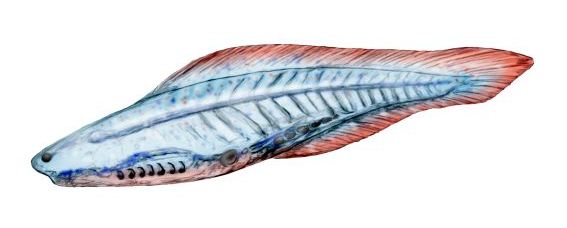
Image: File:Haikouichthys NT.jpg - Wikimedia Commons (CC BY-SA)
About Haikouichthys
Haikouichthys ercaicunensis is an extinct genus of early jawless fish that lived approximately 518 million years ago during the Cambrian Period of the Paleozoic Era, representing one of the earliest and most significant known vertebrates in the fossil record. Discovered in the celebrated Chengjiang fossil beds of Yunnan Province, China, this diminutive marine organism provides profound insights into the foundational evolutionary steps that eventually led to the diverse array of craniates inhabiting the Earth today. Its exceptional preservation in ancient marine sediments has allowed paleontologists to peer back over half a billion years, identifying the nascent anatomical structures that would ultimately define the entire vertebrate lineage, from modern fish to human beings.
The physical anatomy of Haikouichthys ercaicunensis is a fascinating study in early vertebrate design, characterized by a blend of primitive and surprisingly advanced features packed into a remarkably small frame. Measuring merely 2.5 centimeters in length, the organism was roughly the size of a modern thumbnail, yet it possessed a distinct head and a segmented trunk that clearly distinguished it from the invertebrate fauna of its time. Its body was laterally compressed and streamlined, bearing a strong superficial resemblance to modern lancelets or the larval stages of lampreys, though it was far more anatomically complex. The head region featured prominent paired eyes and possibly other sensory capsules, housed within a rudimentary cartilaginous skull structure, which is the defining characteristic of craniates. Running along the length of its back was a prominent dorsal fin supported by distinct fin radials, which extended toward the posterior end and likely merged into a continuous caudal and ventral fin fold. The structural integrity of the animal was maintained by a notochord, a flexible, rod-like primitive backbone that provided both support and an anchor for the surrounding musculature. This musculature was arranged in distinct zigzagging blocks known as myomeres, which are a hallmark of vertebrate anatomy. The respiratory system consisted of six to nine distinct gills supported by cartilaginous gill arches, located just behind the head. Unlike later fish, Haikouichthys completely lacked jaws, true teeth, and paired appendages such as pectoral or pelvic fins, relying instead on its simple, streamlined morphology to navigate its aquatic environment. Its tiny size and lack of mineralized bone or scales meant it was entirely soft-bodied, weighing only a fraction of a gram, making its survival in the fossil record all the more miraculous.
In terms of paleobiology, Haikouichthys ercaicunensis was adapted to a relatively simple but active lifestyle in the ancient Cambrian seas. Lacking jaws or grasping appendages, its feeding strategies were inherently limited. Paleontologists generally agree that it functioned primarily as a detritivore or a micro-scavenger, utilizing its simple, jawless mouth to siphon or filter small organic particles, detritus, and perhaps microscopic plankton from the water column or the uppermost layers of the seafloor sediment. The arrangement of its gill arches suggests they may have played a dual role in both respiration and filter-feeding, a mechanism seen in some primitive aquatic organisms today. Locomotion was achieved through anguilliform swimming, meaning the animal propelled itself forward by undulating its entire body from side to side in an eel-like motion. The zigzag arrangement of its myomeres, combined with the flexible notochord, allowed for efficient lateral contractions, while the dorsal fin and ventral fin folds provided stability and prevented the animal from rolling over as it swam. Although it lacked paired fins for precise steering, its small size and streamlined shape would have made it a relatively agile swimmer in the calm, shallow waters it inhabited. The presence of paired eyes and other potential sensory structures indicates that Haikouichthys was not a blind, passive drifter, but an active organism capable of perceiving its environment, locating food sources, and potentially detecting the shadows or movements of larger predators. Growth patterns in such early, soft-bodied vertebrates are difficult to ascertain with certainty, but the discovery of numerous specimens of varying sizes suggests a continuous growth trajectory typical of early marine organisms, likely reaching sexual maturity quickly in an environment where predation pressures were rapidly escalating.
The ecological context in which Haikouichthys lived was one of the most dynamic and transformative periods in the history of life on Earth, often referred to as the Cambrian Explosion. Approximately 518 million years ago, the region that is now Yunnan Province, China, was situated near the equator, submerged under a warm, shallow, and nutrient-rich epeiric sea on the Yangtze Platform. This marine environment was teeming with an unprecedented diversity of newly evolved, complex multicellular life forms. Haikouichthys shared its habitat with a bizarre and wondrous array of creatures that make up the famous Chengjiang biota. Its neighbors included early arthropods like the iconic trilobites, various sponges, brachiopods, and lobopodians such as Hallucigenia. In the complex food web of this ancient ecosystem, the tiny, jawless Haikouichthys occupied a position near the bottom. As a primary consumer and detritivore, it played a crucial role in nutrient cycling, converting microscopic organic matter into biomass. However, its small size and lack of defensive armor or spines made it highly vulnerable to predation. It lived in the shadow of the world's first apex predators, most notably the fearsome Anomalocaris, a massive, swimming radiodont with grasping appendages and a circular, tooth-lined mouth. To survive in an ocean increasingly dominated by visual predators, Haikouichthys likely relied on its agility, its small size, and perhaps a tendency to seek refuge among the fronds of ancient algae or the uneven terrain of the benthic zone, darting into the water column only when necessary.
The discovery history of Haikouichthys ercaicunensis is a landmark chapter in modern paleontology, fundamentally altering our understanding of early vertebrate evolution. The genus was first discovered in the late twentieth century in the fossil-rich Maotianshan Shales, specifically within the Qiongzhusi Formation near Ercaicun village in Haikou, a town in Chengjiang County, Yunnan Province, China. The formal description of the organism was published in the prestigious journal Nature in 1999 by a team of prominent paleontologists led by Shu Degan of Northwest University in Xi'an, China, in collaboration with Simon Conway Morris of the University of Cambridge. The naming of the organism reflects its origins: Haikouichthys translates to fish from Haikou, while the specific epithet ercaicunensis honors the village of Ercaicun near where the first specimens were unearthed. The initial discovery was based on a remarkably well-preserved holotype specimen that showcased the unmistakable features of a primitive vertebrate, including the dorsal fin, myomeres, and gill structures. Subsequent expeditions to the Chengjiang fossil beds yielded hundreds of additional specimens, many of which were preserved in exquisite detail, allowing researchers to study the organism's soft-tissue anatomy with unprecedented clarity. These discoveries sparked a wave of international interest and collaboration, drawing scientists from around the globe to study the Chengjiang biota. The unearthing of Haikouichthys, alongside other early vertebrates like Myllokunmingia, pushed the known origins of vertebrates back by tens of millions of years, proving that complex chordates had already evolved during the early stages of the Cambrian Explosion, much earlier than previously thought.
The evolutionary significance of Haikouichthys ercaicunensis cannot be overstated, as it occupies a pivotal position near the very base of the vertebrate family tree. Before its discovery, the fossil record of early vertebrates was sparse and highly fragmented, with the earliest widely accepted evidence consisting of isolated bony armor fragments from the Ordovician Period. Haikouichthys provided the first undeniable, articulated evidence of a vertebrate-like organism from the early Cambrian, demonstrating that the fundamental vertebrate body plan—a distinct head, paired sensory organs, a notochord, and segmented musculature—was already established over 518 million years ago. It is widely regarded as a basal craniate or a stem-vertebrate, representing a transitional morphological stage between simpler invertebrate chordates, like modern lancelets and tunicates, and the more derived jawless fishes (agnathans) that would later dominate the Paleozoic seas. The presence of a rudimentary cartilaginous skull and gill arches in Haikouichthys provides crucial clues about the development of the neural crest, a specialized group of embryonic cells unique to vertebrates that gives rise to the skull, jaws, and complex sensory organs. By studying Haikouichthys, evolutionary biologists can trace the deep-time origins of the anatomical structures that would eventually be modified and repurposed over hundreds of millions of years, giving rise to the immense diversity of vertebrate life, including the bony fishes, amphibians, reptiles, birds, and mammals. In essence, this tiny, jawless swimmer carries the ancestral blueprints for the human skeleton and nervous system.
Despite its critical importance, the scientific study of Haikouichthys has not been without debate and controversy. One of the primary taxonomic disputes centers on its exact placement within the chordate phylogenetic tree. While most researchers agree it is a basal craniate, there is ongoing debate about whether it possesses all the necessary characteristics to be classified as a true crown-group vertebrate. Some paleontologists argue that certain features, such as the exact nature of its cartilaginous structures, are too primitive, suggesting it should be placed just outside the vertebrate crown group as a stem-craniate. Another point of contention involves the interpretation of its myomeres. Early studies suggested the muscle blocks were V-shaped, similar to those of lancelets, while later, more detailed analyses using advanced imaging techniques argued they were W-shaped, a definitive characteristic of true vertebrates. Furthermore, there has been significant debate regarding its relationship to Myllokunmingia, another early fish found in the same fossil beds. Some researchers have proposed that Haikouichthys and Myllokunmingia might actually represent different life stages or sexes of the same species, or at least belong to the same genus, given their morphological similarities and shared habitat. However, subtle differences in fin structure and gill arrangement have led the majority of the scientific community to maintain them as distinct genera for the time being. These debates highlight the inherent challenges of interpreting half-billion-year-old, soft-bodied fossils compressed into two dimensions.
The fossil record of Haikouichthys is almost entirely restricted to the Qiongzhusi Formation within the Chengjiang fossil site in Yunnan, China. The preservation quality of these fossils is extraordinary, representing a classic example of Burgess Shale-type preservation. In this taphonomic process, the organisms were rapidly buried by fine-grained mud flows, likely triggered by underwater storms or seismic activity. This sudden entombment in an anoxic, or oxygen-poor, environment prevented the normal processes of decay and scavenging, allowing for the fossilization of delicate soft tissues that are almost never preserved in the geological record. The fossils of Haikouichthys are typically found as flattened, two-dimensional carbonaceous films on the surface of yellowish mudstone slabs. Despite this flattening, the fine-grained nature of the sediment has preserved microscopic details, including the outlines of the eyes, the individual filaments of the gills, and the delicate rays supporting the dorsal fin. To date, over five hundred individual specimens of Haikouichthys have been recovered, making it one of the most abundant early vertebrates known. This large sample size has been invaluable for paleontologists, allowing them to account for taphonomic distortion—the warping and bending of the body during fossilization—and reconstruct a highly accurate, three-dimensional model of the living animal. The sheer abundance of these fossils at the Chengjiang site underscores the ecological success of these early jawless fishes in the Cambrian seas.
The cultural and educational impact of Haikouichthys extends far beyond the confines of academic paleontology. As one of the earliest known ancestors of the vertebrate lineage, it has captured the public imagination and frequently features in popular science media, documentaries, and books detailing the history of life on Earth. It gained widespread recognition when it was featured in the acclaimed BBC documentary series Walking with Monsters, where it was depicted as a tiny, vulnerable ancestor to all modern fish and terrestrial vertebrates, dodging the terrifying Anomalocaris. It has also been highlighted in works by natural historians like David Attenborough, serving as a powerful educational tool to explain the concept of deep time and the shared evolutionary heritage of all backboned animals. Casts and high-resolution photographs of Haikouichthys fossils are prominently displayed in major natural history museums around the world, including the Paleontological Museum of Liaoning and the Natural History Museum in London. By bringing the story of this humble, 2.5-centimeter-long creature to the public, educators and scientists are able to foster a deeper appreciation for the intricate and awe-inspiring narrative of evolutionary biology, reminding us that the origins of humanity's complex anatomy can be traced back to the muddy seafloors of the Cambrian Period.
Classification
Time Period
Discovery
Location
Chengjiang County, Yunnan Province, China
Formation
Qiongzhusi Formation
Frequently Asked Questions
What is Haikouichthys?
Haikouichthys ercaicunensis is an extinct genus of early jawless fish that lived approximately 518 million years ago during the Cambrian Period of the Paleozoic Era, representing one of the earliest and most significant known vertebrates in the fossil record. Discovered in the celebrated Chengjiang ...
When did Haikouichthys live?
Haikouichthys lived during the cambrian period of the paleozoic era approximately 518 million years ago.
Where was Haikouichthys discovered?
Fossils of Haikouichthys were discovered in Chengjiang County, Yunnan Province, China in the Qiongzhusi Formation.
What did Haikouichthys eat?
Haikouichthys was a detritivore. It lived in marine habitats.
What type of fossil is Haikouichthys?
Haikouichthys is preserved as a impression fossil. The preservation quality is exceptional.
Related Specimens
From the paleozoic era · impression fossils