Hesperornis
Hesperornis regalis
Image: Image sourced via web search (Fair use / Educational)
About Hesperornis
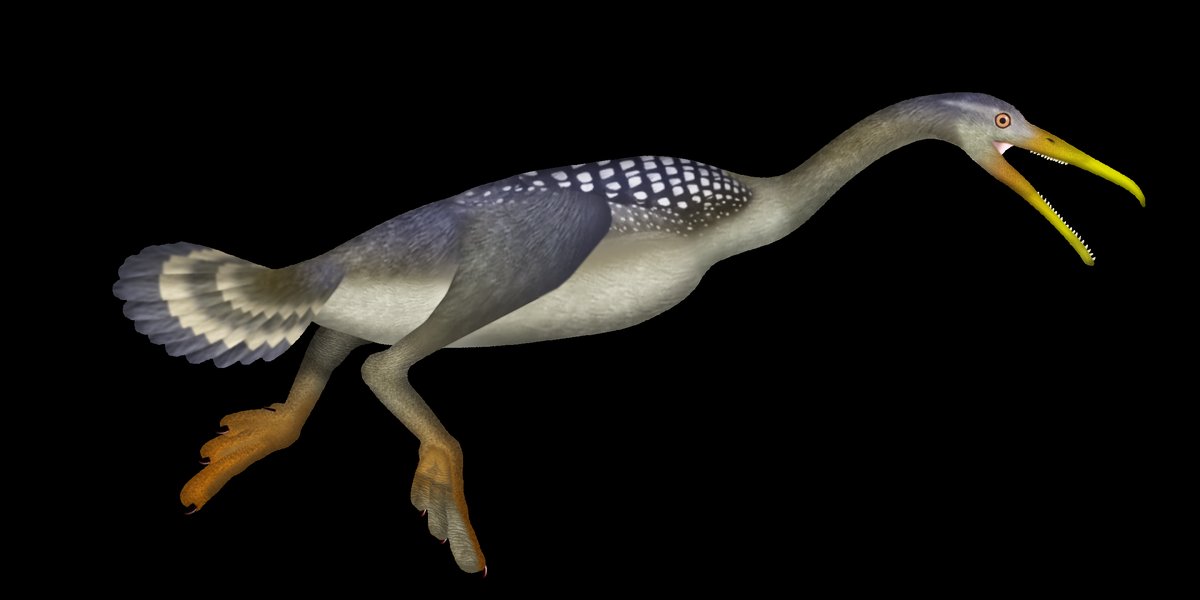
Hesperornis regalis was a large, flightless, toothed seabird that lived during the Late Cretaceous period, approximately 84 to 78 million years ago. It inhabited the Western Interior Seaway, a vast inland sea that once divided North America, making it a key component of a vibrant marine ecosystem. Its discovery was a landmark event in paleontology, providing irrefutable evidence of toothed birds and offering a crucial window into the early evolution and diversification of avian life alongside non-avian dinosaurs.
Hesperornis was a formidable marine predator, reaching lengths of up to 1.8 meters (nearly 6 feet) from beak to tail, making it comparable in size to a modern great northern loon or a small emperor penguin, though far more slender. Its body was highly specialized for an aquatic lifestyle, featuring a streamlined, elongated torso and a long, flexible neck. Unlike modern birds, Hesperornis possessed a beak filled with small, sharp, recurved teeth set within grooves, a primitive trait inherited from its theropod dinosaur ancestors. These teeth were perfectly adapted for seizing slippery prey like fish and squid. The skull was long and narrow, with powerful jaw muscles. Perhaps its most striking feature was its severely reduced, vestigial wings, which were so small they were likely useless for any form of locomotion, rendering the bird completely flightless. In stark contrast, its legs were powerful and robust. The leg bones were dense, reducing buoyancy, and the feet were likely lobed, similar to those of modern grebes, rather than webbed like a duck's. This configuration, with legs positioned far back on the body, would have provided powerful, efficient propulsion underwater but made movement on land extremely awkward, suggesting it spent almost its entire life at sea, only coming ashore to nest.
The paleobiology of Hesperornis is a classic example of evolutionary adaptation to a specific niche. Its anatomy points unequivocally to a life spent hunting in the warm, shallow waters of the Western Interior Seaway. The powerful, rear-set legs propelled it through the water with great speed and agility, using its lobed feet for steering and thrust. It was an active pursuit predator, using its long neck and toothed beak to snatch fast-moving fish and cephalopods from the water column. Fossilized stomach contents, known as cololites, have confirmed a diet rich in fish, with remains of species like Enchodus found within Hesperornis skeletons. Its dense bones would have acted as ballast, helping it dive and remain submerged while hunting. While an expert swimmer, its terrestrial locomotion was likely limited to an awkward shuffle or tobogganing motion on its belly, similar to modern seals. This vulnerability on land implies that Hesperornis would have nested in large, protected coastal colonies, likely on isolated sandbars or rocky shores inaccessible to large terrestrial predators. Its metabolism was likely higher than that of a similar-sized reptile, consistent with an active avian lifestyle, but perhaps not as high as that of modern flying birds, given its flightlessness and the warm climate it inhabited.
During the Late Campanian stage of the Cretaceous, Hesperornis lived in a world vastly different from our own. The climate was much warmer, with no polar ice caps, and sea levels were significantly higher. Its primary habitat, the Western Interior Seaway, was a vast, epicontinental sea teeming with life. This marine ecosystem was highly complex and dangerous. Hesperornis occupied a mid-level position in the food web, preying on abundant fish like Xiphactinus and Gillicus, as well as ammonites and belemnites. However, it was also prey itself. The waters were patrolled by enormous marine reptiles, most notably the mosasaurs, such as Tylosaurus and Platecarpus, which were apex predators and likely a significant threat to the diving birds. Large sharks, like Cretoxyrhina, also posed a constant danger. Hesperornis shared its environment with other marine birds, including the smaller, tern-like Ichthyornis, which, unlike Hesperornis, was a capable flier. The skies above were dominated by giant pterosaurs like Pteranodon, which soared over the seaway, also hunting for fish. The discovery of Hesperornis fossils alongside these other creatures helped paleontologists build a detailed picture of this dynamic and perilous Cretaceous marine environment, illustrating the intricate predator-prey relationships that defined the era.
The discovery of Hesperornis is deeply intertwined with the infamous "Bone Wars" of the late 19th century, the fierce rivalry between paleontologists Othniel Charles Marsh and Edward Drinker Cope. The first significant remains of Hesperornis were discovered in the 1870s in the Smoky Hill Chalk of Kansas by Marsh. In 1871, Marsh found a large, incomplete skeleton which he initially mistook for a new type of plesiosaur. However, upon finding a more complete specimen in 1872, he recognized its avian nature and named it Hesperornis regalis, meaning "regal western bird." The most groundbreaking revelation came when Marsh, while cleaning the specimen back at Yale, discovered that the jaws contained distinct teeth set in grooves. This was a monumental find, as the existence of toothed birds was a controversial topic and a key missing link predicted by Darwin's theory of evolution. Marsh's 1880 monograph, "Odontornithes: A Monograph on the Extinct Toothed Birds of North America," extensively described Hesperornis and Ichthyornis, cementing their importance and providing powerful evidence for the dinosaurian ancestry of birds. The type specimen, YPM 1200, remains a historically significant fossil, representing one of the first major discoveries that illuminated the deep evolutionary history of birds.
Hesperornis holds immense evolutionary significance as a prime example of a transitional fossil, beautifully illustrating the evolutionary path from non-avian dinosaurs to modern birds. Its skeleton is a mosaic of primitive and advanced features. The presence of teeth is a clear ancestral trait shared with its theropod dinosaur relatives, a feature lost in all modern birds. However, many other aspects of its anatomy are distinctly avian, including its fused ankle and foot bones (tarsometatarsus) and a bird-like pelvic structure. Hesperornis belongs to the Enantiornithes' sister group, the Ornithuromorpha, which includes all modern birds (Neornithes). Within this group, it represents a highly specialized, extinct lineage (Hesperornithiformes) that diverged early and adapted to a fully aquatic niche. It demonstrates that during the Cretaceous, avian evolution was not a simple, linear progression towards modern forms. Instead, it was a period of great experimentation, with diverse lineages exploring various ecological roles. Hesperornis shows that flightlessness evolved multiple times in birds and that some early avian forms became highly successful marine specialists, paralleling the later evolution of penguins and loons in the Cenozoic era. Its existence provides a vivid snapshot of avian diversity during the age of dinosaurs.
Despite its well-established importance, Hesperornis has been the subject of some scientific debate, primarily concerning its taxonomy and posture. Initially, Marsh named several species, but subsequent analyses have consolidated many of these, with Hesperornis regalis remaining the most well-understood type species. The exact number of valid species within the genus and the broader Hesperornithidae family is still debated as new, more fragmentary specimens are found. Another area of discussion has been its locomotion on land. While most paleontologists agree it was extremely awkward, the precise mechanics—whether it pushed itself along with its feet or slid on its belly—are inferred rather than directly observed. Furthermore, the nature of its feet, whether fully webbed or lobed, was a point of contention for many years. Detailed analysis of its toe bone structure by researchers like Larry Martin and J.D. Stewart in the late 20th century strongly supported the grebe-like lobed foot hypothesis, which is now the widely accepted view. These debates highlight the ongoing process of scientific refinement as new analytical techniques and fossil evidence become available, allowing for a more nuanced understanding of this ancient bird's life.
The fossil record of Hesperornis is quite robust, making it one of the better-known Mesozoic birds. Fossils are primarily found in marine sediments from the Late Cretaceous of North America, particularly in the Niobrara Formation of Kansas, which represents the bed of the Western Interior Seaway. Additional specimens have been unearthed in Alabama, Montana, South Dakota, and in the Canadian provinces of Alberta and Saskatchewan. Fossils have also been reported from as far away as Russia, indicating a wide distribution across the northern hemisphere's boreal seas. Dozens of specimens are known, ranging from isolated bones to nearly complete, articulated skeletons. The quality of preservation in the fine-grained chalk of the Niobrara Formation is often excellent, allowing for detailed anatomical study. The most commonly preserved elements are the robust leg bones, vertebrae, and parts of the skull, while the more delicate ribs and vestigial wing bones are rarer. Major institutions like the Yale Peabody Museum of Natural History and the University of Kansas Natural History Museum hold significant collections of Hesperornis fossils.
While not as famous as Tyrannosaurus or Triceratops, Hesperornis has a notable cultural impact, especially in educational contexts and museum displays. It is a staple in exhibits on marine life of the Cretaceous or the evolution of birds. Its striking appearance—a large, loon-like bird with a mouthful of sharp teeth—makes it a fascinating subject for paleontological art and reconstructions. Skeletons and models of Hesperornis are displayed in major museums worldwide, including the American Museum of Natural History and the Yale Peabody Museum. It has appeared in various television documentaries, such as the BBC's "Sea Monsters," where it was depicted as a key part of the Cretaceous marine food web. Its discovery was a pivotal moment in the history of science, and for this reason, it remains an important organism for teaching the public about evolution, transitional fossils, and the incredible diversity of life during the Mesozoic Era.
Classification
Time Period
Discovery
Location
Kansas, USA
Formation
Niobrara Formation
Frequently Asked Questions
What is Hesperornis?
Hesperornis regalis was a large, flightless, toothed seabird that lived during the Late Cretaceous period, approximately 84 to 78 million years ago. It inhabited the Western Interior Seaway, a vast inland sea that once divided North America, making it a key component of a vibrant marine ecosystem. I...
When did Hesperornis live?
Hesperornis lived during the cretaceous period of the mesozoic era approximately 84-78 million years ago.
Where was Hesperornis discovered?
Fossils of Hesperornis were discovered in Kansas, USA in the Niobrara Formation.
What did Hesperornis eat?
Hesperornis was a carnivore. It lived in marine habitats.
What type of fossil is Hesperornis?
Hesperornis is preserved as a body fossil. The preservation quality is good.
Related Specimens
From the mesozoic era · body fossils