Pakicetus
Pakicetus inachus
Image: Image sourced via web search (Fair use / Educational)
About Pakicetus
Pakicetus inachus is an extinct genus of amphibious cetacean that lived during the Early Eocene epoch, approximately 53 to 46 million years ago, in what is now modern-day Pakistan. Recognized widely as one of the earliest known and most basal whales, Pakicetus represents a crucial transitional form in the evolutionary history of mammals, bridging the vast morphological gap between terrestrial artiodactyls, which are even-toed ungulates, and fully aquatic modern cetaceans like dolphins and baleen whales. Its discovery fundamentally transformed our understanding of whale evolution, demonstrating unequivocally that the ancestors of today's ocean-dwelling giants were once four-legged, superficially wolf-like predators that hunted along the margins of ancient freshwater streams and shallow seas. The significance of Pakicetus in paleontology cannot be overstated; it provides a perfect snapshot of a major evolutionary transition in progress, capturing the exact moment when a lineage of land-dwelling mammals began to exploit the rich resources of the aquatic realm, setting the stage for one of the most dramatic adaptive radiations in the history of vertebrate life.
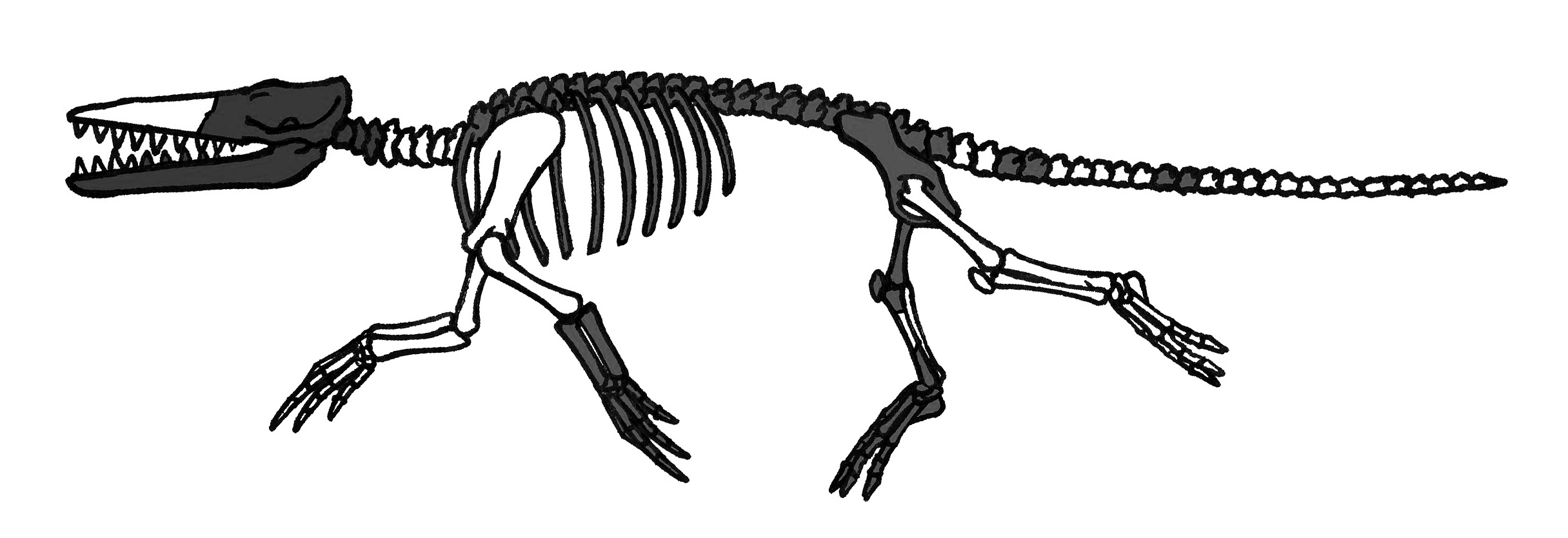
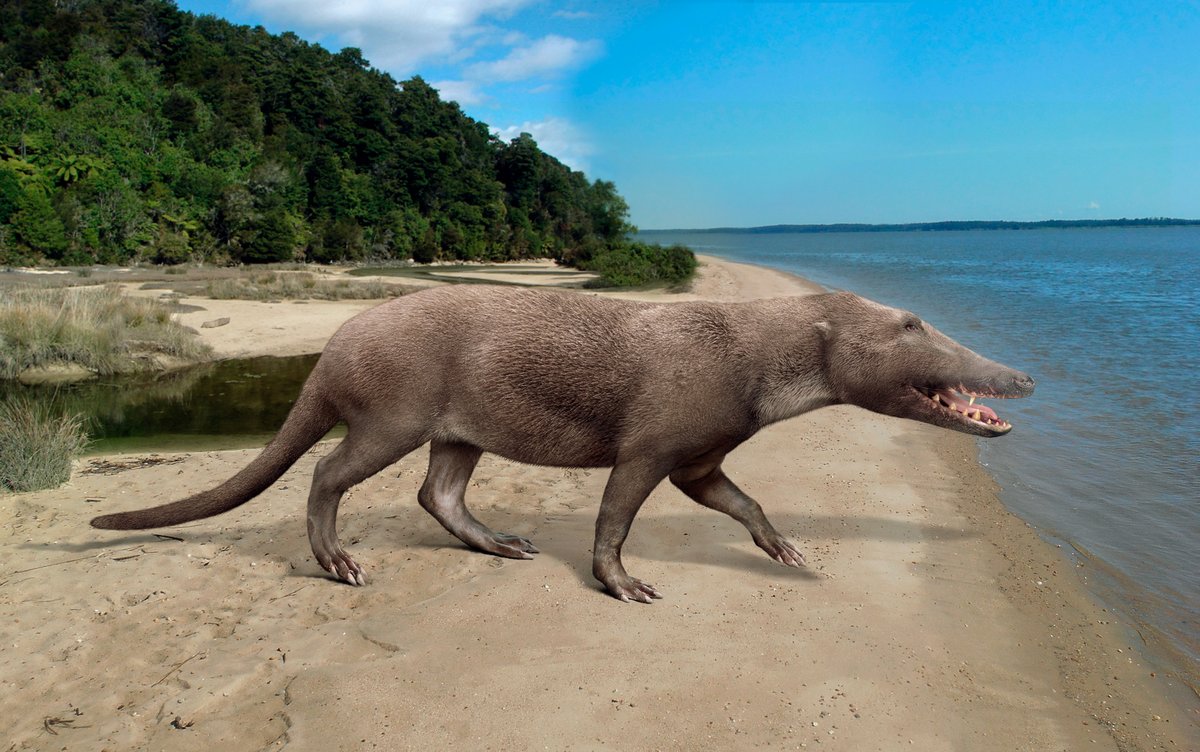
In terms of physical description, Pakicetus looked nothing like the whales of today, instead resembling a strange, long-snouted, quadrupedal mammal roughly the size of a large dog or a modern wolf. Estimates suggest it measured between 100 and 200 centimeters in length and weighed approximately 20 to 45 kilograms. It possessed four fully functional, slender legs ending in hooved toes, a long and muscular tail, and a distinctly elongated skull. The skull of Pakicetus is particularly diagnostic; it featured a narrow snout lined with sharp, differentiated teeth, including incisors for grasping, canines for piercing, and triangular, serrated cheek teeth adapted for shearing flesh. Unlike modern whales, the nostrils of Pakicetus were still located near the tip of the snout rather than having migrated to the top of the head to form a blowhole. However, the most critical anatomical features linking Pakicetus to modern whales are found in its ear region. The auditory bulla, a hollow bony structure enclosing the middle and inner ear, was formed exclusively from the ectotympanic bone and featured a thickened wall known as the involucrum. This highly specific skeletal characteristic is a synapomorphy, or shared derived trait, unique to cetaceans, proving its relationship to modern whales. The postcranial skeleton reveals dense, heavy bones, a condition known as osteosclerosis, which acted as biological ballast to help the animal overcome buoyancy and remain submerged while foraging in shallow waters.
Evaluating the paleobiology of Pakicetus reveals an animal that was primarily a carnivore, occupying a niche similar to that of a modern-day monitor lizard or a small crocodilian. Isotopic analysis of oxygen ratios in the fossilized teeth of Pakicetus indicates that it ingested primarily freshwater, suggesting it lived and hunted in rivers, lakes, and estuaries rather than the open ocean. Its diet likely consisted of small fish, aquatic invertebrates, amphibians, and perhaps small terrestrial animals that ventured too close to the water's edge. The hunting strategies of Pakicetus probably involved wading or ambushing prey in shallow waters, using its sharp teeth to snatch slippery aquatic organisms. Locomotion in Pakicetus was a hybrid affair; on land, it was fully capable of walking and running, though perhaps not with the grace or speed of specialized cursorial predators. In the water, it likely swam using a combination of dog-paddling with its limbs and undulations of its flexible spine and tail. The structure of its inner ear suggests that while it had begun to adapt to underwater hearing, primarily through bone conduction, it lacked the specialized fat pads and isolated ear bones that allow modern whales to hear directionally underwater. Therefore, its sensory perception was still largely adapted for a terrestrial or surface-dwelling existence, relying heavily on sight and smell in the air.
During the Early Eocene, the ecological context of Pakicetus was defined by a dramatically different global climate and geography. The Earth was experiencing the Eocene Climatic Optimum, a period of intense global warming with little to no polar ice, resulting in high sea levels and expansive tropical and subtropical environments. The Indian subcontinent was in the process of colliding with the Eurasian plate, a monumental tectonic event that was slowly closing the ancient Tethys Sea. The region that is now the arid, mountainous terrain of northern Pakistan was then a lush, coastal environment characterized by sprawling river deltas, shallow coastal lagoons, and dense, swampy forests. Pakicetus shared this vibrant ecosystem with a diverse array of fauna. The waters teemed with early bony fishes, sharks, and ancient crocodilians, which may have been both competitors and predators to the early whales. On land, the environment was populated by early perissodactyls, primitive primates, and creodonts, an extinct group of carnivorous mammals. In this food web, Pakicetus occupied a mesopredator role, exploiting the abundant resources of the freshwater-marine interface. This ecotone provided a relatively safe haven from larger terrestrial predators while offering a rich, untapped food source that drove the continued adaptation of the cetacean lineage toward a fully aquatic lifestyle.
The discovery history of Pakicetus is a fascinating chapter in modern paleontology, primarily driven by the pioneering work of American paleontologist Philip D. Gingerich and his Pakistani colleagues. The first fossils of Pakicetus were discovered in 1981 in the Kuldana Formation of the Kala Chitta Range in the Punjab province of Pakistan. Gingerich and his team unearthed a partial skull, which included the crucial ear bones that definitively linked the specimen to cetaceans. In 1983, Gingerich formally named the type species Pakicetus inachus, the genus name translating to 'Pakistan whale,' while the specific epithet honors Inachus, a river god from Greek mythology, reflecting the animal's freshwater habitat. For nearly two decades, Pakicetus was known almost exclusively from cranial material, leading to much speculation about its body shape and mode of locomotion. This changed dramatically in 2001 when paleontologist J.G.M. 'Hans' Thewissen, a former student of Gingerich, published the discovery of several partial postcranial skeletons of Pakicetus and closely related genera from the same region. These remarkable finds finally revealed the animal's wolf-like body, complete with functional legs and hooved toes, confirming the long-held hypothesis that the earliest whales were terrestrial quadrupeds and providing the missing pieces to one of evolution's most profound puzzles.
The evolutionary significance of Pakicetus is monumental, as it firmly anchors the base of the cetacean family tree and provides irrefutable evidence for the terrestrial origins of whales. Before the discovery of Pakicetus and its relatives, the fossil record of early whales was sparse, and the transition from land to water was poorly understood, often cited by critics of evolution as a missing link. Pakicetus fills this gap perfectly, demonstrating a mosaic of primitive terrestrial traits and derived aquatic adaptations. Furthermore, the discovery of the postcranial skeleton, particularly the ankle bones, resolved a long-standing debate regarding the closest living relatives of whales. The ankle of Pakicetus features a double-pulley astragalus, a highly specialized bone structure previously thought to be unique to artiodactyls (even-toed ungulates like hippos, deer, pigs, and cows). This anatomical smoking gun, later corroborated by extensive molecular and genetic studies, proved that cetaceans are deeply nested within the artiodactyl clade, leading to the creation of the new taxonomic group Cetartiodactyla. Pakicetus thus stands as a testament to the power of the fossil record to trace macroevolutionary changes, showing how a lineage of hooved land mammals gradually transformed over millions of years into the highly specialized, obligate aquatic leviathans that navigate our oceans today.
Despite its well-established position in the evolutionary tree, Pakicetus has been the subject of several scientific debates and ongoing research. Early interpretations, based solely on skull material, sometimes envisioned Pakicetus as a more aquatic animal, perhaps resembling a seal or a walrus. The discovery of its postcranial skeleton shifted this paradigm, leading to debates about exactly how much time it spent in the water versus on land. While the dense bones suggest a wading or bottom-walking lifestyle, the limb proportions indicate it was still highly capable on land. Another area of active research involves the evolution of cetacean hearing. While the involucrum is present, the exact mechanics of how Pakicetus heard underwater—whether it relied on bone conduction through the jaw like modern toothed whales, or if it still utilized a more primitive tympanic membrane—remains a topic of detailed biomechanical modeling and morphological study. Additionally, the exact phylogenetic relationships among the various species within the family Pakicetidae (such as Nalacetus and Ichthyolestes) and their precise sequence of divergence continue to be refined as new fossil material is prepared and analyzed.
The fossil record of Pakicetus is geographically restricted but scientifically invaluable. All known specimens of Pakicetus have been recovered from the Early Eocene deposits of the Kuldana Formation in northern Pakistan, and closely related equivalent beds in northwestern India. The preservation quality of these fossils is generally good, though they are often found disarticulated. The fossil sites typically represent ancient river channels and floodplains, meaning the bones were often transported by water currents before burial, which explains the rarity of complete, articulated skeletons. The most commonly preserved parts are the dense, robust elements such as the skull, teeth, and the heavily ossified ear bones, which are highly resistant to taphonomic degradation. The postcranial elements, while rarer, have been found in sufficient quantities to reconstruct the animal's overall morphology accurately. These fossil sites in the Indo-Pakistan region have become world-famous among paleontologists, serving as the primary window into the earliest stages of cetacean evolution and continuing to yield important discoveries that flesh out the diverse community of early amphibious mammals.
In terms of cultural impact, Pakicetus has achieved significant recognition outside the academic sphere, becoming a flagship organism for science communication and evolutionary biology. It frequently appears in popular science books, documentaries, and educational programs detailing the history of life on Earth, often highlighted as a prime example of a transitional fossil. Museums around the world, such as the American Museum of Natural History and the Smithsonian National Museum of Natural History, feature life reconstructions and skeletal casts of Pakicetus in their paleontology halls to illustrate the dramatic narrative of whale evolution. Furthermore, Pakicetus has played a crucial role in public debates regarding evolution, providing a tangible, easily understood example of macroevolutionary change that effectively counters creationist arguments regarding the supposed lack of transitional forms in the fossil record. Its bizarre, chimera-like appearance—a 'whale' with four legs and a snout—captures the public imagination, making it a powerful educational tool for illustrating the dynamic and constantly changing nature of life on our planet.
Classification
Time Period
Discovery
Location
Pakistan
Formation
Kuldana Formation
Frequently Asked Questions
What is Pakicetus?
Pakicetus inachus is an extinct genus of amphibious cetacean that lived during the Early Eocene epoch, approximately 53 to 46 million years ago, in what is now modern-day Pakistan. Recognized widely as one of the earliest known and most basal whales, Pakicetus represents a crucial transitional form ...
When did Pakicetus live?
Pakicetus lived during the paleogene period of the cenozoic era approximately 53-46 million years ago.
Where was Pakicetus discovered?
Fossils of Pakicetus were discovered in Pakistan in the Kuldana Formation.
What did Pakicetus eat?
Pakicetus was a carnivore. It lived in semi-aquatic habitats.
What type of fossil is Pakicetus?
Pakicetus is preserved as a body fossil. The preservation quality is good.
Related Specimens
From the cenozoic era · body fossils