Clymenia
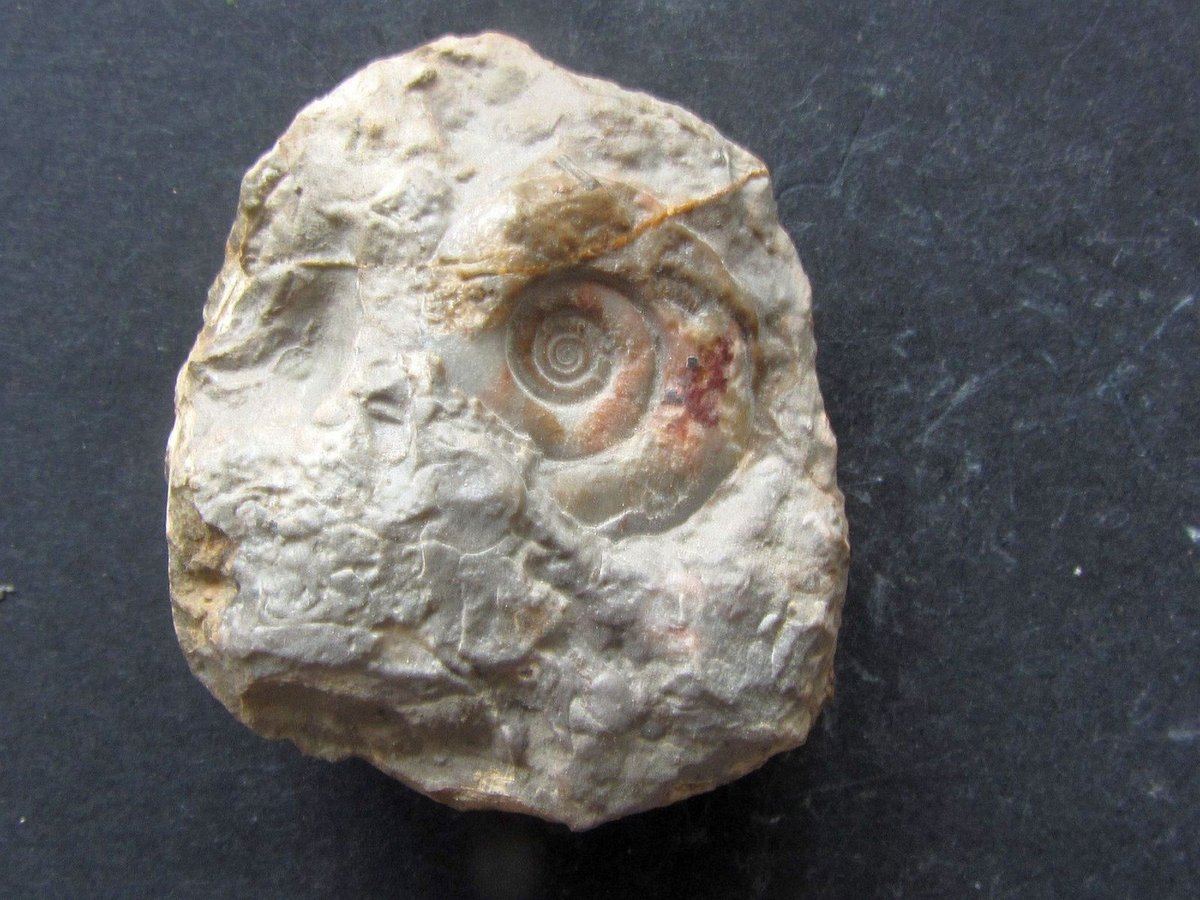
Clymenia laevigata
Image: Image sourced via web search (Fair use / Educational)
About Clymenia
Clymenia is a genus of extinct ammonoid cephalopods that thrived in the marine ecosystems of the Late Devonian Period, approximately 375 to 359 million years ago. As a key member of the order Clymeniida, these creatures are distinguished by a unique anatomical feature: a dorsally located siphuncle, which sets them apart from nearly all other ammonoids. Their widespread and well-preserved fossils serve as crucial index fossils, enabling geologists to precisely date Late Devonian rock strata and correlate geological formations across the globe, making them invaluable tools for understanding one of Earth's most significant mass extinction events.
Clymenia possessed a coiled, planispiral shell, meaning it coiled in a single flat plane, much like a modern nautilus or the more familiar ammonites of the Mesozoic Era. The shell of a typical Clymenia species, such as Clymenia laevigata, was generally small to medium-sized, with diameters commonly ranging from 5 to 15 centimeters, roughly the size of a human palm. The shell was divided into a series of internal chambers, or camerae, by walls known as septa. The animal itself lived in the final, largest chamber, the body chamber. As the animal grew, it would move forward and secrete a new septum behind it, creating a new chamber. The most distinctive feature of Clymenia and its relatives in the order Clymeniida was the position of the siphuncle. This thin tube of living tissue, which regulated gas and fluid levels within the chambers for buoyancy control, ran along the dorsal (top or back) margin of the shell. This is a stark contrast to the vast majority of other ammonoids, where the siphuncle is located ventrally (along the bottom or outer edge). The shell surface, or ornamentation, varied between species but was often relatively smooth (laevigate) or featured fine growth lines, lacking the pronounced ribs or tubercles seen in many other ammonoid groups. The suture lines—the complex, folded patterns where the septa meet the inner shell wall—were also simpler than those of later ammonites, typically exhibiting a goniatitic pattern with smooth, rounded saddles and angular lobes. This simpler suture structure suggests their shells were not built to withstand the same extreme pressures as later, more derived ammonoids that inhabited deeper waters.
As active marine predators, Clymenia likely occupied a niche similar to modern squid or nautiluses. They were nektonic, meaning they were active swimmers rather than bottom-dwellers. Their buoyancy was finely controlled by the siphuncle, allowing them to move vertically through the water column with minimal energy expenditure. Propulsion was achieved through jet propulsion, a method common to most cephalopods, by forcefully expelling water from a muscular funnel (the hyponome) located in the mantle cavity. This would have allowed for rapid bursts of speed to capture prey or evade predators. Their diet likely consisted of small fish, crustaceans, trilobites, and other invertebrates that shared their pelagic or semi-pelagic habitat. They would have used tentacles, extending from the shell's aperture, to grasp their prey. While no soft tissue is preserved, inferences from their modern relatives suggest they possessed well-developed eyes for spotting movement and a sharp, beak-like mouth for tearing apart their food. Their relatively simple suture lines might indicate they were not deep-sea hunters but preferred the middle to upper levels of the water column in epicontinental seas. Growth patterns, visible as lines on the shell, indicate a life cycle that may have spanned several years, with periods of faster and slower growth possibly tied to seasonal changes in food availability and water temperature.
Clymenia lived during the Famennian age of the Late Devonian, a time of significant global change leading up to the Hangenberg event, the final pulse of the Late Devonian mass extinction. The world's geography was dominated by the supercontinents of Gondwana to the south and Euramerica to the north, separated by various oceans and shallow inland seas. Clymenia inhabited these warm, shallow epicontinental seas that covered large parts of modern-day Europe, North Africa, Asia, and North America. The climate was generally warm, but this period saw increasing environmental instability, including episodes of anoxia (low oxygen) in the oceans, known as the Kellwasser events, which preceded the main extinction pulse. The marine ecosystem was incredibly diverse. Clymenia shared the seas with a vast array of other life forms, including the last of the heavily armored placoderm fish like Dunkleosteus, early sharks such as Cladoselache, various trilobites of the order Phacopida, brachiopods, crinoids, and extensive coral-stromatoporoid reefs. As mid-level carnivores, Clymenia would have been part of a complex food web, preying on smaller organisms while themselves being hunted by the larger predatory fish and possibly other, larger cephalopods. Their abundance and subsequent near-total extinction make them a powerful indicator of the environmental collapse that characterized the end of the Devonian.
The genus Clymenia was first described by the German paleontologist Georg zu Münster in 1832. His work was part of the burgeoning field of paleontology in the early 19th century, a period of intense fossil collection and classification across Europe. The type species, Clymenia laevigata, was established based on fossils found in the rich Devonian limestone deposits of the Fichtel Mountains in Bavaria, Germany. These regions, along with the Rhenish Massif, became classic localities for studying Late Devonian marine life. The name 'Clymenia' is derived from Greek mythology, likely referencing Clymene, an Oceanid nymph. Münster's initial descriptions focused on the shell morphology and the distinct suture patterns, which were crucial for differentiating these new forms from other known cephalopods like Goniatites. Over the following decades, paleontologists such as Guido Sandberger and Ferdinand Frech further refined the classification and biostratigraphic use of Clymenia and other clymeniids. No single 'famous' individual specimen of Clymenia exists in the way that 'Sue' the T. rex does; rather, the importance of the genus lies in the collective abundance of its fossils, which have been collected and studied from hundreds of sites worldwide, forming a foundational dataset for Devonian stratigraphy.
Clymenia's evolutionary significance is profound, primarily due to its unique anatomy and its role as a biostratigraphic marker. The dorsal position of the siphuncle in the order Clymeniida represents a fascinating and ultimately short-lived evolutionary experiment within the Ammonoidea. This trait is a synapomorphy, a shared derived characteristic that defines the entire group. The evolutionary origin of the clymeniids is still debated, but they are thought to have evolved from an earlier group of goniatitic ammonoids during the Frasnian-Famennian transition. Their rapid diversification and subsequent extinction within the Famennian stage—a period of only about 16 million years—is a classic example of an evolutionary radiation and bust. They did not leave any direct descendants, as the entire order Clymeniida perished in the Hangenberg extinction event at the Devonian-Carboniferous boundary. Their demise, along with that of the placoderms and many trilobites, paved the way for new groups of animals, including different lineages of ammonoids, to rise to prominence in the subsequent Carboniferous Period. Studying Clymenia provides critical insights into the patterns of morphological innovation, ecological specialization, and vulnerability to extinction that shaped the history of life.
While the basic biology and classification of Clymenia are well-established, several scientific debates persist. The primary controversy revolves around the functional morphology of the dorsal siphuncle. Why did this group evolve a siphuncle in a position so different from all other ammonoids? Some paleontologists propose it may have offered a unique advantage in buoyancy control or stability, perhaps allowing for a different swimming posture or maneuverability. Others suggest it was a neutral trait, a result of developmental happenstance that became fixed in the lineage without conferring a major advantage or disadvantage. Another area of active research is the precise phylogenetic relationship of the Clymeniida to other ammonoid groups. While they are firmly placed within the Ammonoidea, their exact sister group among the goniatites is a subject of ongoing analysis, with different studies proposing different ancestral lineages based on subtle variations in early shell morphology and suture patterns. Furthermore, the exact environmental triggers for their rapid evolution and equally rapid extinction are continuously refined as our understanding of Late Devonian ocean chemistry and climate dynamics improves through geochemical analysis of the rocks in which their fossils are found.
The fossil record of Clymenia is excellent and geographically widespread, a key reason for its utility as an index fossil. Fossils are particularly abundant in Upper Devonian (specifically Famennian) marine sedimentary rocks across the globe. Classic and prolific localities are found in Germany (Rhenish Massif, Harz Mountains), Poland (Holy Cross Mountains), the Czech Republic, Morocco (Anti-Atlas mountains), and parts of Russia (Ural Mountains) and China. In these locations, the fossils are typically preserved as internal molds (steinkerns) or complete shells within limestone nodules or shale layers. The quality of preservation is often good, clearly showing the external shape, suture lines, and sometimes even the siphuncle's position. Because of their hard, easily fossilized aragonitic shells, they are one of the most common macrofossils in the strata they occupy. The sheer number of collected specimens, housed in museum collections worldwide, has allowed for detailed statistical studies of their morphology, evolution, and distribution, making them one of the best-understood groups of Paleozoic cephalopods.
Despite being an invertebrate that lived over 350 million years ago, Clymenia holds a significant place in the scientific and educational spheres, though it lacks the widespread public recognition of dinosaurs or mammoths. For geologists and paleontologists, the name is synonymous with the Late Devonian and is a cornerstone of biostratigraphy. Museum collections around the world, especially those with strong Paleozoic invertebrate holdings like the Senckenberg Museum in Frankfurt or the Museum für Naturkunde in Berlin, feature excellent displays of Clymenia fossils. They are often used in university-level geology and paleontology courses as a prime example of an index fossil, evolutionary radiation, and the impact of mass extinction events. While it has not permeated popular culture in the form of movies or toys, its beautifully coiled and often well-preserved shells are prized by fossil collectors, serving as accessible and tangible links to the ancient oceans of the Devonian world.
Classification
Time Period
Discovery
Location
Germany
Formation
Various Upper Devonian marine shales and limestones (e.g., Kellwasser horizons, Hangenberg Shale)
Frequently Asked Questions
What is Clymenia?
Clymenia is a genus of extinct ammonoid cephalopods that thrived in the marine ecosystems of the Late Devonian Period, approximately 375 to 359 million years ago. As a key member of the order Clymeniida, these creatures are distinguished by a unique anatomical feature: a dorsally located siphuncle, ...
When did Clymenia live?
Clymenia lived during the devonian period of the paleozoic era approximately 375-359 million years ago.
Where was Clymenia discovered?
Fossils of Clymenia were discovered in Germany in the Various Upper Devonian marine shales and limestones (e.g., Kellwasser horizons, Hangenberg Shale).
What did Clymenia eat?
Clymenia was a carnivore. It lived in marine habitats.
What type of fossil is Clymenia?
Clymenia is preserved as a body fossil. The preservation quality is good.
Related Specimens
From the paleozoic era · body fossils