Megalodon
Otodus megalodon
Image: Category:Otodus megalodon fossils - Wikimedia Commons (CC BY-SA)
About Megalodon
Otodus megalodon, whose name translates to 'big tooth,' was an extinct species of giant mackerel shark that dominated the world's oceans from approximately 23 to 3.6 million years ago, a vast timespan covering the Early Miocene to the Pliocene epochs. As one of the largest and most formidable predators in the history of life on Earth, its immense size and power have made it a subject of intense scientific study and public fascination. The paleontological importance of Megalodon is profound, as its fossil remains offer a unique window into the dynamics of prehistoric marine ecosystems, the evolutionary pressures driving gigantism, and the intricate predator-prey relationships that shaped the Cenozoic seas.
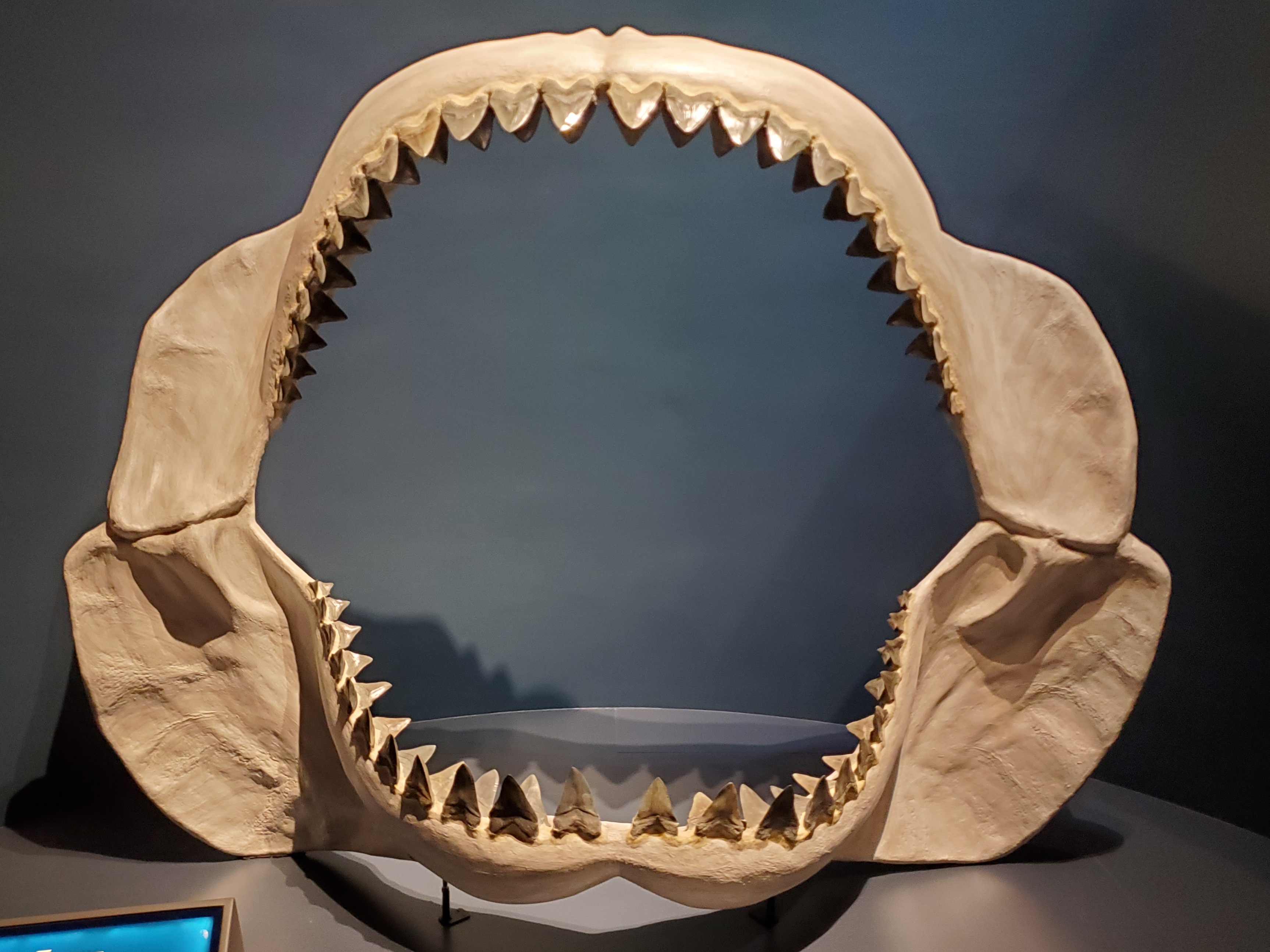
The physical appearance of Otodus megalodon, while not known from a complete skeleton, has been meticulously reconstructed based on its abundant fossil teeth and rare vertebral centra. It was a shark of truly colossal proportions, with conservative scientific estimates placing its maximum length at approximately 18 meters (59 feet), and some studies suggesting it could have reached up to 20 meters (66 feet). Its body mass would have been equally staggering, with estimates for a 16-meter individual exceeding 61 metric tons. In comparison, the largest recorded great white shark (Carcharodon carcharias) measures around 6 meters. Megalodon's body was likely more robust and stockier than that of a great white, with a broader, more dome-shaped head and a shorter snout. Its fins would have been proportionally larger and thicker to propel and stabilize its massive frame. The most iconic features are its teeth: thick, triangular, and finely serrated, designed for shearing through the flesh and bone of large prey. These teeth could reach a slant height of over 18 centimeters (7 inches), the largest of any known shark species. Its jaws, estimated to be up to 2.7 by 3.4 meters wide, were lined with approximately 276 of these formidable teeth arranged in five rows, ensuring a continuous supply of sharp cutting implements.
The paleobiology of Megalodon reveals an animal perfectly adapted to its role as an apex predator. Its primary diet consisted of large marine vertebrates, particularly cetaceans. Fossil evidence, including whale bones bearing deep, serrated bite marks that match Megalodon's dentition, confirms that it preyed upon a wide range of marine mammals, from smaller dolphins and seals to medium-sized baleen whales like Cetotherium and even larger sperm whales. Its hunting strategies were likely varied and brutal. For larger prey, it may have employed a crippling attack, ramming the whale and using its powerful jaws to bite off fins or flukes to immobilize it before delivering a fatal blow to the thoracic region. The estimated bite force of Megalodon is among the highest calculated for any animal, reaching between 110,000 and 182,000 newtons, easily capable of crushing a small car and more than sufficient to puncture the rib cage of a whale. As a warm-blooded (regionally endothermic) shark, similar to modern great whites, Megalodon could maintain a higher body temperature than the surrounding water. This metabolic advantage would have fueled its active, predatory lifestyle, allowing for powerful bursts of speed during hunts and enabling it to tolerate a wider range of water temperatures, from tropical to temperate seas.
Megalodon thrived during the Neogene period, a time of significant climatic and geographic change. During the Miocene epoch, the climate was generally warmer than today, with higher sea levels creating vast, shallow continental shelf seas that served as ideal hunting grounds and cetacean calving areas. These warm, productive waters supported a rich and diverse marine megafauna. Megalodon shared its environment with a host of other large marine animals, including other sharks, giant sea turtles like Stupendemys, and a burgeoning diversity of marine mammals. It occupied the undisputed top of the food web, exerting immense top-down pressure on marine mammal populations. This ecological role likely spurred an evolutionary arms race, with cetaceans evolving larger body sizes and potentially more complex social behaviors as defensive measures against this super-predator. The extinction of Megalodon at the end of the Pliocene marked a major ecological shift, removing the ocean's primary mega-predator and potentially allowing large whales, such as the ancestors of modern blue and fin whales, to evolve to even greater sizes without the constant threat of predation.
The discovery and scientific understanding of Megalodon have a long history. Its enormous fossil teeth have been known for centuries, often mistaken for petrified tongues of dragons or giant serpents, and were referred to as 'glossopetrae' or 'tongue stones.' The true nature of these objects was first correctly identified in 1667 by Danish naturalist Nicolaus Steno, who recognized their striking similarity to the teeth of a modern great white shark. However, the species was not formally described and named until 1843 by the Swiss-American naturalist Louis Agassiz in his monumental work, "Recherches sur les Poissons Fossiles." Agassiz coined the name Carcharodon megalodon, placing it in the same genus as the great white shark based on the superficial similarity of their teeth. This classification would persist for over a century. Key specimens primarily consist of isolated teeth, which are found in marine deposits worldwide, but rare and scientifically invaluable associated vertebral columns have been discovered, such as a partial specimen from Belgium in the 1920s and another from the Gatun Formation in Panama, which have been crucial for constraining size and body form estimates.
The evolutionary placement of Megalodon has been a subject of significant scientific debate, but a consensus has emerged that places it firmly within the extinct family Otodontidae, a lineage of megatoothed sharks that diverged from the lineage leading to the modern great white. This conclusion is supported by detailed analysis of tooth morphology, which reveals a clear evolutionary progression within the Otodus genus, from earlier species like Otodus obliquus to the final, gigantic Otodus megalodon. This lineage is characterized by the gradual development of serrations and the loss of small side cusplets on the teeth over millions of years. This places Megalodon as the terminal member of a 60-million-year-long dynasty of giant sharks, rather than a direct ancestor or close relative of the great white. Its gigantism represents the pinnacle of this evolutionary trend, a specialization for preying on the increasingly large marine mammals of the Neogene. The divergence between the Otodontidae and the Lamnidae (the family of the great white) is now thought to have occurred much earlier, during the Cretaceous period.
Despite growing consensus, several scientific debates surrounding Megalodon persist. The precise taxonomic classification remains a point of contention for some researchers. While most paleontologists now use Otodus megalodon to reflect its place in the otodontid lineage, some still prefer the historical name Carcharodon megalodon, arguing for a closer relationship with the great white, or use the transitional genus Carcharocles. Furthermore, the exact drivers of its extinction are complex and debated. The leading hypothesis points to a combination of factors, including global cooling during the Pliocene, which led to a drop in sea levels, the loss of shallow coastal habitats, and a shift in the distribution of its primary prey. As polar ice caps expanded, large baleen whales may have migrated to colder, more productive polar waters where the warm-blooded Megalodon could not follow, leading to a collapse of its food source. Competition with newly evolving marine predators, such as large raptorial sperm whales like Livyatan and the ancestors of the modern orca (Orcinus orca), may have also contributed to its decline.
The fossil record of Otodus megalodon is geographically extensive, reflecting its status as a cosmopolitan species that inhabited oceans across the globe. Its fossilized teeth are the most common remains and have been unearthed from marine deposits on every continent except Antarctica. These teeth are found in a variety of formations, from the Calvert Cliffs of Maryland, USA, and the phosphate mines of Florida, to the Bone Valley Formation, the Pisco Formation in Peru, and coastal deposits in Australia, Japan, and Europe. The abundance of teeth is due to sharks continuously shedding and replacing them throughout their lives. In contrast, skeletal remains are exceedingly rare because a shark's skeleton is made of cartilage, which does not readily fossilize. The few known associated vertebral columns are therefore of immense scientific value. Famous fossil sites, such as the Sharktooth Hill Bonebed in California, have yielded thousands of teeth, providing crucial data on the species' population structure, geographic range, and temporal distribution, painting a picture of a highly successful and widespread predator over a period of nearly 20 million years.
Beyond its scientific importance, Megalodon has made a significant cultural impact, capturing the public imagination like few other prehistoric animals. Its depiction as the ultimate marine predator has made it a star attraction in museums worldwide, where life-sized jaw reconstructions and massive fossil teeth inspire awe and curiosity. It is a staple of paleontological documentaries and popular science literature, serving as a powerful educational tool to teach concepts of deep time, extinction, and the evolution of marine ecosystems. In recent years, Megalodon has also become a prominent figure in popular culture, most notably as the antagonist in novels and blockbuster films, which, while often exaggerating its size and capabilities, have cemented its status as a prehistoric icon recognized globally.
Classification
Time Period
Discovery
Location
Global distribution (first formally described from European deposits)
Frequently Asked Questions
What is Megalodon?
Otodus megalodon, whose name translates to 'big tooth,' was an extinct species of giant mackerel shark that dominated the world's oceans from approximately 23 to 3.6 million years ago, a vast timespan covering the Early Miocene to the Pliocene epochs. As one of the largest and most formidable predat...
When did Megalodon live?
Megalodon lived during the neogene period of the cenozoic era approximately 23-3.6 million years ago.
Where was Megalodon discovered?
Fossils of Megalodon were discovered in Global distribution (first formally described from European deposits).
What did Megalodon eat?
Megalodon was a carnivore. It lived in marine habitats.
What type of fossil is Megalodon?
Megalodon is preserved as a body fossil. The preservation quality is good.
Related Specimens
From the cenozoic era · body fossils