Coccosteus
Coccosteus cuspidatus
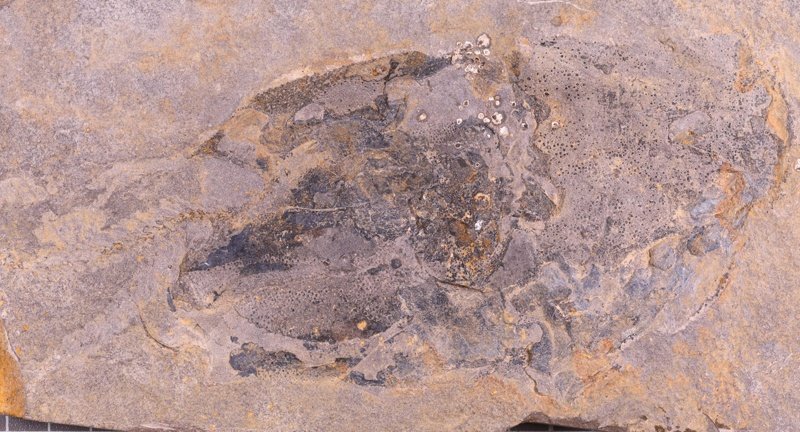
Image: Image sourced via web search (Fair use / Educational)
About Coccosteus
Coccosteus cuspidatus was a small but formidable armored fish that thrived in the aquatic ecosystems of the Middle to Late Devonian Period, approximately 390 to 375 million years ago. As a member of the extinct class Placodermi, it represents a pivotal stage in vertebrate evolution, showcasing the diversification of jawed fishes that would come to dominate the world's oceans, lakes, and rivers. Its exceptionally well-preserved fossils, primarily from the Old Red Sandstone of Scotland, have made it a model organism for understanding the anatomy, biology, and ecological role of early jawed vertebrates, providing invaluable insights into the so-called 'Age of Fishes'.
In terms of physical description, Coccosteus was a relatively small placoderm, especially when compared to its gigantic contemporary, Dunkleosteus. A typical adult Coccosteus cuspidatus measured between 20 and 40 centimeters in length, roughly the size of a modern-day trout or small perch. Its most striking feature was its heavy armor, which encased the head and thoracic region in a series of interlocking bony plates, forming a protective shield. This cranial and thoracic armor was articulated by a unique ball-and-socket joint at the neck, allowing the head to be raised independently of the body, a key adaptation for feeding. The skull plates were adorned with a subtle tuberculated ornamentation. The jaws were formidable for its size, armed not with true teeth, but with sharp, self-sharpening bony plates known as gnathal plates, which functioned like a guillotine. Behind the armored headshield, the posterior part of the body and the tail were unarmored and covered in small scales, indicating a need for flexibility in locomotion. It possessed a heterocercal tail, with the vertebral column extending into a larger upper lobe, a feature common in many early fishes. Paired pectoral and pelvic fins provided stability and steering, while a dorsal fin likely prevented rolling.
The paleobiology of Coccosteus reveals an active and successful predator. Its powerful jaws, equipped with sharp gnathal plates, were well-suited for a carnivorous diet. The unique neck joint allowed it to open its mouth wide and rapidly, creating suction to draw in prey. Fossil evidence, including stomach contents, confirms its predatory nature, with remains of smaller fish like the acanthodian Diplacanthus and other invertebrates found within its body cavity. This suggests it was an opportunistic hunter, likely preying on any smaller organism it could overpower. Its streamlined, unarmored posterior body and powerful tail indicate it was a capable swimmer, not merely a bottom-dweller. It likely employed a burst-and-ambush hunting strategy, using its fins for maneuverability to stalk prey in the complex aquatic environments it inhabited, which ranged from freshwater lakes and rivers to brackish estuaries. There is no direct evidence for social behavior, but its abundance in certain fossil beds might suggest that individuals congregated in favorable feeding or breeding areas. Growth patterns, inferred from studying various-sized specimens, show a typical vertebrate growth curve, reaching its adult size relatively quickly.
During the Devonian Period, Coccosteus inhabited a world vastly different from today's. Geographically, its primary habitat was the Old Red Sandstone continent, a landmass formed by the collision of Laurentia, Baltica, and Avalonia. The climate was generally warm and arid, and the ecosystems were dominated by vast river systems, lakes, and shallow coastal seas. Coccosteus was a mid-level predator in these intricate aquatic food webs. It shared its environment with a diverse array of other organisms, including the jawless ostracoderms, spiny acanthodians (which it preyed upon), early lobe-finned fishes (sarcopterygians) like Osteolepis, and early ray-finned fishes (actinopterygians). While it was a predator, it was also potential prey for larger arthrodires and sarcopterygians that patrolled the same waters. Its armor would have provided crucial protection against such threats. The rise of jawed predators like Coccosteus played a significant role in shaping Devonian ecosystems, driving evolutionary arms races that led to more sophisticated defense mechanisms in prey species and the eventual decline of many jawless fish groups.
The discovery history of Coccosteus is deeply intertwined with the foundational period of paleontology in the 19th century. The organism was first described by the renowned Swiss-American naturalist Louis Agassiz in his monumental work 'Recherches sur les Poissons Fossiles' (Research on Fossil Fishes), published between 1833 and 1843. The fossils Agassiz studied were collected from the rich Devonian-aged Old Red Sandstone deposits in Scotland, a region that became a focal point for early geological and paleontological investigation. Scottish geologist and writer Hugh Miller also famously collected and described Coccosteus fossils in his popular books like 'The Old Red Sandstone' (1841), bringing these strange, armored 'asterolepis' (star-scale) creatures to public attention. The name Coccosteus is derived from Greek, meaning 'berry bone', likely referring to the berry-like tubercles ornamenting the bony plates. The species name, cuspidatus, is Latin for 'pointed', referring to the sharp, pointed nature of its jaw plates. No single 'type' specimen has the fame of a 'Sue' or 'Lucy', but the numerous, often complete, specimens from Achanarras Quarry in Caithness, Scotland, are collectively considered the most important for understanding its anatomy.
Coccosteus holds immense evolutionary significance as a classic representative of the placoderms, the first major radiation of jawed vertebrates (gnathostomes). The evolution of jaws was one of the most profound events in vertebrate history, transforming them from bottom-feeding detritivores into active predators, and Coccosteus exemplifies this new, successful body plan. As an arthrodire ('jointed neck'), it showcases the advanced cranial mobility that made this group so successful. The placoderms represent an early, extinct branch of the gnathostome family tree, a sister group to the lineage that would eventually give rise to all modern jawed vertebrates, including sharks, bony fish, and tetrapods. While they left no direct descendants, studying the anatomy of Coccosteus—its jaw structure, fin arrangement, and nervous system (inferred from cranial endocasts)—provides crucial data for understanding the ancestral state of jawed vertebrates and the developmental pathways that led to the features we see in modern fish and, ultimately, ourselves. Its well-preserved fossils offer a clear window into the experimental phase of early vertebrate evolution.
While the general placement of Coccosteus within the placoderms is well-established, some scientific debates continue. For a long time, placoderms were considered a monolithic, primitive group. However, modern phylogenetic analyses, aided by new discoveries and re-examination of classic specimens, have revealed a much more complex picture. The exact relationship between different placoderm orders, and the position of the placoderms relative to chondrichthyans (cartilaginous fish) and osteichthyans (bony fish), is a subject of ongoing research and revision. Some studies have controversially suggested that placoderms might not be a single, monophyletic group but rather a series of successive sister groups to other gnathostomes. Furthermore, interpretations of its lifestyle have evolved; once thought to be a sluggish, heavily armored bottom-dweller, the consensus now favors a more active, nektonic (free-swimming) predator, based on hydrodynamic analysis of its body shape and tail structure. The discovery of soft tissue preservation, such as muscle fibers and pigment cells in other placoderms, holds the promise of refining our understanding of Coccosteus's biology in the future.
The fossil record of Coccosteus is remarkably rich and geographically widespread for a Devonian fish. The most famous and best-preserved specimens come from the Middle Devonian lacustrine (lake) deposits of the Old Red Sandstone, particularly in Scotland (e.g., Achanarras Quarry, Gamrie) and the Orkney Islands. These sites are renowned for producing articulated, three-dimensional fossils of exceptional quality, often preserving the entire body armor and impressions of the unarmored posterior. Fossils attributed to the genus Coccosteus have also been found in Devonian strata across Europe, including Germany and Latvia, as well as in North America. This wide distribution indicates that the genus was highly successful and adaptable, capable of colonizing a variety of freshwater and brackish environments across the Old Red Sandstone continent. The abundance of its fossils has made it a common and essential subject for university-level paleontology courses and a staple in museum collections worldwide.
In terms of cultural impact, Coccosteus is a classic and recognizable figure in depictions of the Devonian period. While it lacks the celebrity status of its giant relative Dunkleosteus, it is frequently featured in paleontological illustrations, textbooks, and museum displays illustrating the 'Age of Fishes'. Its manageable size and excellent preservation make it an ideal display fossil. Notable specimens of Coccosteus are held in major institutions such as the National Museum of Scotland in Edinburgh, the Natural History Museum in London, and other university and museum collections globally. Its role as a key educational tool for explaining the evolution of jaws and the diversity of early vertebrate life ensures its continued importance and modest public profile within the world of paleontology.
Classification
Time Period
Discovery
Location
Scotland, United Kingdom
Formation
Old Red Sandstone
Frequently Asked Questions
What is Coccosteus?
Coccosteus cuspidatus was a small but formidable armored fish that thrived in the aquatic ecosystems of the Middle to Late Devonian Period, approximately 390 to 375 million years ago. As a member of the extinct class Placodermi, it represents a pivotal stage in vertebrate evolution, showcasing the d...
When did Coccosteus live?
Coccosteus lived during the devonian period of the paleozoic era approximately 390-375 million years ago.
Where was Coccosteus discovered?
Fossils of Coccosteus were discovered in Scotland, United Kingdom in the Old Red Sandstone.
What did Coccosteus eat?
Coccosteus was a carnivore. It lived in marine, freshwater, brackish habitats.
What type of fossil is Coccosteus?
Coccosteus is preserved as a body fossil. The preservation quality is excellent.
Related Specimens
From the paleozoic era · body fossils
/7725c8fee486.jpg)