Compsognathus
Compsognathus longipes
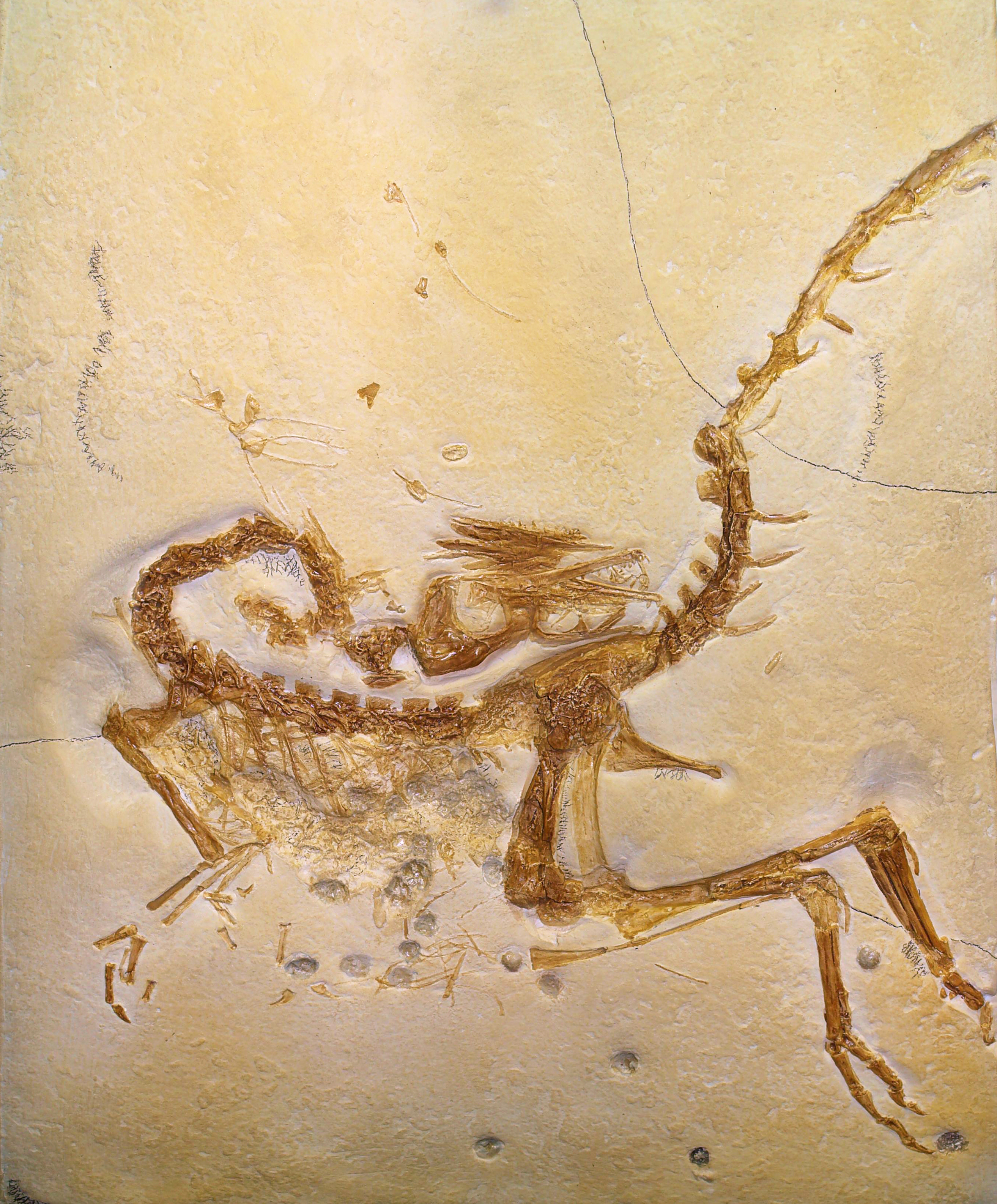
Image: File:Compsognathus longipes 01.JPG - Wikimedia Commons (CC BY-SA)
About Compsognathus
Compsognathus longipes was a small, bipedal theropod dinosaur that inhabited the archipelago of islands in what is now modern-day Europe during the Late Jurassic period, approximately 150 million years ago. As one of the first relatively complete non-avian dinosaur skeletons ever discovered, its small size and delicate features have made it a cornerstone in paleontological studies for over a century and a half. Its close anatomical similarity to the early bird Archaeopteryx, found in the same geological deposits, has historically placed Compsognathus at the center of critical debates regarding the evolutionary origin of birds from dinosaurs.
Compsognathus was a diminutive dinosaur, with adult specimens reaching a length of approximately 1 meter from snout to tail tip, and standing no more than 30 centimeters high at the hip. Its estimated body mass was slight, likely between 2.5 and 3.5 kilograms, comparable in size to a modern-day chicken or a small turkey. The name Compsognathus, meaning 'elegant jaw,' aptly describes its most distinctive feature: a long, narrow, and delicately constructed skull that measured around 7 centimeters in length. This skull housed numerous small, sharp, and slightly recurved teeth, perfectly adapted for grasping and processing small prey. Its body was built for agility, characterized by a lightweight and hollow-boned skeleton typical of theropods. It possessed long, slender hind limbs with three main weight-bearing toes, indicating it was a swift and nimble runner. In contrast, its forelimbs were considerably shorter, though still functional. For many decades, it was believed to have only two clawed digits on each hand, but later analysis of a more complete French specimen revealed the presence of a third, much smaller and likely vestigial, digit. A very long, stiffened tail, comprising more than half of its total body length, acted as a dynamic counterbalance, providing stability during high-speed pursuit of prey.
The paleobiology of Compsognathus is remarkably well-understood thanks to the exceptional preservation of its fossil remains. Direct fossil evidence confirms its carnivorous diet and predatory nature. The German holotype specimen, discovered in the 1850s, contains the articulated skeleton of a small, agile lizard, identified as Bavarisaurus, preserved within its abdominal cavity. This "last meal" provides a definitive snapshot of its feeding habits, indicating it was an active hunter of small vertebrates. The French specimen further supports this, containing unidentified lizard remains. Its sharp, pointed teeth were not suited for heavy shearing or crushing but were ideal for seizing and holding onto struggling prey like lizards, insects, and possibly small mammals that shared its island habitat. Its bipedal stance and long legs suggest a cursorial lifestyle, meaning it was adapted for running. It likely used its speed to chase down fast-moving prey across the semi-arid landscapes of the Jurassic archipelago. There is no direct evidence of social behavior, and it is generally assumed to have been a solitary hunter, given its size and the nature of its prey. Growth studies based on the two known specimens, one juvenile and one adult, suggest a relatively rapid growth rate, reaching near-adult size within a year.
During the Tithonian age of the Late Jurassic, the environment inhabited by Compsognathus was vastly different from present-day Europe. The region was a shallow, tropical sea dotted with a series of low-lying, semi-arid islands, forming an archipelago. The climate was warm and dry, with seasonal monsoons. The flora was dominated by drought-resistant plants like cycads and conifers, rather than lush jungles. Compsognathus occupied a specific ecological niche as a small terrestrial predator within this unique island ecosystem. It shared its habitat with a fascinating array of creatures preserved in the Solnhofen limestone. These included various insects, small pterosaurs like Pterodactylus and Rhamphorhynchus that likely hunted over the nearby lagoons, and the iconic "first bird," Archaeopteryx. In the surrounding waters, marine life was abundant, including ammonites, fish, and marine crocodiles. On its island home, Compsognathus would have been a mid-level predator, preying on the abundant lizards and insects while potentially being prey for larger pterosaurs or small marine reptiles that may have ventured ashore. Its existence highlights the diversity of theropod body plans, demonstrating that not all Jurassic carnivores were giants like Allosaurus.
The discovery of Compsognathus is deeply intertwined with the early history of paleontology. The first and most famous specimen was unearthed in the limestone quarries near Riedenburg, Bavaria, in the late 1850s. It was acquired by the physician and fossil collector Joseph Oberndorfer, who allowed paleontologist Johann A. Wagner to study it. Wagner formally described the fossil in 1859, giving it the name Compsognathus longipes, with the species name meaning 'long foot,' a reference to its elongated metatarsals. Tragically, Wagner passed away before he could publish a full monograph, but his initial description established the genus. This German specimen, now housed at the Bavarian State Collection of Paleontology in Munich, is considered the holotype. For over a century, it remained the only known example of this dinosaur. This changed in 1971 when a second, larger, and more complete specimen was discovered in the Canjuers plateau near Nice, France, from deposits of a similar age and environment. Initially misidentified as a new species, it was later confirmed by paleontologists like John Ostrom to be an adult Compsognathus longipes, providing invaluable new anatomical details, including the presence of the third manual digit and confirming its dietary habits.
Compsognathus holds a pivotal position in the story of dinosaur evolution, particularly in the debate surrounding the origin of birds. Its discovery in the Solnhofen limestone, the same fossil beds that yielded the first Archaeopteryx skeleton in 1861, was a remarkable coincidence. In the late 19th century, Thomas Henry Huxley, a staunch supporter of Charles Darwin's theory of evolution, was the first to champion the link between dinosaurs and birds. He pointed to the striking anatomical similarities between the skeletons of Compsognathus and Archaeopteryx, noting their shared features such as long hind limbs, a stiffened tail, and a generally similar body plan. Compsognathus became his prime example of a dinosaur that closely resembled an ancestral bird, making it a key piece of evidence in one of the most important evolutionary arguments of the era. Later discoveries of feathered dinosaurs from China, such as Sinosauropteryx, which is a close relative within the family Compsognathidae, have further solidified this connection. Compsognathus is now classified as a coelurosaurian theropod, placing it within the direct lineage that ultimately gave rise to modern birds, and its family, the Compsognathidae, represents a successful and widespread group of small-bodied predators of the Mesozoic.
Despite its long history of study, Compsognathus has not been without scientific controversy. One of the most enduring debates centered on its integument, or skin covering. For many years, skin impressions from the tail region of the German specimen were interpreted as showing only scales. This was used as evidence against the idea that small coelurosaurs were feathered. However, the discovery of its close relative, Sinosauropteryx, in the 1990s with a preserved coat of simple, filamentous proto-feathers, reopened the debate. Re-examination of the Compsognathus fossils using advanced imaging techniques has failed to definitively resolve the issue, with some researchers suggesting the "scale" impressions might be artifacts of preservation or represent scales on only a portion of the body. Today, it is widely considered probable, though not yet directly proven, that Compsognathus was covered in some form of primitive, downy feathers for insulation, consistent with its position in the dinosaur family tree. Another minor debate involved the number of digits on its hand, which was settled by the French specimen, confirming three digits instead of the two originally proposed.
The fossil record of Compsognathus longipes is exceptionally rare but of outstanding quality. To date, only two articulated skeletons are known to science, one from Germany and one from France. Both were recovered from lagerstätten, geological formations renowned for their extraordinary fossil preservation. The Solnhofen limestone of Bavaria, where the holotype was found, represents an ancient, anoxic lagoon environment. The fine-grained carbonate mud and lack of oxygen on the lagoon floor prevented scavenging and decay, allowing for the preservation of complete, articulated skeletons, soft tissue impressions, and even the stomach contents of animals that fell or were washed into the water. The French specimen from the Canjuers plateau was found in similar lithographic limestone deposits, indicating a comparable paleoenvironment. This exceptional preservation has provided a level of anatomical detail rarely seen in dinosaur fossils, allowing for confident reconstructions of its skeleton, diet, and lifestyle. The scarcity of specimens, however, means that our understanding of its population dynamics, geographic range, and individual variation remains limited.
Although small in stature, Compsognathus has had a significant cultural impact. As one of the first small dinosaurs discovered, it provided an early and important counterpoint to the popular image of dinosaurs as exclusively giant, lumbering brutes. It demonstrated the diversity and complexity of Mesozoic ecosystems. Skeletons and casts of Compsognathus are displayed in major natural history museums worldwide, including the Bavarian State Collection of Paleontology in Munich and the National Museum of Natural History in Paris. Its most prominent appearance in popular culture was in "The Lost World: Jurassic Park" and subsequent films in the franchise, where it was depicted as a small, agile pack hunter, often nicknamed "compys." While this portrayal took creative liberties with its behavior, it cemented the image of Compsognathus in the public consciousness as one of the most recognizable small carnivorous dinosaurs.
Classification
Time Period
Discovery
Location
Bavaria, Germany
Formation
Solnhofen Limestone
Frequently Asked Questions
What is Compsognathus?
Compsognathus longipes was a small, bipedal theropod dinosaur that inhabited the archipelago of islands in what is now modern-day Europe during the Late Jurassic period, approximately 150 million years ago. As one of the first relatively complete non-avian dinosaur skeletons ever discovered, its sma...
When did Compsognathus live?
Compsognathus lived during the jurassic period of the mesozoic era approximately 150 million years ago.
Where was Compsognathus discovered?
Fossils of Compsognathus were discovered in Bavaria, Germany in the Solnhofen Limestone.
What did Compsognathus eat?
Compsognathus was a carnivore. It lived in terrestrial habitats.
What type of fossil is Compsognathus?
Compsognathus is preserved as a body fossil. The preservation quality is exceptional.
Related Specimens
From the mesozoic era · body fossils