Huayangosaurus
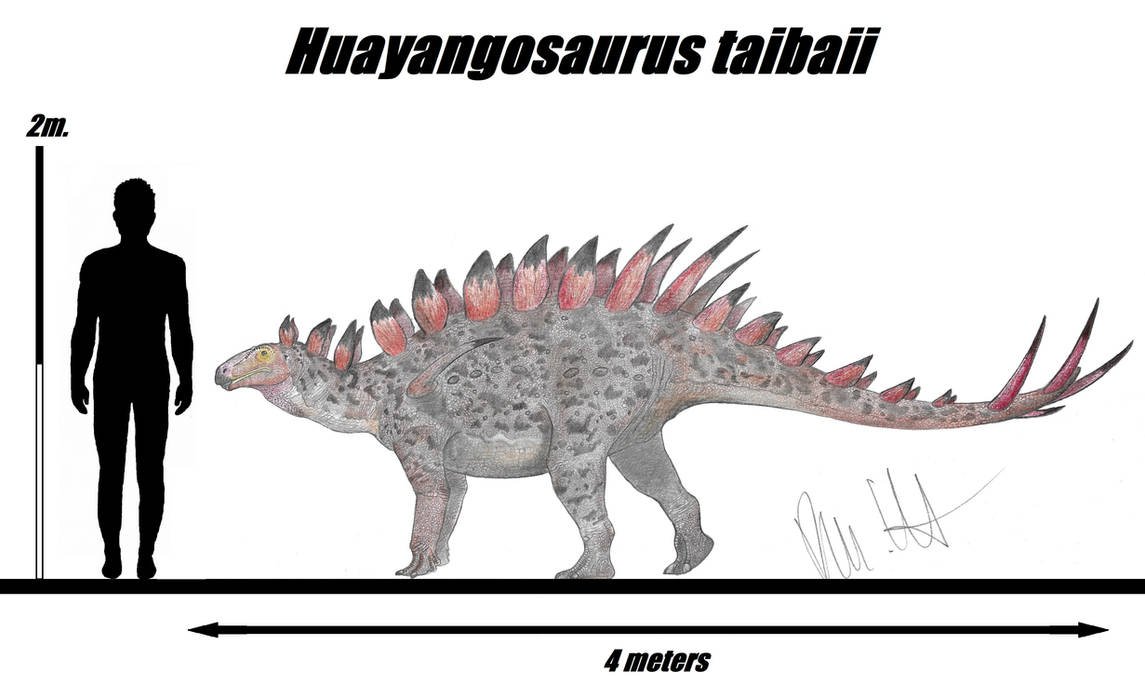
Huayangosaurus taibaii
Image: Image sourced via web search (Fair use / Educational)
About Huayangosaurus
Huayangosaurus taibaii represents one of the earliest and most primitive known stegosaurian dinosaurs, providing invaluable insights into the initial evolution of this iconic armored group. This herbivorous reptile roamed the lush, subtropical landscapes of what is now Sichuan Province, China, during the Middle Jurassic period, approximately 170 to 160 million years ago. Its discovery was pivotal, as it offered a much clearer picture of the ancestral stegosaur body plan, predating its more famous North American relative, Stegosaurus, by several million years and showcasing features that link stegosaurs to other early ornithischian dinosaurs.
Huayangosaurus was a moderately sized dinosaur, considerably smaller than its later, more derived relatives. It reached an estimated body length of about 4 to 4.5 meters (approximately 13 to 15 feet), roughly the size of a modern rhinoceros or a small car. Weight estimates for an adult Huayangosaurus typically range from 500 to 1,000 kilograms (about 1,100 to 2,200 pounds). Its most striking characteristic, shared with all stegosaurs, was the double row of bony plates, or osteoderms, running along its back. However, unlike the large, flat, kite-shaped plates of Stegosaurus, the plates of Huayangosaurus were smaller, thicker, and more spike-like or leaf-shaped, particularly over the neck and shoulders. These plates transitioned into taller, more conventional plate shapes over the hips before giving way to a formidable tail armature. The tail terminated in two pairs of long, sharp spikes, a defensive weapon often referred to as a 'thagomizer'. Another key primitive feature was its skull, which was proportionally shorter, deeper, and wider than that of later stegosaurs. It possessed a small, premaxillary beak at the front of its snout, but uniquely among stegosaurs, it also retained several small teeth in the premaxilla, a trait lost in its descendants. Its forelimbs were relatively long compared to its hindlimbs, resulting in a less dramatically sloped posture than seen in Stegosaurus, suggesting a more level-backed stance. Additionally, a prominent spike-like osteoderm projected outwards from each shoulder, providing further defense against predators.
The paleobiology of Huayangosaurus is inferred from its skeletal anatomy and the paleoenvironment in which it lived. As a herbivore, its diet consisted of low-growing vegetation such as ferns, cycads, and conifers. The short, broad snout and simple, leaf-shaped teeth were not designed for extensive chewing but were effective for cropping and stripping foliage. It likely processed this tough plant matter in a large digestive tract, aided by gastroliths (stomach stones), which have been found in association with some stegosaur fossils. Its locomotion was quadrupedal, with a relatively slow, deliberate gait suited for browsing in dense undergrowth. While not built for speed, its powerful limbs would have provided stability and endurance. The primary function of its dorsal plates remains a subject of study; they may have served multiple purposes, including species recognition, thermoregulation by catching sunlight or shedding heat, or as a form of passive defense, making the animal appear larger and more intimidating to predators. The thagomizer on its tail, however, was almost certainly an active defensive weapon, capable of being swung with considerable force to inflict deep puncture wounds on attacking theropods. Evidence of social behavior is limited, but the discovery of multiple individuals together suggests they may have lived in small groups or herds, which would have offered greater protection against predation. Growth patterns are not well-documented, but like other dinosaurs, it would have hatched from an egg and undergone a period of relatively rapid juvenile growth to reach its adult size.
Huayangosaurus lived in the Dashanpu Quarry region of China, which during the Middle Jurassic was a warm, humid, subtropical floodplain environment crisscrossed by rivers and dotted with lakes. This lush ecosystem supported a rich and diverse dinosaur fauna, making it one of the most important fossil sites in the world for understanding Jurassic life. The flora was dominated by gymnosperms like conifers and cycads, as well as abundant ferns and horsetails, providing ample food for a variety of herbivores. Huayangosaurus shared this environment with numerous other dinosaurs. Its primary predators would have been large theropods such as Gasosaurus and Yangchuanosaurus, formidable carnivores that would have posed a significant threat. To survive, Huayangosaurus relied on its armor and tail spikes for defense. It coexisted with a range of other herbivores, occupying a niche as a low-to-medium-level browser. These included the massive sauropods Shunosaurus and Omeisaurus, which fed on higher vegetation, and smaller ornithopods like Xiaosaurus. This complex food web illustrates a vibrant and competitive ecosystem where different herbivorous dinosaurs specialized in consuming different types of plants at various heights, minimizing direct competition for resources while navigating the constant threat of predation from the apex carnivores of their time.
The discovery of Huayangosaurus is a significant chapter in Chinese paleontology. The first fossils were unearthed in 1979 and 1980 by a team from the Zigong Dinosaur Museum during excavations at the Dashanpu Quarry near Zigong city in Sichuan Province. This remarkable fossil site has yielded an incredible wealth of well-preserved Middle Jurassic dinosaurs. The dinosaur was formally named and described in 1982 by paleontologists Dong Zhiming, Tang Zilu, and Zhou Shiwu. The generic name, 'Huayangosaurus', translates to 'lizard from Huayang', with 'Huayang' being an ancient name for the Sichuan region. The specific name, 'taibaii', honors the great Tang Dynasty poet Li Bai (also known as Li Taibai), who was a native of Sichuan. The holotype specimen, catalogued as IVPP V6728, is a nearly complete skeleton, including a well-preserved skull, which is exceptionally rare for stegosaurs. This specimen, along with several other partial skeletons and isolated bones found at the same site, has provided paleontologists with a comprehensive understanding of its anatomy. The completeness of these initial finds allowed for a detailed and confident reconstruction of the animal shortly after its discovery, and it remains one of the best-known early stegosaurs.
From an evolutionary perspective, Huayangosaurus is of paramount importance. It is classified within its own family, Huayangosauridae, which is considered the most basal, or primitive, group within the Stegosauria infraorder. Its anatomy provides a crucial link between the earliest armored dinosaurs and the more advanced stegosaurids like Stegosaurus and Kentrosaurus. The presence of premaxillary teeth is a key primitive trait, or plesiomorphy, that it shares with other early ornithischians but which was lost in all later stegosaurs. This feature strongly supports its position near the base of the stegosaur family tree. Furthermore, its less specialized skull and more generalized body proportions offer a glimpse into the ancestral condition from which the more derived stegosaurids evolved their highly specialized features, such as elongated skulls, dramatically sloped backs, and larger, more elaborate plates. By studying Huayangosaurus, scientists can trace the evolutionary trajectory of stegosaurian armor, feeding adaptations, and posture, understanding how this unique group of dinosaurs diversified over millions of years. It serves as a textbook example of a transitional fossil, bridging the gap between different branches of the dinosaur evolutionary tree and clarifying the origins of one of the most recognizable dinosaur clades.
While the classification of Huayangosaurus as a basal stegosaur is widely accepted, some scientific debates persist regarding the specific functions of its anatomical features. The primary debate, common to all stegosaurs, concerns the function of the dorsal plates. While defense and species recognition are leading hypotheses, the idea of them acting as thermoregulatory devices remains a point of contention. Some studies suggest the plates were highly vascularized, which could support a role in heat exchange, but others argue their internal structure was not optimized for this function. Another area of discussion involves the exact posture and mobility of the animal. The relatively long forelimbs compared to later stegosaurs suggest a different center of mass and gait, but the precise mechanics of its movement are still being modeled and refined. The discovery of potential skin impressions could one day resolve questions about its external appearance and the full extent of its osteoderms, but such finds remain elusive. As new analytical techniques are applied to existing fossils, our understanding of its biology and behavior continues to evolve, ensuring that Huayangosaurus remains a subject of active scientific inquiry.
The fossil record of Huayangosaurus is geographically concentrated in the Dashanpu Formation of Sichuan, China. This locality has proven to be an exceptionally rich source of its remains. To date, fossils representing at least a dozen individual animals have been recovered, ranging from juveniles to adults. This collection includes several nearly complete skeletons, making Huayangosaurus one of the most completely known of all stegosaurs. The preservation quality is generally good to excellent, with many bones found articulated or in close association, allowing for accurate skeletal reconstructions. The famous Zigong Dinosaur Museum in Sichuan was built directly on top of the Dashanpu Quarry and features a spectacular mounted skeleton of Huayangosaurus as one of its centerpiece exhibits. This concentration of fossils in a single area provides a unique snapshot of a local population, offering data on potential variation within the species, though more widespread discoveries would be needed to understand its full geographic range during the Middle Jurassic.
Despite being less famous globally than Stegosaurus, Huayangosaurus has a significant cultural impact, particularly within China. It is celebrated as one of the country's most important fossil discoveries and is a star attraction at the Zigong Dinosaur Museum, a major center for paleontological tourism and education. Its status as a primitive ancestor to more famous dinosaurs makes it an important educational tool for explaining concepts of evolution and transitional forms to the public. Huayangosaurus has been featured in various dinosaur books, documentaries, and has been produced as a high-quality collectible figure for enthusiasts. Its distinctive, spike-covered appearance makes it a memorable and visually interesting dinosaur that continues to capture the imagination of those fascinated by the prehistoric world.
Classification
Time Period
Discovery
Location
Sichuan Province, China
Formation
Dashanpu Formation (specifically the Lower Shaximiao Formation)
Frequently Asked Questions
What is Huayangosaurus?
Huayangosaurus taibaii represents one of the earliest and most primitive known stegosaurian dinosaurs, providing invaluable insights into the initial evolution of this iconic armored group. This herbivorous reptile roamed the lush, subtropical landscapes of what is now Sichuan Province, China, durin...
When did Huayangosaurus live?
Huayangosaurus lived during the jurassic period of the mesozoic era approximately 170-160 million years ago.
Where was Huayangosaurus discovered?
Fossils of Huayangosaurus were discovered in Sichuan Province, China in the Dashanpu Formation (specifically the Lower Shaximiao Formation).
What did Huayangosaurus eat?
Huayangosaurus was a herbivore. It lived in terrestrial habitats.
What type of fossil is Huayangosaurus?
Huayangosaurus is preserved as a body fossil. The preservation quality is good.
Related Specimens
From the mesozoic era · body fossils