Drotops
Drotops megalomanicus
Image: Image sourced via web search (Fair use / Educational)
About Drotops
Drotops megalomanicus was a large and formidable trilobite, a type of extinct marine arthropod, that thrived in the warm, shallow seas of the Middle Devonian period, approximately 393 to 383 million years ago. Its exquisitely preserved fossils, primarily found in the Anti-Atlas mountains of Morocco, offer a remarkable window into the complex ecosystems of ancient reefs. As a member of the order Phacopida, Drotops represents a pinnacle of trilobite evolution, showcasing advanced visual systems and a robust, spiny exoskeleton that made it a well-defended predator in its environment.
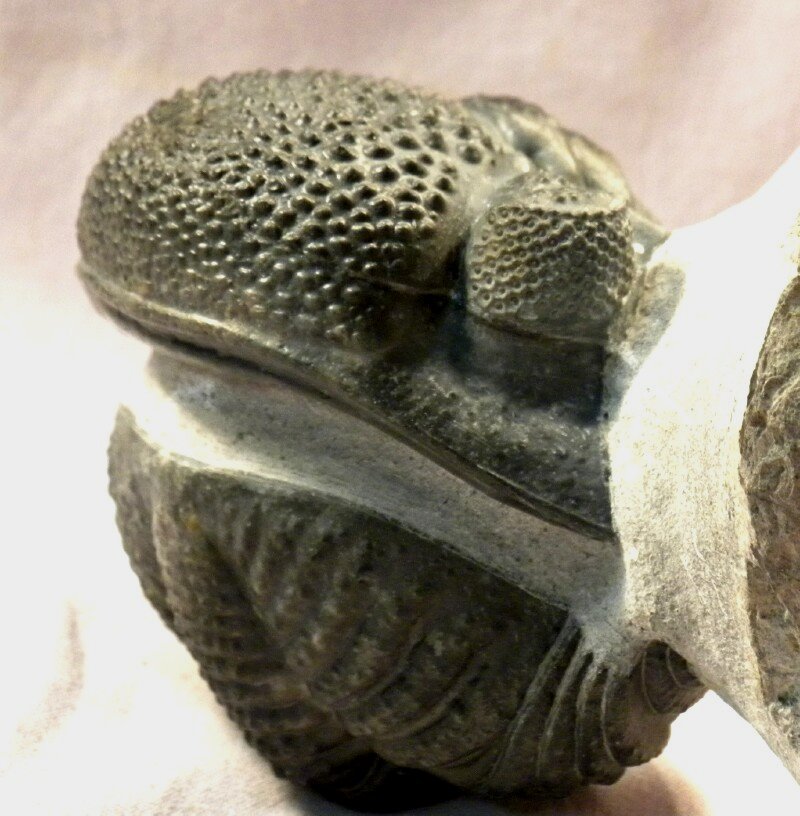
The most striking feature of Drotops megalomanicus was its sheer size and formidable appearance. Reaching lengths of 15 to 20 centimeters (6 to 8 inches), it was among the larger trilobites of its time, dwarfing many of its contemporaries. Its body plan followed the classic trilobite structure, divided longitudinally into three lobes (hence the name "tri-lobite"): a central axial lobe and two flanking pleural lobes. The exoskeleton, or carapace, was composed of calcite and was exceptionally thick and tuberculated, covered in a dense array of bumps, spines, and pustules. This ornamentation provided both structural reinforcement and a significant defensive advantage against predators like the giant armored placoderm fish, such as Dunkleosteus, that shared its waters. The cephalon (head shield) was large and semicircular, dominated by a pair of enormous, crescent-shaped schizochroal eyes. These complex eyes, characteristic of phacopid trilobites, were composed of numerous large, individual calcite lenses, each separated by scleral tissue, providing a wide, high-resolution field of view. The glabella, the raised central part of the cephalon, was heavily inflated and covered in coarse tubercles. The thorax consisted of 11 articulating segments, allowing for flexibility and the ability to enroll into a defensive ball, a behavior known as volvation. The pygidium (tail shield) was smaller than the cephalon and also heavily ornamented. Its overall build was robust and powerful, suggesting an animal well-adapted for a benthic, or seafloor-dwelling, lifestyle.
Drotops megalomanicus was an active and likely predatory arthropod, a conclusion drawn from its advanced sensory organs and robust morphology. Its large, sophisticated schizochroal eyes would have provided excellent stereoscopic vision, crucial for detecting movement and judging distances to both prey and predators in the complex, three-dimensional environment of a Devonian reef. It is believed to have been a benthic hunter, crawling along the seafloor in search of food. Its diet likely consisted of smaller, soft-bodied invertebrates such as worms, mollusks, and other arthropods that it could overpower and consume. The spiny projections on its exoskeleton may have also served a sensory function, helping it navigate and detect chemical cues in the water. Locomotion was achieved through numerous pairs of jointed legs located on the underside of the body, which are almost never preserved in the fossil record. By flexing its thoracic segments, it could maneuver over uneven substrate. The ability to enroll into a tight, spiky ball was its primary defense mechanism. When threatened, it would tuck its soft underside and vulnerable appendages away, presenting a nearly impregnable, armored sphere to would-be attackers. This defensive posture is a classic example of convergent evolution, seen today in animals like armadillos and pill bugs.
The world of Drotops during the Middle Devonian was a vibrant and dangerous place. It inhabited the warm, tropical waters that covered the continental shelf of the supercontinent Gondwana, in a region that would eventually become modern-day North Africa. These seas were dominated by the construction of massive coral and stromatoporoid reefs, creating complex habitats teeming with life. This period is often called the "Age of Fishes," and Drotops shared its ecosystem with a diverse array of marine fauna. Its neighbors included other trilobite species, brachiopods, crinoids, cephalopods like ammonoids and orthocones, and a spectacular radiation of fish. Jawless ostracoderms still scuttled on the seafloor, while acanthodians (spiny sharks) and early cartilaginous fish patrolled the water column. The apex predators were the placoderms, heavily armored fish that came in all shapes and sizes, from small bottom-dwellers to the colossal Dunkleosteus. Drotops likely occupied a mid-level trophic position as a mesopredator. It hunted smaller organisms while simultaneously being prey for larger fish and cephalopods. The intricate and spiny armor of Drotops was a direct evolutionary response to this high-predation environment, a clear example of a co-evolutionary arms race between predator and prey on the Devonian reefs.
The discovery and study of Drotops are intrinsically linked to the rich fossil beds of Morocco. While trilobites have been known from this region for decades, the specific identification and popularization of Drotops are more recent phenomena, driven by a burgeoning commercial fossil trade that began in the late 20th century. The German paleontologist Rudolf Richter first described the genus in the early 1900s, but it was the exceptional quality and abundance of specimens emerging from the Moroccan Anti-Atlas mountains that brought Drotops to global prominence. Key fossil sites are located near the towns of Alnif, Erfoud, and Oufaten. There is no single "holotype" specimen as famous as a dinosaur like 'Sue'; rather, the scientific understanding of Drotops is built upon the study of thousands of high-quality fossils prepared by local Moroccan artisans and studied by paleontologists worldwide. The specific name, *megalomanicus*, was assigned by the German paleontologist Gerhard K.B. Alberti in 1969, a fitting descriptor referring to its large size and seemingly grandiose, heavily ornamented appearance. The meticulous and often artistic preparation of these fossils, which involves carefully removing the surrounding matrix rock with air scribes and micro-sandblasters, has made Drotops a celebrated icon among fossil collectors and museum curators.
Within the grand tree of life, Drotops megalomanicus sits firmly within the phylum Arthropoda, the most diverse animal phylum, which also includes modern insects, crustaceans, and arachnids. As a trilobite, it belongs to an entirely extinct class of arthropods that were among the most successful and long-lived animal groups in Earth's history, flourishing for over 270 million years before vanishing in the Permian-Triassic mass extinction. Drotops is a member of the order Phacopida and the family Phacopidae, a group distinguished by their advanced schizochroal eyes and the ability to enroll tightly. The evolution of these complex eyes is a major point of significance; they are among the most sophisticated visual systems ever to have evolved, featuring rigid calcite lenses corrected for spherical aberration, a feat of natural engineering that has fascinated scientists for over a century. Drotops represents a later stage in phacopid evolution, showcasing increased size, more elaborate ornamentation, and a highly specialized reef-dwelling lifestyle. It has no direct modern descendants, as the entire trilobite lineage is extinct, but its arthropod body plan provides a crucial link to understanding the early evolution and diversification of this incredibly successful phylum.
Despite the abundance of well-preserved fossils, some aspects of Drotops biology remain subjects of scientific discussion. One area of debate revolves around the precise function of its elaborate tuberculation and spines. While defense is the most widely accepted primary function, some researchers propose they may have also played a role in sensory perception, camouflage by breaking up the animal's outline, or even in stabilizing the trilobite in strong currents on the reef. Another topic of interest is the potential for sexual dimorphism. Subtle variations in the size and shape of the glabella or the density of tubercles have been observed, leading to speculation that these could represent differences between males and females, though conclusive evidence is lacking. Furthermore, the exact classification and relationship between Drotops and closely related genera, such as the even larger and spinier *Walliserops*, are continually refined as new specimens are discovered and analyzed. These ongoing studies highlight that even for a well-known fossil, new technologies and discoveries can continue to reshape our understanding of its life and times.
The fossil record of Drotops megalomanicus is geographically concentrated but locally abundant. The vast majority of specimens are unearthed from the Middle Devonian (Eifelian to Givetian stages) strata of the Hamada Group in the Anti-Atlas region of Morocco. These fossils are renowned for their exceptional three-dimensional preservation. Unlike many fossils that are compressed and flattened, Moroccan Drotops are often found fully inflated and articulated, encased in hard limestone nodules. This allows for the study of their original life-like shape and intricate surface details. Complete, enrolled specimens are highly prized, capturing a moment of defensive behavior frozen in time for nearly 400 million years. While complete individuals are the most sought-after, disarticulated parts of the exoskeleton, such as isolated cephalons and pygidia, are also common, a result of the natural molting process that all arthropods undergo as they grow. Famous fossil markets in towns like Erfoud are central hubs where these remarkable specimens are prepared and sold to institutions and collectors around the globe.
Thanks to its impressive size, menacing appearance, and the superb quality of its fossils, Drotops megalomanicus has achieved a significant cultural impact beyond paleontological circles. It is a star attraction in museum collections worldwide, with prominent displays at the Houston Museum of Natural Science, the Senckenberg Museum in Frankfurt, and many others. Its image is frequently used in books, documentaries, and educational materials to represent the alien yet familiar world of the Paleozoic Era. For the fossil collecting community, a well-prepared, complete Drotops is considered a centerpiece acquisition. This popularity has fueled a local industry in Morocco, providing livelihoods for miners and fossil preparators who have developed world-class skills in extracting and revealing these ancient treasures. In this way, Drotops serves not only as a window into the deep past but also as a bridge connecting geology, science, art, and local economies in the present day.
Classification
Time Period
Discovery
Location
Morocco
Formation
Hamada Group (specifically formations like the Timrhanrhart and El Otfal Formation)
Frequently Asked Questions
What is Drotops?
Drotops megalomanicus was a large and formidable trilobite, a type of extinct marine arthropod, that thrived in the warm, shallow seas of the Middle Devonian period, approximately 393 to 383 million years ago. Its exquisitely preserved fossils, primarily found in the Anti-Atlas mountains of Morocco,...
When did Drotops live?
Drotops lived during the devonian period of the paleozoic era approximately 393-383 million years ago.
Where was Drotops discovered?
Fossils of Drotops were discovered in Morocco in the Hamada Group (specifically formations like the Timrhanrhart and El Otfal Formation).
What did Drotops eat?
Drotops was a carnivore. It lived in marine, reef habitats.
What type of fossil is Drotops?
Drotops is preserved as a body fossil. The preservation quality is excellent.
Related Specimens
From the paleozoic era · body fossils