Paranthropus robustus
Image: Image sourced via web search (Fair use / Educational)
About Paranthropus robustus
Paranthropus robustus was a species of early hominin that lived in Southern Africa during the Early to Middle Pleistocene, approximately 2 to 1.2 million years ago. As a member of the 'robust' australopithecine group, it is renowned for its massive craniodental adaptations, suggesting a diet of tough, hard-to-process foods. Its discovery and subsequent study have been pivotal in understanding the diversity of hominin lineages and the complex evolutionary pathways that ultimately led to modern humans, highlighting a specialized adaptive route that ultimately ended in extinction.
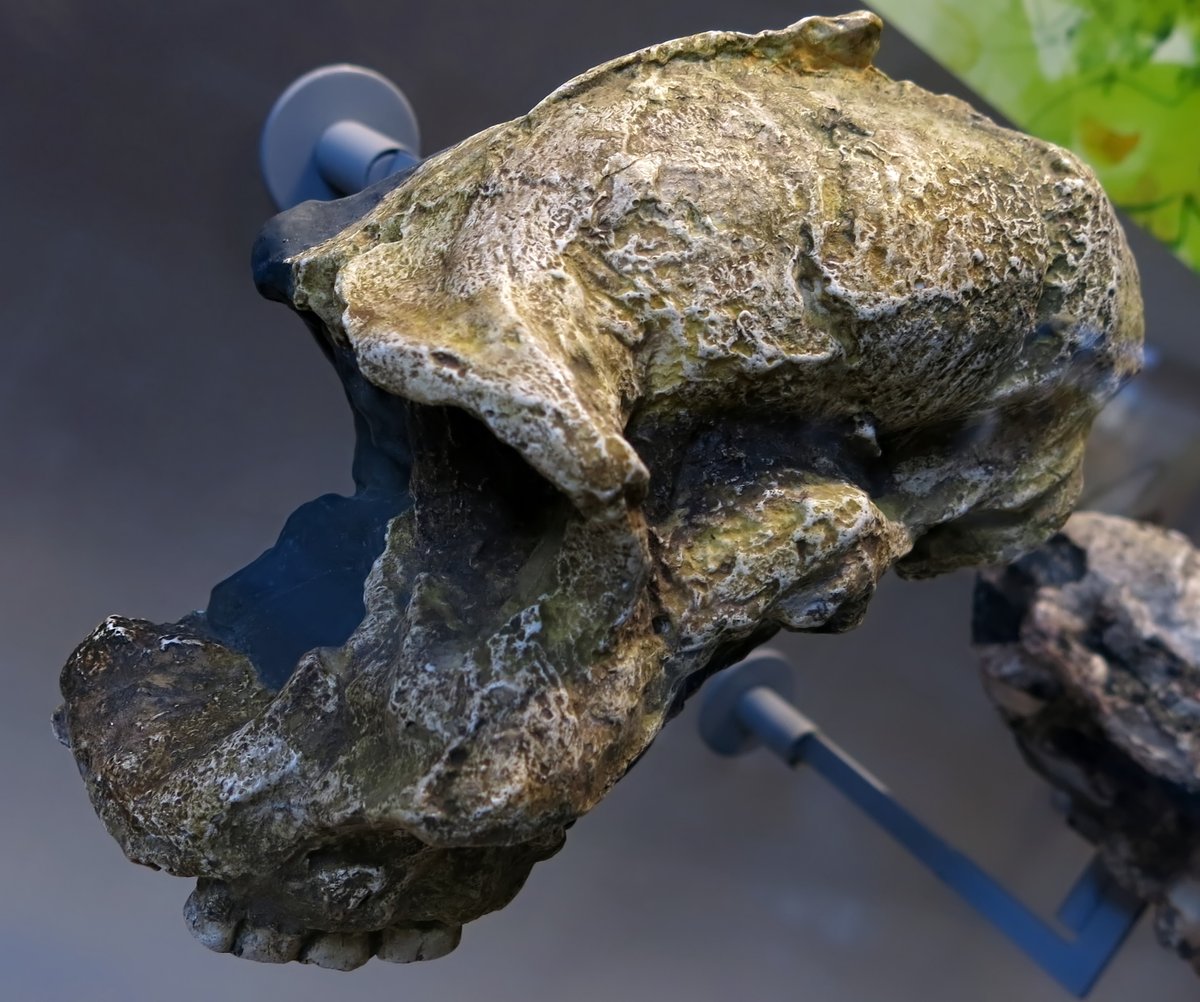
Paranthropus robustus exhibited a striking degree of sexual dimorphism, with males being significantly larger and more robustly built than females. Males stood approximately 132 centimeters (4 feet 4 inches) tall and weighed around 40 kilograms (88 pounds), while females were smaller, averaging about 110 centimeters (3 feet 7 inches) and 30 kilograms (66 pounds). This size difference is comparable to that seen in modern gorillas. The most distinctive features of P. robustus were concentrated in its skull, which was heavily built to support powerful chewing muscles. It possessed a prominent sagittal crest, a bony ridge running along the midline of the skull, which served as an anchor for the massive temporalis muscles used in mastication. The zygomatic arches, or cheekbones, were wide and flaring, creating a broad, dish-shaped face to accommodate these muscles and resist chewing stresses. The mandible, or lower jaw, was deep and thick, and the dentition was specialized. The incisors and canines at the front of the jaw were relatively small, while the premolars and molars were enormous, with thick enamel, a condition known as megadontia. This dental morphology points to a diet that required extensive grinding and crushing. Postcranially, its skeleton was similar to that of the 'gracile' australopithecines like Australopithecus africanus, with a broad pelvis and leg bones indicating it was a habitual biped, though it likely retained some climbing abilities, suggested by the curvature of its finger and toe bones.
The unique anatomy of Paranthropus robustus provides significant clues about its paleobiology. Its powerful jaws and large, flat-topped molars were long interpreted as adaptations for a specialist diet of hard, brittle items like nuts, seeds, and hard-shelled fruits, a concept known as the 'nutcracker man' hypothesis. However, more recent isotopic and dental microwear analyses have challenged this view, suggesting a more complex dietary picture. Microwear studies on their teeth show patterns consistent with a varied diet that included softer items like fruits, leaves, and possibly insects or tubers, rather than just hard objects. It appears P. robustus was more of a dietary generalist, capable of 'fallback' on tough, low-quality foods during periods of scarcity. This dietary flexibility would have been crucial for survival in the fluctuating Pleistocene environment. Locomotion was primarily bipedal, allowing for efficient travel across the open savanna-woodland mosaic it inhabited. The pronounced sexual dimorphism suggests a polygynous social structure, similar to modern gorillas, where a dominant male may have led a group of females and their offspring. Growth patterns, inferred from dental development, were faster than in modern humans but slower than in great apes, indicating a prolonged period of juvenile dependency characteristic of hominins.
During the Pleistocene, the environment of Southern Africa was a dynamic mosaic of grasslands, woodlands, and riverine forests, subject to significant climatic shifts. Paranthropus robustus shared this landscape with a diverse array of fauna, including various species of antelope, zebra, giraffes, and formidable predators such as saber-toothed cats (e.g., Megantereon, Dinofelis) and hyenas. Crucially, its habitat was also shared with other hominins, most notably early members of our own genus, Homo, such as Homo habilis or Homo ergaster. This sympatry raises fascinating questions about niche partitioning and potential competition between these two distinct hominin lineages. While P. robustus was specialized for powerful chewing of tough plant matter, early Homo was developing a different strategy centered around tool use and a more generalized, likely omnivorous diet that included meat. P. robustus occupied a position as a primary consumer, but it was also prey. Fossil evidence from the Swartkrans cave site, including puncture marks on a P. robustus skull (SK 54) that perfectly match the canines of a leopard, confirms that these hominins were hunted by large carnivores. This constant predation pressure likely influenced their social behavior and habitat selection.
The history of Paranthropus robustus begins in 1938 with a discovery by a schoolboy, Gert Terblanche, at the Kromdraai B site in South Africa. He found a partial skull with a jaw, which he brought to the attention of paleontologist Robert Broom. Broom recognized its significance as a new type of hominin, distinct from the gracile Australopithecus africanus discovered by Raymond Dart. He named the species Paranthropus robustus, meaning 'robust near-man'. This discovery was monumental as it revealed a second, parallel lineage of hominins coexisting in Africa. Broom's work continued at the nearby Swartkrans cave, which would become the richest source of P. robustus fossils. Another key specimen is DNH 7, also known as 'Eurydice', a remarkably complete female skull discovered at the Drimolen site in 1994 by Andre Keyser. Paired with the 'Orpheus' mandible (DNH 8), it provides one of the best-preserved examples of the species. The wealth of fossils from these South African cave sites, which are often accumulations from carnivore lairs or natural traps, has been instrumental in building a detailed picture of this hominin's anatomy and lifestyle.
Paranthropus robustus occupies a crucial, albeit extinct, branch on the hominin family tree. It represents a highly successful and specialized evolutionary experiment that persisted for nearly a million years. Along with its East African relatives, Paranthropus boisei and Paranthropus aethiopicus, it forms a distinct genus, Paranthropus, characterized by extreme craniodental robusticity. This lineage diverged from the one leading to Homo sometime before 2.5 million years ago. The existence of Paranthropus demonstrates that the path of human evolution was not a single, linear progression but a complex, branching bush with multiple hominin species coexisting and exploring different ecological niches. P. robustus is not a direct ancestor of modern humans; instead, it is a 'cousin' lineage that highlights an alternative adaptive strategy. While the lineage leading to Homo invested in increasing brain size and sophisticated tool use to process a wider range of foods, the Paranthropus lineage invested in powerful biological machinery—its masticatory apparatus—to exploit tough, low-quality plant resources. Its eventual extinction around 1.2 million years ago, possibly due to climate change and competition from the more adaptable genus Homo, underscores the contingent nature of evolutionary success.
Despite a rich fossil record, several scientific debates surround Paranthropus robustus. A primary controversy involves its exact diet. While the 'hard-object specialist' model has been largely replaced by a 'fallback food generalist' model based on microwear and isotopic evidence, the precise composition of its diet remains a topic of active research. Another significant debate concerns its taxonomic classification. Some researchers, following the initial interpretations, argue that the robust australopithecines are different enough from the gracile ones to warrant their own genus, Paranthropus. Others contend that the differences are not sufficient for a separate genus and prefer to classify them within the genus Australopithecus, as Australopithecus robustus. This debate reflects broader disagreements on how to define a genus in the hominin fossil record. Furthermore, the degree of tool use by P. robustus is contested. While bone tools have been found in association with P. robustus remains at sites like Swartkrans, some argue these were more likely made and used by contemporary Homo, while others maintain that P. robustus was also capable of basic tool manufacture and use, particularly for digging up tubers or processing plant materials.
The fossil record of Paranthropus robustus is concentrated in a handful of limestone cave systems in the Cradle of Humankind World Heritage Site in Gauteng province, South Africa. The primary sites include Swartkrans, Kromdraai, Drimolen, Gondolin, and Coopers. Swartkrans alone has yielded the remains of over 100 individuals, making it one of the most important hominin fossil sites in the world. The fossils are typically found in breccia, a type of rock formed from cemented cave floor deposits, which must be carefully excavated and prepared. Preservation quality is generally good, though complete skeletons are unknown. The record is dominated by cranial and dental remains—skulls, jaws, and teeth—due to their durability. Postcranial elements like vertebrae, ribs, and limb bones are rarer but have provided crucial information about locomotion and body size. The abundance of fossils from a relatively small geographic area allows for detailed studies of population variability, growth, and sexual dimorphism within the species, offering a clearer picture than is available for many other early hominins.
Paranthropus robustus, while not as famous as 'Lucy' (Australopithecus afarensis), holds a significant place in public understanding of human evolution. Its dramatic, specialized skull is a visually powerful example of an extinct side-branch of the human family tree, effectively dispelling the outdated linear model of human evolution. Casts and original fossils of P. robustus are prominently displayed in museums worldwide, including the Ditsong National Museum of Natural History in Pretoria and the Maropeng Visitor Centre at the Cradle of Humankind. These displays are vital for educating the public about the diversity of our ancient relatives and the complex, branching nature of our evolutionary past. Its distinctive appearance has also led to its inclusion in numerous documentaries and popular science books about prehistory, where it often serves as a point of contrast to the emerging lineage of our own genus, Homo.
Classification
Time Period
Discovery
Location
South Africa
Formation
Swartkrans, Kromdraai, Drimolen, Gondolin, and Coopers cave systems
Frequently Asked Questions
What is Paranthropus robustus?
Paranthropus robustus was a species of early hominin that lived in Southern Africa during the Early to Middle Pleistocene, approximately 2 to 1.2 million years ago. As a member of the 'robust' australopithecine group, it is renowned for its massive craniodental adaptations, suggesting a diet of toug...
When did Paranthropus robustus live?
Paranthropus robustus lived during the quaternary period of the cenozoic era approximately 2-1.2 million years ago.
Where was Paranthropus robustus discovered?
Fossils of Paranthropus robustus were discovered in South Africa in the Swartkrans, Kromdraai, Drimolen, Gondolin, and Coopers cave systems.
What did Paranthropus robustus eat?
Paranthropus robustus was a omnivore. It lived in terrestrial habitats.
What type of fossil is Paranthropus robustus?
Paranthropus robustus is preserved as a body fossil. The preservation quality is good.
Related Specimens
From the cenozoic era · body fossils