Confuciusornis
Confuciusornis sanctus
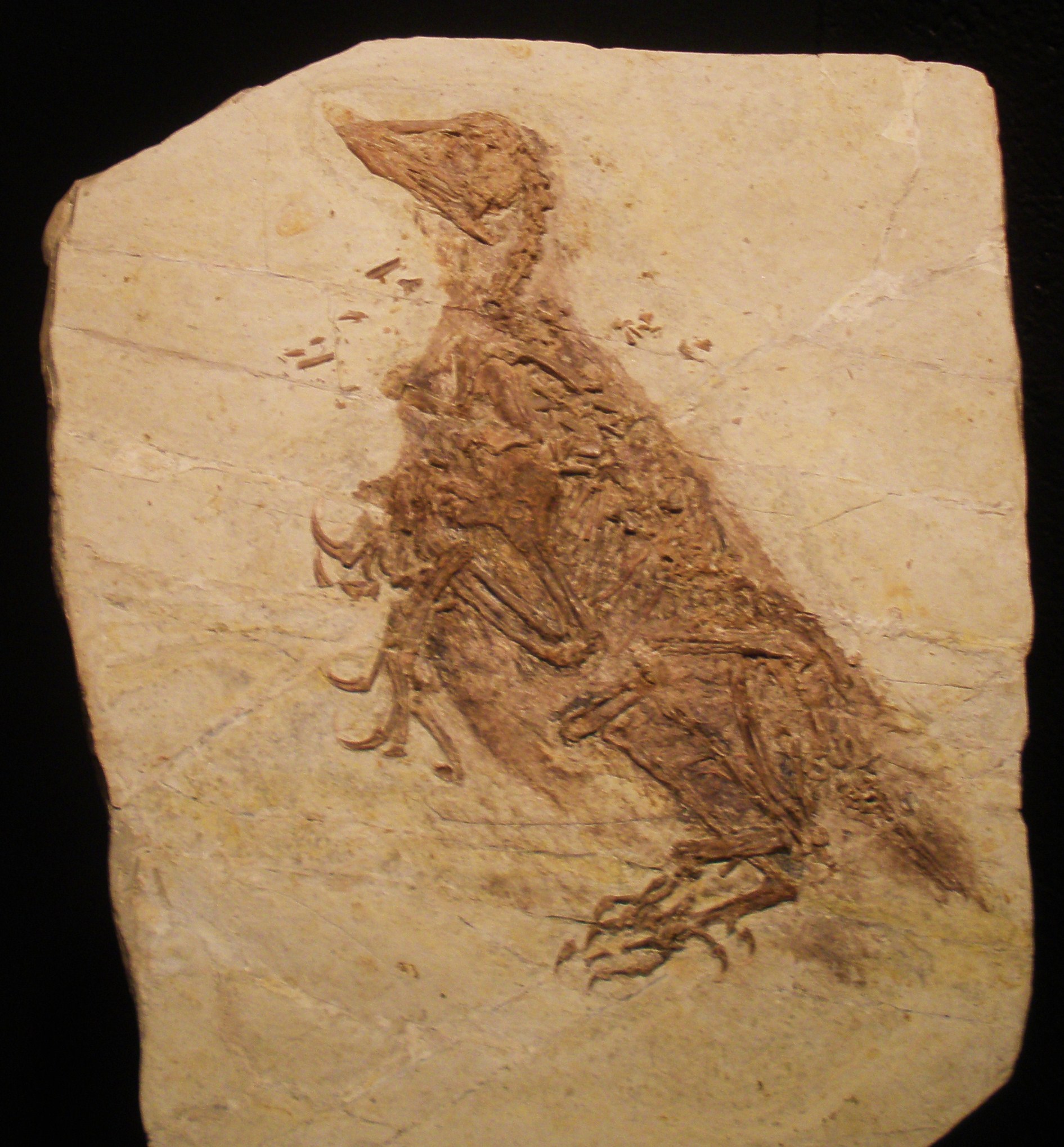
Image: File:Confuciusornis sanctus fossil.jpg - Wikimedia Commons (CC BY-SA)
About Confuciusornis
Confuciusornis sanctus was a highly significant, crow-sized primitive bird that lived during the Early Cretaceous period, approximately 125 to 120 million years ago, in what is now the Liaoning Province of northeastern China. As one of the most abundant and exceptionally preserved fossil birds ever discovered, it provides an unparalleled window into the early evolution of avian lineages during the Mesozoic era. Representing a crucial transitional form between its dinosaurian ancestors and modern birds, Confuciusornis is particularly renowned for possessing the first known toothless beak in the fossil record, marking a major milestone in avian evolutionary biology.
Physically, Confuciusornis sanctus measured approximately 25 centimeters in length from the tip of its beak to the base of its tail, with a body size and general build roughly comparable to that of a modern crow or magpie. Its weight is estimated to have been between 200 and 500 grams, making it a relatively robust creature for an early bird. The anatomy of Confuciusornis exhibited a fascinating mosaic of primitive, dinosaur-like traits and advanced avian adaptations. Its skull was heavily built and featured a completely toothless beak, a remarkable evolutionary innovation that predates the widespread loss of teeth in other bird lineages by millions of years. Despite this modern-looking beak, its wings retained distinctively primitive characteristics, most notably the presence of three large, robust, and sharply curved claws extending from the digits of its wings. These claws were highly functional and likely used for climbing or clinging to tree trunks. The skeletal structure of Confuciusornis was sturdy, featuring a fully fused pygostyle, which is the fusion of the final few tail vertebrae into a single bone to support tail feathers, a feature absent in earlier birds like Archaeopteryx. However, it lacked a strongly keeled sternum, or breastbone, which in modern birds serves as the primary attachment point for powerful flight muscles. The entire body of Confuciusornis was covered in a dense coat of downy, hair-like contour feathers, while its wings bore well-developed, asymmetrical flight feathers that formed an aerodynamic surface. Perhaps the most striking physical feature of this ancient bird was its pronounced sexual dimorphism. A large percentage of adult specimens possess a pair of extraordinarily long, ribbon-like ornamental tail feathers that often exceeded the length of the bird's entire body. Paleontologists widely believe that these elaborate tail feathers were present only in males and were utilized in elaborate courtship displays to attract mates, while the females lacked these ornaments entirely. This striking visual difference between the sexes represents the earliest known definitive evidence of plumage-based sexual dimorphism in the avian fossil record.
The paleobiology of Confuciusornis reveals a complex and adaptable organism that thrived in the dynamic environments of the Early Cretaceous. Its diet is generally considered to have been omnivorous, taking advantage of a wide variety of food sources available in its habitat. The robust, toothless beak was a versatile tool; its sharp edges and strong jaw musculature would have been well-suited for cracking open hard seeds, snapping up insects, and foraging for plant material. Furthermore, fossil evidence, including the preserved stomach contents of some specimens, indicates that Confuciusornis also consumed small fish, suggesting it occasionally hunted in the shallow waters of its lake ecosystem. The feeding strategies of this early bird likely involved a combination of active foraging in the forest canopy and opportunistic scavenging along the shorelines. Locomotion in Confuciusornis is a subject of intense study, particularly regarding its flight capabilities. Because it lacked the deep, keeled sternum necessary to anchor massive pectoral muscles, its ability to sustain powered, flapping flight was likely limited compared to modern birds. Instead, biomechanical models suggest that Confuciusornis was a proficient glider and perhaps capable of short bursts of flapping flight, relying on its strong wing claws to climb high into the trees before launching itself into the air to glide from branch to branch. This arboreal lifestyle is supported by the anatomy of its feet, which, although lacking the fully reversed first toe seen in highly specialized perching birds, were still capable of grasping branches. Bone histology studies have also provided insights into the growth patterns of Confuciusornis. Microscopic analysis of its fossilized bones reveals lines of arrested growth, indicating that, unlike modern birds which typically reach adult size within a single year, Confuciusornis grew at a much slower rate. It likely took several years for an individual to reach full maturity, a growth trajectory that is much more reminiscent of its non-avian dinosaur relatives than of contemporary avian species.
The ecological context in which Confuciusornis lived was part of the world-renowned Jehol Biota, a remarkably diverse and well-preserved ancient ecosystem centered around the Yixian Formation in northeastern China. During the Early Cretaceous, this region was characterized by a temperate, highly seasonal climate with dense, lush forests consisting of conifers, ginkgoes, cycads, and early angiosperms, or flowering plants. The landscape was dominated by a series of large, freshwater lakes surrounded by active volcanoes. These volcanic eruptions played a dual role; they periodically devastated the local environment but also deposited thick layers of fine ash into the lakes, creating the perfect anoxic conditions required for the exceptional preservation of the fossils found there today. In this vibrant ecosystem, Confuciusornis shared its habitat with a staggering array of other prehistoric creatures. It coexisted with other early birds, such as the enantiornithine Sinornis, as well as a variety of feathered non-avian dinosaurs, including the four-winged glider Microraptor, the large tyrannosauroid Yutyrannus, and the small, agile compsognathid Sinosauropteryx. The skies above the lakes were also patrolled by pterosaurs, while the forest floor and underbrush were home to early mammals like the badger-sized Repenomamus, which is known to have preyed upon small dinosaurs. Within this complex food web, Confuciusornis occupied a mid-level position. As an omnivore, it helped regulate populations of insects and small aquatic prey, while also playing a potential role in seed dispersal for the flora of the Jehol ecosystem. Conversely, despite its ability to take to the trees, Confuciusornis would have been a prime target for the myriad of predators in its environment. Small arboreal theropods, larger predatory birds, and opportunistic mammals would have posed a constant threat to both the adult birds and their nests, shaping the evolutionary pressures that drove the survival strategies of this ancient avian species.
The discovery history of Confuciusornis is a landmark chapter in modern paleontology, fundamentally altering our understanding of bird evolution. The first specimens were discovered in 1993 by local farmers digging in the fossil-rich beds of Sihetun, a small village in Beipiao, Liaoning Province. Recognizing the potential importance of these remains, the fossils were brought to the attention of Chinese paleontologists at the Institute of Vertebrate Paleontology and Paleoanthropology in Beijing. In 1995, a team led by prominent paleontologist Hou Lianhai formally described and named the type species, Confuciusornis sanctus. The genus name honors the ancient Chinese philosopher Confucius, while the specific epithet sanctus translates to holy or sacred, reflecting the profound scientific reverence for this pivotal discovery. The holotype specimen, designated IVPP V10913, was a beautifully preserved partial skeleton that clearly showcased the revolutionary toothless beak and the distinct wing claws. Following the initial discovery, the Yixian Formation yielded an unprecedented treasure trove of Confuciusornis fossils. Over the subsequent decades, thousands of complete and articulated skeletons were unearthed, many preserving exquisite details of soft tissues, feathers, and even the horny sheaths of the beak and claws. International collaborations, involving researchers like Zhou Zhonghe from China and Luis Chiappe from the United States, led to extensive monographs detailing the anatomy and taxonomy of the genus. These discoveries sparked a paleontological gold rush in Liaoning, transforming the region into the epicenter of research on feathered dinosaurs and early birds, and cementing Confuciusornis as one of the most thoroughly documented extinct vertebrates in the history of science.
The evolutionary significance of Confuciusornis cannot be overstated, as it occupies a critical juncture in the phylogenetic tree of life, bridging the morphological gap between the most primitive known bird, Archaeopteryx, and the more advanced Ornithurae, the clade that includes all living birds. Taxonomically, Confuciusornis is placed within the clade Pygostylia, a group defined by the presence of a pygostyle, the fused tail vertebrae that replaced the long, bony reptilian tails of earlier forms. This anatomical shift was a major step in the evolution of modern avian flight, allowing for the attachment of a fan of tail feathers that provided crucial steering and braking capabilities in the air. Furthermore, the development of a keratinous, toothless beak in Confuciusornis represents a remarkable instance of convergent evolution, as the later ancestors of modern birds would independently lose their teeth millions of years later. By demonstrating that a beak could evolve early in avian history, Confuciusornis provided researchers with vital clues about the developmental plasticity of the dinosaurian skull. Its skeleton also shows the beginnings of the fusion of the hand bones, a feature that would eventually become the highly specialized carpometacarpus of modern birds, essential for supporting primary flight feathers. Despite these advanced traits, the retention of unfused foot bones, a lack of a complex sternum, and the presence of prominent wing claws firmly anchor Confuciusornis to its theropod dinosaur ancestry. Studying this unique combination of transitional features allows evolutionary biologists to map the sequence of anatomical changes that transformed ground-dwelling, carnivorous dinosaurs into the diverse array of highly specialized, flying birds that populate the globe today.
Despite the abundance of fossil material, Confuciusornis remains the subject of several ongoing scientific debates and controversies. One of the most enduring disputes centers around its flight capabilities. While early researchers posited that it was a relatively strong flier, subsequent biomechanical analyses by scientists such as Dieter Peters and others have argued that the narrow shape of its primary feathers and the lack of a keeled sternum would have made sustained flapping flight aerodynamically impossible. The current consensus leans toward Confuciusornis being a glider or a weak flier that relied heavily on its environment to gain altitude, but the exact mechanics of its aerial locomotion remain highly contested. Another major debate involves the interpretation of its sexual dimorphism. While the presence or absence of the long ornamental tail feathers is widely accepted as a difference between males and females, some researchers have historically argued that these differences might instead represent distinct species within the Confuciusornis genus, or different growth stages. However, statistical analyses of hundreds of specimens have largely supported the sexual dimorphism hypothesis, showing a roughly fifty-fifty split in the presence of tail feathers among adult individuals of the same size. Additionally, there have been taxonomic disputes regarding the number of valid species within the Confuciusornithidae family, with some previously named species now considered to be synonymous with Confuciusornis sanctus, reflecting natural variation within a single, highly successful population rather than distinct evolutionary branches.
The fossil record of Confuciusornis is arguably one of the most spectacular of any Mesozoic vertebrate. Geographically restricted to the Early Cretaceous deposits of northeastern China, specifically the Yixian and Jiufotang formations, the sheer volume of material recovered is staggering. It is estimated that several thousand individual specimens of Confuciusornis have been collected, ranging from isolated bones to perfectly articulated, complete skeletons. The preservation quality is world-class, characteristic of a true Konservat-Lagerstatte. The fine-grained volcanic ash that entombed these birds preserved not only their delicate hollow bones but also carbonized traces of their soft tissues. Feathers are routinely preserved in microscopic detail, allowing scientists to study the structure of the barbs and barbules. In recent years, groundbreaking research utilizing scanning electron microscopy has even identified fossilized melanosomes, the pigment-bearing organelles within the feathers. By comparing the shape and density of these ancient melanosomes to those of modern birds, researchers have been able to reconstruct the original coloration of Confuciusornis, revealing that it likely sported a complex plumage pattern consisting of black, white, and reddish-brown hues. Famous excavation sites like Sihetun and Dawangzhangzi have become legendary in paleontological circles, continuously yielding specimens that push the boundaries of our understanding of ancient life and taphonomy.
The cultural impact of Confuciusornis extends far beyond the confines of academic journals, playing a pivotal role in public education and the popularization of paleontology. As one of the flagship species of the feathered dinosaur revolution, it has been featured prominently in countless documentaries, popular science books, and magazine articles, helping to visually communicate the evolutionary link between dinosaurs and birds to the general public. Spectacularly preserved specimens of Confuciusornis are highly prized centerpieces in major natural history museums around the world, including the Paleozoological Museum of China in Beijing and the American Museum of Natural History in New York. These exhibits serve as powerful educational tools, illustrating the concepts of transitional fossils, deep time, and evolutionary biology. By providing a tangible, beautifully preserved face to the story of avian origins, Confuciusornis has captured the imagination of millions, cementing its legacy not only as a scientific marvel but as a cultural icon of our planet's dynamic prehistoric past.
Classification
Time Period
Discovery
Location
Liaoning Province, China
Formation
Yixian Formation
Frequently Asked Questions
What is Confuciusornis?
Confuciusornis sanctus was a highly significant, crow-sized primitive bird that lived during the Early Cretaceous period, approximately 125 to 120 million years ago, in what is now the Liaoning Province of northeastern China. As one of the most abundant and exceptionally preserved fossil birds ever ...
When did Confuciusornis live?
Confuciusornis lived during the cretaceous period of the mesozoic era approximately 125-120 million years ago.
Where was Confuciusornis discovered?
Fossils of Confuciusornis were discovered in Liaoning Province, China in the Yixian Formation.
What did Confuciusornis eat?
Confuciusornis was a omnivore. It lived in terrestrial, arboreal habitats.
What type of fossil is Confuciusornis?
Confuciusornis is preserved as a carbonized fossil. The preservation quality is exceptional.
Related Specimens
From the mesozoic era · carbonized fossils