Styracosaurus
Styracosaurus albertensis
Image: Image sourced via web search (Fair use / Educational)
About Styracosaurus
Styracosaurus albertensis was a large, herbivorous ceratopsian dinosaur that inhabited the coastal floodplains of western North America during the Late Cretaceous Period, approximately 75.5 to 75 million years ago. Renowned for its spectacular head ornamentation, featuring a prominent nasal horn and a formidable array of long spikes radiating from its neck frill, Styracosaurus is one of the most recognizable and significant dinosaurs from the Campanian age. Its fossils provide crucial insights into the diversity, evolution, and paleoecology of horned dinosaurs just before their extinction.
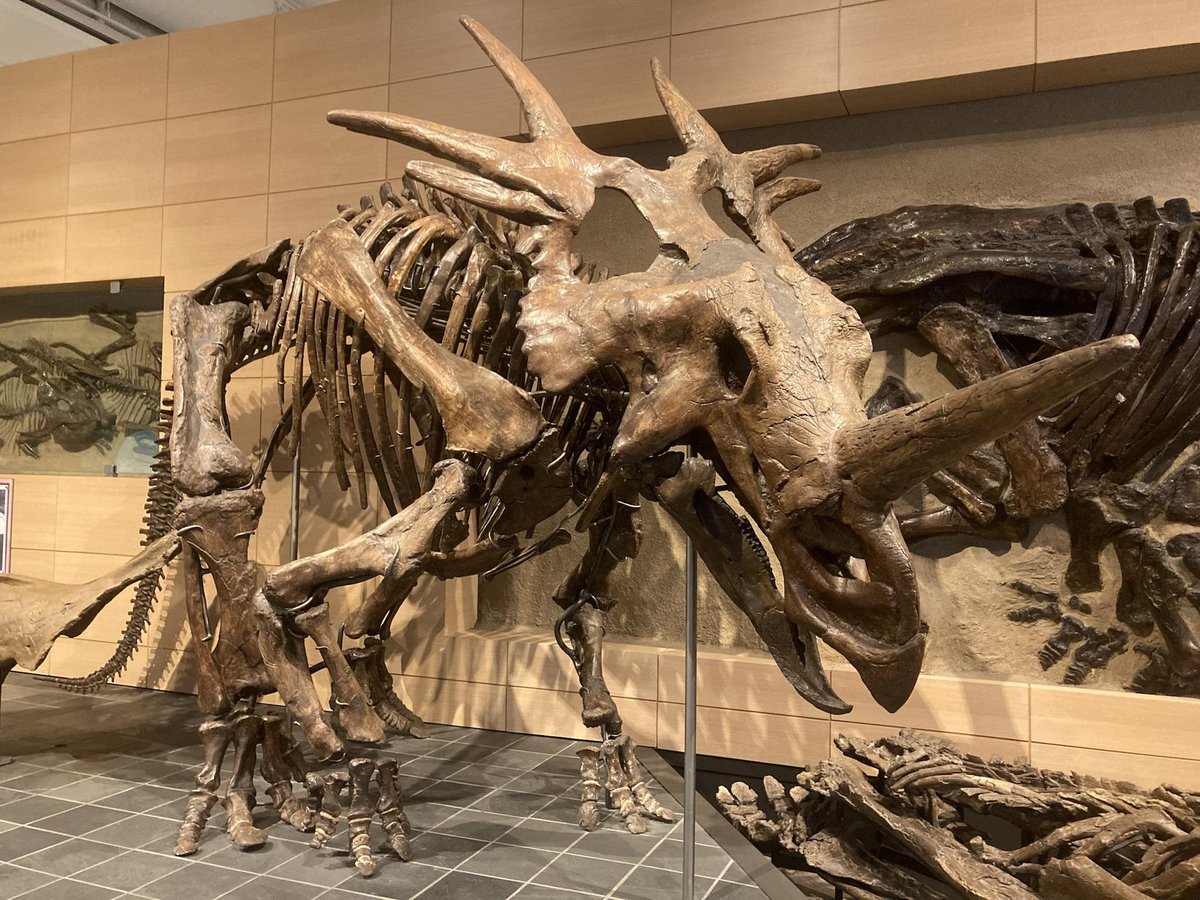
Styracosaurus was a robust, quadrupedal dinosaur, measuring approximately 5.5 meters (18 feet) in length and weighing an estimated 2.7 to 3 tonnes (around 6,000 pounds). For comparison, it was similar in length to a large white rhinoceros but significantly heavier and more powerfully built. Its most defining characteristic was its massive skull, which could reach up to 2 meters (6.6 feet) long, including the frill. A single, formidable horn projected from its snout, reaching lengths of up to 60 centimeters (2 feet) and a thickness of 15 centimeters (6 inches) at the base. Unlike its relative Triceratops, Styracosaurus lacked prominent brow horns; instead, it possessed small, knob-like projections above its eyes. The most dramatic feature was its parietal frill, a large extension of bone at the back of the skull. This frill was adorned with at least four to six long, straight spikes. The two uppermost pairs were the longest, potentially reaching lengths comparable to the nasal horn itself. The frill also featured smaller, variable hornlets or knobs along its outer margin. The frill itself had two large openings, or fenestrae, which were covered by skin in life and served to reduce the skull's weight. The rest of its body was stocky and powerful, with strong, pillar-like limbs to support its great weight, and a relatively short, deep tail. Its mouth terminated in a sharp, toothless beak, ideal for cropping tough vegetation, with batteries of shearing cheek teeth further back in the jaws for processing plant matter.
As a member of the Ceratopsidae, Styracosaurus was a dedicated herbivore. Its powerful beak was well-suited for snipping cycads, ferns, and flowering plants that were abundant in its environment. The complex dental batteries, containing hundreds of stacked, self-sharpening teeth, acted like shears, efficiently slicing fibrous vegetation before it was swallowed. The dinosaur's low-slung head suggests it was primarily a low-level browser, feeding on plants under 2 meters in height. The function of its elaborate horns and frill is a subject of ongoing study, but the leading hypothesis is that they were primarily for display. They could have been used for species recognition, attracting mates, or intimidating rivals in intra-specific combat, much like the antlers of modern deer. While the nasal horn could have served as a formidable defensive weapon against large predators like tyrannosaurids, the frill spikes were likely too fragile for direct combat and were probably more for show. Evidence from bonebeds, particularly one containing the remains of multiple individuals, suggests that Styracosaurus may have been a social animal, living in herds. This herding behavior could have offered protection from predators and facilitated mating. Its growth patterns, inferred from bone histology, indicate a relatively rapid growth rate to reach its large adult size, a common strategy among dinosaurs to outgrow predator vulnerability.
Styracosaurus lived in a warm, subtropical environment on the western coastal plain of the Western Interior Seaway, a vast inland sea that split North America in two during the Late Cretaceous. This region, known as Laramidia, was a lush, swampy floodplain crisscrossed by rivers, resembling the modern-day Louisiana bayou. The climate was humid with distinct wet and dry seasons. Styracosaurus shared this vibrant ecosystem with a diverse array of other dinosaurs. It was part of a rich ceratopsian fauna that included Centrosaurus and Chasmosaurus. Other herbivores included hadrosaurids (duck-billed dinosaurs) like Parasaurolophus and Corythosaurus, and armored ankylosaurs such as Euoplocephalus. The apex predator in this environment was the tyrannosaurid Gorgosaurus, a slightly smaller relative of Tyrannosaurus rex, which undoubtedly preyed upon Styracosaurus. Fossil evidence of bite marks on ceratopsian bones confirms this predator-prey relationship. Styracosaurus occupied a niche as a large, low-browsing herbivore, and its presence alongside other large herbivores suggests a high degree of niche partitioning, where different species specialized in feeding on different types of plants or at different heights to avoid direct competition.
The discovery of Styracosaurus is credited to the renowned paleontologist Charles M. Sternberg, who was working for the Geological Survey of Canada. In the summer of 1913, Sternberg and his team were excavating in the rich fossil beds of what is now Dinosaur Provincial Park in Alberta, Canada. They unearthed a nearly complete skull and a partial skeleton, which became the holotype specimen, designated CMN 344. This specimen was remarkable for its unique and dramatic cranial ornamentation. The following year, paleontologist Lawrence Lambe formally described and named the new dinosaur Styracosaurus albertensis. The genus name, Styracosaurus, derives from the Greek 'styrax' (spike at the butt-end of a spear-shaft) and 'sauros' (lizard), a direct reference to the impressive spikes on its neck frill. The species name, 'albertensis', honors the province of Alberta where it was discovered. Another significant find was a large bonebed discovered in 1915 by Barnum Brown in the same formation, which contained the remains of at least five individuals, providing valuable information about variation within the species and suggesting gregarious behavior. This collection is now housed at the American Museum of Natural History in New York.
Styracosaurus holds a key position within the evolutionary tree of horned dinosaurs. It belongs to the family Ceratopsidae and, more specifically, to the subfamily Centrosaurinae. Centrosaurines are characterized by prominent nasal horns, smaller brow horns, and elaborate frill ornamentation with spikes or hooks, in contrast to the Chasmosaurinae (like Triceratops), which typically had long brow horns, small nasal horns, and long, broad frills. Styracosaurus is considered a derived member of the centrosaurine lineage, closely related to genera like Centrosaurus and Einiosaurus. Its unique combination of a long nasal horn and extremely long parietal spikes helps paleontologists trace the diversification of display structures within this group. The rapid evolution and high diversity of ceratopsian headgear in the Late Cretaceous are thought to be driven by sexual selection and species recognition, and Styracosaurus provides a spectacular example of this evolutionary trend. It represents a successful evolutionary experiment in cranial display, showcasing how these structures could become highly specialized in a relatively short period of geologic time. It has no direct modern descendants, as the entire non-avian dinosaur lineage was wiped out in the Cretaceous-Paleogene extinction event.
Despite its iconic status, Styracosaurus has been at the center of several scientific debates. For years, the validity of a second species, 'Styracosaurus ovatus', named by Charles Gilmore in 1930 based on a partial frill from Montana, was contested. The 'S. ovatus' frill had spikes that seemed to converge inward rather than radiate outward. However, a 2010 study by Ryan, Holmes, and Russell re-examined the material and concluded it was distinct enough to warrant its own genus, which they named Rubeosaurus. More recent analysis in 2020 by Wilson, Ryan, and Evans suggested that Rubeosaurus might actually represent a transitional growth stage of Styracosaurus, reigniting the debate. Another area of discussion involves the function of the frill and horns. While display is the most accepted hypothesis, some researchers argue for a more significant role in defense or thermoregulation. The discovery of a new specimen in 2019, nicknamed 'Hannah', with an asymmetrical frill, has provided further evidence for individual variation and potential pathologies, adding complexity to our understanding of these animals' lives and appearance.
The fossil record of Styracosaurus is primarily concentrated in the Dinosaur Park Formation of Alberta, Canada, a UNESCO World Heritage Site renowned for its abundance and diversity of Late Cretaceous fossils. Dozens of partial to relatively complete skulls and skeletons have been recovered from these deposits, making Styracosaurus a well-understood ceratopsian. The quality of preservation is generally good, with many specimens retaining three-dimensional skull structures that are crucial for studying their unique ornamentation. The most commonly found elements are the robust parts of the skull, including the frill fragments, horn cores, and beak, as they were more resistant to decay and transport before burial. The aforementioned bonebeds, while rare, offer invaluable snapshots of populations, providing data on age ranges, social structure, and individual variation that isolated skeletons cannot. These fossil sites in Alberta remain the most important source of Styracosaurus material in the world, cementing the region's importance in the history of paleontology.
With its dramatic appearance, Styracosaurus has secured a firm place in popular culture. Its distinctive silhouette, bristling with horns and spikes, has made it a favorite subject in dinosaur books, toys, and documentaries. It has been featured in numerous films, including Disney's 'Dinosaur' (2000) and 'The Land Before Time' franchise, often portrayed as a powerful and sometimes cantankerous herbivore. Major museums, such as the Royal Tyrrell Museum of Palaeontology in Alberta, the Canadian Museum of Nature in Ottawa, and the American Museum of Natural History in New York, feature impressive mounted skeletons or skulls of Styracosaurus, allowing the public to appreciate the scale and bizarre beauty of this magnificent Cretaceous beast. Its striking form serves as an excellent educational tool for teaching about dinosaur diversity, evolution, and the concept of sexual selection in the prehistoric world.
Classification
Time Period
Discovery
Location
Canada (Alberta)
Formation
Dinosaur Park Formation
Frequently Asked Questions
What is Styracosaurus?
Styracosaurus albertensis was a large, herbivorous ceratopsian dinosaur that inhabited the coastal floodplains of western North America during the Late Cretaceous Period, approximately 75.5 to 75 million years ago. Renowned for its spectacular head ornamentation, featuring a prominent nasal horn and...
When did Styracosaurus live?
Styracosaurus lived during the cretaceous period of the mesozoic era approximately 76-75 million years ago.
Where was Styracosaurus discovered?
Fossils of Styracosaurus were discovered in Canada (Alberta) in the Dinosaur Park Formation.
What did Styracosaurus eat?
Styracosaurus was a herbivore. It lived in terrestrial (coastal floodplain) habitats.
What type of fossil is Styracosaurus?
Styracosaurus is preserved as a body fossil. The preservation quality is good.
Related Specimens
From the mesozoic era · body fossils