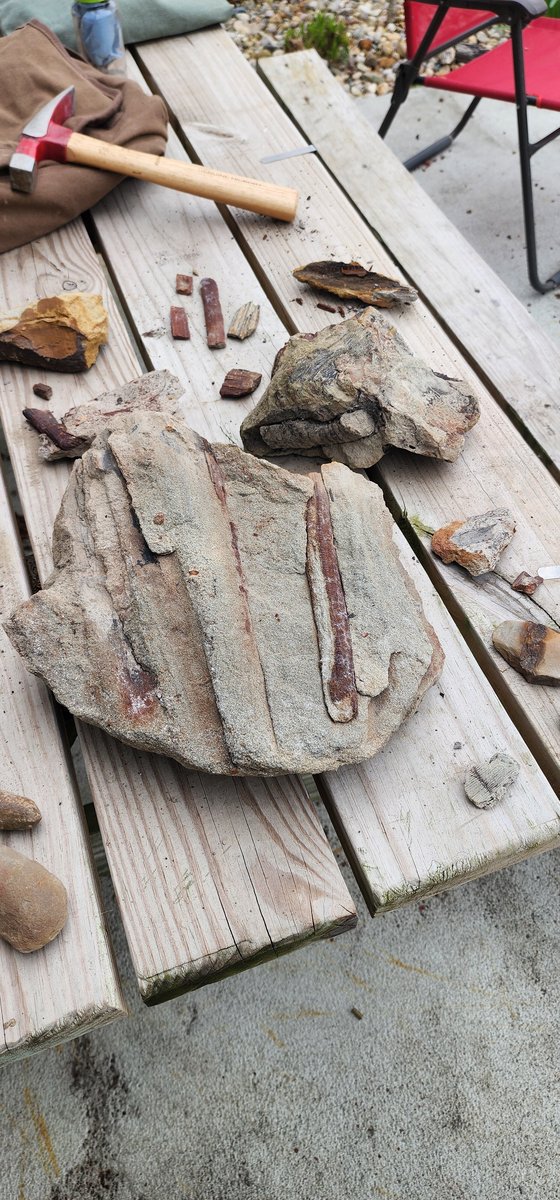
Cordaites
Cordaites principalis
Image: Image sourced via web search (Fair use / Educational)
About Cordaites
Cordaites represents a major group of extinct seed-bearing plants that flourished during the Paleozoic Era, particularly dominating the vast coal swamps of the Carboniferous Period. These ancient trees were among the first large, woody plants to evolve, playing a crucial role in shaping terrestrial ecosystems and contributing significantly to the formation of the coal deposits that define this geologic time. As early members of the gymnosperm lineage, their study provides critical insights into the evolutionary transition from spore-bearing plants to the seed plants that now dominate most of the world's forests.
Cordaites were impressive trees, often reaching heights of 30 to 45 meters (approximately 100 to 150 feet), with some estimates suggesting they could grow even taller, rivaling many modern forest canopy trees. Their overall morphology was distinct, featuring a tall, slender, and often unbranched trunk that culminated in a dense crown of large, strap-like leaves. The trunk, known from fossils as Dadoxylon, could achieve diameters of up to one meter and was characterized by a large pith, a feature indicating rapid growth. Unlike the complex branching patterns of modern conifers, Cordaites exhibited a simpler architecture, focusing vertical growth to reach the sunlight above the dense swamp undergrowth. The leaves themselves were one of the most recognizable features, being simple, elongated, and leathery, sometimes reaching over a meter in length and 15 centimeters in width. These massive leaves, arranged spirally at the ends of branches, had parallel venation, similar to modern monocots, though they are not related. The root system, known as Amyelon, was extensive and featured specialized air-filled tissues (aerenchyma), an adaptation for anchoring the massive tree in the waterlogged, anoxic soils of its swampy habitat.
As photosynthetic organisms, Cordaites were primary producers, converting sunlight into energy through their massive leaf canopies. Their reproductive strategy marked a significant evolutionary step. They were gymnosperms, meaning they produced 'naked' seeds not enclosed within a fruit. Reproduction was facilitated by complex structures called Cordaianthus, which were unisexual catkin-like cones. These cones grew on slender branches within the main leaf crown. Pollen-producing male cones (microsporangiate) and ovule-bearing female cones (megasporangiate) were typically borne on the same plant, making them monoecious. The pollen was likely dispersed by wind, a common strategy for gymnosperms, to fertilize the ovules on the female cones. Once fertilized, the ovules developed into seeds, known as Cardiocarpus. These seeds were flattened, heart-shaped, and often had a wing-like structure, suggesting they were adapted for dispersal by either wind or water, allowing the plant to colonize new areas within the vast wetland ecosystems. The plant's rapid growth, tall stature, and efficient reproductive system enabled it to thrive and become a dominant component of its environment.
The world of the Carboniferous Period was vastly different from today's. Tectonic activity had assembled the supercontinent of Pangaea, and vast regions near the equator were covered by extensive, low-lying tropical wetlands. The climate was warm, humid, and characterized by extremely high atmospheric oxygen levels, perhaps as high as 35%, which fueled the immense growth of plant life and the gigantism seen in many arthropods of the era. Cordaites formed dense, monotypic stands, often described as 'Cordaites forests,' particularly in slightly drier, better-drained areas on the fringes of the great lycopod-dominated coal swamps. They coexisted with other iconic Carboniferous flora, including the giant clubmosses Lepidodendron and Sigillaria, the towering horsetail Calamites, and a variety of tree ferns. This lush vegetation formed the base of a complex food web. While Cordaites had no direct predators in the modern sense, its biomass supported a vast ecosystem of detritivores, such as giant millipedes like Arthropleura, and provided shelter for a host of animals, including early amphibians and the first reptiles that were beginning to colonize terrestrial environments.
The discovery and study of Cordaites are intertwined with the early history of paleobotany in the 19th century, driven by the Industrial Revolution's demand for coal. Fossils of these plants were commonly found by miners in the coal-bearing strata of Europe and North America. The genus Cordaites was formally named in 1877 by the French paleobotanist Charles-Eugène Bertrand, though various parts of the plant had been described earlier under different names. Because plant fossils are often found disarticulated, the leaves (Cordaites), stems (Dadoxylon), roots (Amyelon), pollen cones (Cordaianthus), and seeds (Cardiocarpus) were initially classified as separate organisms. It was the painstaking work of paleobotanists like Bertrand, Henry Witham, and later Adolphe-Théodore Brongniart, who pieced together these disparate fossil parts, or 'form genera,' to reconstruct the whole plant. This process of whole-plant reconstruction, based on the consistent co-occurrence of these fossil types in the same geological layers, was a major achievement in paleontology, demonstrating how a complete prehistoric organism could be understood from its fragmented remains. No single 'type specimen' represents the entire organism, but rather a composite understanding built from countless fossils from classic Coal Measures localities.
Cordaites holds a pivotal position in the evolutionary history of plants. As members of the Cordaitales, they are considered to be closely related to the ancestors of modern conifers, placing them firmly within the lineage of seed plants (spermatophytes). They represent a successful early experiment in the evolution of large, woody trees and demonstrate key adaptations for terrestrial life, including a robust vascular system for water transport, supportive woody tissue, and the revolutionary innovation of the seed. The seed provided the embryo with protection and a nutrient supply, freeing plant reproduction from the dependence on water that constrained their spore-bearing predecessors like ferns. This evolutionary leap allowed plants to conquer a wider range of terrestrial habitats. The Cordaitales are often placed as a sister group to the conifers, sharing features like woody structure and cone-like reproductive organs. Their eventual decline and extinction at the end of the Permian Period, during the 'Great Dying,' was part of a major floral turnover, paving the way for the rise of the more drought-tolerant conifers and cycads that would dominate the Mesozoic Era.
While the general morphology and life history of Cordaites are well-established, scientific debate continues, particularly concerning their precise ecological role and taxonomic relationships. Some researchers argue that Cordaites were not just limited to the fringes of swamps but may have also formed upland forests, suggesting a greater ecological diversity than traditionally thought. Evidence for this comes from fossilized soils (paleosols) and the distribution of their fossils away from typical coal-swamp deposits. Furthermore, the exact phylogenetic relationship between the Cordaitales, conifers, and other early seed plant groups like pteridosperms (seed ferns) is still a subject of active research. New fossil discoveries and the application of advanced cladistic analyses continually refine our understanding of where Cordaites and its relatives fit on the complex family tree of plants. The diversity within the group itself is also debated, with questions remaining as to whether the many described species of leaves and seeds represent true biological diversity or simply variations within a few widespread and variable species.
The fossil record of Cordaites is extensive and globally distributed, reflecting their success during the late Paleozoic. Their remains are particularly abundant in the Carboniferous and Permian rock strata of North America and Eurasia, which formed the tropical belt of Pangaea. The most common fossils are impressions and compressions of their large, strap-like leaves, which are frequently found layered upon each other in shale and sandstone deposits associated with coal seams. Petrifactions of the wood (Dadoxylon) and roots (Amyelon) are also common, providing detailed cellular information. The reproductive structures, Cordaianthus and Cardiocarpus, are found more rarely but are crucial for understanding the plant's life cycle. Famous fossil sites yielding exceptional Cordaites material include the Mazon Creek lagerstätte in Illinois, USA, and the historic coalfields of Saarland in Germany, and Lancashire in the UK. The sheer abundance of their fossilized remains makes them a key index fossil for the Carboniferous Period.
Although not as famous as dinosaurs, Cordaites holds a significant place in paleontological outreach and education. Its fossils are common and visually impressive, making them staples in museum collections worldwide, including the Field Museum in Chicago and the Natural History Museum in London. Dioramas depicting Carboniferous coal swamps almost invariably feature towering Cordaites trees in the background, helping the public visualize these ancient, alien-looking forests. They serve as a powerful educational tool to explain the origin of fossil fuels, the concept of ancient ecosystems, and the major evolutionary steps taken by plant life. For amateur fossil hunters, the distinctive, parallel-veined leaves of Cordaites are often a prized and readily identifiable find in Carboniferous shales, providing a direct, tangible link to the deep past of our planet.
Classification
Time Period
Discovery
Location
Europe (specifically France and Great Britain)
Formation
Coal Measures (Westphalian and Stephanian stages)
Frequently Asked Questions
What is Cordaites?
Cordaites represents a major group of extinct seed-bearing plants that flourished during the Paleozoic Era, particularly dominating the vast coal swamps of the Carboniferous Period. These ancient trees were among the first large, woody plants to evolve, playing a crucial role in shaping terrestrial ...
When did Cordaites live?
Cordaites lived during the carboniferous period of the paleozoic era approximately 340-299 million years ago.
Where was Cordaites discovered?
Fossils of Cordaites were discovered in Europe (specifically France and Great Britain) in the Coal Measures (Westphalian and Stephanian stages).
What did Cordaites eat?
Cordaites was a photosynthetic. It lived in terrestrial (wetland, swamp) habitats.
What type of fossil is Cordaites?
Cordaites is preserved as a impression fossil. The preservation quality is good.
Related Specimens
From the paleozoic era · impression fossils
-bark/c858d48fc5cb.jpg)