-slab/453736fb9032.jpg)
Crinoid (Sea lily) slab
Class Crinoidea
About Crinoid (Sea lily) slab
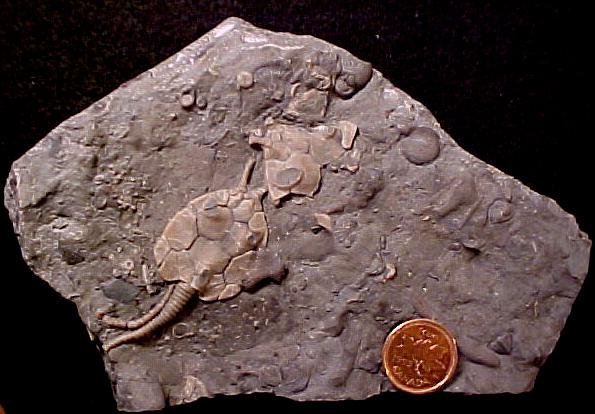
Crinoids, specifically those preserved in dense, multi-specimen fossil slabs from the Carboniferous period, represent some of the most spectacular and ecologically significant marine invertebrates in the entire paleontological record. Flourishing between 359 and 323 million years ago during the Mississippian subperiod, these echinoderms, commonly referred to as sea lilies, formed vast, dense underwater meadows that dominated the shallow continental shelf environments of the Paleozoic era. The preservation of multiple articulated specimens on a single slab of dark grey marine sedimentary rock offers an unparalleled window into the benthic communities of the ancient oceans, capturing a literal snapshot of life in a dynamic, rapidly changing world. These slabs are not merely individual fossils; they are preserved ecosystems that highlight the immense biological productivity of early marine environments and the profound evolutionary success of the echinoderm lineage.
The physical anatomy of a Carboniferous crinoid is a marvel of natural engineering, characterized by a complex, multi-part skeleton composed of high-magnesium calcite plates. Despite their plant-like appearance and the colloquial name sea lily, crinoids are fully functional animals closely related to modern starfish, sea urchins, and brittle stars. A typical specimen preserved in these slabs consists of three primary anatomical regions: the holdfast, the stem or column, and the crown. The holdfast functioned as a root-like anchoring system, securing the animal to the benthic substrate or to the debris of other marine organisms. Rising from the holdfast is the stem, which could reach lengths of over a meter in some Carboniferous species, though most slab-preserved specimens exhibit stems ranging from ten to fifty centimeters. This stem is constructed from stacked, disc-like ossicles called columnals, which were bound together by living tissue, allowing for a degree of flexibility in the water column. Atop the stem sits the crown, which includes the calyx—a cup-like structure housing the vital organs, including the digestive and reproductive systems. Extending from the calyx are the arms, which branch out in a distinctively pentaradial (five-fold) symmetry. These arms are further lined with tiny, feather-like appendages called pinnules. In life, the entire structure was covered in a thin epidermis. The dark grey sedimentary matrix of these slabs often provides a stark, beautiful contrast to the lighter calcite of the fossils, allowing observers to trace the intricate, articulated geometry of the calyx plates and the delicate branching of the feeding arms.
In terms of paleobiology, these ancient crinoids were highly specialized, sessile suspension feeders that relied entirely on the ambient currents of their marine environment to deliver sustenance. They positioned their elaborate crowns in the water column, orienting their pinnule-lined arms to form a parabolic filtration fan perpendicular to the prevailing water flow. This rheophilic feeding strategy allowed them to capture microscopic plankton, detritus, and suspended organic particulate matter. The pinnules were equipped with microscopic tube feet covered in sticky mucus, which would trap passing food particles. Once captured, the food was flicked into a ciliated ambulacral groove running down the center of each arm, where it was transported conveyor-belt style down into the mouth located on the upper surface of the calyx, known as the tegmen. Growth in these organisms was achieved through the continuous addition of new calcite plates and the enlargement of existing ones. New columnals were typically generated just below the calyx, slowly pushing the older segments downward and lengthening the stem over the animal's lifespan. While they were primarily attached to the seafloor, inferences from their skeletal morphology suggest that some species possessed enough muscular control in their stems to actively reorient their crowns in response to shifting currents, maximizing their feeding efficiency in the dynamic shallow-water environments they inhabited.
The ecological context of the Carboniferous period, often dubbed the Age of Crinoids, provided the perfect crucible for the proliferation of these organisms. During this time, the Earth was experiencing significant climatic shifts, transitioning from a greenhouse climate to an icehouse climate with the onset of the Karoo Ice Age. However, the equatorial regions were covered by extensive, warm, shallow epicontinental seas. These nutrient-rich waters were highly oxygenated and supported incredibly diverse marine ecosystems. Crinoids were the dominant benthic organisms in these habitats, growing in such immense, dense forests that their skeletal remains literally built the seafloor, forming massive regional deposits known as encrinites or crinoidal limestones. In these vibrant underwater ecosystems, crinoids shared their habitat with a wide array of other Paleozoic marine life. The dark grey matrix of a typical crinoid slab often contains the fragmented remains or impressions of these co-existing species, including fenestrate bryozoans, spiriferid brachiopods, rugose corals, and various bivalves. In the food web, crinoids occupied a crucial position as primary consumers of microplankton. In turn, they were preyed upon by a growing diversity of durophagous (shell-crushing) predators. Early chondrichthyans (cartilaginous fishes), placoderms, and specialized echinoids (sea urchins) evolved robust jaws and crushing dentition specifically adapted to crack through the hard calcite armor of the crinoid calyx to access the nutrient-rich visceral mass inside.
The discovery and scientific documentation of crinoids have a rich history that dates back to the very dawn of paleontology as a formalized science. Long before they were understood to be the remains of ancient animals, isolated crinoid stem columnals were collected by ancient and medieval peoples, who called them fairy money, St. Cuthbert's beads, or star stones, often attributing magical or religious significance to their perfect geometric shapes. The true biological nature of these fossils was not fully recognized until the Renaissance, with early naturalists like Georgius Agricola beginning to classify them in the 16th century. However, it was the pioneering work of the British naturalist J.S. Miller in 1821 that formally established the Class Crinoidea, separating them from other echinoderms and recognizing their distinct anatomical features. The discovery of intact, multi-specimen slabs from the Carboniferous period dramatically accelerated our understanding of these creatures. In the 19th and early 20th centuries, legendary fossil sites such as the Crawfordsville fossil beds in Indiana, USA, and the Burlington Limestone formations across the American Midwest yielded thousands of perfectly articulated specimens. Paleontologists like Charles Wachsmuth and Frank Springer dedicated their lives to studying these North American Carboniferous slabs, producing monumental monographs in the late 1800s and early 1900s that remain foundational texts in invertebrate paleontology today.
The evolutionary significance of Carboniferous crinoids cannot be overstated, as they represent a massive evolutionary radiation and a critical juncture in the history of the echinoderm phylum. Crinoids first appeared in the Ordovician period, but it was during the Carboniferous that they reached their absolute zenith in terms of morphological diversity, abundance, and ecological dominance. They are divided into several major subclasses, with the Camerata, Inadunata, and Flexibilia being the most prominent during the Paleozoic. The specimens preserved in these slabs often showcase transitional features that help paleontologists map the complex phylogenetic tree of echinoderms, illustrating how pentaradial symmetry and the water vascular system were adapted for a sessile, filter-feeding lifestyle. Crucially, the study of these Paleozoic crinoids provides vital insights into macroevolutionary survival and extinction. At the end of the Permian period, approximately 252 million years ago, the Earth experienced its most severe mass extinction event, which wiped out roughly 96 percent of all marine species. The vast majority of the crinoid lineages that built the Carboniferous meadows were completely eradicated. Only a tiny fraction of the subclass Articulata survived this bottleneck, eventually giving rise to all modern, extant crinoid species. Therefore, these Carboniferous slabs represent the peak of a lost dynasty, showcasing a diversity of forms that the Earth would never see again.
Despite centuries of study, these ancient organisms remain the subject of intense scientific debate and ongoing research. One of the primary areas of contention involves the precise taxonomic relationships between the various Paleozoic subclasses. Because crinoid skeletons easily disarticulate upon death, classifying species based on isolated calyx plates or stem fragments has historically led to a highly convoluted taxonomy, with many species names being rendered invalid upon the discovery of fully articulated slabs. Modern paleontologists are increasingly using advanced morphometric analysis and 3D scanning technologies to revise these outdated classifications. Another significant debate centers around the biomechanics and behavior of the living animals. While traditionally viewed as entirely passive filter feeders, recent hydrodynamic modeling suggests that some Carboniferous crinoids may have actively manipulated their arms and stems to create localized water vortices, thereby increasing the flow of plankton to their tube feet. Furthermore, the extent of their mobility is contested; while most were permanently anchored, some researchers argue that certain flexible-stemmed species could detach their holdfasts and crawl along the substrate to escape predators or seek better feeding grounds, a behavior observed in some modern stalked crinoids.
The fossil record of Carboniferous crinoids is exceptionally robust, yet the preservation of fully articulated, multi-specimen slabs is a relatively rare taphonomic phenomenon. Because the connective tissues holding the calcite plates together decay rapidly after death, a crinoid will typically disintegrate into thousands of individual ossicles within days of dying. Therefore, the existence of a slab featuring intact crowns, stems, and arms indicates a catastrophic and rapid burial event. These assemblages were likely smothered by sudden influxes of fine-grained sediment, such as underwater mudslides triggered by storms or seismic activity, which sealed the animals in an anoxic environment before scavengers or decay could pull them apart. These exceptional preservation sites, known as Konservat-Lagerstätten, are distributed globally but are most famously concentrated in North America and Europe. The dark grey shales and limestones of the American Midwest, the Carboniferous limestone formations of the United Kingdom, and specific deposits in Morocco have yielded some of the most breathtaking slabs ever recovered. These sites provide paleontologists with thousands of specimens, allowing for population-level studies of ancient marine communities.
The cultural impact of these magnificent fossil slabs extends far beyond the confines of academic paleontology. Due to their striking aesthetic appeal, featuring intricate, flower-like animals frozen in stone, crinoid slabs are highly prized by museums, private collectors, and educators around the world. They serve as spectacular centerpiece displays in natural history museums, instantly communicating the deep antiquity and alien beauty of the prehistoric Earth to the general public. In popular culture, their plant-like appearance often surprises people when they learn these were actually complex animals, making them excellent educational tools for teaching concepts of convergent evolution, deep time, and the dynamic history of life on our planet. Furthermore, their historical legacy endures in regional identities; the crinoid is the official state fossil of Missouri, honoring the vast Carboniferous limestone deposits that shape the region's geology and history. Through these beautifully preserved slabs, the ancient sea lilies continue to captivate the human imagination, bridging the gap between a long-lost Paleozoic world and the modern day.
Time Period
Frequently Asked Questions
What is Crinoid (Sea lily) slab?
Crinoids, specifically those preserved in dense, multi-specimen fossil slabs from the Carboniferous period, represent some of the most spectacular and ecologically significant marine invertebrates in the entire paleontological record. Flourishing between 359 and 323 million years ago during the Miss...
When did Crinoid (Sea lily) slab live?
Crinoid (Sea lily) slab lived during the carboniferous period of the paleozoic era approximately 359-323 million years ago.
What did Crinoid (Sea lily) slab eat?
Crinoid (Sea lily) slab was a filter feeder. It lived in marine, benthic (attached to the seafloor) habitats.
What type of fossil is Crinoid (Sea lily) slab?
Crinoid (Sea lily) slab is preserved as a body fossil. The preservation quality is excellent.
Related Specimens
From the paleozoic era · body fossils