Cryptoclidus
Cryptoclidus eurymerus
Image: Image sourced via web search (Fair use / Educational)
About Cryptoclidus
Cryptoclidus was a medium-sized plesiosaur, a type of marine reptile, that inhabited the warm, shallow seas of what is now Europe during the Middle Jurassic Period, approximately 166 to 163 million years ago. As a quintessential representative of the long-necked plesiosaurs, its exceptionally well-preserved fossils have made it a cornerstone for understanding the anatomy, lifestyle, and evolution of this successful group of Mesozoic sea creatures. Its name, meaning 'hidden clavicle,' refers to a key anatomical feature that helped distinguish it from its relatives, and its study continues to provide invaluable insights into the marine ecosystems of the Jurassic world.
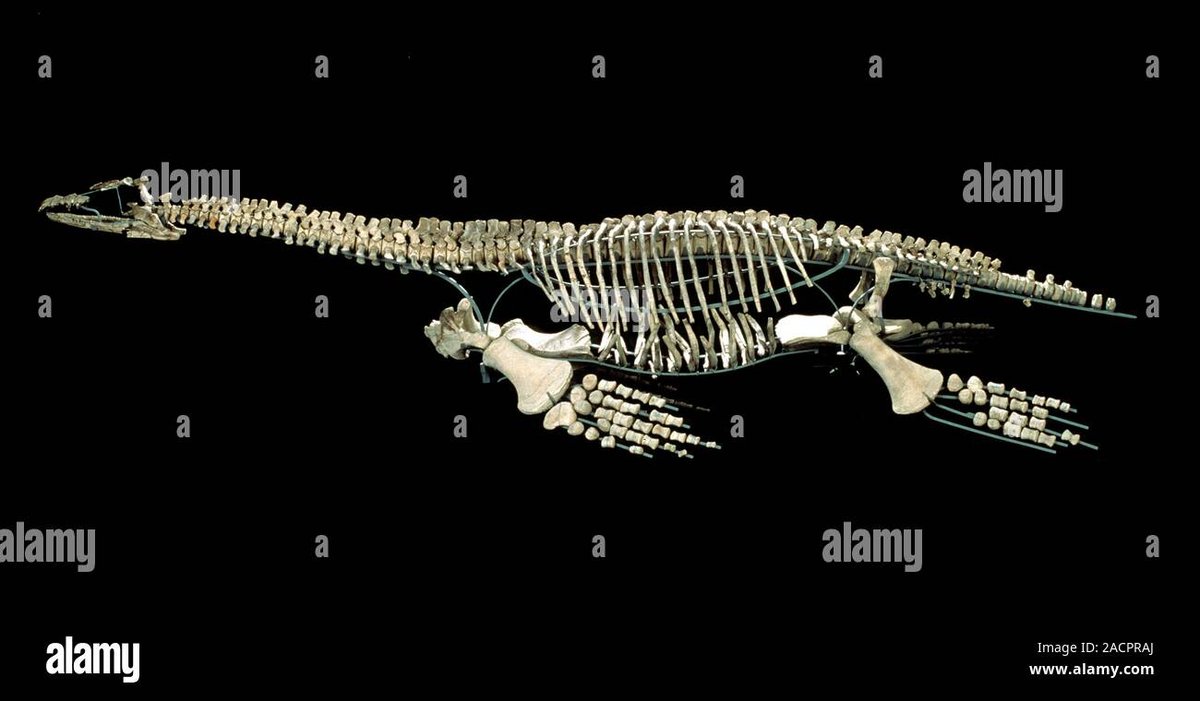
Cryptoclidus eurymerus was a moderately sized plesiosaur, typically reaching an estimated length of 3 to 4 meters (about 10 to 13 feet) and weighing around 1,000 to 2,000 kilograms (approximately 1 to 2 tons), comparable in length to a large bottlenose dolphin but significantly more robust. Its most striking feature was its long, flexible neck, which comprised about 32 vertebrae and accounted for a significant portion of its body length. This neck was not as extremely elongated as some later plesiosaurs like Elasmosaurus, but it was still a highly mobile and crucial tool for hunting. The skull was relatively broad, flat, and lightweight, measuring about 25 centimeters (10 inches) long. It housed a formidable array of long, slender, interlocking teeth that projected outwards from the jaws. These needle-like teeth were perfectly adapted for ensnaring small, slippery prey. The body was barrel-shaped and rigid, providing a stable platform for its four powerful, wing-like flippers. Each flipper was an expanded limb with elongated digits forming a hydrofoil, allowing for efficient 'underwater flight' locomotion. The clavicles (collarbones) were small and concealed by the larger coracoids in the pectoral girdle, a diagnostic feature that gave the genus its name, Cryptoclidus, meaning 'hidden clavicle'.
Analyses of its anatomy provide a clear picture of Cryptoclidus as an active predator. The arrangement of its long, thin, interlocking teeth strongly suggests a diet consisting primarily of small, fast-moving prey like fish and cephalopods such as belemnites and ammonites. The teeth formed a 'trapping basket' or sieve, ideal for snatching agile animals from the water column rather than for tearing flesh from larger victims. Its feeding strategy likely involved using its long, flexible neck to dart its head into shoals of fish, ambushing them from below or the side. The large, forward-facing eyes provided good binocular vision, essential for judging distance to prey in the aquatic environment. Locomotion was achieved through a unique method of 'underwater flight,' where all four flippers were moved in a coordinated figure-eight pattern, similar to the way sea turtles and penguins swim today. This method would have provided both powerful propulsion for pursuit and excellent maneuverability for navigating complex environments or tracking evasive prey. There is little direct fossil evidence for social behavior, but like many marine predators, it may have been a solitary hunter or lived in small groups. Its metabolism was likely higher than that of modern reptiles, reflecting an active, predatory lifestyle in temperate waters.
Cryptoclidus lived during the Callovian stage of the Middle Jurassic, a time when global sea levels were high and much of Europe was submerged under a vast, shallow epicontinental sea known as the Sundance Sea. The climate was warm and subtropical, with no polar ice caps. The specific environment it inhabited, preserved in the Oxford Clay Formation of England, was a relatively shallow, nutrient-rich marine basin. This ecosystem teemed with life. Cryptoclidus shared these waters with a diverse array of other marine reptiles. These included other plesiosaurs like the short-necked, large-headed pliosaurs Liopleurodon and Pliosaurus, which were apex predators that likely preyed on smaller animals, including juvenile Cryptoclidus. Ichthyosaurs such as Ophthalmosaurus, with their massive eyes adapted for deep or low-light hunting, were also abundant. The seabed was home to a rich invertebrate fauna, including ammonites, belemnites, bivalves, and gastropods. The water column was filled with various species of fish, which formed the primary food source for Cryptoclidus. As a mid-sized predator, Cryptoclidus occupied an intermediate position in the food web, preying on smaller fish and squid while being a potential target for the giant pliosaurs that dominated the top of the marine food chain.
The discovery history of Cryptoclidus is rooted in the 19th-century 'bone wars' of British paleontology. The first significant remains were unearthed from the clay pits near Peterborough, England, which were being excavated for brick-making. These pits exposed the fossil-rich Oxford Clay Formation. The initial fossils were collected and studied by prominent naturalists of the era. The genus was officially named and described in 1892 by the British paleontologist Harry Govier Seeley. The name 'Cryptoclidus' was chosen to highlight the small clavicles 'hidden' by the coracoids, a key diagnostic feature. The species name, 'eurymerus,' means 'wide femur,' referring to the characteristic shape of its thigh bone. One of the most important and complete specimens is housed at the Natural History Museum in London. This particular skeleton, discovered in the Fletton clay pits, has been pivotal in shaping our understanding of plesiosaur anatomy and biomechanics. Unlike many dinosaur genera known from single, fragmentary individuals, Cryptoclidus is represented by numerous, often articulated and well-preserved skeletons, making it one of the best-understood of all plesiosaurs and a reference point for the entire group.
Cryptoclidus holds a significant position within the evolutionary tree of marine reptiles. It is the type genus for the family Cryptoclididae, a group of plesiosaurs characterized by their relatively broad skulls, numerous slender teeth, and moderately long necks. This family is part of the larger clade Plesiosauroidea, which encompasses all the long-necked plesiosaurs. The excellent preservation of Cryptoclidus fossils provides a crucial anatomical baseline for studying the evolution of plesiosaur feeding mechanisms and locomotion. Its unique 'four-winged' swimming style is a classic example of convergent evolution with modern animals like sea lions and penguins, demonstrating how different lineages can independently evolve similar solutions to the physical challenges of aquatic propulsion. While plesiosaurs have no direct living descendants, having gone extinct alongside the non-avian dinosaurs 66 million years ago, their closest living relatives are modern reptiles, though the exact relationship within the reptile family tree remains a subject of ongoing research. The study of Cryptoclidus and its relatives illuminates a major evolutionary radiation of reptiles back into the marine environment, a transition as profound as the move from water to land.
Despite being one of the best-known plesiosaurs, Cryptoclidus is not without its scientific debates. A primary area of discussion has centered on the exact function and flexibility of its long neck. Early reconstructions often depicted it with a swan-like, highly flexible neck capable of striking far out of the water. However, more recent biomechanical studies, led by researchers like Leslie Noè, have shown that the vertebral structure would have limited its vertical movement, making such a pose impossible. The neck was likely held relatively straight and was most flexible for side-to-side and downward movements, consistent with scanning for and ambushing prey below it in the water column. Another debate involves the specifics of its locomotion. While the 'underwater flight' model is widely accepted, the precise coordination of the front and rear flippers—whether they moved in unison, alternately, or in some other combination—is still being modeled and analyzed. The classification of some related species has also been revised, with specimens once assigned to Cryptoclidus now placed in other genera, refining the definition of the Cryptoclididae family.
The fossil record of Cryptoclidus is remarkably rich and geographically concentrated. The vast majority of specimens have been recovered from the Oxford Clay Formation in southern England, particularly from the brick pits around Peterborough and Cambridgeshire. This geological formation is a 'Lagerstätte,' a site of exceptional fossil preservation, where the anoxic conditions of the seafloor mud led to the stunningly complete and articulated preservation of marine life. Dozens of skeletons, ranging from juveniles to adults, have been found, making Cryptoclidus one of the most common and completely known plesiosaurs in the world. The quality of preservation is often excellent, with many skeletons being nearly complete and three-dimensionally preserved, allowing for detailed anatomical study. Fossils attributed to the genus or closely related forms have also been reported from other parts of Europe, including France and potentially Russia, indicating a wider distribution across the Jurassic seas of the northern hemisphere. The abundance of high-quality fossils makes it a staple for museum collections and paleontological research.
Due to its classic plesiosaur appearance and the completeness of its fossil remains, Cryptoclidus has made a notable impact on popular culture and public education. It was famously featured in the 1999 BBC documentary series 'Walking with Dinosaurs,' where it was depicted as a coastal predator, cementing its image in the public consciousness. This appearance, alongside representations in numerous books, toys, and video games, has made it one of the most recognizable marine reptiles after the more famous Liopleurodon and Elasmosaurus. Major museums, including the Natural History Museum in London and the Sedgwick Museum of Earth Sciences in Cambridge, feature spectacular mounted skeletons of Cryptoclidus, offering visitors a direct and impressive look into the marine world of the Jurassic. Its role as a well-understood, 'textbook' example of a plesiosaur makes it an invaluable tool for science education, illustrating concepts of adaptation, extinction, and life in prehistoric ecosystems.
Classification
Time Period
Discovery
Location
England, United Kingdom
Formation
Oxford Clay Formation
Frequently Asked Questions
What is Cryptoclidus?
Cryptoclidus was a medium-sized plesiosaur, a type of marine reptile, that inhabited the warm, shallow seas of what is now Europe during the Middle Jurassic Period, approximately 166 to 163 million years ago. As a quintessential representative of the long-necked plesiosaurs, its exceptionally well-p...
When did Cryptoclidus live?
Cryptoclidus lived during the jurassic period of the mesozoic era approximately 166-163 million years ago.
Where was Cryptoclidus discovered?
Fossils of Cryptoclidus were discovered in England, United Kingdom in the Oxford Clay Formation.
What did Cryptoclidus eat?
Cryptoclidus was a carnivore. It lived in marine habitats.
What type of fossil is Cryptoclidus?
Cryptoclidus is preserved as a body fossil. The preservation quality is excellent.
Related Specimens
From the mesozoic era · body fossils