Cynognathus
Cynognathus crateronotus
Image: Image sourced via web search (Fair use / Educational)
About Cynognathus
Cynognathus crateronotus was a formidable, non-mammalian synapsid that roamed the supercontinent of Gondwana during the Middle Triassic period, approximately 247 to 235 million years ago. As a member of the cynodonts, a group that includes the direct ancestors of mammals, Cynognathus represents a crucial transitional stage in vertebrate evolution, showcasing a mosaic of reptilian and mammalian characteristics. Its fossils provide invaluable insights into the recovery of life following the devastating Permian-Triassic extinction event and the subsequent rise of the archosaurs, including the dinosaurs.
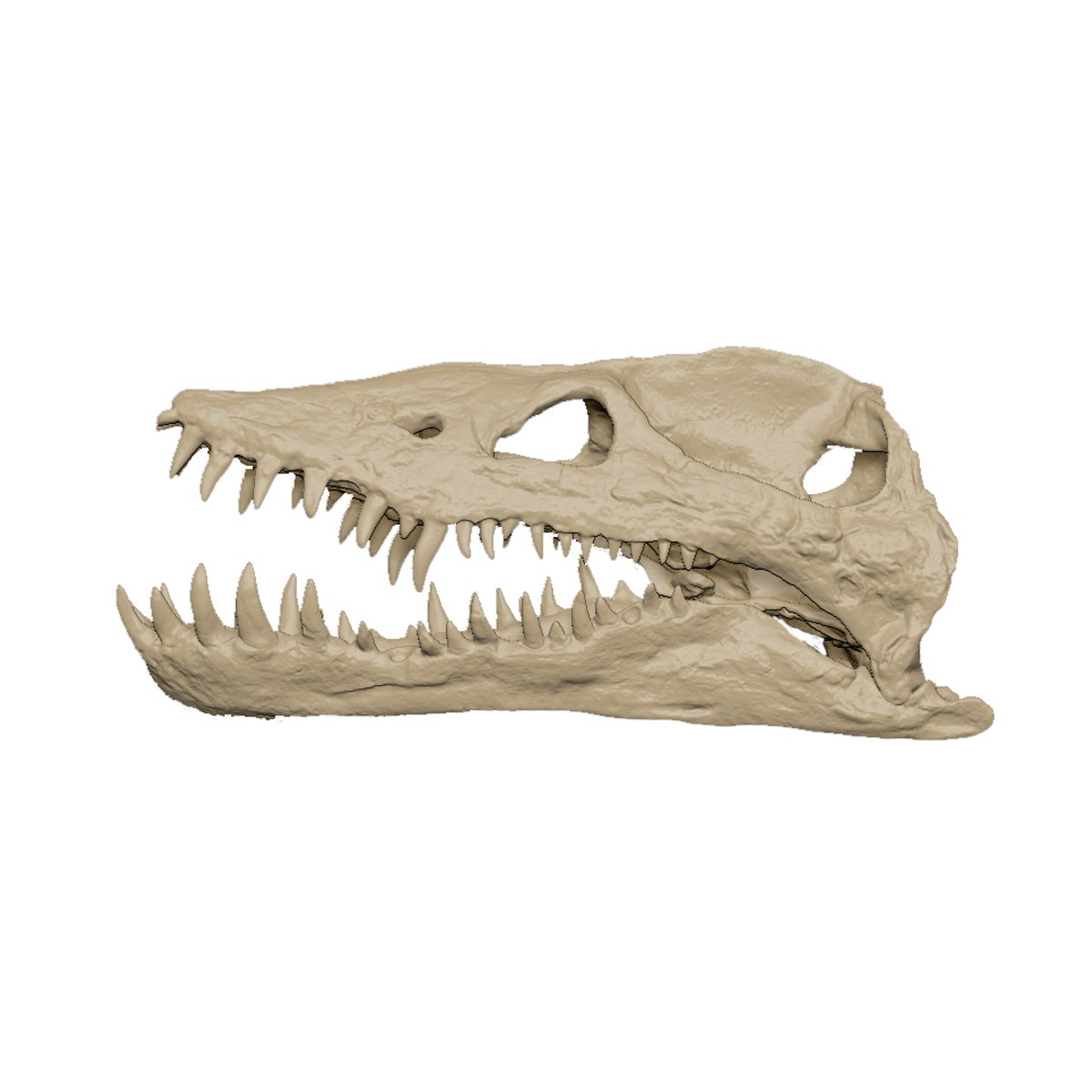
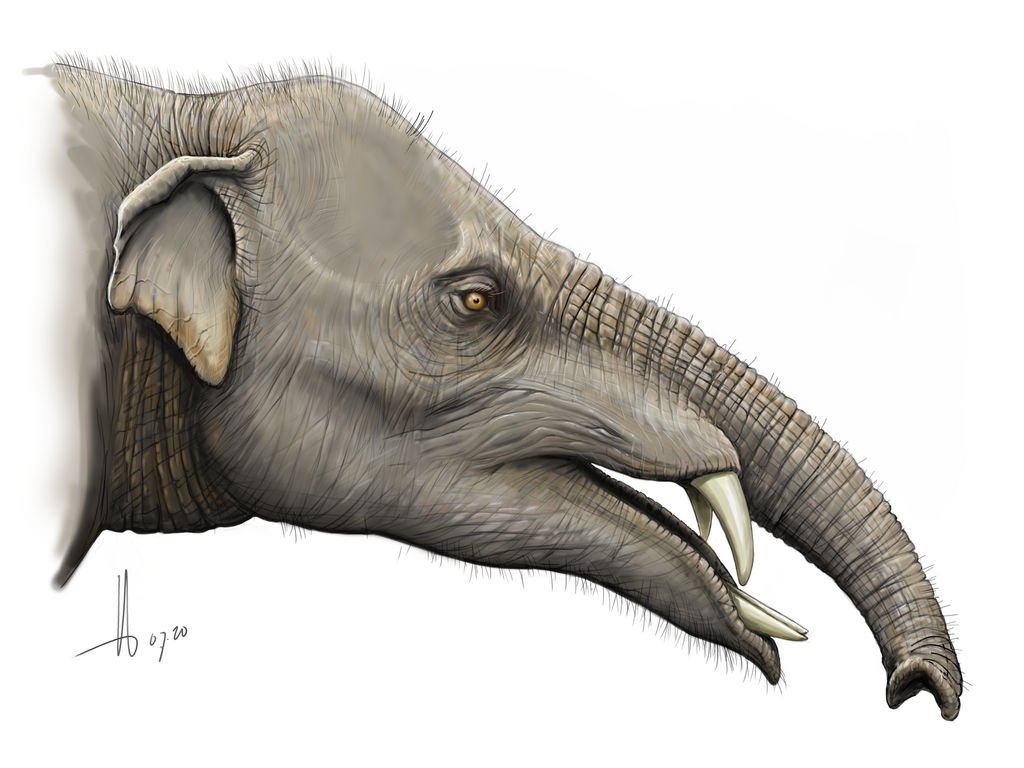
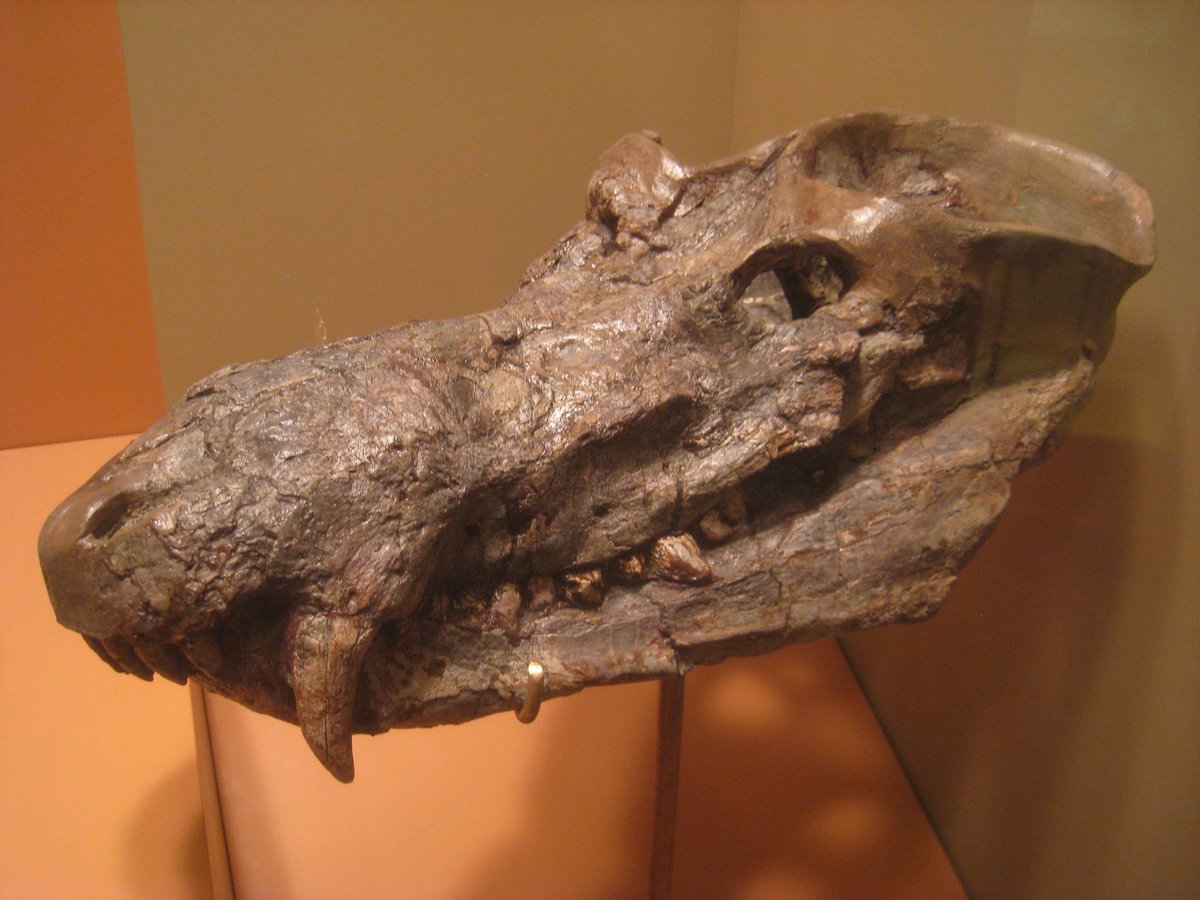
Cynognathus was a robust, powerfully built predator, comparable in size to a modern wolf or a medium-sized dog. It reached an average body length of about 1 to 1.2 meters (100-120 cm) from snout to tail tip, with some larger specimens potentially exceeding this. Its skull was disproportionately large, measuring up to 30 centimeters long, and was its most defining feature. This massive head housed powerful jaw muscles, indicated by the wide temporal fenestrae (openings in the skull behind the eyes) that provided extensive attachment points. Unlike more primitive reptiles, Cynognathus possessed a highly differentiated dentition remarkably similar to that of mammals. It had sharp incisors at the front for nipping and tearing, a pair of very long, saber-like canines for piercing and killing prey, and complex, multi-cusped postcanine teeth (cheek teeth) for shearing and processing meat. This dental specialization allowed for more efficient food processing than the simple, conical teeth of its reptilian contemporaries. Its skeletal structure blended ancestral and derived traits. The limbs were positioned more directly beneath the body than in sprawling reptiles, suggesting a more efficient, semi-erect gait. While it still possessed a reptilian-like pectoral and pelvic girdle, the overall posture was an intermediate step towards the fully erect stance of mammals. Inferences about soft tissue suggest it likely had whiskers, evidenced by pits on the snout bones (foramina) that would have housed nerves and blood vessels, and it is widely hypothesized to have been covered in fur, an adaptation for thermoregulation.
As an active predator, the paleobiology of Cynognathus reflects its advanced, mammal-like adaptations. Its specialized dentition strongly indicates a carnivorous diet, with its powerful jaws and sharp teeth well-suited for hunting and consuming other Triassic vertebrates, such as the herbivorous dicynodonts like Kannemeyeria. The postcanine teeth, which occluded (met precisely), allowed it to shear flesh and crush bone, a significant advance over the simple gulping feeding strategy of most reptiles. Its semi-erect posture would have enabled greater stamina and speed compared to sprawling animals, making it an effective pursuit predator over moderate distances. The presence of a secondary palate, a bony shelf separating the nasal passage from the mouth, allowed Cynognathus to breathe while holding prey or chewing, a critical adaptation for an active animal with a higher metabolic rate. This, combined with the likelihood of fur for insulation, strongly suggests it was approaching endothermy, or warm-bloodedness, though perhaps not to the same degree as modern mammals. There is little direct evidence for social behavior, but given its role as a top predator, it may have been solitary or lived in small family groups, similar to many modern mammalian carnivores. Growth patterns, inferred from bone histology, suggest a relatively rapid growth rate compared to contemporary reptiles, another hallmark of a higher metabolism.
Cynognathus inhabited a world recovering from the most severe mass extinction in Earth's history. During the Middle Triassic, the continents were fused into the supercontinent Pangaea, and the climate was generally hot and arid, with pronounced seasonal monsoons. Cynognathus fossils are primarily found in what was the southern part of this landmass, Gondwana, in regions that are now South Africa, Argentina, Antarctica, and China. It lived in semi-arid, open woodland and floodplain environments, crisscrossed by river systems. As a top terrestrial predator of its time, Cynognathus occupied a high position in the food web. Its primary prey likely consisted of the abundant medium-to-large herbivorous synapsids, particularly the tusked dicynodonts like Kannemeyeria and the smaller Diademodon. It also would have preyed on smaller reptiles and other cynodonts. However, it was not without competition or threats. The Triassic saw the rise of the archosaurs, the group that would eventually give rise to dinosaurs, crocodiles, and pterosaurs. Cynognathus shared its environment with formidable rauisuchians and early dinosaurs like Eoraptor, creating a complex and competitive ecosystem where the old guard of synapsid predators was being challenged by a new wave of archosaur dominance. This ecological pressure likely played a significant role in the eventual decline of large cynodonts like Cynognathus by the end of the Triassic.
The discovery of Cynognathus was a landmark event in 19th-century paleontology. The first and most significant fossils were unearthed in the Karoo Basin of South Africa, a region renowned for its rich record of Permian and Triassic life. The animal was formally named and described in 1895 by the British paleontologist Harry Govier Seeley. Seeley recognized the creature's unique blend of features and chose the name Cynognathus crateronotus, which translates to 'dog jaw from the large crater,' referencing its canine-like skull and the basin-like shape of the temporal region. The holotype specimen, the fossil upon which the species description is based, consists of a well-preserved skull that clearly showcases the advanced, mammal-like dentition and jaw structure. Over the subsequent decades, numerous additional specimens, ranging from complete skulls to partial skeletons, were recovered from the Burgersdorp Formation within the Karoo's Beaufort Group. These discoveries, made by paleontologists such as Robert Broom and James Kitching, solidified the importance of the Karoo Basin as a window into the Triassic period and helped cement Cynognathus's status as a key transitional fossil. No single specimen has achieved a popular nickname like 'Sue' the T. rex, but the collective fossil evidence for Cynognathus is extensive and has been foundational to our understanding of synapsid evolution.
Cynognathus holds a place of paramount importance in the story of vertebrate evolution. It is a quintessential example of a transitional fossil, beautifully illustrating the evolutionary path from early synapsids (often inaccurately called 'mammal-like reptiles') to true mammals. Its skeleton is a mosaic of ancestral reptilian traits and derived mammalian features. While it retained a reptilian jaw joint (involving the quadrate and articular bones) and laid eggs, it possessed numerous characteristics that foreshadowed the mammalian condition. These include highly specialized, differentiated teeth (heterodonty), a secondary palate for simultaneous breathing and eating, a more upright limb posture for efficient locomotion, and likely a diaphragm for improved respiration, inferred from the separation of the thoracic and abdominal regions. The enlarged temporal fenestra indicates powerful, complex jaw musculature capable of precise chewing motions. As a member of the clade Eucynodontia, Cynognathus is positioned very close to the direct ancestors of mammals. Studying its anatomy allows scientists to trace the step-by-step acquisition of key mammalian traits and understand the selective pressures, such as the need for more efficient food processing and higher activity levels, that drove this remarkable evolutionary transition. It provides a vivid snapshot of a time when our own distant ancestors were dominant predators, before the long reign of the dinosaurs began.
Despite being a well-studied animal, Cynognathus is still the subject of scientific discussion. A primary area of debate has revolved around its taxonomy and the number of valid species. For many years, several different species and even genera (such as Lycaenognathus) were named based on fossils from different locations and of slightly different sizes or ages. However, more recent and comprehensive analyses, particularly by paleontologist James Hopson, have led to a consensus that most of these represent variations within a single, widespread, and long-lived species: Cynognathus crateronotus. The slight differences are now largely attributed to individual variation, age (ontogeny), or sexual dimorphism rather than distinct species. Another ongoing discussion concerns the precise nature of its metabolism. While the evidence for a higher-than-reptilian metabolic rate is strong, the degree to which it was truly warm-blooded (endothermic) remains uncertain. It may have occupied an intermediate metabolic state, a condition known as mesothermy, allowing for greater activity than ectotherms but without the high energetic costs of modern mammals. The exact nature of its integument—whether it had scales, fur, or a combination—is also a matter of inference, as direct fossil evidence of its skin is lacking, though the presence of fur is widely accepted based on phylogenetic bracketing and anatomical correlates like facial foramina for whiskers.
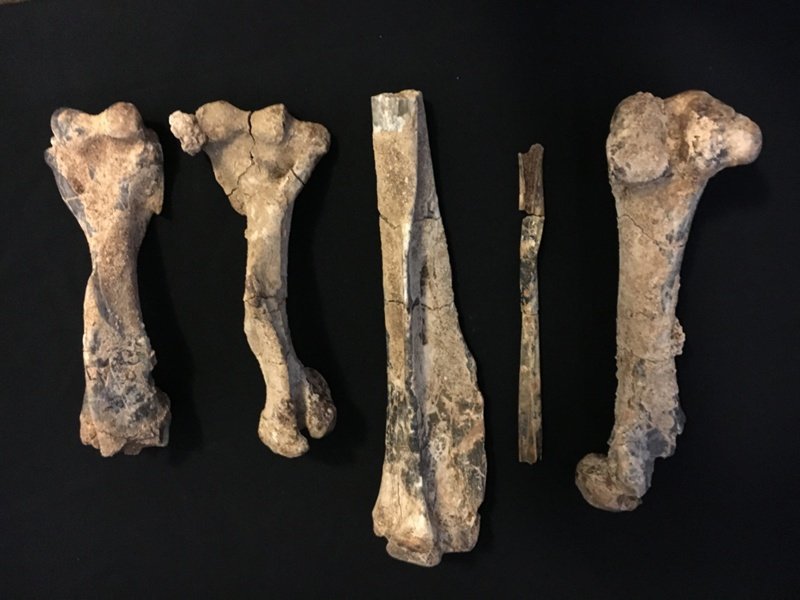
The fossil record of Cynognathus is robust, making it one of the best-known Triassic synapsids. Its fossils are geographically widespread across the former supercontinent of Gondwana, a testament to its success as a species. The most numerous and well-preserved specimens come from the Cynognathus Assemblage Zone of the Burgersdorp Formation in the Karoo Basin of South Africa. This geological zone is named for the abundance of its fossils and serves as a key biostratigraphic marker for the Middle Triassic. Fossils attributed to Cynognathus have also been found in the Fremouw Formation of Antarctica, the Río Seco de la Quebrada Formation in Argentina, and the Ermaying Formation in China. The quality of preservation is generally good, with many complete or nearly complete skulls known, though articulated postcranial skeletons are less common. The skull is the most frequently preserved and studied element, as its robust construction and complex anatomy provide a wealth of information about the animal's life. Famous fossil sites in the Karoo, near towns like Burgersdorp and Aliwal North, have yielded the bulk of Cynognathus material, making South African museum collections, such as that of the Iziko South African Museum, critical repositories for its study.
Cynognathus has made a notable impact on popular culture and public science education as a prime example of a 'mammal-like reptile.' It is frequently featured in books, television documentaries like 'Walking with Dinosaurs,' and museum exhibits about the Triassic period and the origin of mammals. Its fierce, dog-like appearance, complete with saber-like canines, makes it a visually compelling creature that captures the public imagination. Major natural history museums around the world, including the American Museum of Natural History in New York and the Natural History Museum in London, often feature casts or reconstructed skeletons of Cynognathus in their exhibits on vertebrate evolution. Its clear transitional nature makes it an excellent educational tool for explaining the process of evolution and demonstrating the deep ancestral connection between mammals and their ancient synapsid relatives. It serves as a powerful reminder that before the age of dinosaurs, the world was dominated by our own distant kin.
Classification
Time Period
Discovery
Location
South Africa
Formation
Burgersdorp Formation (Beaufort Group)
Frequently Asked Questions
What is Cynognathus?
Cynognathus crateronotus was a formidable, non-mammalian synapsid that roamed the supercontinent of Gondwana during the Middle Triassic period, approximately 247 to 235 million years ago. As a member of the cynodonts, a group that includes the direct ancestors of mammals, Cynognathus represents a cr...
When did Cynognathus live?
Cynognathus lived during the triassic period of the mesozoic era approximately 247-235 million years ago.
Where was Cynognathus discovered?
Fossils of Cynognathus were discovered in South Africa in the Burgersdorp Formation (Beaufort Group).
What did Cynognathus eat?
Cynognathus was a carnivore. It lived in terrestrial habitats.
What type of fossil is Cynognathus?
Cynognathus is preserved as a body fossil. The preservation quality is good.
Related Specimens
From the mesozoic era · body fossils