Dactylioceras
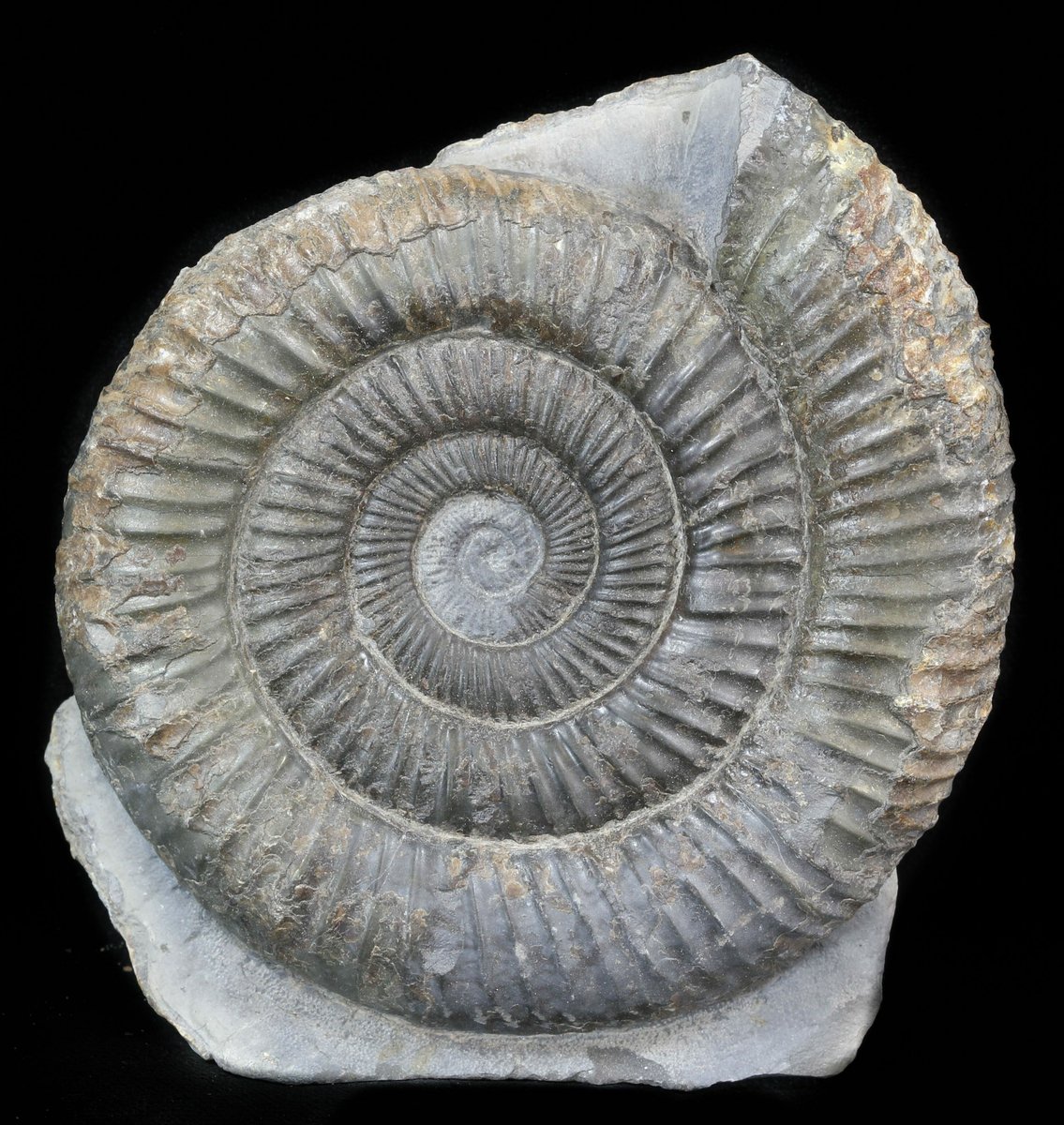
Dactylioceras commune
Image: Image sourced via web search (Fair use / Educational)
About Dactylioceras
Dactylioceras is an extinct genus of ammonite, a type of marine cephalopod mollusc, that thrived during the Toarcian Age of the Early Jurassic Period, approximately 183 to 175 million years ago. Its fossils are exceptionally common and well-preserved, particularly in the marine shales of Europe, making it one of the most recognizable and scientifically important index fossils for dating Jurassic strata. The distinctive, finely ribbed shell of Dactylioceras provides a classic example of ammonite morphology and has played a crucial role in our understanding of Mesozoic marine ecosystems and biostratigraphy.
The physical form of Dactylioceras is defined by its iconic, coiled, planispiral shell, which is typically evolute, meaning that the outer whorls only slightly overlap the inner ones, leaving the umbilicus (the central depression) wide and open. The shell diameter of the most common species, Dactylioceras commune, generally ranges from 2 to 15 centimeters, comparable in size to a modern-day coaster or a small plate. The shell is characterized by its numerous, fine, sharp, and straight or slightly curved ribs that cross the flanks of the whorls. These ribs are a key diagnostic feature, giving the genus its name, derived from the Greek 'daktylos' for finger, alluding to the finger-like branching of the ribs in some species. The shell was composed of aragonite and divided internally into a series of chambers by walls called septa. The living animal occupied only the final, largest chamber, known as the body chamber. A thin tube called a siphuncle ran through the septa, connecting all the chambers and allowing the ammonite to regulate gas and fluid levels to control its buoyancy, much like the modern nautilus. While soft tissues are rarely preserved, it is inferred that Dactylioceras possessed a head with large eyes, a sharp beak-like jaw for predation, and a ring of tentacles or arms for capturing prey and manipulation, similar to modern squids and octopuses.
As an active marine predator, Dactylioceras likely played a significant role in the Jurassic nectonic food web. Its diet probably consisted of small crustaceans, plankton, and possibly other small marine invertebrates or fish larvae that it could capture with its tentacles. The streamlined, discoidal shape of its shell suggests it was a relatively capable swimmer, using jet propulsion for locomotion. By forcefully expelling water from a muscular funnel (the hyponome), it could move through the water column, likely with the shell oriented vertically for stability. This method of movement, while not as fast as that of belemnites or modern squid, would have been sufficient for hunting small prey and evading some predators. Growth patterns, visible as fine lines on the shell surface between the prominent ribs, indicate that Dactylioceras grew by adding new shell material to the aperture of its body chamber. This incremental growth, recorded in the shell's structure, allows paleontologists to study its life history, suggesting a life cycle that may have spanned several years, culminating in a single reproductive event (semelparity), a strategy common in many modern cephalopods.
The world of Dactylioceras during the Toarcian was one of warm, shallow epicontinental seas that covered much of modern-day Europe. This period was marked by a significant marine transgression and a major oceanic anoxic event, which paradoxically may have contributed to the exceptional preservation of its fossils in oxygen-poor bottom sediments. Dactylioceras inhabited the open waters of these seas, sharing its environment with a diverse array of marine life. Its primary predators would have included large marine reptiles such as ichthyosaurs and plesiosaurs, whose fossilized stomach contents sometimes contain ammonite remains. It also faced threats from larger predatory fish and other cephalopods like belemnites. Dactylioceras itself was a mid-level predator, positioned above smaller zooplankton and crustaceans in the food web. It coexisted with other ammonite genera such as Harpoceras and Hildoceras, each occupying slightly different ecological niches, which helps paleontologists create a highly resolved biostratigraphic framework for the Toarcian stage. The seafloor below was home to bivalves, gastropods, crinoids, and brachiopods, forming a complex and dynamic ecosystem.
The discovery and study of Dactylioceras are intrinsically linked to the birth of geology and paleontology in 19th-century England. The first significant and scientifically described fossils were found along the Yorkshire coast, near towns like Whitby. These coastal cliffs, composed of the Whitby Mudstone Formation, have been eroding for centuries, revealing an incredible abundance of beautifully preserved ammonites. While local collectors had known of these 'snake stones' for generations, it was naturalists like George Young, Martin Simpson, and later the influential paleontologist Alpheus Hyatt who formally studied and classified them. The species Dactylioceras commune was first described by James Sowerby in 1815, though it was initially placed in the genus Ammonites. The genus Dactylioceras was formally established by Alpheus Hyatt in 1867, who recognized its distinct morphological characteristics. The sheer number of specimens collected from this region, housed in institutions like the Natural History Museum in London and the Whitby Museum, has made Dactylioceras a foundational taxon for Jurassic studies and a staple of fossil collections worldwide. There is no single 'type' specimen with a famous name like 'Sue', but rather a vast and well-documented fossil population that serves as the reference.
Dactylioceras holds immense evolutionary and stratigraphic significance. As a member of the Ammonitida, it represents a highly successful and diverse lineage of cephalopods that dominated the Mesozoic seas before their extinction alongside the non-avian dinosaurs 66 million years ago. Within the ammonites, Dactylioceras is the type genus for the family Dactylioceratidae, a group characterized by their evolute shells and distinctive ribbing. The rapid evolution and widespread geographic distribution of Dactylioceras species make them premier index fossils. The appearance of Dactylioceras tenuicostatum, for instance, is used globally to mark the base of the Toarcian Stage of the Jurassic Period. This high-resolution dating capability allows geologists to precisely correlate rock layers across continents, which is fundamental for resource exploration and understanding Earth's history. The evolutionary radiation of the Dactylioceratidae during the Toarcian is a classic example of adaptive radiation following an extinction event at the end of the Pliensbachian, demonstrating how new ecological opportunities can drive rapid diversification.
While Dactylioceras is a well-understood genus, some scientific debates persist, primarily concerning finer points of its taxonomy and paleoecology. The classification at the species level can be complex, with paleontologists debating whether certain variations in rib density and shell shape represent distinct species, subspecies, or simply ecophenotypic variation within a single, plastic species like D. commune. For example, forms previously assigned to separate species are now often considered variants reflecting different environmental conditions or stages of growth. There is also ongoing research into the exact function of the intricate ribbing on the shell. While it certainly added structural strength, it may also have played a hydrodynamic role, affecting stability and drag as the animal moved through the water. Recent studies using advanced imaging techniques and biomechanical modeling are attempting to better understand the life habits and swimming capabilities of Dactylioceras, refining our picture of this ancient cephalopod from a simple index fossil to a complex living organism.
The fossil record of Dactylioceras is nothing short of spectacular. Its fossils are found in abundance in Jurassic marine deposits across the globe, with major occurrences in England (especially the Yorkshire coast), Germany (the Posidonia Shale), France, Spain, and other parts of Europe, as well as in North America and Asia. The preservation is often excellent, with the original aragonitic shell material sometimes intact, though more commonly preserved as calcite replacements or pyrite impressions. The Whitby Mudstone and Posidonia Shale are famous Lagerstätten (sites of exceptional preservation), where fossils are not only numerous but also often retain fine details. It is common to find entire bedding planes covered with hundreds of Dactylioceras fossils, suggesting mass mortality events. These 'ammonite pavements' provide a powerful snapshot of the Jurassic seafloor. Both the coiled shell (phragmocone) and the body chamber are typically preserved together, providing a complete record of the animal's hard anatomy.
Culturally, Dactylioceras is one of the most iconic and recognizable of all fossils, second perhaps only to Tyrannosaurus rex or Triceratops. Its beautifully symmetric, ribbed form has made it a favorite among amateur fossil hunters and professional collectors alike. The 'snake stones' of Whitby folklore, where local legend claimed the ammonites were snakes turned to stone by Saint Hilda, are Dactylioceras fossils. This legend even led to the practice of carving snake heads onto the fossils to sell to tourists, a tradition dating back centuries. Major natural history museums around the world, including the Natural History Museum in London and the American Museum of Natural History in New York, feature prominent displays of Dactylioceras to illustrate Jurassic marine life and the concept of index fossils, making it a vital tool in public science education.
Classification
Time Period
Discovery
Location
Yorkshire, England
Formation
Whitby Mudstone Formation
Frequently Asked Questions
What is Dactylioceras?
Dactylioceras is an extinct genus of ammonite, a type of marine cephalopod mollusc, that thrived during the Toarcian Age of the Early Jurassic Period, approximately 183 to 175 million years ago. Its fossils are exceptionally common and well-preserved, particularly in the marine shales of Europe, mak...
When did Dactylioceras live?
Dactylioceras lived during the jurassic period of the mesozoic era approximately 183-175 million years ago.
Where was Dactylioceras discovered?
Fossils of Dactylioceras were discovered in Yorkshire, England in the Whitby Mudstone Formation.
What did Dactylioceras eat?
Dactylioceras was a carnivore. It lived in marine habitats.
What type of fossil is Dactylioceras?
Dactylioceras is preserved as a body fossil. The preservation quality is excellent.
Related Specimens
From the mesozoic era · body fossils