Leptoceratops
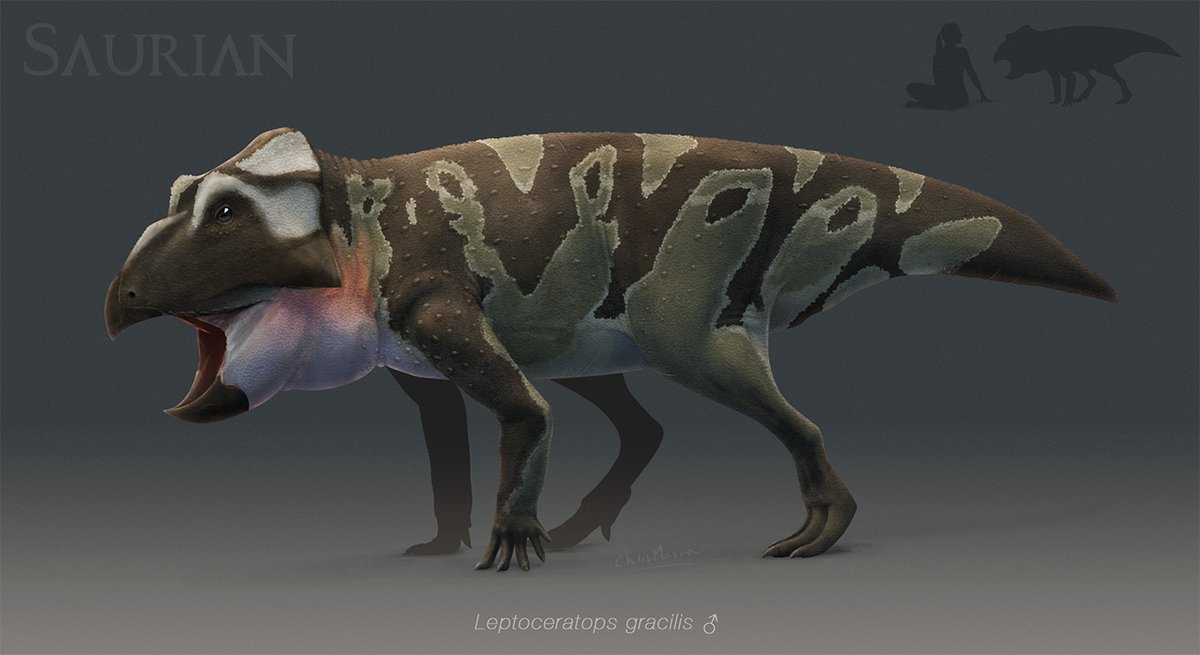
Leptoceratops gracilis
Image: Image sourced via web search (Fair use / Educational)
About Leptoceratops
Leptoceratops gracilis was a small, primitive ceratopsian dinosaur that lived during the late Maastrichtian stage of the Late Cretaceous period, approximately 68 to 66 million years ago. Roaming the ancient landscapes of what is now western North America, this remarkable herbivore represents a fascinating survival of a basal lineage alongside its much larger, heavily ornamented relatives like Triceratops. Its fossils have been primarily recovered from the Scollard Formation in Alberta, Canada, as well as the famous Hell Creek and Lance formations in the United States. In the broader context of paleontology, Leptoceratops is highly significant because it provides a crucial anatomical baseline for understanding the evolutionary trajectory of horned dinosaurs. Despite living at the very end of the age of dinosaurs, just before the Cretaceous-Paleogene extinction event, it retained a primitive body plan lacking the massive facial horns and expansive neck frills characteristic of the advanced ceratopsids, offering a unique window into the morphological diversity of late Mesozoic ecosystems.
In terms of physical description, Leptoceratops was a relatively small dinosaur, especially when compared to the gigantic ceratopsids that shared its environment. An adult Leptoceratops reached an approximate body length of 2 meters, or roughly 6.5 feet, and is estimated to have weighed between 68 and 200 kilograms, making it somewhat comparable in size and heft to a modern large wild boar or a small bear. Unlike the advanced ceratopsids, which were obligate quadrupeds, Leptoceratops possessed a skeletal structure that suggests it was capable of both bipedal and quadrupedal locomotion. Its forelimbs were robust but notably shorter than its powerful hind limbs, indicating that while it may have foraged on all fours, it could likely rear up or run on its hind legs when necessary. The skull of Leptoceratops was uniquely adapted, featuring a deep, parrot-like beak and a very short, thick neck frill that lacked the large fenestrae (openings) seen in many other ceratopsians. It completely lacked facial horns, possessing instead a solid, heavily built skull designed for powerful biting. The lower jaw was particularly deep and robust, housing tightly packed teeth that formed a specialized dental battery. Soft tissue inferences suggest it had a tough, scaly hide, possibly with quill-like structures on its tail or lower back, similar to those found in its earlier relative Psittacosaurus, though direct evidence of integument in Leptoceratops remains elusive. The overall build was compact and muscular, perfectly suited for navigating dense underbrush.
The paleobiology of Leptoceratops reveals a highly specialized herbivore adapted to processing tough, fibrous vegetation. Its powerful jaws and sharp, self-sharpening dental batteries were capable of shearing through thick cycads, ferns, and the increasingly abundant angiosperms (flowering plants) of the Late Cretaceous. Unlike the grinding motion used by modern mammalian herbivores, Leptoceratops utilized a vertical shearing action, with the upper and lower teeth sliding past each other like the blades of a pair of scissors to slice plant material into easily digestible pieces. Locomotion studies suggest that while it was not a rapid runner, its powerful hind legs provided enough agility to escape large predators. The ability to switch between quadrupedal and bipedal stances would have allowed it to forage at varying heights, from ground-level ferns to low-hanging branches. Social behavior in Leptoceratops is a subject of ongoing study; while there is no definitive evidence of large herd formations like those seen in Centrosaurus or Pachyrhinosaurus, the discovery of multiple individuals in close proximity in some formations suggests they may have lived in small family groups or loose aggregations. Growth patterns analyzed through bone histology indicate a relatively rapid growth rate during early life, slowing down as the animal reached sexual maturity, a common trait among many dinosaurs that needed to quickly outgrow the most vulnerable stages of life to avoid predation. Its metabolism was likely intermediate, possessing a higher metabolic rate than modern reptiles but perhaps not fully endothermic in the manner of modern birds or mammals.
The ecological context of the Late Cretaceous period in western North America, known as Laramidia, was one of lush, dynamic environments. The climate was generally warm, temperate to subtropical, with distinct wet and dry seasons. The landscape was dominated by coastal plains, meandering river systems, and dense floodplains bordered by the Western Interior Seaway, which was beginning to retreat during the Maastrichtian. Leptoceratops shared this rich habitat with an incredible array of iconic dinosaur species. It lived alongside massive herbivores such as the ceratopsid Triceratops, the hadrosaurid Edmontosaurus, and the heavily armored ankylosaur Ankylosaurus. As a smaller, low-browsing herbivore, Leptoceratops occupied a distinct ecological niche, likely feeding on the understory vegetation that the larger herbivores ignored or trampled. This niche partitioning allowed it to avoid direct competition for food resources. However, its small size also made it a prime target for the apex predators of the time, most notably the formidable Tyrannosaurus rex, as well as smaller, more agile dromaeosaurids like Acheroraptor and troodontids. To survive in an ecosystem teeming with predators, Leptoceratops likely relied on its cryptic coloration, agility, and the dense cover of the forest undergrowth to avoid detection, utilizing its powerful beak as a last resort for self-defense if cornered.
The discovery history of Leptoceratops is deeply intertwined with the golden age of North American paleontology. The first fossils of this genus were discovered in 1910 by the legendary paleontologist Barnum Brown during an expedition for the American Museum of Natural History. Brown unearthed the type specimen in the Scollard Formation along the banks of the Red Deer River in Alberta, Canada. He officially named the species Leptoceratops gracilis in 1914. The generic name Leptoceratops translates from Greek as 'slender horned face' (leptos meaning slender, keras meaning horn, and ops meaning face), a somewhat ironic name given its lack of prominent horns, but referring to its slender build compared to the massive ceratopsids known at the time. The specific epithet, gracilis, further emphasizes its graceful, lightly built form. For decades, the genus was known only from fragmentary remains, leading to some confusion regarding its exact appearance and classification. It wasn't until 1947 that Charles M. Sternberg discovered a spectacular, nearly complete skeleton in the same region of Alberta, which finally provided a comprehensive look at the animal's anatomy. Since then, additional specimens have been recovered from the Hell Creek Formation in Montana and the Lance Formation in Wyoming, expanding its known geographic range and confirming its presence up to the very end of the Cretaceous period. These well-preserved skeletons have made Leptoceratops one of the best-understood basal ceratopsians.
The evolutionary significance of Leptoceratops cannot be overstated, as it represents a crucial piece of the puzzle in understanding ceratopsian evolution. Taxonomically, it belongs to the family Leptoceratopsidae, a group of basal neoceratopsians that diverged from the main ceratopsian lineage before the evolution of the massive, horned ceratopsids. What makes Leptoceratops particularly fascinating is that it is a 'living fossil' of its own time; it retained a primitive, ancestral body plan while living alongside its highly derived, advanced cousins at the very end of the Mesozoic era. This indicates that the small, hornless, potentially bipedal ecological niche remained viable and successful for tens of millions of years. Leptoceratops helps paleontologists map the transitional features between early, bipedal forms like Psittacosaurus and the quadrupedal giants like Triceratops. Its skull morphology demonstrates the early development of the powerful shearing jaw mechanism that would become a hallmark of the entire ceratopsian clade. Furthermore, the presence of leptoceratopsids in both North America and Asia provides vital evidence for faunal interchange between these two landmasses via the Beringian land bridge during the Late Cretaceous, highlighting the complex biogeographical dynamics of the era.
Scientific debates surrounding Leptoceratops have historically focused on its locomotion and its exact phylogenetic placement. For many years, paleontologists debated whether Leptoceratops was strictly quadrupedal or capable of bipedalism. Early reconstructions often depicted it walking on all fours, heavily influenced by its relationship to the larger ceratopsids. However, detailed biomechanical analyses of its forelimb-to-hindlimb ratio and the structure of its pelvis and tail have led to a modern consensus that it was a facultative biped, able to walk on two legs when moving quickly but likely resting or foraging on all fours. Another area of ongoing debate involves the taxonomy of the Leptoceratopsidae family itself. As new, similar genera like Prenoceratops, Montanoceratops, and Udanoceratops have been discovered, researchers continually refine the phylogenetic trees to determine the exact evolutionary relationships and divergence times within the clade. Some recent controversies have also touched upon the extent of sexual dimorphism within the species, with researchers analyzing variations in skull depth and frill size to determine if these differences represent distinct sexes or merely individual variation and ontogenetic (growth-related) changes.
The fossil record of Leptoceratops is considered excellent, particularly for a small dinosaur, which are often less likely to be preserved than massive ones. Fossils have been predominantly found in the western interior of North America, spanning Alberta, Montana, and Wyoming. Currently, there are over a dozen well-documented specimens, ranging from isolated teeth and jaw fragments to nearly complete, articulated skeletons. The preservation quality in the Scollard and Hell Creek formations is often exceptional, allowing for detailed study of the cranial anatomy and postcranial skeleton. The robust nature of the Leptoceratops skull means that cranial material is the most typically preserved part of the animal, providing a wealth of data on its feeding mechanics. Famous fossil sites include the Red Deer River valley in Alberta, which has yielded some of the most pristine articulated skeletons, offering invaluable insights into the proportions and posture of the living animal. These high-quality specimens have made Leptoceratops a standard reference taxon for comparative anatomical studies of basal ornithischians.
In terms of cultural impact, while Leptoceratops may not share the superstar status of its contemporary Triceratops or its predator Tyrannosaurus rex, it holds a respected place in dinosaur literature and museum exhibits. It frequently appears in educational books and documentaries as a prime example of the diverse array of life that existed in the shadow of the giant dinosaurs. Notable displays of Leptoceratops can be found at the Royal Tyrrell Museum of Palaeontology in Alberta and the American Museum of Natural History in New York, where its skeleton helps illustrate the evolutionary progression of the horned dinosaurs. For the public and paleontology enthusiasts, Leptoceratops serves as a compelling reminder that the Late Cretaceous ecosystem was not just a land of titans, but a complex web of life filled with highly adapted, successful smaller animals that played crucial roles in their environment.
Classification
Time Period
Discovery
Location
Alberta, Canada
Formation
Scollard Formation
Frequently Asked Questions
What is Leptoceratops?
Leptoceratops gracilis was a small, primitive ceratopsian dinosaur that lived during the late Maastrichtian stage of the Late Cretaceous period, approximately 68 to 66 million years ago. Roaming the ancient landscapes of what is now western North America, this remarkable herbivore represents a fasci...
When did Leptoceratops live?
Leptoceratops lived during the cretaceous period of the mesozoic era approximately 68-66 million years ago.
Where was Leptoceratops discovered?
Fossils of Leptoceratops were discovered in Alberta, Canada in the Scollard Formation.
What did Leptoceratops eat?
Leptoceratops was a herbivore. It lived in terrestrial habitats.
What type of fossil is Leptoceratops?
Leptoceratops is preserved as a body fossil. The preservation quality is excellent.
Related Specimens
From the mesozoic era · body fossils