Kettneraspis
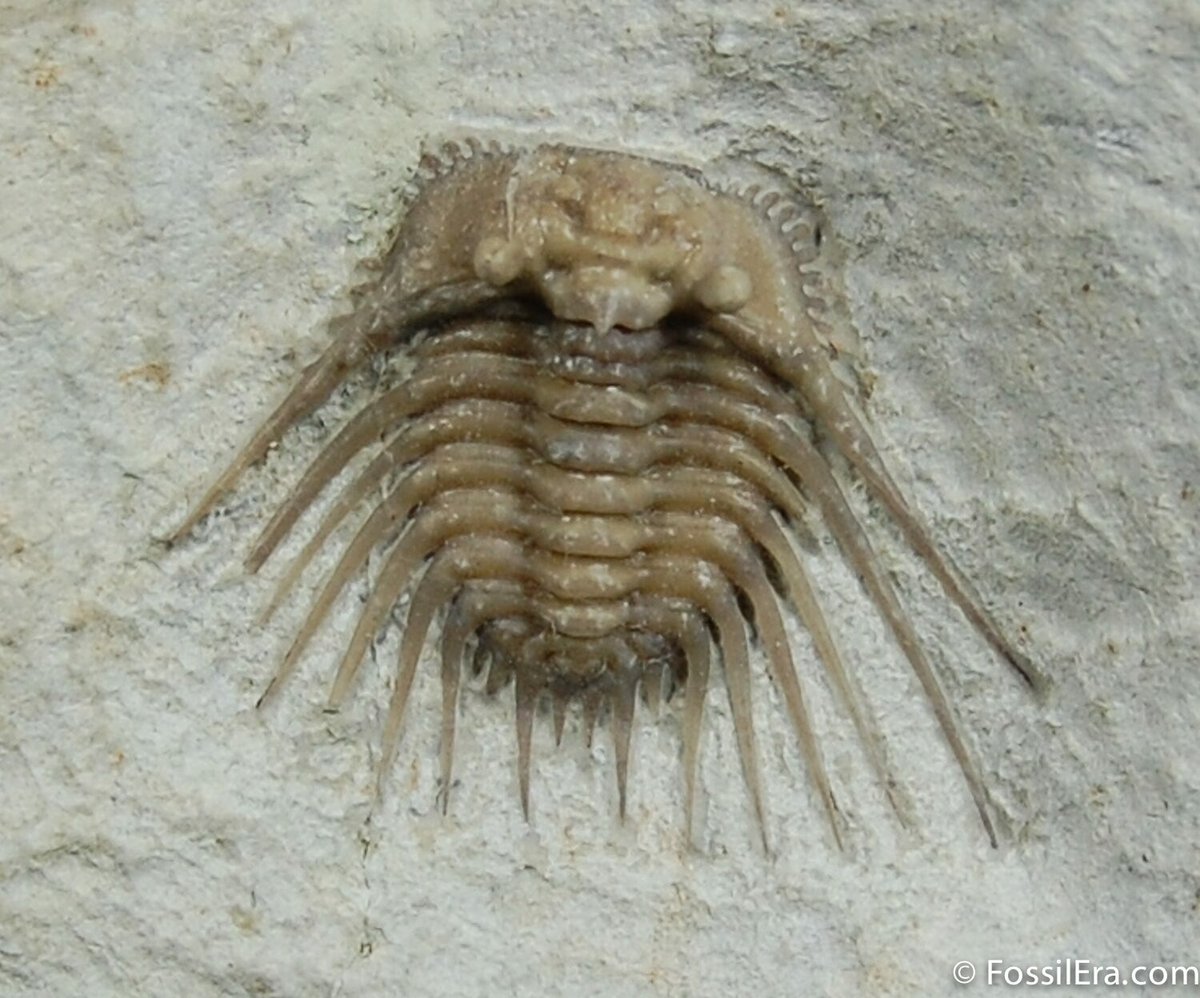
Kettneraspis williamsi
Image: Image sourced via web search (Fair use / Educational)
About Kettneraspis
Kettneraspis williamsi was a small, ornate trilobite that inhabited the warm, shallow seas of the Silurian period, approximately 430 to 420 million years ago. As a member of the order Lichida, it represents a highly specialized and visually striking lineage of these extinct marine arthropods. Its exquisitely preserved fossils, particularly from the Henryhouse Formation in Oklahoma, provide paleontologists with a detailed window into the complex reef ecosystems that flourished long before the age of dinosaurs.
Kettneraspis williamsi was a diminutive trilobite, with most complete specimens measuring between 2 and 4 centimeters in length. Despite its small size, its morphology was incredibly complex and elaborate, a hallmark of the lichid trilobites. The exoskeleton, or carapace, was highly tuberculate, covered in a dense array of bumps, granules, and spines that gave it a formidable, thorny appearance. The body was divided into the three characteristic trilobite lobes: a central axial lobe and two flanking pleural lobes. The cephalon, or head shield, was proportionally large and semicircular, dominated by prominent, crescent-shaped holochroal eyes composed of numerous calcite lenses, which would have provided a wide field of view. The glabella, the raised central part of the cephalon, was inflated and subdivided by deep furrows into a complex pattern of lobes, a diagnostic feature of the Lichidae family. Perhaps its most dramatic features were the long, elegant genal spines that curved backwards from the 'cheeks' of the cephalon, and the array of pygidial spines. The pygidium, or tail shield, was a spectacle of defensive architecture, featuring multiple pairs of sharp, backward-projecting spines of varying lengths. The thorax, situated between the cephalon and pygidium, typically consisted of 11 segments, each bearing axial spines and terminating in pointed pleural tips. This intricate spiny armor likely served a dual purpose: as a defense mechanism against predators and potentially as a hydrodynamic stabilizer, preventing the animal from sinking into soft seafloor sediment. Inferred soft tissues, such as delicate, jointed legs and antennae, are not preserved, but based on other exceptionally preserved trilobites, it would have possessed numerous pairs of biramous limbs used for walking, digging, and respiration.
The paleobiology of Kettneraspis williamsi is inferred from its morphology and the paleoenvironment in which its fossils are found. Its body plan suggests it was a benthic organism, living on or near the seafloor. The flattened, spiny exoskeleton and robust limbs would have been well-suited for navigating the complex topography of a Silurian reef environment, crawling over carbonate mounds, coral-like stromatoporoids, and through shelly debris. Its diet is believed to have been that of a detritivore or a scavenger. The mouth, located on the underside of the cephalon, was associated with a plate called the hypostome. The morphology of the lichid hypostome suggests it was not adapted for active predation but rather for scooping up or processing organic detritus, microorganisms, and decaying matter from the sediment. Kettneraspis likely used its numerous legs to stir up the substrate, filtering out edible particles. The elaborate spines may have also played a role in feeding, perhaps helping to channel food-bearing currents towards the mouth. There is no evidence for social behavior; like most trilobites, Kettneraspis was likely a solitary creature. Growth occurred through ecdysis, or molting, where the trilobite would shed its exoskeleton to grow larger. Disarticulated fossil parts are far more common than complete specimens, a testament to this life-long molting process. Its metabolism would have been that of a cold-blooded ectotherm, typical for marine invertebrates of the Paleozoic.
During the Silurian period, the world of Kettneraspis williamsi was one of warm, shallow epicontinental seas covering much of the paleocontinent of Laurentia, which included modern-day North America. The climate was generally stable and warm, fostering the development of the first extensive reef ecosystems on Earth. These were not built by modern corals but by a different cast of characters, including tabulate and rugose corals, stromatoporoid sponges, and calcareous algae. The Henryhouse Formation, where Kettneraspis is found, represents such an environment—a high-energy, carbonate-rich setting teeming with life. Kettneraspis shared its habitat with a diverse marine fauna. Co-existing species included other trilobite genera like Dalmanites and Calymene, brachiopods, crinoids (sea lilies) whose fossilized stems formed vast 'meadows', gastropods, bivalves, and early cephalopods such as nautiloids, which were among the apex predators of the time. Other potential predators for a small trilobite like Kettneraspis would have included early jawed fish (placoderms and acanthodians) and large eurypterids (sea scorpions). Within this complex food web, Kettneraspis occupied a low trophic level as a primary consumer or decomposer, playing a crucial role in nutrient cycling on the seafloor. Its spiny armor was its primary defense against the escalating predation pressures of the Silurian marine revolution.
The discovery history of Kettneraspis williamsi is intrinsically linked to the rich fossil beds of Oklahoma. The species was formally described in 1959 by the renowned paleontologist Alwyn Williams in his comprehensive monograph on the trilobites of the Henryhouse Formation. The specific epithet, *williamsi*, honors him. However, the genus *Kettneraspis* was first established by Bouček in 1936 for similar trilobites found in Bohemia (modern-day Czech Republic). For many years, the Oklahoma specimens were assigned to the genus *Leonaspis*. It was later work, particularly by trilobite specialists like Richard Fortey and Alan Shaw, that revised the classification and placed the species within *Kettneraspis*. The primary fossil locality is a site known as 'Black Cat Mountain' near St. Clair Lime Quarry in Oklahoma, a world-famous location for its abundance of silicified Silurian fossils. These fossils are preserved in limestone, and collectors and paleontologists use a weak acid solution (typically acetic or formic acid) to dissolve the surrounding rock matrix, leaving behind the perfectly preserved, three-dimensional silica-replaced exoskeletons. This exceptional preservation has made Kettneraspis williamsi a prized specimen for both scientific study and private collection, with the key holotypes and paratypes housed in major museum collections, including the Sam Noble Oklahoma Museum of Natural History.
As a member of the order Lichida, Kettneraspis williamsi occupies a significant branch on the arthropod tree of life. The lichids were a highly successful and diverse group of trilobites that thrived from the Ordovician to the Devonian. They are characterized by their spinose, tuberculate exoskeletons and complex glabellar lobation. Kettneraspis showcases the peak of this morphological specialization during the Silurian. Its elaborate armor is a prime example of the evolutionary arms race between predators and prey that intensified during the Paleozoic. The rise of more effective predators, such as jawed fish and eurypterids, drove the evolution of increasingly sophisticated defensive structures in trilobites and other invertebrates. Kettneraspis does not have any direct modern descendants, as the entire class Trilobita perished in the Permian-Triassic mass extinction event around 252 million years ago. Its closest living relatives are the chelicerates, a group that includes spiders, scorpions, and horseshoe crabs. Studying the intricate morphology of Kettneraspis helps paleontologists understand the developmental genetics (evo-devo) of arthropod segmentation and appendage formation, providing clues about the ancient genetic toolkit that governs the body plans of all arthropods today.
While the placement of Kettneraspis williamsi within the family Lichidae is secure, the finer points of lichid taxonomy have been a subject of ongoing scientific debate. The family itself is large and complex, and the precise relationships between genera like Kettneraspis, Leonaspis, Acidaspis, and others have been revised multiple times as new specimens are found and new analytical techniques are applied. The distinction between these genera often relies on subtle differences in the number and arrangement of spines, the pattern of glabellar furrows, and pygidial morphology. For a time, the North American species *williamsi* was considered part of the European genus *Leonaspis*. However, detailed comparative studies in the late 20th century highlighted consistent differences, particularly in the structure of the occipital ring and pygidial spines, leading to its current classification under *Kettneraspis*. These taxonomic revisions underscore the global distribution of trilobite families during the Paleozoic and the subtle regional variations that evolved as populations became isolated on different paleocontinents.
The fossil record of Kettneraspis williamsi is geographically localized but locally abundant. The vast majority of high-quality specimens come from the Henryhouse Formation of the Hunton Group in south-central Oklahoma, USA. Other species of Kettneraspis are known from Silurian and Devonian strata in other parts of the world, including Bohemia, Morocco, and other regions of North America, but *K. williamsi* is most famously associated with its Oklahoma type locality. The preservation quality at this site is often excellent to exceptional. The process of silicification, where the original calcite exoskeleton is replaced molecule-by-molecule with silica, allows for the preservation of incredibly fine details, including the delicate spines and surface granulation. Because these fossils can be chemically etched from their limestone matrix, complete, three-dimensional specimens are known, which is relatively rare for many fossil organisms. While thousands of individual parts (disarticulated sclerites) have been recovered, fully articulated, complete specimens remain uncommon and are highly valued by researchers and collectors alike.
Despite its small size, Kettneraspis williamsi has a notable cultural impact, particularly within the community of fossil enthusiasts and collectors. Its stunning, almost alien-like spiny appearance makes it one of a handful of 'celebrity' trilobites, alongside larger or more common genera like Elrathia, Phacops, and Isotelus. Its intricate, perfectly preserved three-dimensional form makes it a museum-quality showpiece. Exceptional specimens of Kettneraspis williamsi are displayed in natural history museums around the world, including the Sam Noble Oklahoma Museum of Natural History and the Smithsonian National Museum of Natural History. It serves as a powerful educational tool, beautifully illustrating the concepts of adaptation, extinction, and the incredible diversity of life that existed in Earth's ancient oceans. For many, it is a gateway fossil, sparking a lifelong interest in paleontology through its sheer aesthetic beauty and the tangible connection it provides to a deep, primordial past.
Classification
Time Period
Discovery
Location
Oklahoma, USA
Formation
Henryhouse Formation
Frequently Asked Questions
What is Kettneraspis?
Kettneraspis williamsi was a small, ornate trilobite that inhabited the warm, shallow seas of the Silurian period, approximately 430 to 420 million years ago. As a member of the order Lichida, it represents a highly specialized and visually striking lineage of these extinct marine arthropods. Its ex...
When did Kettneraspis live?
Kettneraspis lived during the silurian period of the paleozoic era approximately 430-420 million years ago.
Where was Kettneraspis discovered?
Fossils of Kettneraspis were discovered in Oklahoma, USA in the Henryhouse Formation.
What did Kettneraspis eat?
Kettneraspis was a detritivore. It lived in marine reef habitats.
What type of fossil is Kettneraspis?
Kettneraspis is preserved as a body fossil. The preservation quality is excellent.
Related Specimens
From the paleozoic era · body fossils
/7725c8fee486.jpg)