Deinosuchus
Deinosuchus riograndensis
Image: Image sourced via web search (Fair use / Educational)
About Deinosuchus
Deinosuchus was a colossal alligatoroid that inhabited the coastal and riverine environments of North America during the Late Cretaceous period, approximately 82 to 73 million years ago. As one of the largest crocodilians ever to have lived, it was an apex predator of its time, capable of preying on large dinosaurs. Its immense size and powerful bite make it a subject of significant paleontological interest, offering insights into the upper limits of crocodilian evolution and the dynamics of Cretaceous ecosystems.
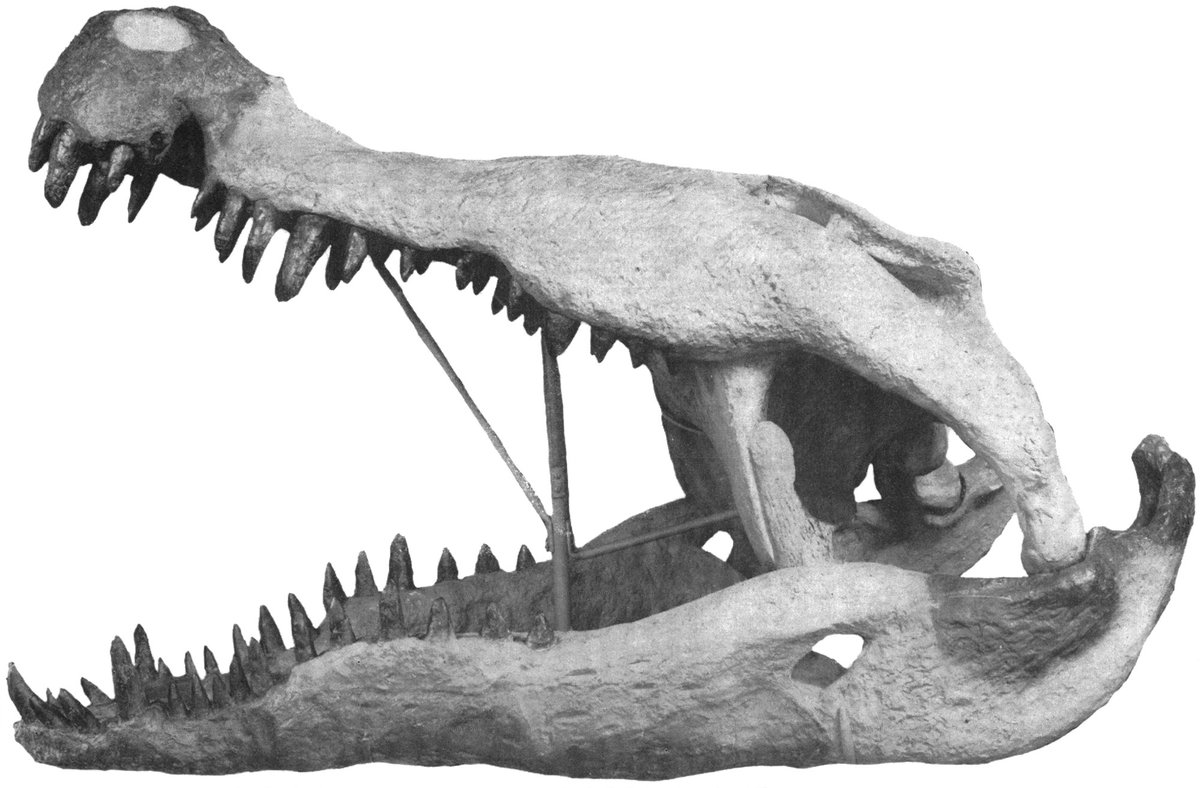
Deinosuchus was a truly gigantic reptile, with the largest individuals of species like Deinosuchus riograndensis estimated to have reached lengths of 10 to 12 meters (33 to 39 feet) and weighed between 5 and 8.5 metric tons. This places it on par with the largest saltwater crocodiles of today, but considerably more robust. Its skull alone could measure up to 1.5 meters (5 feet) in length. The skull was broad and alligator-like, but possessed several unique features, including a distinctively inflated, bulbous region at the tip of its snout around the external nares, the function of which remains uncertain but may have been related to vocalization or thermoregulation. Its teeth were thick, conical, and robust, resembling large railroad spikes, perfectly adapted for crushing bone and puncturing the tough hides of its prey. The back of Deinosuchus was covered in thick, heavy osteoderms (bony plates embedded in the skin), some of which were hemispherical and deeply pitted, forming a formidable suit of armor. These osteoderms would have provided protection from both predators and large, struggling prey. Its overall build was exceptionally powerful, with a massive torso and a long, muscular tail that would have propelled it through the water with immense force.
As an apex predator, Deinosuchus had a diet that likely included a wide variety of animals available in its semi-aquatic habitat. Its immense size and powerful jaws, capable of exerting one of the strongest bite forces of any known animal, allowed it to tackle very large prey. Fossil evidence, including tooth marks found on the bones of large tyrannosaurid dinosaurs like Albertosaurus and Appalachiosaurus, strongly suggests that Deinosuchus actively hunted these formidable terrestrial predators when they came to the water's edge to drink. It also preyed upon large hadrosaurs (duck-billed dinosaurs) and ceratopsians. Beyond dinosaurs, its diet would have been supplemented by large fish, sea turtles (fossilized turtle shells have been found with Deinosuchus bite marks), and smaller crocodilians. It was likely an ambush predator, similar to modern crocodilians, using the murky waters of its estuarine and riverine habitats to conceal its enormous body before launching a sudden, explosive attack. Studies of its growth rings in its osteoderms suggest a life history similar to modern alligators, but on a much grander scale, taking approximately 35 years to reach its maximum size and potentially living for over 50 years.
The world of Deinosuchus during the Campanian stage of the Late Cretaceous was a vastly different place. North America was divided by a large inland sea known as the Western Interior Seaway, creating two landmasses: Laramidia to the west and Appalachia to the east. Deinosuchus fossils are found on both sides, indicating it thrived in the warm, subtropical coastal plains, estuaries, and large river systems bordering this seaway. The climate was much warmer and more humid than today, supporting lush vegetation and a diverse array of fauna. In Appalachia, Deinosuchus shared its environment with hadrosaurs like Lophorhothon and tyrannosaurs like Appalachiosaurus. In Laramidia, its ecosystem included a richer dinosaur fauna, such as the ceratopsians Chasmosaurus and Pentaceratops, hadrosaurs like Kritosaurus, and tyrannosaurs like Teratophoneus. In these complex food webs, Deinosuchus occupied the highest trophic level in aquatic and near-shore environments, a keystone predator whose presence would have significantly shaped the behavior and distribution of other animals, particularly large herbivores and carnivores that needed access to water sources.
The history of Deinosuchus discovery begins in the mid-19th century. The first fossils were found in 1858 by geologist Ebenezer Emmons in the coalfields of Bladen County, North Carolina. He initially misidentified the large, conical teeth as belonging to a new species of the pliosaur Polyptychodon, which he named Polyptychodon rugosus. It wasn't until 1904 that paleontologist William Jacob Holland correctly identified similar remains from Montana as belonging to a giant crocodilian. Holland erected the new genus Deinosuchus, meaning 'terrible crocodile', and named the species Deinosuchus hatcheri. A more significant discovery came in 1940 when a team from the American Museum of Natural History, led by Barnum Brown, unearthed several large specimens in Big Bend National Park, Texas. These fossils, including large portions of skulls and postcranial material, provided the first clear picture of the animal's immense size and anatomy. This Texas material would later form the basis for the species Deinosuchus riograndensis, described by Colbert and Bird in 1954. To this day, the Big Bend specimens remain some of the most important and complete Deinosuchus fossils ever found.
Deinosuchus holds a crucial position in the evolutionary history of crocodilians. It belongs to the superfamily Alligatoroidea, placing it closer to modern alligators and caimans than to crocodiles or gharials. It represents an early, giant member of this lineage, demonstrating that the potential for gigantism within this group evolved relatively early. Its existence highlights a period of evolutionary experimentation in crocodilian body size during the Mesozoic, a trend also seen in other groups like the marine thalattosuchians and the terrestrial sebecosuchians. While not a direct ancestor of modern alligators, it is a side branch that showcases the peak of alligatoroid size and predatory capability. Studying Deinosuchus helps paleontologists understand the anatomical and physiological adaptations required for such extreme size in semi-aquatic reptiles, providing a vital data point for modeling the paleobiology of other giant archosaurs. Its specialized, robust dentition and broad snout are features that evolved convergently in other large crocodilians, illustrating a common adaptive solution for preying on megafauna.
Despite its fame, Deinosuchus has been the subject of several scientific debates. For many years, its exact size was a point of contention, with early estimates, sometimes exceeding 15 meters, now considered exaggerations based on flawed scaling from smaller relatives. More recent studies using more complete fossil material have constrained its maximum length to around 12 meters. Another significant debate revolves around its taxonomy. For decades, all North American material was assigned to a single species, Deinosuchus rugosus. However, a comprehensive 2020 study by Cossette and Brochu re-evaluated the known fossils and concluded that there were at least three distinct species: Deinosuchus hatcheri and Deinosuchus riograndensis from the western part of North America (Laramidia), and Deinosuchus schwimmeri from the eastern coastal plain (Appalachia). This revision suggests that the Western Interior Seaway may have acted as a barrier, leading to separate evolutionary paths for the eastern and western populations. The function of its bulbous snout tip also remains a topic of speculation, with no definitive consensus yet reached.
The fossil record of Deinosuchus is geographically widespread but often fragmentary. Fossils have been recovered from ten U.S. states, including Montana, Wyoming, Utah, Texas, Mississippi, Alabama, Georgia, North Carolina, and New Jersey, as well as from northern Mexico. This distribution traces the ancient coastlines of the Western Interior Seaway. While complete skeletons are unknown, the fossil record includes numerous isolated teeth, osteoderms, vertebrae, and, most importantly, several partial but well-preserved skulls from Texas and Montana. The quality of preservation is generally good, particularly for the robust skull bones and osteoderms, which are the most commonly found elements. The Big Bend National Park in Texas and the Aguja Formation are particularly famous sites for yielding significant Deinosuchus material that has been foundational to our understanding of the animal. The sheer number of isolated teeth found suggests that Deinosuchus was a relatively common component of its coastal ecosystems.
Deinosuchus has captured the public imagination as the ultimate 'dinosaur-killer', a real-life monster that embodies the perils of the Cretaceous world. It is frequently featured in television documentaries, including 'Walking with Dinosaurs' and 'Prehistoric Park', where it is often depicted in dramatic showdowns with large dinosaurs. Its impressive fossils are a major attraction in several museums. The American Museum of Natural History in New York features a famous composite skull reconstruction based on the Big Bend material, showcasing its terrifying size and power. Its role as an apex predator capable of challenging the largest terrestrial carnivores of its day makes it a powerful tool for science education, illustrating the complexity and ferocity of prehistoric food webs.
Classification
Time Period
Discovery
Location
United States (North Carolina)
Formation
Agua Nueva Formation, Aguja Formation, Blufftown Formation, Demopolis Chalk, Menefee Formation, Mesaverde Formation, San Carlos Formation, Tar Heel Formation, Upson Clay, Woodbury Formation
Frequently Asked Questions
What is Deinosuchus?
Deinosuchus was a colossal alligatoroid that inhabited the coastal and riverine environments of North America during the Late Cretaceous period, approximately 82 to 73 million years ago. As one of the largest crocodilians ever to have lived, it was an apex predator of its time, capable of preying on...
When did Deinosuchus live?
Deinosuchus lived during the cretaceous period of the mesozoic era approximately 82-73 million years ago.
Where was Deinosuchus discovered?
Fossils of Deinosuchus were discovered in United States (North Carolina) in the Agua Nueva Formation, Aguja Formation, Blufftown Formation, Demopolis Chalk, Menefee Formation, Mesaverde Formation, San Carlos Formation, Tar Heel Formation, Upson Clay, Woodbury Formation.
What did Deinosuchus eat?
Deinosuchus was a carnivore. It lived in semi-aquatic (estuarine, coastal marine, freshwater river systems) habitats.
What type of fossil is Deinosuchus?
Deinosuchus is preserved as a body fossil. The preservation quality is good.
Related Specimens
From the mesozoic era · body fossils
-slab/453736fb9032.jpg)