Dilophosaurus
Dilophosaurus wetherilli
Image: Image sourced via web search (Fair use / Educational)
About Dilophosaurus
Dilophosaurus wetherilli was a large, bipedal carnivorous dinosaur that roamed the terrestrial landscapes of North America during the Early Jurassic period, approximately 193 to 190 million years ago. As one of the earliest known large predatory dinosaurs, Dilophosaurus represents a crucial transitional phase in theropod evolution, bridging the gap between the smaller, more basal carnivores of the Late Triassic and the massive apex predators that would later dominate the Mesozoic era. The genus name, meaning 'two-crested lizard,' refers to the spectacular pair of longitudinal bony crests adorning its skull, a feature that has made it one of the most instantly recognizable dinosaurs in the world. Living in what is now the southwestern United States, specifically within the geological bounds of the Kayenta Formation, Dilophosaurus was the undisputed apex predator of its ecosystem. Its discovery and subsequent study have provided paleontologists with invaluable insights into the early diversification, anatomical experimentation, and ecological dominance of neotheropod dinosaurs following the Triassic-Jurassic extinction event.
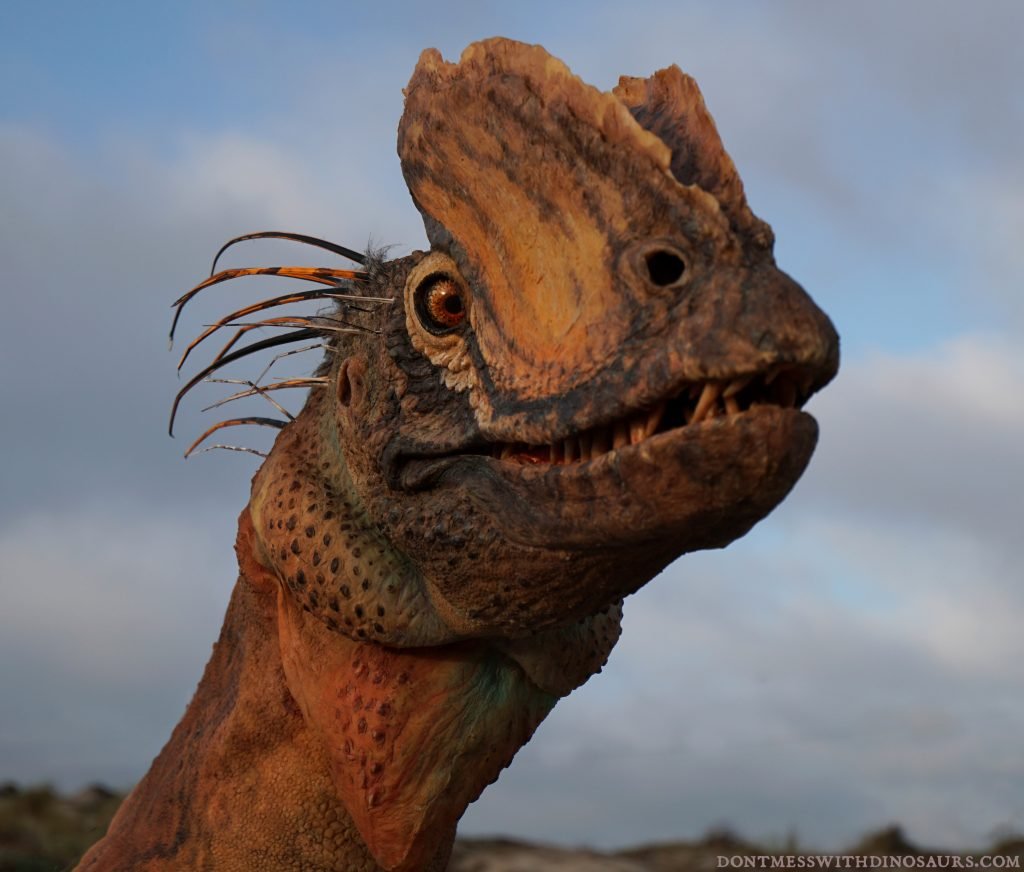
In terms of physical description, Dilophosaurus was a remarkably large animal for its time, measuring approximately 7 meters (23 feet) in length and weighing an estimated 400 kilograms (about 880 pounds). This size made it significantly larger than its Triassic predecessors and comparable in mass to a modern adult grizzly bear, though distributed over a much longer, more slender, and agile bipedal frame. The most distinctive anatomical feature of Dilophosaurus was undoubtedly its cranial ornamentation: a pair of thin, parallel, semi-circular crests extending longitudinally along the roof of the skull. These crests were formed primarily by extensions of the premaxillary and nasal bones, and they were highly pneumatized, meaning they were honeycombed with air pockets, making them incredibly light despite their large surface area. Another notable cranial feature was the pronounced subnarial gap, or 'kink,' in its upper jaw—a distinct notch between the premaxilla and maxilla bones. For decades, this notch led scientists to believe the animal had a weak bite, but recent biomechanical studies have shown the surrounding bone was actually quite robust. The postcranial skeleton of Dilophosaurus was characterized by long, powerful hindlimbs built for sustained running, a long, stiffened tail that acted as a dynamic counterbalance, and relatively long, muscular forelimbs equipped with three grasping fingers ending in sharp, recurved claws. Unlike the highly fictionalized depictions in popular media, there is absolutely no anatomical evidence to suggest Dilophosaurus possessed a fleshy neck frill or the biological apparatus required to spit venom.
The paleobiology of Dilophosaurus paints a picture of a highly active, visually oriented, and formidable macropredator. Its diet consisted primarily of the large herbivorous dinosaurs and other vertebrates that shared its environment. The robust nature of its jaws, combined with its large, serrated, blade-like teeth, indicates it was fully capable of tackling substantial prey, dispatching them with powerful, flesh-tearing bites. The strong forelimbs and grasping hands would have been instrumental in grappling with and subduing struggling victims. The function of the iconic cranial crests has been the subject of much scientific inquiry. Because the crests were too fragile for physical combat or defense, paleontologists widely agree they served primarily as visual display structures. These crests may have been brightly colored in life and used for species recognition, intimidating rivals, or attracting mates, functioning similarly to the elaborate plumage of modern birds or the antlers of extant cervids. Furthermore, the extensive pneumatization of the skull and crests suggests a complex respiratory system, likely featuring avian-style air sacs that would have provided highly efficient oxygen exchange, supporting a high metabolic rate and an active, warm-blooded (endothermic) lifestyle. Growth ring analysis of Dilophosaurus limb bones indicates that these animals grew rapidly during their early years, reaching adult size much faster than modern reptiles, further supporting the hypothesis of an elevated, bird-like metabolism.
The ecological context of the Early Jurassic world inhabited by Dilophosaurus was one of dynamic environmental shifts and evolving faunal assemblages. The Kayenta Formation, where its fossils are exclusively found, represents a paleoenvironment characterized by a seasonal, semi-arid climate with distinct wet and dry periods. The landscape was dominated by braided river systems, expansive floodplains, and temporary lakes, bordered by gallery forests of conifers, cycads, and ferns. In this riparian ecosystem, Dilophosaurus occupied the very top of the food web. It coexisted with a diverse array of animals, including early armored dinosaurs like Scutellosaurus, early sauropodomorphs such as Sarahsaurus, and smaller, more basal theropods like Megapnosaurus. The presence of these varied herbivores provided a rich and abundant prey base for Dilophosaurus. Additionally, the waterways of the Kayenta environment were populated by early turtles, heavily armored fish, and large temnospondyl amphibians, which may have occasionally supplemented the diet of this opportunistic predator. The evolutionary arms race between Dilophosaurus and its prey likely drove the development of defensive adaptations in contemporary herbivores, such as the dermal armor seen in Scutellosaurus, while Dilophosaurus itself evolved greater size and more efficient predatory adaptations to maintain its status as the apex carnivore.
The discovery history of Dilophosaurus is a fascinating chapter in American paleontology, beginning in the rugged landscapes of the Navajo Nation in northern Arizona. In 1942, a Navajo man named Jesse Williams discovered the first significant fossil remains of the animal and subsequently guided a team from the University of California Museum of Paleontology (UCMP), led by paleontologist Samuel P. Welles, to the site. The initial excavation yielded three partial skeletons. Because the delicate cranial crests were not preserved or recognized in these early specimens, Welles originally described the animal in 1954 as a new species of the European genus Megalosaurus, naming it Megalosaurus wetherilli in honor of John Wetherill, a local trading post operator who had facilitated the expedition. It was not until over a decade later, in 1964, that Welles returned to the area and discovered a new, more complete specimen that clearly preserved the spectacular double crests. Realizing this was an entirely different and previously unknown type of dinosaur, Welles erected the new genus Dilophosaurus in 1970. The holotype specimen, UCMP 37302, remains one of the most important theropod fossils of the Early Jurassic. The collaborative relationship between the Navajo Nation and paleontological institutions has continued to be vital for ongoing discoveries in the region.
The evolutionary significance of Dilophosaurus cannot be overstated, as it occupies a critical basal position within the neotheropod lineage. Neotheropoda is the massive clade that encompasses all advanced theropod dinosaurs, including the massive allosauroids, the tyrannosauroids, and ultimately, modern birds. Dilophosaurus lived during a time when theropods were transitioning from the small, lightly built forms of the Triassic, such as Coelophysis, to the giant, robust apex predators that would characterize the later Jurassic and Cretaceous periods. Anatomically, Dilophosaurus exhibits a mosaic of primitive and derived features. While it retains some basal characteristics in its postcranial skeleton, its large body size, complex cranial pneumatization, and specialized feeding apparatus foreshadow the evolutionary trajectories of later theropod groups. For many years, the exact phylogenetic placement of Dilophosaurus was highly contentious, with some researchers grouping it with the coelophysids and others placing it closer to the averostrans (the group containing Ceratosauria and Tetanurae). Modern cladistic analyses, bolstered by recent comprehensive re-evaluations of its anatomy, firmly position Dilophosaurus as an early-diverging neotheropod, slightly more derived than the coelophysids but basal to the averostrans, making it a vital keystone species for understanding the early evolutionary radiation of predatory dinosaurs.
Scientific debates surrounding Dilophosaurus have been vigorous, particularly regarding its feeding ecology and jaw mechanics. For decades, the prevailing hypothesis, heavily influenced by early descriptions of the subnarial gap, was that Dilophosaurus possessed a weak bite force. This led to widespread speculation that it was primarily a scavenger, incapable of bringing down large prey, or that it specialized in catching small fish. However, a landmark 2020 study by paleontologists Adam Marsh and Timothy Rowe completely revolutionized our understanding of this animal. By conducting a comprehensive anatomical re-description using modern techniques, including CT scanning of the original fossils, Marsh and Rowe demonstrated that the bones surrounding the premaxillary notch were actually heavily reinforced and deeply anchored. Their research proved conclusively that Dilophosaurus had a powerful bite capable of subduing and dismembering large, struggling prey, firmly re-establishing it as a formidable apex macropredator rather than a weak-jawed scavenger. This study also resolved long-standing taxonomic confusion by confirming that several different specimens previously thought to represent multiple species or genera all belonged to a single, highly variable species, Dilophosaurus wetherilli.
The fossil record of Dilophosaurus is relatively sparse but of exceptionally high scientific quality. To date, all confirmed specimens of Dilophosaurus wetherilli have been recovered from the Kayenta Formation within the Navajo Nation in Arizona. The known fossil material consists of several partial to nearly complete skeletons, including multiple well-preserved skulls. The preservation quality of these specimens is generally good, though the delicate nature of the cranial crests means they are often found crushed, distorted, or incomplete, requiring careful preparation and reconstruction. The UCMP houses the most significant collection of Dilophosaurus material, including the holotype and the famous crested specimen discovered in 1964. More recently, additional fragmentary remains have been discovered in the same region, contributing to a broader understanding of the animal's ontogeny (growth and development) and individual variation. The restricted geographic and stratigraphic range of Dilophosaurus fossils makes it an important index fossil for dating the specific rock layers of the Kayenta Formation and correlating them with other Early Jurassic geological deposits worldwide.
The cultural impact of Dilophosaurus is immense, largely due to its prominent and highly fictionalized appearance in Michael Crichton's 1990 novel 'Jurassic Park' and Steven Spielberg's blockbuster 1993 film adaptation. The film depicted Dilophosaurus as a dog-sized creature possessing a retractable, brightly colored neck frill and the ability to spit blinding venom at its prey. While these creative liberties made for thrilling cinema, they have no basis in paleontological fact; the real Dilophosaurus was vastly larger, lacked a frill, and was not venomous. Despite these inaccuracies, the film catapulted Dilophosaurus into global pop culture stardom, making it one of the most famous dinosaurs in the public consciousness. This immense popularity has ultimately benefited paleontology by driving public interest, funding, and museum attendance. Today, scientifically accurate skeletal mounts and life reconstructions of Dilophosaurus are proudly displayed in major institutions, such as the University of California Museum of Paleontology and the American Museum of Natural History, serving as powerful educational tools to teach the public about the realities of dinosaur anatomy, the scientific method, and the ever-evolving nature of paleontological discovery.
Classification
Time Period
Discovery
Location
Navajo Nation, Arizona, United States
Formation
Kayenta Formation
Frequently Asked Questions
What is Dilophosaurus?
Dilophosaurus wetherilli was a large, bipedal carnivorous dinosaur that roamed the terrestrial landscapes of North America during the Early Jurassic period, approximately 193 to 190 million years ago. As one of the earliest known large predatory dinosaurs, Dilophosaurus represents a crucial transiti...
When did Dilophosaurus live?
Dilophosaurus lived during the jurassic period of the mesozoic era approximately 193-190 million years ago.
Where was Dilophosaurus discovered?
Fossils of Dilophosaurus were discovered in Navajo Nation, Arizona, United States in the Kayenta Formation.
What did Dilophosaurus eat?
Dilophosaurus was a carnivore. It lived in terrestrial habitats.
What type of fossil is Dilophosaurus?
Dilophosaurus is preserved as a body fossil. The preservation quality is good.
Related Specimens
From the mesozoic era · body fossils