Eudimorphodon
Eudimorphodon ranzii
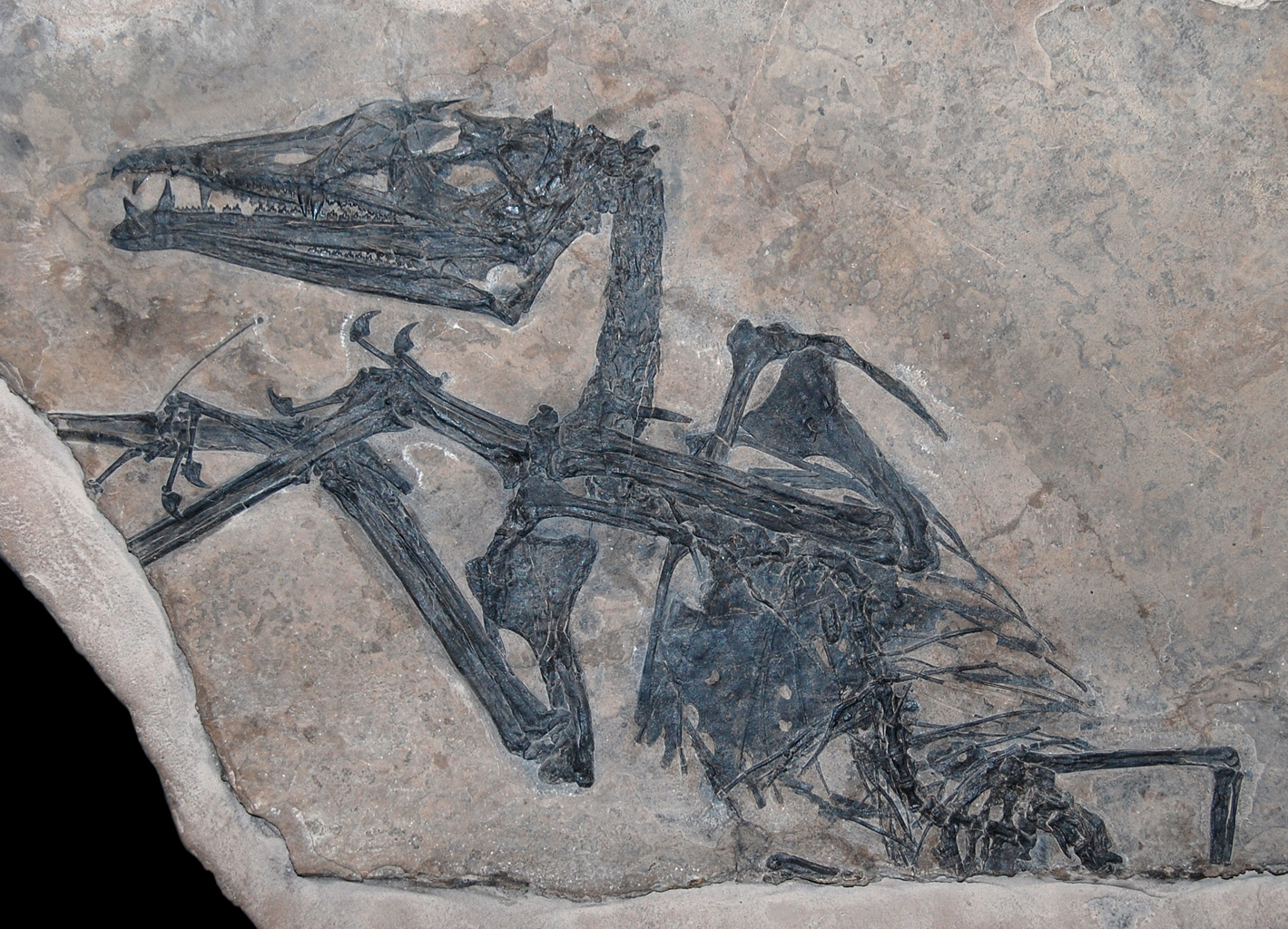
Image: File:Eudimorphodon.jpg - Wikimedia Commons (CC BY-SA)
About Eudimorphodon
Eudimorphodon ranzii stands as one of the most significant and well-understood of the earliest known pterosaurs, a group of pioneering flying reptiles that dominated the skies of the Mesozoic Era. Living during the Late Triassic period, approximately 210 to 203 million years ago, this creature provides a crucial, albeit already highly specialized, glimpse into the dawn of vertebrate powered flight. Discovered in the fossil-rich Zorzino Limestone of northern Italy, Eudimorphodon's remarkably preserved remains have offered paleontologists invaluable data on the anatomy, diet, and evolutionary standing of the first vertebrates to truly conquer the air.
The physical anatomy of Eudimorphodon reveals a creature exquisitely adapted for an aerial lifestyle, yet retaining certain primitive characteristics. It was a relatively small pterosaur, with a wingspan measuring approximately 100 centimeters (about 3.3 feet), comparable to that of a modern gull or a large crow. Its body was lightly built to minimize weight, a critical requirement for flight, with estimates placing its mass at only a few kilograms. The wings were formed by a membrane of skin, muscle, and other tissues, known as a patagium, which stretched from the side of its body to the tip of a dramatically elongated fourth finger on each hand. This structure, a hallmark of all pterosaurs, was supported by hollow, yet strong, bones. Eudimorphodon also possessed a very long tail, which was stiffened by a network of interwoven bony rods, or ossified tendons. This rigid tail terminated in a distinctive diamond-shaped, fleshy vane, which is believed to have acted as a rudder or stabilizer, providing crucial aerodynamic control during flight, particularly for making sharp turns or adjusting pitch. Unlike many later, more advanced pterosaurs that reduced or lost their tails, this feature highlights Eudimorphodon's basal position within the pterosaur lineage.
The most defining and scientifically informative feature of Eudimorphodon is its highly specialized and complex dentition, from which its name, meaning "true dimorphic tooth," is derived. Unlike the simple, conical teeth of many later pterosaurs, Eudimorphodon possessed a formidable and varied dental arsenal. At the front of its long, slender jaws were several large, fang-like teeth, perfectly suited for snagging and holding onto slippery prey. Further back, the jaws were lined with a battery of smaller, more complex teeth, each bearing multiple cusps—typically three to five points per tooth. This heterodont condition, with different tooth shapes in different parts of the jaw, is a relatively primitive trait among reptiles but was highly refined in this species. This intricate dental morphology strongly suggested a specialized diet, a hypothesis that was spectacularly confirmed by direct fossil evidence. The holotype specimen of Eudimorphodon ranzii was found with fossilized stomach contents, including the scales of the fish genus Parapholidophorus. This discovery provided unequivocal proof that Eudimorphodon was a piscivore, using its fangs to capture fish from the water and its multi-cusped back teeth to process them before swallowing. Its feeding strategy likely involved flying low over the water's surface, similar to a modern skimmer or tern, and snatching fish with a quick dip of its head. On the ground, its locomotion is thought to have been quadrupedal, walking on its hindlimbs and the knuckles of its folded wings, although debate continues on the exact posture and efficiency of its terrestrial movement.
Eudimorphodon inhabited a specific and well-documented paleoenvironment during the Norian age of the Late Triassic. The Zorzino Limestone, where its fossils are found, was deposited in a series of deep, anoxic marine basins surrounded by a shallow carbonate platform, dotted with small islands and reefs. This setting was part of the vast Tethys Sea, a tropical ocean that separated the supercontinents of Laurasia and Gondwana. The climate was warm and monsoonal. The anoxic (oxygen-poor) conditions at the bottom of these basins were inhospitable to scavengers, leading to the exceptional preservation of organisms that sank there after death. Eudimorphodon shared this ecosystem with a rich diversity of marine and terrestrial life. The waters teemed with fish like Parapholidophorus and Saurichthys, as well as marine reptiles such as the bizarre, long-necked protorosaur Tanystropheus and the nothosaur Nothosaurus. In the air, it may have coexisted with other early pterosaurs, such as Peteinosaurus, which was found in the same geological formation. On the nearby islands, small terrestrial reptiles like the drepanosaur Megalancosaurus, an arboreal creature with a prehensile tail, likely lived. Within this complex food web, Eudimorphodon occupied the niche of a specialized aerial piscivore, a predator that exploited the abundant fish resources of the shallow Tethyan lagoons and coastal waters.
The discovery of Eudimorphodon is a landmark event in the history of paleontology. The first and most important specimen, the holotype MCSNB 2888, was unearthed in 1973 by Mario Pandolfi during quarrying operations for limestone slabs near the town of Cene in the province of Bergamo, Italy. The fossil was brought to the attention of paleontologist Rocco Zambelli of the Bergamo Natural History Museum. Later that year, the renowned paleontologist Rupert Wild was invited to study the specimen. Recognizing its immense scientific value, Wild formally described the species in a 1978 publication, naming it Eudimorphodon ranzii. The generic name, Eudimorphodon, was chosen to highlight its "true dimorphic teeth," distinguishing it from other pterosaurs known at the time. The specific name, ranzii, honors Professor Silvio Ranzi for his contributions to Italian biology and paleontology. The holotype is a nearly complete and articulated skeleton of an adult individual, preserved in stunning detail on a limestone slab. Since this initial find, several other Eudimorphodon specimens, including juveniles, have been recovered from the same Zorzino Limestone formation and other contemporaneous sites in northern Italy, providing a more complete picture of its anatomy and life history.
From an evolutionary perspective, Eudimorphodon is a cornerstone species for understanding the origins of pterosaurs. When it was discovered, it was the oldest pterosaur known, pushing the fossil record of the group deep into the Triassic. Despite its great age, it was already a fully realized flying animal, with all the key adaptations for powered flight—elongated fourth finger, patagium, and lightweight skeleton—firmly in place. This indicates that the true origins of pterosaurs, and the evolutionary steps leading to flight, must have occurred even earlier in the Triassic, a period from which fossils of their immediate ancestors remain elusive. Eudimorphodon is classified as a basal, non-pterodactyloid pterosaur, but its exact placement within the pterosaur family tree has been a subject of ongoing research. Initially considered a member of the family Rhamphorhynchidae, it is now often placed in its own family, Eudimorphodontidae. Its combination of advanced flight features with primitive traits like a long, stiff tail and complex, multi-cusped teeth provides a vital reference point for tracing the subsequent diversification of pterosaurs throughout the Mesozoic, from the long-tailed rhamphorhynchoids of the Jurassic to the giant, short-tailed pterodactyloids of the Cretaceous.
The study of Eudimorphodon has not been without scientific debate, primarily concerning its taxonomic relationships. For many years, several other Triassic pterosaur species from around the world, including specimens from Greenland and the United States, were assigned to the genus Eudimorphodon based on general similarities. However, more detailed comparative studies, particularly focusing on the unique dental morphology, have led to a significant revision. Paleontologist Fabio Marco Dalla Vecchia, a leading expert on Italian Triassic reptiles, has argued convincingly that the genus Eudimorphodon should be restricted to the specimens found in the Zorzino Limestone of Italy. Other fossils previously attributed to it have since been reclassified into new genera, such as Carniadactylus. This taxonomic refinement has sharpened our understanding of pterosaur diversity in the Late Triassic, suggesting that multiple distinct lineages of flying reptiles had already evolved and spread across the globe by this time. Another area of discussion involves the function of its multi-cusped teeth, with some researchers suggesting they may have also been used to crush the exoskeletons of insects or small crustaceans in addition to processing fish.
The fossil record of Eudimorphodon ranzii is geographically constrained but exceptionally informative. All confirmed specimens have been discovered in the Norian-age alpine deposits of northern Italy, primarily the Zorzino Limestone. This formation has yielded at least seven known specimens, ranging from fully grown adults to small juveniles. The quality of preservation is often extraordinary, a result of the rapid burial in anoxic marine sediments. Skeletons are frequently found fully articulated, with delicate structures like the thin wing bones, the tail vane, and even stomach contents intact. This high-fidelity preservation has allowed for detailed biomechanical studies of its flight capabilities and precise reconstructions of its diet. The discovery of juvenile specimens has also provided insights into the growth, or ontogeny, of early pterosaurs, showing how their proportions changed as they matured. The fossil sites around Bergamo, Italy, thus represent a critical window, or Lagerstätte, into the world of the very first flying vertebrates.
Although not as widely recognized by the public as its larger Jurassic and Cretaceous relatives like Pteranodon or Quetzalcoatlus, Eudimorphodon holds a place of honor in paleontological circles and museum collections. The holotype specimen is a prized possession of the Museo di Scienze Naturali Enrico Caffi in Bergamo, where it serves as a centerpiece for exhibits on local prehistory. Casts and reconstructions of Eudimorphodon are featured in natural history museums worldwide to illustrate the early stages of pterosaur evolution. Its discovery and unique anatomy are consistently highlighted in paleontological textbooks and scientific documentaries about the evolution of flight, cementing its role as a key educational tool for explaining one of the most remarkable evolutionary transitions in the history of life.
Classification
Time Period
Discovery
Location
Bergamo, Italy
Formation
Zorzino Limestone
Frequently Asked Questions
What is Eudimorphodon?
Eudimorphodon ranzii stands as one of the most significant and well-understood of the earliest known pterosaurs, a group of pioneering flying reptiles that dominated the skies of the Mesozoic Era. Living during the Late Triassic period, approximately 210 to 203 million years ago, this creature provi...
When did Eudimorphodon live?
Eudimorphodon lived during the triassic period of the mesozoic era approximately 210-203 million years ago.
Where was Eudimorphodon discovered?
Fossils of Eudimorphodon were discovered in Bergamo, Italy in the Zorzino Limestone.
What did Eudimorphodon eat?
Eudimorphodon was a carnivore. It lived in aerial/coastal habitats.
What type of fossil is Eudimorphodon?
Eudimorphodon is preserved as a body fossil. The preservation quality is exceptional.
Related Specimens
From the mesozoic era · body fossils
/cc86f4a1bc00.jpg)