Dimorphodon
Dimorphodon macronyx
Image: Image sourced via web search (Fair use / Educational)
About Dimorphodon
Dimorphodon macronyx was a medium-sized, early pterosaur that inhabited the coastal regions of what is now Europe during the Early Jurassic period, approximately 195 to 190 million years ago. As one of the first pterosaurs to be scientifically described, it holds a significant place in the history of paleontology, offering crucial insights into the early evolution and diversity of these pioneering flying reptiles. Its unusual combination of a large, robust skull and a relatively primitive body plan has made it a subject of enduring scientific interest and debate regarding its lifestyle and capabilities.
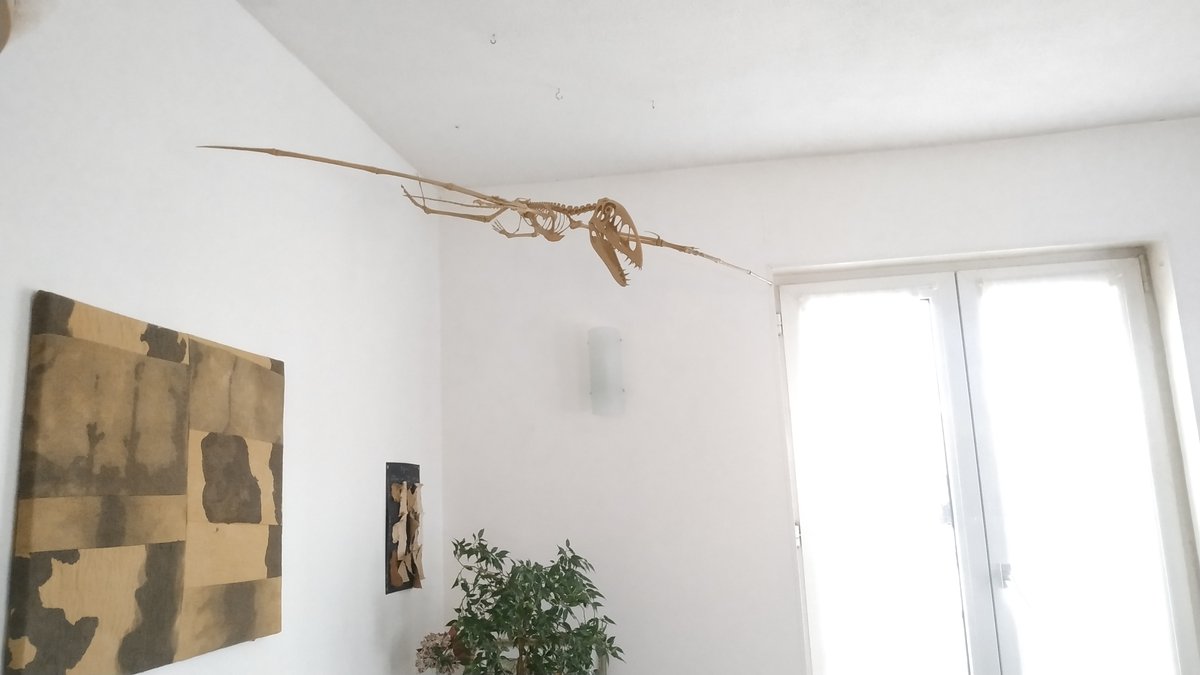
Dimorphodon possessed a unique and somewhat paradoxical anatomy. It had a wingspan of about 1.4 meters (4.6 feet) and a total body length, including its long tail, of around 1 meter (3.3 feet). Its most striking feature was its disproportionately large and deep skull, which measured up to 23 centimeters (9 inches) long, giving it a somewhat top-heavy, puffin-like appearance. This skull was not a solid, heavy structure; instead, it was lightened by several large openings, or fenestrae, a common adaptation in pterosaurs and archosaurs. The name Dimorphodon, meaning 'two-form tooth', refers to its distinct dentition: it had long, fang-like teeth at the front of its jaws, likely for grasping prey, followed by smaller, flatter, and more blade-like teeth further back, possibly for processing food. Its limbs were also distinctive. The forelimbs were adapted into wings, with a greatly elongated fourth finger supporting a leathery membrane, or patagium. The hind limbs were relatively long and robust, and the species name, 'macronyx', meaning 'large claw', refers to the powerful claws on its feet. Unlike later, more advanced pterosaurs, Dimorphodon retained a long, bony tail, which was stiffened by a network of ossified tendons and likely ended in a small, diamond-shaped vane that acted as a stabilizer during flight.
The paleobiology of Dimorphodon has been a topic of considerable discussion, primarily revolving around its locomotion and diet. Its robust hind limbs and well-developed claws initially led some paleontologists, such as Kevin Padian, to suggest it was a capable terrestrial animal, able to run bipedally with agility, using its wings folded up at its sides. This hypothesis proposed that Dimorphodon was a fast-moving ground predator, snatching small vertebrates and insects. However, more recent analyses of its limb proportions and joint mechanics suggest that while it could move on the ground, it was likely a rather clumsy quadruped, similar to modern bats, rather than an agile bipedal runner. Its flight capabilities have also been debated. While certainly able to fly, its relatively short wings and stocky build suggest it was not a soaring specialist like later pterosaurs. Instead, it likely engaged in active, flapping flight over short distances, perhaps fluttering between trees or along coastal cliffs. Its diet is inferred from its dual-form teeth. The long front fangs were well-suited for seizing slippery prey, leading to popular theories that it was a piscivore, catching fish from the sea. However, its robust jaw structure and stronger bite force compared to other early pterosaurs might also indicate a diet of terrestrial vertebrates, such as small lizards, early mammals, and large insects. It is most likely that Dimorphodon was an opportunistic generalist, feeding on a variety of small animals available in its coastal habitat.
During the Early Jurassic, the world of Dimorphodon was vastly different from today. The supercontinent Pangaea was in the process of breaking apart, creating new seaways and coastlines. The climate was generally warm and humid, with no polar ice caps. The fossil remains of Dimorphodon are found in the Blue Lias Formation of southern England, which represents a marine environment with a series of small islands, similar to the modern-day Caribbean or Indonesian archipelago. This island chain, part of the European Archipelago, was lush with vegetation like conifers, cycads, and ferns. Dimorphodon shared this ecosystem with a diverse array of fauna. The surrounding seas teemed with marine reptiles like the ichthyosaur Ichthyosaurus and the long-necked plesiosaur Plesiosaurus. The seafloor was home to abundant ammonites, belemnites, and fish, which would have formed a key part of the local food web. On land, the islands were inhabited by early dinosaurs, such as the armored herbivore Scelidosaurus, and various small theropods. As a flying carnivore, Dimorphodon likely occupied an ecological niche as a mid-level predator, preying on small terrestrial animals and possibly fish, while itself being potential prey for larger marine reptiles if it ventured too close to the water's surface or for larger terrestrial dinosaurs.
The discovery history of Dimorphodon is deeply intertwined with the dawn of paleontology. The first fossils were found in Dorset, England, by the pioneering fossil collector Mary Anning in 1828. The specimen, now housed in the Natural History Museum, London, consisted of a partial skeleton, including the distinctive skull. Initially, the remains were examined by the Reverend William Buckland, who thought they belonged to a new species of Pterodactylus, which he named Pterodactylus macronyx. For decades, this classification stood. It was not until 1858, when the renowned anatomist Richard Owen was presented with more complete specimens, also from Lyme Regis, that the animal's unique characteristics were fully appreciated. Owen recognized that the skull and dentition were significantly different from Pterodactylus, particularly noting the two distinct types of teeth. In 1859, he erected the new genus Dimorphodon to accommodate these differences, retaining Buckland's species name to create the binomial Dimorphodon macronyx. Owen's detailed studies of the skeleton provided one of the earliest comprehensive descriptions of a non-Pterodactylus pterosaur, helping to establish the great diversity that existed within this group of flying reptiles and cementing Dimorphodon's place as a key taxon in vertebrate paleontology.
Dimorphodon's evolutionary significance lies in its position as a relatively early and 'basal' (primitive) pterosaur. It belongs to the Dimorphodontidae family, a group of early, long-tailed pterosaurs that existed before the rise of the more advanced, short-tailed pterodactyloids in the Late Jurassic and Cretaceous. Its anatomy provides a valuable snapshot of pterosaur evolution. It showcases a mosaic of features: a highly specialized skull and dentition combined with a more primitive postcranial skeleton, including the long tail and limb structure, which are ancestral traits for the group. This combination demonstrates that different parts of the pterosaur body evolved at different rates—a phenomenon known as mosaic evolution. While not a direct ancestor to later forms, Dimorphodon and its relatives represent an important early branch of the pterosaur family tree, illustrating the initial diversification of these animals after they first evolved flight in the Late Triassic. Studying its anatomy helps paleontologists understand the foundational body plan from which the enormous diversity of later pterosaurs, from the tiny Anurognathus to the gigantic Quetzalcoatlus, ultimately evolved. It highlights that early in their history, pterosaurs were already experimenting with a variety of head shapes and feeding strategies.
Despite being known for nearly two centuries, Dimorphodon remains the subject of scientific debate, particularly concerning its lifestyle. The primary controversy revolves around its locomotion. The traditional view, championed by researchers like Kevin Padian, depicted it as an agile, bipedal terrestrial predator. This was challenged by studies in the early 2000s by paleontologists like David Unwin, who argued that its anatomy was ill-suited for efficient running and that it was a clumsy quadruped on land, spending most of its time in trees or on cliffs. This debate over a 'terrestrial stalker' versus a 'quadrupedal climber/flyer' continues, with different researchers emphasizing different anatomical features to support their case. Its dietary habits are also contested; while often depicted as a fish-eater (piscivore) in popular media, detailed biomechanical studies of its skull suggest its jaws were better adapted for crushing or tearing than for piercing slippery fish. This has led to alternative proposals that it was primarily an insectivore or a predator of small terrestrial vertebrates. These ongoing discussions highlight how difficult it can be to reconstruct the precise behavior of extinct animals, even from relatively complete fossil material.
The fossil record of Dimorphodon is geographically limited but significant. The vast majority of known specimens have been recovered from the Lower Lias Group, specifically the Blue Lias Formation, in and around Lyme Regis in Dorset, a stretch of coastline now part of the Jurassic Coast UNESCO World Heritage Site. This region is famous for its exceptional preservation of Early Jurassic marine and coastal fauna. Several partial skeletons of Dimorphodon have been found, providing a reasonably complete picture of its anatomy. The holotype specimen discovered by Mary Anning (NHMUK PV R 1034) and the more complete skeletons studied by Richard Owen (NHMUK PV R 1035) are housed at the Natural History Museum in London and remain critically important references. While fossils are not abundant, making Dimorphodon an uncommon find, the quality of preservation is generally good, often including delicate skull bones and articulated limbs. A second species, 'Dimorphodon' weintraubi, was named from Early Jurassic deposits in Mexico, but most paleontologists now consider it to represent a different, though related, genus, making Dimorphodon macronyx the only confirmed species and restricting its known range to the British Isles.
Dimorphodon has secured a notable place in popular culture, largely due to its distinctive and somewhat fierce appearance. Its large head and toothy grin make it a memorable creature, and it has been featured in numerous books, documentaries, and films about prehistoric life. One of its most prominent appearances was in the 2015 film 'Jurassic World', where a flock of Dimorphodon is released and causes havoc, although its depiction was heavily stylized for dramatic effect, showing them as aggressive, pack-hunting animals. Skeletons and life-sized models of Dimorphodon are displayed in major museums around the world, including the Natural History Museum in London, which holds the original specimens. Its unique anatomy makes it an excellent educational tool for illustrating the diversity of early pterosaurs and the concept of mosaic evolution, serving as a classic example of the strange and wonderful life forms that populated the Mesozoic Era.
Classification
Time Period
Discovery
Location
United Kingdom
Formation
Blue Lias Formation
Frequently Asked Questions
What is Dimorphodon?
Dimorphodon macronyx was a medium-sized, early pterosaur that inhabited the coastal regions of what is now Europe during the Early Jurassic period, approximately 195 to 190 million years ago. As one of the first pterosaurs to be scientifically described, it holds a significant place in the history o...
When did Dimorphodon live?
Dimorphodon lived during the jurassic period of the mesozoic era approximately 195-190 million years ago.
Where was Dimorphodon discovered?
Fossils of Dimorphodon were discovered in United Kingdom in the Blue Lias Formation.
What did Dimorphodon eat?
Dimorphodon was a carnivore. It lived in terrestrial, coastal, aerial habitats.
What type of fossil is Dimorphodon?
Dimorphodon is preserved as a body fossil. The preservation quality is good.
Related Specimens
From the mesozoic era · body fossils
/929f881473a0.jpg)