Dippy the Diplodocus (CM 84)
Diplodocus carnegii
Image: Image sourced via web search (Fair use / Educational)
About Dippy the Diplodocus (CM 84)
Dippy the Diplodocus, scientifically designated as Diplodocus carnegii specimen CM 84, is arguably one of the most famous and historically significant dinosaur fossils ever discovered. Living during the Late Jurassic epoch, approximately 154 to 150 million years ago, this colossal sauropod roamed the semi-arid floodplains of what is now western North America. As a flagship specimen of the Morrison Formation, Dippy has served as the quintessential representative of sauropod dinosaurs for over a century. Its discovery at the dawn of the twentieth century not only revolutionized our understanding of dinosaur anatomy and scale but also catalyzed a global fascination with paleontology, largely due to the unprecedented philanthropic distribution of its skeletal casts to museums worldwide by the industrialist Andrew Carnegie.
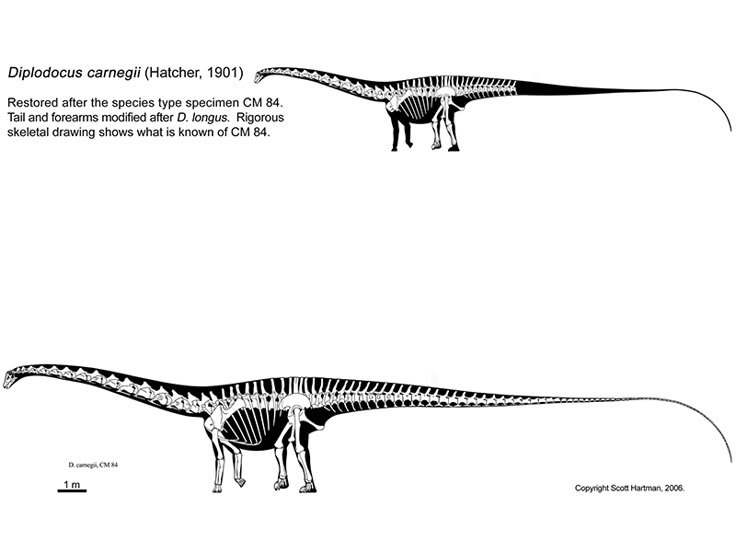
In terms of physical description, Diplodocus carnegii was a marvel of biomechanical engineering, characterized by its extreme length and relatively lightweight construction. Specimen CM 84 measures approximately 24 to 26 meters (about 79 to 85 feet) from the tip of its snout to the end of its whip-like tail. Despite this immense length, weight estimates for Diplodocus are surprisingly modest compared to bulkier sauropods like Brachiosaurus or Apatosaurus, generally falling between 12 and 15 metric tons. This relative lightness was achieved through a highly pneumatized skeletal system; the vertebrae of the neck and back were deeply hollowed out by air sacs, a trait shared with modern birds. The skull of Diplodocus was remarkably small relative to its body size, elongated and horse-like, with peg-shaped teeth confined exclusively to the front of the jaws. Its neck, consisting of 15 elongated cervical vertebrae, extended outward and was counterbalanced by an incredibly long tail composed of over 80 caudal vertebrae. The distal half of this tail tapered into a slender, whip-like structure. The limbs were robust and pillar-like, with the forelimbs being slightly shorter than the hindlimbs, giving the animal a distinctive horizontal posture. Soft tissue inferences, based on rare skin impressions from related diplodocids, suggest that the animal possessed a row of keratinous spines running along the midline of its back, tail, and possibly neck, somewhat resembling the dorsal crest of a modern iguana. When compared to modern animals, a fully grown Diplodocus would stretch the length of three school buses parked end-to-end, yet its overall mass would be roughly equivalent to two large African bull elephants, highlighting its uniquely elongated and slender build.
The paleobiology of Diplodocus carnegii reveals a highly specialized herbivore adapted to a specific ecological niche. Its peculiar dentition—peg-like teeth located only at the front of the mouth—suggests a feeding strategy known as branch-stripping. Rather than chewing its food, Diplodocus likely used its teeth as a comb to strip leaves and needles from branches, swallowing the vegetation whole. This plant matter would then be processed in a massive, fermenting gut, possibly aided by gastroliths (stomach stones), though the presence of gastroliths in diplodocids remains a subject of debate. The long neck of Diplodocus allowed it to feed over a wide swath of ground without moving its massive body, highly efficient for conserving energy. While earlier reconstructions depicted the animal browsing high in the forest canopy, modern biomechanical studies suggest that the neck was primarily held horizontally or slightly elevated, making it a low-to-medium browser feeding on ferns, cycads, and low-lying conifers. Locomotion was obligately quadrupedal and relatively slow; trackways attributed to large sauropods indicate a walking speed of roughly 2 to 4 kilometers per hour. Socially, there is evidence from trackways and bonebeds that diplodocids may have traveled in herds, possibly segregated by age, which would have provided protection for younger, more vulnerable individuals against the formidable predators of the era. Growth patterns derived from bone histology indicate that Diplodocus grew rapidly, reaching sexual maturity in little more than a decade, a necessary adaptation to outgrow the danger zone of predation as quickly as possible. Its metabolism is thought to have been mesothermic—an intermediate state between cold-blooded reptiles and warm-blooded mammals—allowing it to sustain rapid growth while managing the immense heat generated by its massive, fermenting digestive tract.
The ecological context of the Late Jurassic Morrison Formation was a dynamic and challenging environment. The climate was highly seasonal, characterized by distinct wet and dry periods, creating a landscape of vast, semi-arid floodplains interspersed with gallery forests along river channels. During the wet season, the environment would have been lush and capable of supporting immense biomass, but the dry season would have forced large herbivores to migrate or rely on tough, drought-resistant vegetation. Diplodocus shared this ecosystem with a staggering diversity of other dinosaurs. It co-existed with other giant sauropods, including the heavily built Apatosaurus, the towering Brachiosaurus, and the closely related Barosaurus. To avoid direct competition, these giants likely partitioned the available resources; while Brachiosaurus browsed the high canopy, Diplodocus swept the lower vegetation. The landscape was also populated by armored dinosaurs like Stegosaurus and small, agile ornithopods like Camptosaurus and Dryosaurus. As a primary consumer, Diplodocus occupied a foundational position in the food web, converting vast quantities of low-quality plant matter into animal biomass. However, this ecosystem was also home to some of the most formidable predators of the Mesozoic. The apex predator was Allosaurus, a large theropod capable of taking down juvenile or sick sauropods, and possibly even healthy adults if hunting in groups. Other predators included the massive Torvosaurus and the agile Ceratosaurus. A fully grown, healthy Diplodocus would have been largely immune to predation due to its sheer size and the defensive capabilities of its whip-like tail, which could potentially be swung at supersonic speeds to crack like a bullwhip, deterring attackers.
The discovery history of Diplodocus carnegii is a fascinating tale of Gilded Age philanthropy, scientific ambition, and international diplomacy. The story begins in 1898 when the wealthy industrialist Andrew Carnegie read a newspaper article about the discovery of a massive dinosaur in Wyoming. Eager to acquire a spectacular centerpiece for his newly founded Carnegie Museum of Natural History in Pittsburgh, Carnegie dispatched a team led by William Holland and Arthur Coggeshall to the American West. In 1899, the team, guided by fossil hunter William Reed, struck paleontological gold at Sheep Creek in the Shirley Basin of Wyoming. They uncovered a remarkably complete skeleton of a new species of Diplodocus. The specimen, cataloged as CM 84, was excavated with great difficulty due to its size and the harsh conditions of the Wyoming badlands. It was shipped back to Pittsburgh, where it was meticulously prepared and mounted. In 1901, the paleontologist John Bell Hatcher formally described the new species, naming it Diplodocus carnegii in honor of the expedition's patron. The specimen quickly became famous, not just for its completeness, but for what happened next. King Edward VII of the United Kingdom, upon seeing a sketch of the dinosaur at Carnegie's Scottish estate, requested a specimen for the British Museum. Since finding another complete skeleton was unlikely, Carnegie funded the creation of an exact plaster cast of CM 84. This cast, affectionately dubbed 'Dippy', was unveiled at the Natural History Museum in London in 1905 to massive public acclaim. Carnegie subsequently funded the production and distribution of similar casts to museums in Paris, Berlin, Vienna, Bologna, St. Petersburg, Buenos Aires, Madrid, and Mexico City, making Dippy the most widely viewed dinosaur skeleton in the world and a unique tool of international diplomacy.
The evolutionary significance of Diplodocus carnegii lies in its status as a highly derived member of the Diplodocidae family, representing a pinnacle of sauropod evolution in the Late Jurassic. The sauropodomorph lineage began in the Triassic with small, bipedal omnivores, gradually evolving into the massive, quadrupedal herbivores of the Jurassic. Diplodocus and its kin represent a specific evolutionary divergence characterized by a focus on extreme elongation of the neck and tail, coupled with a relatively lightweight skeletal architecture. This contrasts sharply with the Macronaria clade (which includes Brachiosaurus and later titanosaurs), which evolved broader, more robust bodies and more vertical neck postures. The anatomical features of Diplodocus, such as the deeply bifurcated (split) neural spines on its neck and back vertebrae, provided attachment points for a massive, complex system of ligaments and muscles that supported the cantilevered weight of its neck and tail. This structural engineering allowed diplodocids to maximize their feeding envelope while minimizing energy expenditure. Furthermore, the specialized peg-like teeth confined to the front of the snout demonstrate a highly derived evolutionary adaptation for a specific type of browsing, indicating a complex evolutionary arms race between sauropod feeding strategies and the defensive adaptations of Jurassic flora. While the diplodocid lineage eventually went extinct at the end of the Early Cretaceous, likely due to changing climates and the rise of new plant types like angiosperms (flowering plants), their evolutionary innovations in weight reduction and energy efficiency remain some of the most remarkable adaptations in the history of terrestrial vertebrates.
Scientific debates surrounding Diplodocus have been numerous and vigorous, reflecting the evolving nature of paleontological science. For decades, the posture of the animal was a subject of intense controversy. Early reconstructions sometimes depicted Diplodocus with a sprawling, lizard-like gait, a notion that was quickly dismissed by biomechanical analysis of the limb joints. More recently, the debate has centered on the flexibility and resting posture of the neck. While mid-20th-century art often showed Diplodocus holding its head high in a swan-like curve, modern computer modeling of the cervical vertebrae suggests that the neck was relatively inflexible and naturally held in a horizontal, neutral position. Another ongoing debate concerns the function of the whip-like tail. While the 'bullwhip' defense theory is popular, some paleontologists argue that the tail may have been used primarily for tactile communication within a herd or for producing loud, booming sounds for mating displays or territorial defense, rather than for direct physical combat, as the delicate distal vertebrae could easily shatter upon impact. Additionally, there is ongoing taxonomic debate regarding the validity of various Diplodocus species. While D. carnegii is universally recognized due to the completeness of CM 84, the type species, D. longus, is based on fragmentary material and is considered by some researchers to be a nomen dubium (a doubtful name), leading to proposals to make D. carnegii the new type species of the genus.
The fossil record of Diplodocus is primarily restricted to the Morrison Formation of the western United States, spanning states such as Colorado, Utah, Wyoming, and Montana. Compared to many other dinosaurs, the fossil record for Diplodocus is exceptionally good. While complete skeletons are exceedingly rare, partial skeletons, isolated bones, and skulls have been found in relative abundance. The preservation quality in the Morrison Formation varies from poor, highly weathered bone fragments to exceptionally preserved, articulated skeletons. The massive size of sauropod bones means they are often preferentially preserved in the fossil record compared to the delicate bones of smaller animals, as they are less likely to be completely destroyed by scavengers or river currents before burial. However, skulls are notoriously rare; because the skull of Diplodocus was small and attached to the neck by relatively weak joints, it frequently detached and was lost or crushed after the animal died. Famous fossil sites that have yielded Diplodocus material include the Carnegie Quarry at Dinosaur National Monument in Utah, the Howe Quarry in Wyoming, and the original Sheep Creek site. The abundance of material has allowed scientists to study the ontogeny (growth), biomechanics, and pathology of Diplodocus in greater detail than almost any other sauropod.
The cultural impact of Dippy the Diplodocus cannot be overstated; it is the dinosaur that introduced the concept of prehistoric giants to the global public. Before the distribution of the Carnegie casts, dinosaurs were largely the domain of specialized academics. The arrival of Dippy casts in major capital cities around the world transformed dinosaurs into a global cultural phenomenon. The London cast, which stood in the central Hintze Hall of the Natural History Museum for over a century, became an iconic symbol of the museum and a beloved national treasure in the UK, viewed by an estimated 90 million people before it went on a national tour in 2017. Dippy's distinctive, elongated silhouette has become the archetypal representation of a dinosaur in popular culture, appearing in countless books, films, and television documentaries. The educational importance of CM 84 and its casts is immense; it has inspired generations of children to pursue careers in science and paleontology, serving as a tangible, awe-inspiring connection to the deep history of our planet.
Classification
Time Period
Discovery
Location
Wyoming, USA
Formation
Morrison Formation
Frequently Asked Questions
What is Dippy the Diplodocus (CM 84)?
Dippy the Diplodocus, scientifically designated as Diplodocus carnegii specimen CM 84, is arguably one of the most famous and historically significant dinosaur fossils ever discovered. Living during the Late Jurassic epoch, approximately 154 to 150 million years ago, this colossal sauropod roamed th...
When did Dippy the Diplodocus (CM 84) live?
Dippy the Diplodocus (CM 84) lived during the jurassic period of the mesozoic era approximately 154-150 million years ago.
Where was Dippy the Diplodocus (CM 84) discovered?
Fossils of Dippy the Diplodocus (CM 84) were discovered in Wyoming, USA in the Morrison Formation.
What did Dippy the Diplodocus (CM 84) eat?
Dippy the Diplodocus (CM 84) was a herbivore. It lived in terrestrial habitats.
What type of fossil is Dippy the Diplodocus (CM 84)?
Dippy the Diplodocus (CM 84) is preserved as a body fossil. The preservation quality is excellent.
Related Specimens
From the mesozoic era · body fossils