Dire Wolf
Aenocyon dirus
Image: Category:Aenocyon dirus - Wikimedia Commons (CC BY-SA)
About Dire Wolf
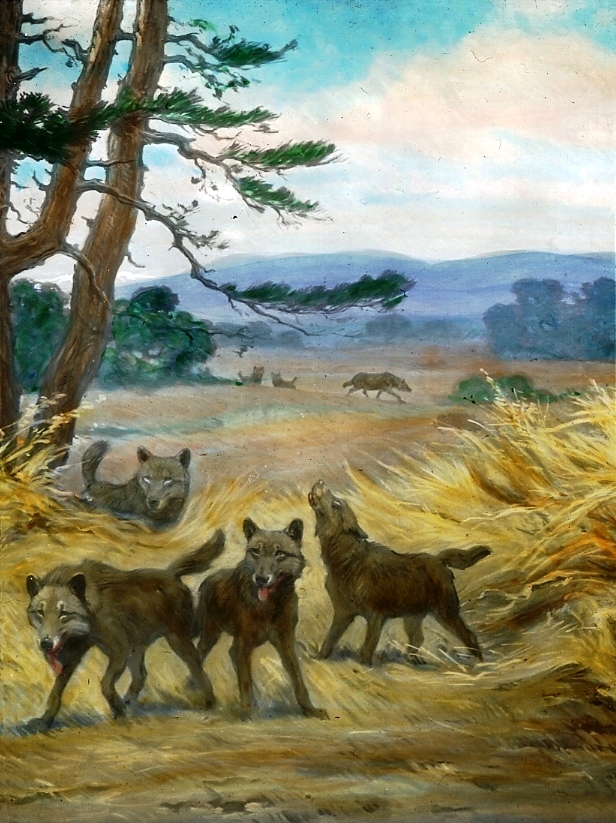
The Dire Wolf, scientifically known as *Aenocyon dirus*, was a formidable carnivorous mammal that roamed throughout the Americas during the Late Pleistocene epoch. Flourishing from approximately 250,000 to 13,000 years ago, this apex predator represents one of the most iconic and abundant large carnivores of the last Ice Age. Its extensive fossil record, particularly from the La Brea Tar Pits in California, has provided paleontologists with an unparalleled window into the life, evolution, and eventual extinction of a uniquely North American canid lineage.
Physically, *Aenocyon dirus* was a powerful and robust predator, superficially resembling the modern gray wolf (*Canis lupus*) but with a distinctly more massive build. While its average body length was comparable to that of large gray wolves, around 150 centimeters from nose to tail, its body mass was significantly greater, estimated to be about 25% heavier. An average Dire Wolf likely weighed between 60 to 68 kilograms (132 to 150 pounds), with some large males potentially exceeding this. Its skeleton was characterized by thicker, denser bones, suggesting a musculature adapted for strength rather than sheer speed. The skull was particularly noteworthy, being larger and broader than a gray wolf's, housing a smaller braincase relative to its overall size. The most striking feature was its dentition; the Dire Wolf possessed immense teeth, with molars adapted for crushing and shearing, and massive canines for gripping and killing prey. Its jaws were capable of generating immense bite force, significantly greater than that of any living canid, an adaptation likely linked to processing the carcasses of large megafauna and crushing bone to access marrow. This combination of a heavy frame and powerful jaws paints a picture of a predator built for ambush and overwhelming force.
The paleobiology of *Aenocyon dirus* reveals a creature finely tuned to its role as an apex predator and scavenger in a world of giants. Its diet consisted primarily of large herbivores, a conclusion supported by isotopic analysis of its fossilized bones and the sheer abundance of its remains alongside those of megafauna. Prey animals included Pleistocene horses (*Equus occidentalis*), bison (*Bison antiquus*), camels (*Camelops hesternus*), and even juvenile mammoths and mastodons. The Dire Wolf’s powerful build and bone-crushing teeth suggest a feeding strategy that involved not just killing but also thoroughly consuming carcasses, leaving little for other scavengers. Like modern wolves, it is widely believed that *Aenocyon dirus* was a social, pack-hunting animal. This cooperative behavior would have been essential for tackling formidable prey such as a 900-kilogram bison or a struggling ground sloth. The high incidence of healed fractures and other injuries found on Dire Wolf skeletons from La Brea suggests a life of violent confrontations with large, dangerous animals, and the fact that many of these individuals survived their injuries points towards a social structure where injured pack members may have been supported by the group. Locomotion studies indicate it was not as cursorial, or adapted for long-distance running, as the gray wolf, suggesting a hunting style reliant on ambush or shorter, more powerful pursuits.
*Aenocyon dirus* inhabited a vast range of environments across North and South America during the Late Pleistocene, a period characterized by dramatic climatic fluctuations and diverse ecosystems. Its habitat spanned from open grasslands and savannas to woodlands and montane forests, reflecting its adaptability. The world it occupied was populated by a spectacular array of megafauna, placing the Dire Wolf within a complex and competitive food web. It shared its territory with other formidable predators, creating a dynamic of competition and niche partitioning. Key competitors included the saber-toothed cat (*Smilodon fatalis*), the American lion (*Panthera atrox*), and the giant short-faced bear (*Arctodus simus*). At the La Brea Tar Pits, the remains of Dire Wolves outnumber those of *Smilodon* by a significant margin, suggesting they were either more numerous in the local ecosystem or more susceptible to becoming entrapped, perhaps drawn in large numbers to the cries of struggling herbivores. As an apex predator, the Dire Wolf played a crucial role in regulating herbivore populations, influencing the health and structure of the entire ecosystem. Its eventual extinction coincided with the disappearance of its primary large prey, highlighting the delicate interdependence of species within these Pleistocene communities.
The discovery and scientific understanding of the Dire Wolf began in the mid-19th century. The first fossil evidence, a fossilized jaw, was unearthed near the Ohio River in Evansville, Indiana, in the summer of 1854. The specimen was obtained by the geologist Joseph Granville Norwood and sent to the paleontologist Joseph Leidy at the Academy of Natural Sciences of Philadelphia. Leidy determined the fossil belonged to an extinct species of wolf and, in 1858, formally named it *Canis dirus*, with "dirus" being Latin for "fearful" or "dire." For over a century, this classification within the *Canis* genus, alongside modern wolves and coyotes, was universally accepted. However, the most significant discoveries that would truly define our knowledge of the species came from the La Brea Tar Pits in Los Angeles, California. Beginning with excavations in the early 20th century under the direction of paleontologists like John C. Merriam, the tar pits yielded an astonishing quantity of exceptionally preserved *Aenocyon dirus* fossils. The sheer volume of material, including thousands of skulls and post-cranial skeletons, transformed the Dire Wolf from a sparsely known fossil animal into one of the best-understood prehistoric predators, providing invaluable data on its population structure, pathology, and life history.
The evolutionary history of the Dire Wolf has been a subject of intense study and recent, dramatic revision. For more than 150 years, its robust morphology was interpreted as an extreme adaptation within the same lineage as the gray wolf, placing it firmly within the genus *Canis*. It was considered a close relative, perhaps a sister species, that had evolved in the Americas to specialize in hunting megafauna. However, this long-held view was overturned by a landmark genetic study published in 2021 by a team of researchers including Angela Perri, Laurent Frantz, and Greger Larson. By sequencing ancient DNA extracted from well-preserved Dire Wolf fossils, they made a startling discovery: the Dire Wolf was not closely related to gray wolves at all. The genetic data revealed that the Dire Wolf lineage had diverged from the lineage leading to gray wolves, coyotes, and dholes nearly six million years ago. This deep genetic split indicated that the Dire Wolf was the last surviving member of an ancient canid lineage endemic to the Americas, while gray wolves evolved in Eurasia and only later migrated to North America. This profound genetic distance, coupled with morphological distinctions, warranted a reclassification of the species into its own genus, *Aenocyon*. The superficial resemblance to gray wolves is now understood to be a remarkable case of convergent evolution, where two distantly related species independently evolved similar body plans to fill a similar ecological niche as a large, pack-hunting predator.
This reclassification has reshaped scientific debates surrounding the animal. The primary debate, its taxonomic placement, was largely settled by the 2021 genetic study, leading to the widespread adoption of the genus *Aenocyon*. This new understanding of its evolutionary isolation also helps explain its extinction. The study revealed no evidence of interbreeding between Dire Wolves and the newly arriving gray wolves, suggesting they were too genetically distinct to produce viable offspring. This reproductive isolation meant that as the Dire Wolf's megafaunal prey disappeared at the end of the Pleistocene, it could not adapt by hybridizing with the more versatile gray wolves, which were better suited to hunting smaller, swifter prey. While the pack-hunting behavior of *Aenocyon* is widely accepted based on fossil evidence, the exact social dynamics and hunting strategies remain topics of discussion. Some researchers debate the extent to which they were pure predators versus opportunistic scavengers, with the high numbers at La Brea suggesting a strong draw to carrion. The new genetic framework provides a fresh lens through which to re-examine these questions, recasting the Dire Wolf not as a "super wolf" but as a unique evolutionary experiment that ultimately failed to survive the profound environmental changes of the Quaternary extinction event.
The fossil record of *Aenocyon dirus* is one of the most extensive for any large Pleistocene carnivore. Its remains have been found across a vast geographic area, from Alberta, Canada, down through the United States and Mexico, and as far south as Bolivia, though it was most common in North America. The most famous and scientifically important fossil site is unequivocally the La Brea Tar Pits in Los Angeles. Over 4,000 individual Dire Wolves have been excavated from these asphalt seeps, providing an unprecedented statistical sample for studying population demographics, disease, and injury rates. The exceptional preservation in the asphalt has kept bones in pristine condition, allowing for detailed morphological, isotopic, and even paleogenomic analyses. Other significant fossil localities include the Cutler Hammock site in Florida and San Josecito Cave in Nuevo León, Mexico, which have also yielded numerous specimens. This wealth of fossil material has made *Aenocyon dirus* a cornerstone species for understanding predator-prey dynamics and ecosystem structure during the American Late Pleistocene.
The Dire Wolf has left a significant mark on popular culture, largely due to its evocative name and its portrayal as a larger, more menacing version of the modern wolf. It is a staple in museum exhibits on Ice Age fauna, with impressive skeletal mounts captivating visitors at institutions like the La Brea Tar Pits and Museum in Los Angeles and the American Museum of Natural History in New York. Its fame has been amplified in recent years through its prominent role in fiction, most notably in George R. R. Martin's "A Song of Ice and Fire" book series and its television adaptation, "Game of Thrones," where direwolves are depicted as loyal and formidable companions. While these portrayals often take creative liberties, they have cemented the Dire Wolf's place in the public imagination and sparked widespread interest in Pleistocene paleontology.
Classification
Time Period
Discovery
Location
La Brea Tar Pits, California, USA
Formation
Rancho La Brea
Frequently Asked Questions
What is Dire Wolf?
The Dire Wolf, scientifically known as *Aenocyon dirus*, was a formidable carnivorous mammal that roamed throughout the Americas during the Late Pleistocene epoch. Flourishing from approximately 250,000 to 13,000 years ago, this apex predator represents one of the most iconic and abundant large carn...
When did Dire Wolf live?
Dire Wolf lived during the quaternary period of the cenozoic era approximately 0.25-0.013 million years ago.
Where was Dire Wolf discovered?
Fossils of Dire Wolf were discovered in La Brea Tar Pits, California, USA in the Rancho La Brea.
What did Dire Wolf eat?
Dire Wolf was a carnivore. It lived in terrestrial habitats.
What type of fossil is Dire Wolf?
Dire Wolf is preserved as a body fossil. The preservation quality is excellent.
Related Specimens
From the cenozoic era · body fossils