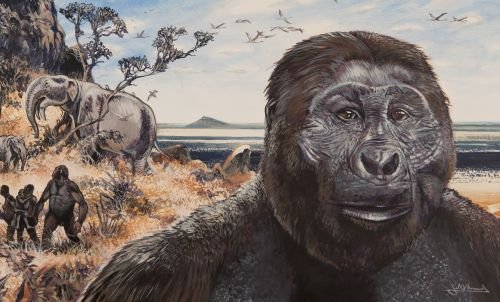
Paranthropus boisei
Image: Image sourced via web search (Fair use / Educational)
About Paranthropus boisei
Paranthropus boisei was a species of robust australopithecine that lived in Eastern Africa during the Pleistocene epoch, from approximately 2.3 to 1.2 million years ago. It is one of the most well-known early hominins, primarily due to its incredibly specialized and powerful chewing apparatus, which earned it the nickname 'Nutcracker Man'. Its discovery and subsequent study have provided profound insights into the diversity of hominin adaptations and the complex evolutionary pathways that ultimately led to modern humans.
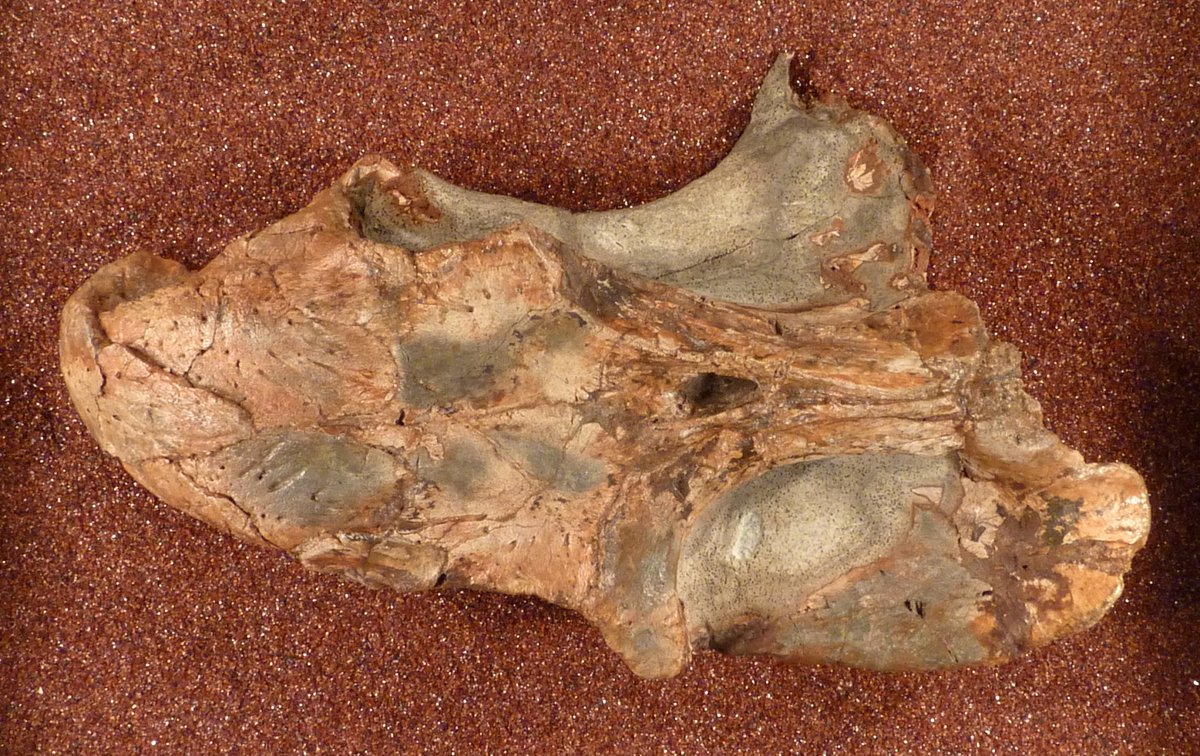
Paranthropus boisei possessed a unique and highly specialized anatomy, particularly in its skull, which was adapted for generating immense bite forces. Males were significantly larger than females, a condition known as sexual dimorphism, standing around 137 cm (4 ft 6 in) tall and weighing approximately 49 kg (108 lbs), while females were smaller at about 124 cm (4 ft 1 in) and 34 kg (75 lbs). This size difference is comparable to that seen in modern gorillas. The most striking feature was the massive, wide, dish-shaped face with flaring cheekbones (zygomatic arches) to accommodate enormous temporalis muscles. The skull also featured a prominent sagittal crest, a ridge of bone running along the midline of the cranium, which served as an anchor point for these powerful jaw muscles. Its brain size was relatively small, with a cranial capacity averaging around 500-550 cubic centimeters, similar to other australopithecines and modern chimpanzees. The dentition was equally extreme; the molars and premolars were enormous (megadont), up to four times the size of those in modern humans, covered in a thick layer of enamel (hyper-thick enamel). In stark contrast, the incisors and canines at the front of the jaw were comparatively tiny and crowded, suggesting they were not used for significant food processing.
The unique morphology of Paranthropus boisei provides critical clues about its paleobiology, particularly its diet and feeding strategies. The massive molars, thick enamel, and powerful jaw musculature strongly suggest a diet consisting of tough, hard, or fibrous plant materials. For decades, this led to the 'Nutcracker Man' hypothesis, proposing a diet of hard nuts and seeds. However, isotopic analysis of the tooth enamel has challenged this view. Studies by Thure Cerling and others revealed a diet dominated by C4 plants, such as grasses and sedges, which are abrasive but not necessarily hard. This suggests P. boisei spent a significant amount of time chewing large quantities of low-quality, tough vegetation, much like a modern cow or goat, rather than cracking hard objects. The powerful jaws may have been an adaptation for endurance chewing of abrasive foods, or perhaps a fallback mechanism for processing hard items during times of scarcity. Its postcranial skeleton, though less completely known, indicates it was fully bipedal, with a mode of locomotion similar to other australopithecines like 'Lucy' (Australopithecus afarensis). The marked sexual dimorphism suggests a social structure potentially similar to modern gorillas, with a polygynous mating system where a dominant male may have had exclusive access to a group of females. This social model, however, remains a subject of debate among paleoanthropologists.
Paranthropus boisei inhabited the dynamic landscapes of Eastern Africa during a period of significant climatic fluctuation. It lived in environments that ranged from open grasslands and savannas to more wooded, riverine habitats, as evidenced by the fossil assemblages found at sites like Olduvai Gorge, Tanzania, and Koobi Fora, Kenya. This hominin shared its world with a diverse array of fauna, including early species of our own genus, Homo, such as Homo habilis and later Homo erectus. This co-existence is one of the most fascinating aspects of its ecology, as it implies that at least two distinct hominin lineages with different adaptive strategies occupied the same geographic areas for over a million years. P. boisei's specialized herbivorous diet likely placed it in a different ecological niche, reducing direct competition with the more omnivorous and tool-using Homo species. Predators would have been a constant threat, with formidable carnivores like the saber-toothed cat Megantereon, giant hyenas (Pachycrocuta), and crocodiles roaming the landscape. Its position in the food web was that of a primary consumer, a specialized herbivore that was, in turn, prey for the apex predators of the Pleistocene savanna.
The discovery history of Paranthropus boisei is a cornerstone of paleoanthropology. The first and most famous specimen, a nearly complete cranium designated OH 5 (Olduvai Hominid 5), was discovered by Mary Leakey on July 17, 1959, at Olduvai Gorge in Tanzania. Initially, her husband, Louis Leakey, named the find Zinjanthropus boisei, meaning 'East Africa Man' (Zinj being an old Arabic word for the East African coast) and 'boisei' in honor of Charles Boise, a benefactor who funded their research. The discovery was monumental because it was the first well-preserved hominin cranium found in the region and, when dated using potassium-argon methods, its age of 1.75 million years dramatically pushed back the known timeline of human evolution. Later, Richard Leakey's team uncovered numerous other significant P. boisei fossils at Koobi Fora, near Lake Turkana in Kenya, including the well-preserved cranium KNM-ER 406. These and other finds from the Omo River basin in Ethiopia solidified the species' anatomical profile and geographic range. The genus name was eventually revised from Zinjanthropus to Paranthropus ('beside man'), grouping it with other robust australopithecines like Paranthropus robustus from Southern Africa.
Paranthropus boisei holds immense evolutionary significance as a prime example of a highly specialized, and ultimately extinct, branch of the hominin family tree. It represents a divergent evolutionary path from the one that led to the genus Homo. While the ancestors of Homo were developing larger brains, creating stone tools, and adopting a more flexible, omnivorous diet, the Paranthropus lineage doubled down on a specialized vegetarian diet, developing an ever-more robust chewing apparatus. This divergence highlights a critical juncture in human evolution, demonstrating that bipedalism and other hominin traits did not lead to a single, linear progression towards Homo sapiens. Instead, the Pliocene-Pleistocene landscape supported multiple hominin experiments in living. P. boisei's eventual extinction around 1.2 million years ago, after a successful run of over a million years, is often attributed to its overspecialization. As African climates continued to change, its specific food sources may have dwindled, leaving it unable to adapt, while the generalist strategy of contemporary Homo species proved more resilient and successful in the long term. It serves as a powerful case study in how specialization can be both a short-term advantage and a long-term evolutionary dead end.
Despite its well-defined morphology, Paranthropus boisei remains the subject of several scientific debates. The primary controversy revolves around its exact diet. While isotopic data points strongly to C4 grasses and sedges, the 'paradox of the robust australopithecines' is that their powerful jaws and thick-enamelled teeth seem biomechanically over-engineered for this diet. Some researchers argue that the isotopic signature reflects their staple food, but the robust anatomy was a critical adaptation for processing very hard 'fallback foods' during dry seasons when preferred resources were scarce. Another area of debate concerns its taxonomic placement. While most researchers accept the genus Paranthropus for the robust australopithecines (P. boisei, P. robustus, and P. aethiopicus), some argue that the differences are not significant enough to warrant a separate genus and that they should be classified as a specialized branch within the genus Australopithecus. The degree of sexual dimorphism and its implications for social structure are also continually re-evaluated as new postcranial fossils are discovered and analyzed.
The fossil record for Paranthropus boisei is one of the richest for any extinct hominin species. Fossils are concentrated in the Great Rift Valley of Eastern Africa, with major finds unearthed in Tanzania (Olduvai Gorge), Kenya (Koobi Fora, Chesowanja, West Turkana), and Ethiopia (Omo River basin, Konso). Hundreds of individual fossil specimens are known, ranging from isolated teeth and jaw fragments to several remarkably complete crania and partial skeletons. The preservation quality is often good to excellent, particularly for the hard, dense bones of the skull and jaw, which are more likely to survive the fossilization process. The discovery of specimens like OH 5 ('Zinj') and KNM-ER 406 provided an unprecedentedly clear picture of the cranial anatomy of an early hominin. Famous fossil sites like Olduvai Gorge are particularly important as they preserve a long sequence of geological layers, allowing scientists to track the presence of P. boisei over hundreds of thousands of years and study its relationship with the contemporaneous Homo habilis.
Paranthropus boisei, particularly through the iconic 'Zinj' skull, has had a significant cultural impact. Its discovery was a global news event in 1959, featured in National Geographic and bringing the Leakey family and the field of paleoanthropology into the public spotlight. The nickname 'Nutcracker Man' created a memorable and easily understood image that captured the public's imagination. Today, high-quality casts and reconstructions of P. boisei skulls are staple exhibits in natural history museums worldwide, including the Smithsonian National Museum of Natural History and the Natural History Museum in London. These displays are crucial educational tools, visually demonstrating the diversity of our ancient relatives and illustrating that human evolution was not a simple, linear march but a complex, branching bush with many now-extinct side-branches.
Classification
Time Period
Discovery
Location
Tanzania
Formation
Olduvai Gorge (Bed I and II), Koobi Fora Formation, Omo Group Formations
Frequently Asked Questions
What is Paranthropus boisei?
Paranthropus boisei was a species of robust australopithecine that lived in Eastern Africa during the Pleistocene epoch, from approximately 2.3 to 1.2 million years ago. It is one of the most well-known early hominins, primarily due to its incredibly specialized and powerful chewing apparatus, which...
When did Paranthropus boisei live?
Paranthropus boisei lived during the quaternary period of the cenozoic era approximately 2.3-1.2 million years ago.
Where was Paranthropus boisei discovered?
Fossils of Paranthropus boisei were discovered in Tanzania in the Olduvai Gorge (Bed I and II), Koobi Fora Formation, Omo Group Formations.
What did Paranthropus boisei eat?
Paranthropus boisei was a herbivore. It lived in terrestrial (savanna, woodland) habitats.
What type of fossil is Paranthropus boisei?
Paranthropus boisei is preserved as a body fossil. The preservation quality is good.
Related Specimens
From the cenozoic era · body fossils