Edaphosaurus
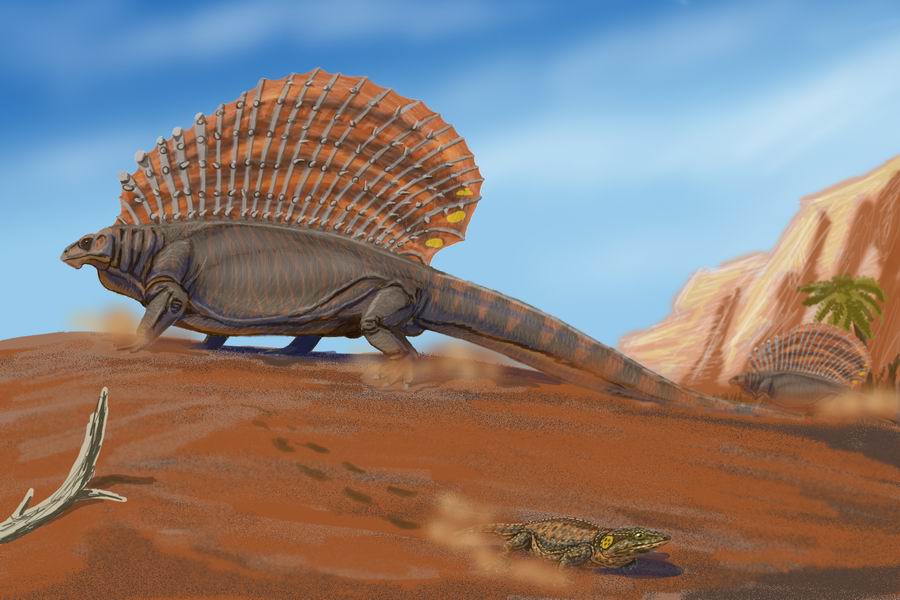
Edaphosaurus pogonias
Image: File:Edaphosaurus pogonias.jpg - Wikimedia Commons (CC BY-SA)
About Edaphosaurus
Edaphosaurus was a remarkable genus of early synapsids that inhabited terrestrial ecosystems during the late Carboniferous and early Permian periods, approximately 299 to 272.5 million years ago. Often colloquially termed a 'mammal-like reptile,' it is more accurately placed within the evolutionary lineage that includes all modern mammals, making it a distant relative of humanity itself. Its fossils, primarily unearthed from the iconic Red Beds of Texas, reveal an animal distinguished by a spectacular dorsal sail, marking it as one of the most recognizable creatures of the Paleozoic Era and a key player in the development of early terrestrial food webs as one of the first large-bodied herbivores.
The physical appearance of Edaphosaurus was both robust and extraordinary, combining a stout, lizard-like body with its unique sail structure. A typical adult, such as the well-known species *Edaphosaurus pogonias*, reached lengths of up to 3.5 meters (approximately 11.5 feet) and likely weighed between 200 and 300 kilograms (440-660 pounds). Its body was barrel-shaped and deep, supported by short, sprawling limbs that extended out from the sides, indicating a somewhat lumbering, reptilian gait. The head was disproportionately small compared to its massive torso, a feature common among early large herbivores. The skull was short and triangular, housing a specialized dentition of peg-like teeth along the jaw margins and a dense battery of crushing teeth on the palate, or roof of the mouth. The most defining anatomical feature was its dorsal sail, a pelycosaurian innovation it shared with its contemporary, Dimetrodon. However, the sail of Edaphosaurus was structurally distinct. The elongated neural spines of its vertebrae, which formed the sail's framework, were adorned with numerous small, bony crossbars or tubercles, giving it a gnarled, almost branch-like appearance. These crossbars, projecting laterally from the spines, are unique to the Edaphosauridae family and their exact function remains a subject of scientific inquiry, though they may have increased the sail's surface area or provided structural reinforcement.
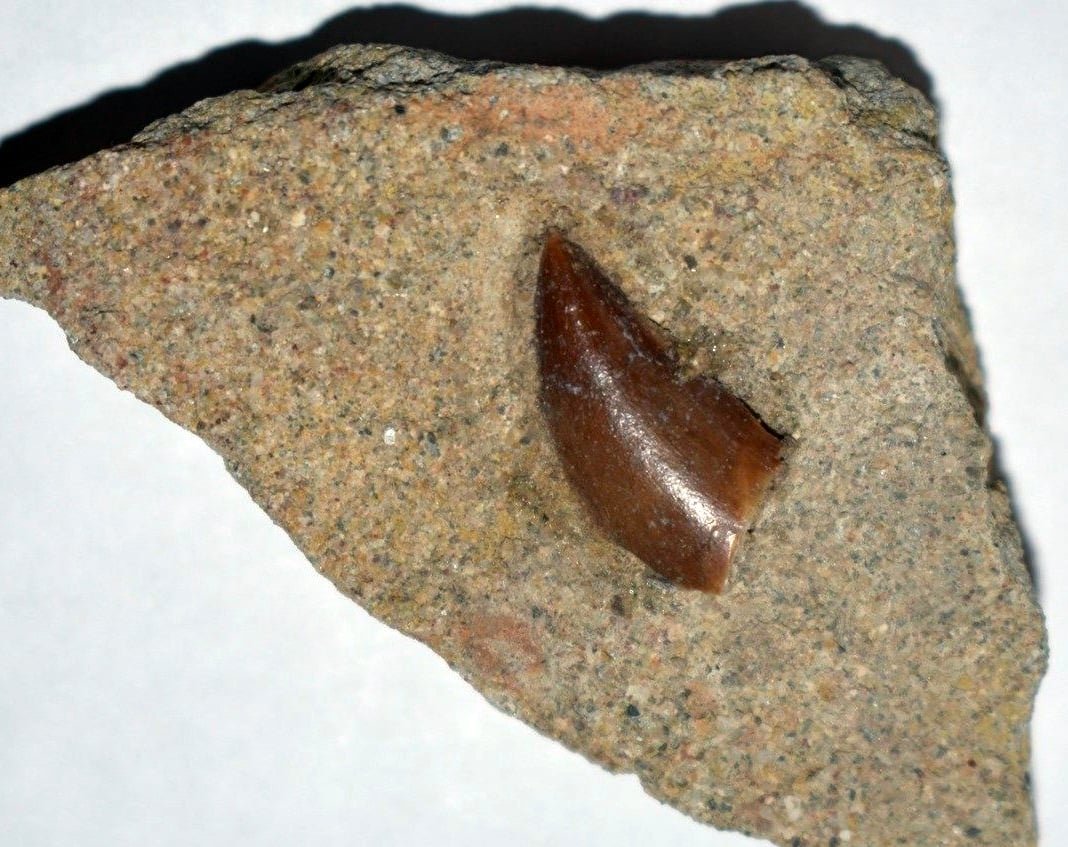
The paleobiology of Edaphosaurus reveals a creature adapted to a novel ecological niche for its time: high-fiber herbivory on a large scale. Its dental arrangement was highly specialized for processing tough, fibrous plant material. The peg-like marginal teeth were likely used for nipping or stripping vegetation, such as ferns, seed ferns, and cycads, while the extensive palatal tooth plates acted as a grinding mill. The lower jaw could slide back and forth, creating a powerful shearing and crushing action against the upper palate, effectively shredding plant matter before ingestion. This efficient oral processing was crucial, as its large, barrel-shaped gut was necessary for the prolonged fermentation of cellulose-rich food, similar to modern ruminants. Its sprawling posture and short limbs suggest Edaphosaurus was not a fast-moving animal, likely spending its days slowly traversing the Permian landscape in search of food. The sail's function is central to its biology. The prevailing hypothesis is thermoregulation; by orienting the sail towards or away from the sun, Edaphosaurus could have rapidly absorbed heat to become active in the cool mornings or dissipated excess heat during the midday peak, a significant advantage for a large, ectothermic animal. Alternatively, the sail may have served a display purpose, used for species recognition, intimidating rivals, or attracting mates, with the unique crossbars perhaps enhancing its visual impact.
Edaphosaurus lived in a world vastly different from our own, during the early Permian period when the supercontinent of Pangaea was still assembling. The climate was generally arid to semi-arid, characterized by strong seasonality with wet and dry periods. Its primary habitat, as evidenced by the fossil deposits of the Wichita Group in Texas, consisted of vast coastal floodplains and deltaic environments crisscrossed by rivers and streams. These "Red Beds" formations indicate an environment with highly oxidized, iron-rich soils. The flora was dominated by hardy, drought-resistant plants like conifers, seed ferns (pteridosperms), and cycads, which would have formed the bulk of the Edaphosaurus diet. It shared this ecosystem with a diverse array of fauna. The most famous co-inhabitant was the apex predator Dimetrodon, another sail-backed synapsid that likely represented the primary threat to Edaphosaurus. This predator-prey relationship is one of the most classic examples from the Paleozoic. Other contemporaries included the large, caseid herbivore Cotylorhynchus, the aquatic amphibian Eryops, and the "boomerang-headed" amphibian Diplocaulus, which populated the waterways. As a primary consumer, Edaphosaurus occupied a crucial position in the food web, converting plant energy into a food source for the era's top carnivores and demonstrating the increasing complexity of terrestrial ecosystems.
The discovery and scientific understanding of Edaphosaurus are rooted in the "Bone Wars" of the late 19th century, a period of intense fossil-hunting rivalry between American paleontologists Edward Drinker Cope and Othniel Charles Marsh. It was Cope who first described the genus in 1882, based on fragmentary remains, including vertebrae and a partial skull, recovered from the Red Beds of Texas. He coined the name Edaphosaurus, meaning "pavement lizard," a reference to the dense cluster of grinding teeth on its palate which resembled a cobblestone pavement. The type species he named was *Edaphosaurus pogonias*. Over the following decades, more complete specimens were unearthed, particularly from the rich fossil localities of the Wichita and Clear Fork Groups in Texas and Oklahoma. These discoveries, including nearly complete skeletons with intact sails, allowed paleontologists like E.C. Case and Alfred Sherwood Romer in the early 20th century to develop a much clearer picture of the animal's anatomy and lifestyle. Romer's extensive work on Permian fauna, in particular, helped solidify the placement of Edaphosaurus within the synapsid lineage and clarified its relationship with other pelycosaurs, distinguishing it clearly from the carnivorous Dimetrodon, with which it was often confused by the public.
Edaphosaurus holds a pivotal position in the grand narrative of vertebrate evolution. As a member of the order Pelycosauria and the family Edaphosauridae, it belongs to the Synapsida, the group that includes all mammals. Synapsids are distinguished by a single temporal fenestra, an opening in the skull behind each eye socket, which allowed for the attachment of more powerful jaw muscles. This feature, present in Edaphosaurus, represents a critical early step on the evolutionary path leading to the complex skulls and powerful jaws of modern mammals. While its sprawling posture and ectothermic physiology appear reptilian, these are ancestral traits for amniotes. Edaphosaurus was not a reptile, but rather a member of a separate, parallel branch that diverged from the sauropsid line (which leads to reptiles and birds) in the late Carboniferous. It represents a successful "experiment" in large-scale herbivory among early synapsids, showcasing how this lineage began to diversify and dominate terrestrial ecosystems long before the dinosaurs. Although the edaphosaurid lineage itself died out by the end of the early Permian, other synapsid groups, such as the therapsids, would continue to evolve, eventually giving rise to the first true mammals in the Mesozoic Era.
Despite being a well-known genus, Edaphosaurus is still the subject of scientific debate, primarily concerning the precise function of its unique sail. While the thermoregulation hypothesis remains popular, critics point out that the sail's thick, bony structure, complete with crossbars, might not have been as efficient for heat exchange as the more delicate sail of Dimetrodon, which was richly supplied with blood vessels. The crossbars, in particular, are an enigma; they add weight and complexity without an obvious thermoregulatory benefit. This has bolstered arguments for a primary display function, suggesting the sail was a billboard for species identification or sexual selection, with the tubercles adding to its visual complexity and perceived strength. Another area of discussion involves its feeding mechanics. While the general herbivorous diet is accepted, the specifics of its jaw movement and which plants it preferred are still being refined through biomechanical modeling and analysis of tooth wear patterns. Taxonomic debates are less contentious, with the genus being firmly established, though the validity and relationships of the dozen or so named species within the genus are periodically reviewed as new fossil material comes to light.
The fossil record of Edaphosaurus is robust, providing a solid foundation for our understanding of the animal. Its remains are most famously and abundantly found in the early Permian Red Beds of North America, particularly in Texas, Oklahoma, and New Mexico. The Wichita and Clear Fork Groups have yielded numerous articulated skeletons, some of which are nearly complete, offering a detailed view of its anatomy from juvenile to adult stages. Beyond North America, fossils attributed to Edaphosaurus have also been discovered in Europe, specifically in Germany and the Czech Republic, indicating that the genus had a wide geographic distribution across the northern regions of the supercontinent Pangaea. The quality of preservation is often excellent, with the delicate sail spines and even the small crossbars frequently found intact. This widespread and well-preserved fossil record makes Edaphosaurus a cornerstone for paleontological studies of the early Permian, allowing for detailed research into its growth, population structure, and evolutionary history. Famous paleontological sites like the Texas Red Beds continue to be a primary source of new information about this iconic synapsid.
Due to its distinctive and visually striking appearance, Edaphosaurus has secured a notable place in popular culture and public education. It is a staple in museum exhibits on Paleozoic life, often displayed alongside its famous contemporary, Dimetrodon, to illustrate the concept of early predator-prey dynamics and the diversity of life before the dinosaurs. Reconstructed skeletons and life-sized models of Edaphosaurus can be seen in major institutions such as the American Museum of Natural History and the Field Museum. Its appearance in books, documentaries, and even as a classic plastic toy has made its sail-backed silhouette, second only to Dimetrodon, one of the most recognizable images associated with the Permian period, serving as an important educational tool for introducing the public to the fascinating world of synapsids and the deep history of the lineage that would eventually lead to mammals.
Classification
Time Period
Discovery
Location
Texas, USA (Red Beds)
Formation
Wichita Group
Frequently Asked Questions
What is Edaphosaurus?
Edaphosaurus was a remarkable genus of early synapsids that inhabited terrestrial ecosystems during the late Carboniferous and early Permian periods, approximately 299 to 272.5 million years ago. Often colloquially termed a 'mammal-like reptile,' it is more accurately placed within the evolutionary ...
When did Edaphosaurus live?
Edaphosaurus lived during the permian period of the paleozoic era approximately 299-272.5 million years ago.
Where was Edaphosaurus discovered?
Fossils of Edaphosaurus were discovered in Texas, USA (Red Beds) in the Wichita Group.
What did Edaphosaurus eat?
Edaphosaurus was a herbivore. It lived in terrestrial habitats.
What type of fossil is Edaphosaurus?
Edaphosaurus is preserved as a body fossil. The preservation quality is good.
Related Specimens
From the paleozoic era · body fossils