Rhynia
Rhynia gwynne-vaughanii
Image: Image sourced via web search (Fair use / Educational)
About Rhynia
Rhynia gwynne-vaughanii is an extinct, early vascular plant that lived during the Early Devonian period, approximately 412 to 407 million years ago. Discovered in the famous Rhynie Chert of Aberdeenshire, Scotland, this organism represents one of the most significant botanical discoveries in paleontological history. It provides an unparalleled window into the early colonization of land by plants, serving as a critical transitional form in the evolution of terrestrial ecosystems. By preserving the cellular details of one of the earliest known vascular plants, Rhynia has fundamentally shaped our understanding of how life transitioned from aquatic environments to conquer the barren continents of the early Earth.
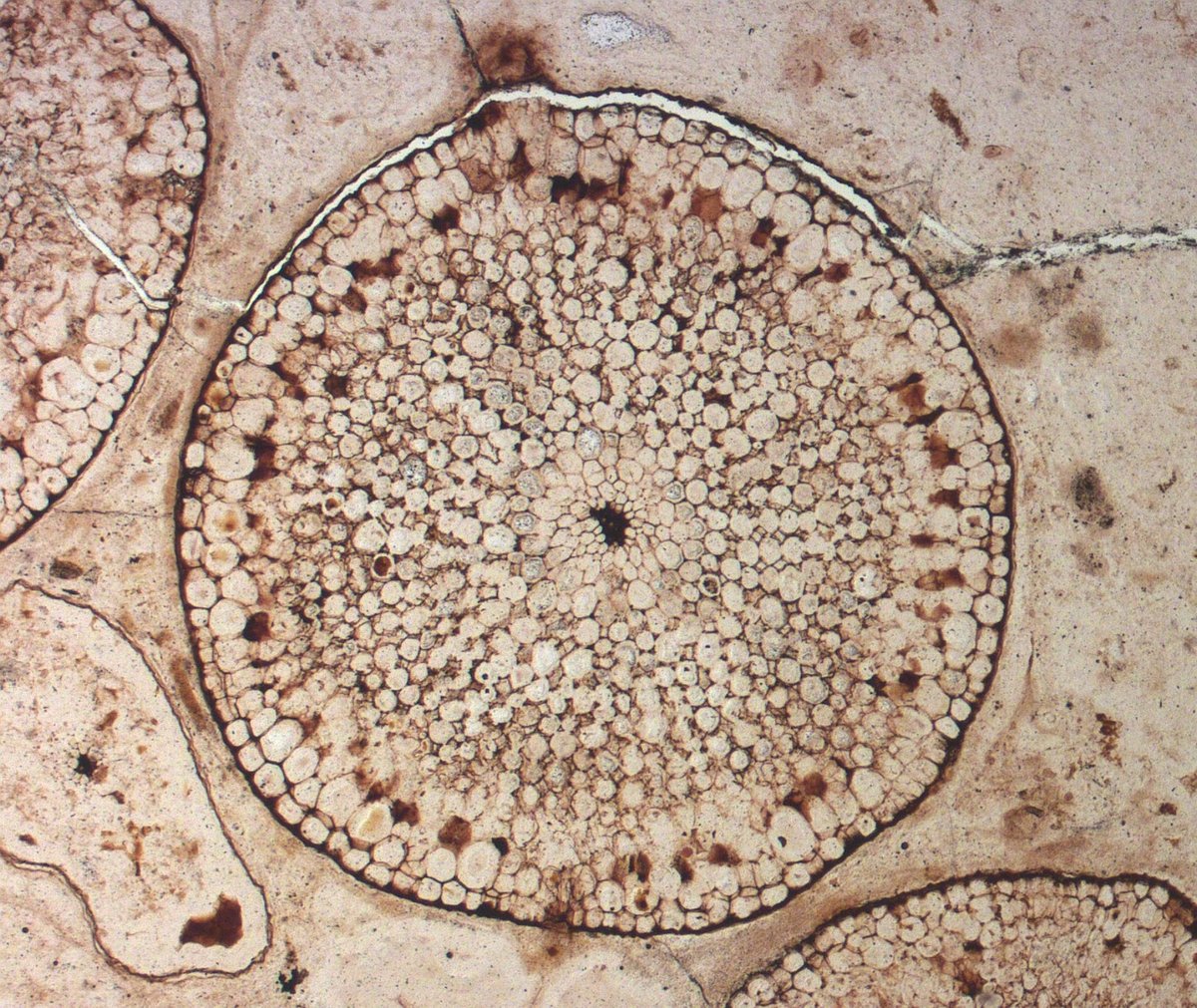
Rhynia was a relatively small, structurally simple plant, completely lacking the true roots, leaves, and complex vascular tissues found in modern flora. It stood approximately 18 to 20 centimeters in height, with creeping underground stems called rhizomes that anchored it to the substrate. From these rhizomes, smooth, naked, photosynthetic stems grew upward, measuring about 2 to 3 millimeters in diameter. The stems branched dichotomously, meaning they split into two equal forks at various intervals as they grew. At the tips of some of these aerial stems were sporangia, which were oval-shaped structures responsible for producing and releasing spores for reproduction. The internal anatomy of Rhynia is exceptionally well-documented due to the nature of its preservation. It possessed a simple central vascular cylinder, or protostele, consisting of water-conducting cells known as tracheids surrounded by food-conducting tissue. However, these tracheids lacked the secondary cell wall thickenings characteristic of more advanced vascular plants, exhibiting instead a spongy, decay-resistant structure. The outer epidermis of the stems featured a thick, waxy cuticle and stomata, which are microscopic pores essential for gas exchange and water regulation in a terrestrial environment. Small hemispherical projections, often interpreted as adventitious branches or healing responses to injury, dotted the lower portions of the stems. Rhizoids, which are simple, hair-like extensions, grew from the rhizomes to absorb water and nutrients from the soil, functioning as primitive precursors to true roots. Compared to modern plants, Rhynia would have resembled a patch of leafless, green twigs or modern whisk ferns like Psilotum, though it is not directly related to them.
As a photosynthetic organism, Rhynia synthesized its own food using sunlight, carbon dioxide, and water. Its paleobiology was intricately tied to its unique environment, which was a geothermally active wetland. The presence of stomata and a waxy cuticle indicates that Rhynia was well-adapted to life in the open air, capable of regulating water loss while maximizing carbon dioxide uptake for photosynthesis. Reproduction in Rhynia was achieved through the dispersal of spores from its terminal sporangia. These spores were likely carried by the wind to colonize new areas of the surrounding landscape. The life cycle of Rhynia is thought to have involved an alternation of generations, a characteristic feature of all land plants, where a spore-producing sporophyte generation alternates with a gamete-producing gametophyte generation. While the sporophyte of Rhynia is well-known, the gametophyte stage, named Remyophyton delicatum, has also been identified in the fossil record, revealing that both generations were independent, free-living organisms. The growth patterns of Rhynia suggest it grew in dense, clonal stands, spreading horizontally via its rhizomes and sending up vertical shoots. This clonal growth strategy would have allowed it to rapidly colonize the mineral-rich, unstable soils around the hot springs. The plant's metabolism was likely adapted to the warm, humid conditions of the Early Devonian, and its simple vascular system, while less efficient than those of later plants, was sufficient for its modest height and the damp environment it inhabited. Evidence of fungal associations, including arbuscular mycorrhizae, has been found within the tissues of Rhynia, suggesting that these early plants engaged in symbiotic relationships with fungi to enhance nutrient uptake from the primitive soils, a critical adaptation for the successful colonization of land.
During the Early Devonian, the Earth's landscape was undergoing a profound transformation. The continents were largely barren, rocky expanses, but the margins of waterways and wetlands were beginning to turn green with the first terrestrial ecosystems. Rhynia thrived in a highly specific and dynamic environment: a geothermally active, silica-rich hot spring system, similar to modern-day Yellowstone National Park. The climate was generally warm and tropical, as the landmass that would become Scotland was situated south of the equator at the time. Rhynia was a primary producer in this early terrestrial food web, capturing solar energy and converting it into biomass. It grew alongside a diverse community of other early land plants, such as Asteroxylon, Horneophyton, and Aglaophyton, forming dense, low-lying thickets. These plant communities provided habitat and sustenance for a variety of early terrestrial arthropods. The Rhynie Chert has yielded fossils of springtails, mites, early spiders, and primitive wingless insects, many of which likely fed on the decaying plant matter, spores, or even the living tissues of Rhynia. Some stems of Rhynia show evidence of damage, including puncture wounds and lesions, which paleontologists interpret as the earliest known examples of herbivory or parasitism by arthropods and fungi. The hot spring environment was both a sanctuary and a hazard; periodic inundations of silica-rich water from geyser eruptions would rapidly entomb and petrify the plants and animals, preserving this ancient ecosystem in extraordinary detail while simultaneously destroying the local community.
The discovery of Rhynia and the Rhynie Chert is a landmark event in the history of paleontology. The site was discovered in 1912 by William Mackie, a Scottish medical doctor and amateur geologist, while he was mapping the geology of the area around the village of Rhynie in Aberdeenshire, Scotland. Mackie noticed unusual, dark, cherty rocks incorporated into the local stone walls and traced them back to their source in a nearby field. Upon examining thin sections of the rock under a microscope, he was astounded to find perfectly preserved plant stems with their cellular structure intact. Mackie brought his discovery to the attention of Robert Kidston and William Henry Lang, two prominent paleobotanists of the era. Between 1917 and 1921, Kidston and Lang published a series of five monumental monographs detailing the flora of the Rhynie Chert. They named the most abundant plant Rhynia gwynne-vaughanii in 1917. The genus name honors the village of Rhynie, while the specific epithet commemorates David Thomas Gwynne-Vaughan, a distinguished botanist and close colleague of Kidston and Lang who had recently passed away. The initial descriptions by Kidston and Lang were so thorough and accurate that they remain foundational texts in paleobotany today. Over the decades, the Rhynie Chert has been the subject of numerous excavations and intense scientific scrutiny. Notable subsequent discoveries include the identification of the gametophyte generation of Rhynia by Winfried Remy and colleagues in the 1990s, which resolved long-standing questions about the plant's life cycle. The site itself is now a protected Site of Special Scientific Interest, and while the original trenches have been backfilled, researchers continue to study archived specimens and occasionally extract new cores for analysis.
Rhynia occupies a pivotal position in the evolutionary tree of life, serving as a crucial transitional form between primitive, non-vascular bryophytes like mosses and liverworts and the more complex vascular plants that dominate the Earth today. It is the type genus for the Rhyniophytina, a group of early vascular plants that are considered basal to all other tracheophytes. Rhynia demonstrates the early acquisition of key terrestrial adaptations, most notably a waterproof cuticle, stomata for gas exchange, and a rudimentary vascular system for internal water transport. However, its lack of true roots and leaves highlights the stepwise nature of plant evolution; these complex organs evolved later in different plant lineages. The vascular tissue of Rhynia, with its simple tracheids lacking secondary thickening, represents an intermediate stage in the evolution of water-conducting cells. Furthermore, the discovery of the independent gametophyte generation of Rhynia provided concrete fossil evidence for the homologous theory of the alternation of generations, which posits that the sporophyte and gametophyte generations evolved from a common, free-living ancestor. By studying Rhynia, scientists can reconstruct the sequence of anatomical and physiological innovations that allowed plants to conquer the land, a process that fundamentally altered the Earth's atmosphere, weathered its rocks to create soil, and paved the way for the terrestrial colonization of animals. Rhynia is not considered a direct ancestor of any specific modern plant group, but rather a representative of the early, experimental radiation of vascular plants from which modern lineages eventually emerged.
Despite over a century of study, Rhynia remains the subject of ongoing scientific debate and reinterpretation. One major area of contention has been its exact taxonomic placement. Originally, Kidston and Lang described two species of Rhynia: Rhynia gwynne-vaughanii and Rhynia major. However, in the 1980s, paleobotanist David Edwards re-examined the specimens and determined that Rhynia major lacked true vascular tissue, leading to its reclassification into a new genus, Aglaophyton. This left Rhynia gwynne-vaughanii as the sole species of Rhynia and refined the definition of what constitutes a true vascular plant. Another ongoing debate concerns the nature of the hemispherical projections on the stems of Rhynia. While traditionally viewed as adventitious branches or organs for vegetative reproduction, some researchers have proposed that they might be traumatic responses to piercing damage by early arthropods or fungal infections. The interpretation of the plant's water-conducting cells has also been debated; some argue they are true tracheids, while others suggest they represent an evolutionary precursor. Furthermore, the precise ecological conditions of the Rhynie hot springs and how these extreme environments influenced the preservation and evolution of the flora continue to be actively researched and discussed among geochemists and paleobotanists.
The fossil record of Rhynia is entirely restricted to the Rhynie Chert in Aberdeenshire, Scotland. Despite this highly localized geographic distribution, the sheer volume and quality of the fossils are staggering. Thousands of specimens have been identified within the chert nodules. The preservation quality is exceptional, categorized as permineralization by silica. The silica-rich waters of the Devonian hot springs permeated the plant tissues before they could decay, crystallizing and preserving the cellular anatomy in three dimensions. Paleobotanists study these fossils by cutting the chert into ultra-thin slices, which can be examined under a microscope to reveal individual cell walls, stomata, spores, and even the delicate hyphae of symbiotic fungi. Typically, the entire plant is preserved, from the underground rhizomes and rhizoids to the upright stems and terminal sporangia. This level of whole-plant preservation is incredibly rare in the fossil record, where plants are usually found as fragmented, flattened impressions. The Rhynie Chert remains the most important Early Devonian fossil site in the world, providing an unmatched snapshot of an early terrestrial ecosystem.
While Rhynia may not possess the mainstream cultural cachet of dinosaurs like Tyrannosaurus rex, it holds a legendary status within the scientific community and among botany enthusiasts. It is a staple of university biology and paleontology textbooks, universally cited as the classic example of an early land plant. Specimens and life-sized dioramas of the Rhynie ecosystem are prominently displayed in major natural history museums worldwide, including the Natural History Museum in London and the National Museum of Scotland in Edinburgh. The village of Rhynie celebrates its unique geological heritage, and the site has inspired public fascination with the deep history of plant life and the alien landscapes of the early Earth.
Classification
Time Period
Discovery
Location
Scotland
Formation
Rhynie Chert
Frequently Asked Questions
What is Rhynia?
Rhynia gwynne-vaughanii is an extinct, early vascular plant that lived during the Early Devonian period, approximately 412 to 407 million years ago. Discovered in the famous Rhynie Chert of Aberdeenshire, Scotland, this organism represents one of the most significant botanical discoveries in paleont...
When did Rhynia live?
Rhynia lived during the devonian period of the paleozoic era approximately 412-407 million years ago.
Where was Rhynia discovered?
Fossils of Rhynia were discovered in Scotland in the Rhynie Chert.
What did Rhynia eat?
Rhynia was a photosynthetic. It lived in terrestrial habitats.
What type of fossil is Rhynia?
Rhynia is preserved as a permineralized fossil. The preservation quality is exceptional.
Related Specimens
From the paleozoic era · permineralized fossils