Estemmenosuchus
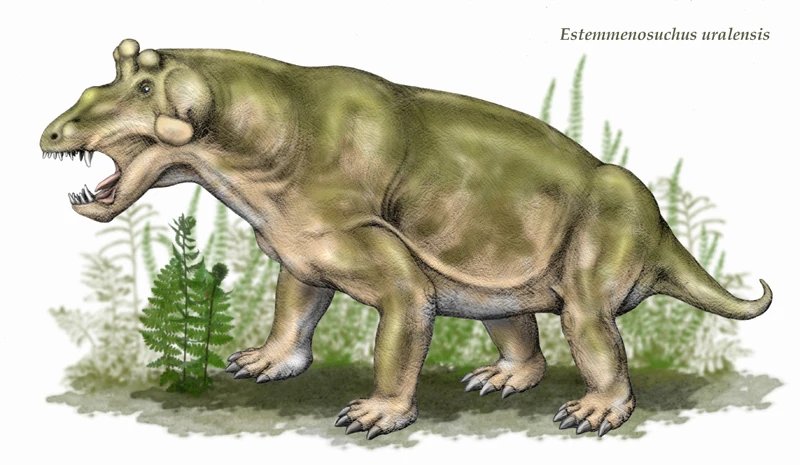
Estemmenosuchus uralensis
Image: Image sourced via web search (Fair use / Educational)
About Estemmenosuchus
Estemmenosuchus uralensis, whose scientific name translates to the crowned crocodile of the Ural Mountains, was a heavily built, early therapsid that roamed the terrestrial landscapes of the Middle Permian period, approximately 268 to 260 million years ago. Found primarily in the Perm region of modern-day Russia, this remarkable synapsid represents one of the most bizarre and distinctive animals of the Paleozoic era. Its significance in paleontology lies in its unique cranial ornamentation and its position as an early offshoot of the therapsid lineage, providing crucial insights into the early diversification of the ancestors of mammals long before the catastrophic Permian-Triassic extinction event reshaped life on Earth. As a member of the Dinocephalia, a group of early therapsids characterized by their large size and often thickened skulls, Estemmenosuchus stands out due to the spectacular array of horn-like structures adorning its head. These features have fascinated paleontologists for decades, offering a unique window into the evolutionary experimentation that characterized the synapsid lineage during the Permian. The discovery of Estemmenosuchus has fundamentally altered our understanding of the morphological diversity and ecological roles of early therapsids, cementing its place as a cornerstone species in the study of pre-mammalian evolution.
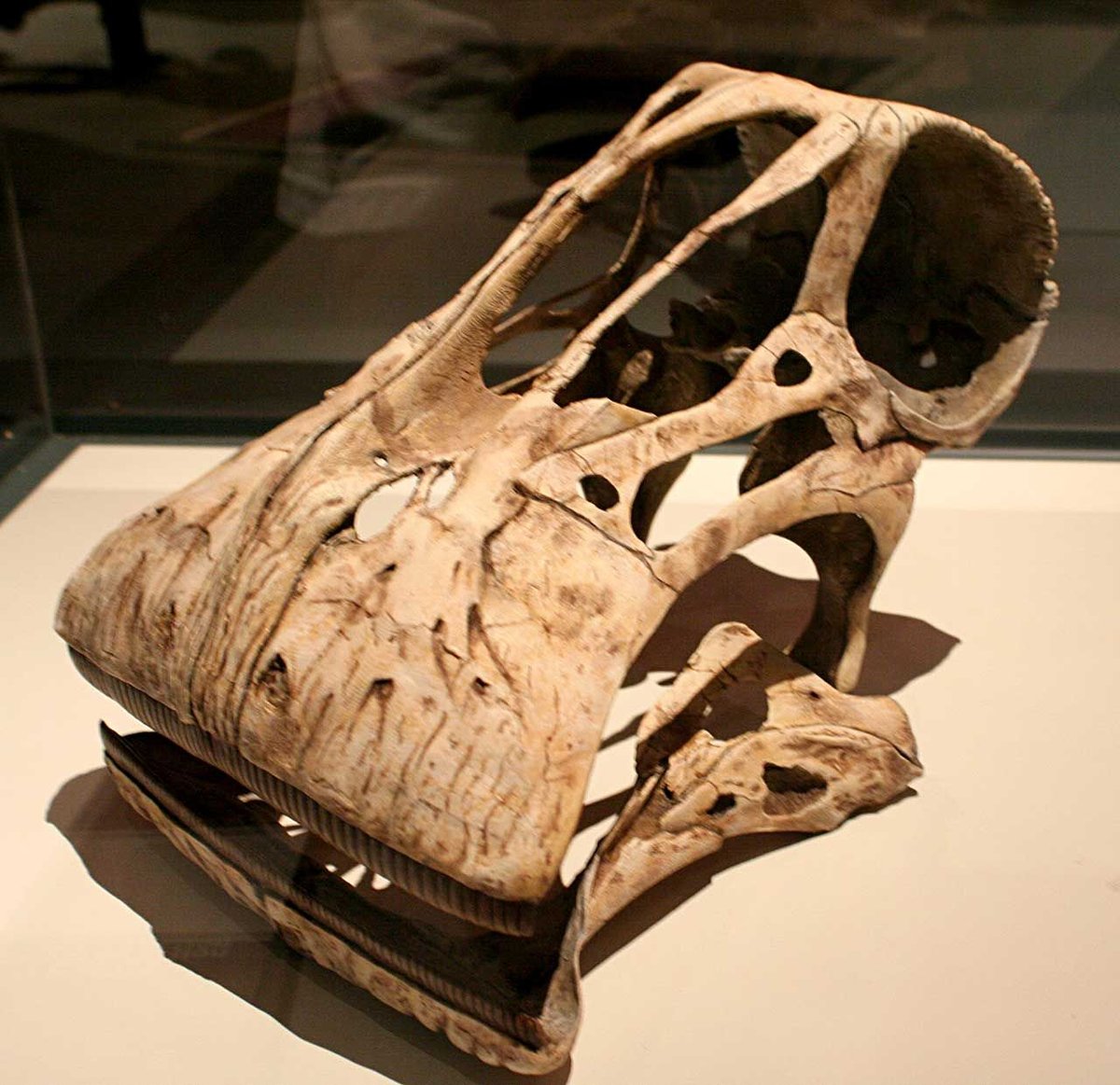
In terms of physical description, Estemmenosuchus uralensis was an imposing creature, representing one of the largest terrestrial animals of its time. Adult individuals are estimated to have reached lengths of 3 to 4.5 meters, or roughly 10 to 15 feet, with a shoulder height of over a meter. Weight estimates vary, but a fully grown adult could likely have weighed anywhere from 500 to over 1000 kilograms, making it comparable in size and bulk to a modern rhinoceros or a large domestic bull. The most striking anatomical feature of Estemmenosuchus was undoubtedly its skull, which was heavily ornamented with a series of bony protuberances. These included a pair of large, upward-pointing, antler-like horns projecting from the frontals and parietals, as well as wide, flaring cheek flanges extending outward from the jugal bones. Unlike the keratinous horns of modern bovids or the antlers of cervids, these structures were solid bone, covered in life by a layer of tough skin or keratin. The postcranial skeleton of Estemmenosuchus was robust and heavily ossified, designed to support its massive bulk. It possessed a sprawling to semi-erect posture, with powerful forelimbs that were slightly longer and more heavily muscled than the hindlimbs, suggesting a front-heavy weight distribution. The ribcage was expansive, indicating the presence of a large digestive tract necessary for processing large volumes of food. Soft tissue inferences, based on exceptionally preserved skin impressions found in the Ocher locality, reveal that Estemmenosuchus lacked scales; instead, it possessed smooth, glandular skin, somewhat similar to that of modern hairless mammals or certain amphibians. This remarkable preservation provides direct evidence that the transition away from the scaly integument of early amniotes was already well underway in these early synapsids.
The paleobiology of Estemmenosuchus has been a subject of considerable interest and debate, particularly regarding its diet and feeding strategies. The dentition of Estemmenosuchus uralensis is highly unusual and somewhat contradictory. It possessed large, prominent canine teeth, reminiscent of a carnivore, but these were accompanied by small, peg-like incisors and a battery of leaf-shaped cheek teeth that are typically associated with an herbivorous diet. This unique dental arrangement suggests that Estemmenosuchus was likely an omnivore, capable of processing a wide variety of food sources. It may have used its large canines for defense, intra-specific combat, or occasionally scavenging and dispatching small prey, while relying on its cheek teeth to grind tough, fibrous plant material such as ferns, horsetails, and early gymnosperms. The massive barrel-shaped torso supports the hypothesis of a largely herbivorous diet, as it would have housed the extensive gut necessary for fermenting and digesting low-quality vegetation. In terms of locomotion, Estemmenosuchus was not a fast runner. Its sprawling forelimbs and heavy build suggest a slow, deliberate walking pace, well-suited for browsing in dense vegetation or navigating the muddy margins of rivers and lakes. Social behavior in Estemmenosuchus is inferred primarily from its cranial ornamentation. The elaborate horns and cheek flanges were likely used for intra-specific display, species recognition, and possibly ritualized combat among males competing for mates or territory, similar to the behavior seen in modern horned mammals. Growth patterns, analyzed through bone histology, indicate that Estemmenosuchus grew relatively quickly during its early years before reaching a plateau, suggesting a metabolism that was higher than that of contemporary reptiles but not yet fully endothermic like modern mammals.
The ecological context of the Middle Permian world in which Estemmenosuchus lived was vastly different from today. During this time, the Earth's landmasses were joined together in the supercontinent of Pangea. The climate in the Ural region of Russia, where Estemmenosuchus fossils are found, was characterized by a warm, temperate environment with distinct seasonal variations, including monsoonal rains and periodic dry spells. The landscape was dominated by extensive floodplains, meandering river systems, and lush, swampy forests composed of glossopteris trees, giant horsetails, and early seed ferns. Estemmenosuchus occupied a prominent position in this ecosystem as a large, primary consumer or omnivore. It shared its habitat with a diverse array of other early synapsids, including smaller therapsids, primitive pelycosaurs, and large, carnivorous biarmosuchians such as Eotitanosuchus, which may have been one of the few predators capable of threatening an adult Estemmenosuchus. The rivers and lakes were teeming with large temnospondyl amphibians and early bony fishes. In this complex food web, Estemmenosuchus likely acted as a major ecosystem engineer, clearing vegetation and shaping the physical environment through its browsing and movement. The presence of such large herbivores indicates a highly productive ecosystem capable of supporting massive biomass, highlighting the evolutionary success of the therapsid lineage during the Middle Permian before the devastating environmental changes that would later characterize the end of the period.
The discovery history of Estemmenosuchus is intimately tied to the rich paleontological heritage of Russia. The first fossils of Estemmenosuchus uralensis were discovered in 1960 by the renowned Soviet paleontologist Petr Konstantinovich Chudinov during extensive excavations at the Ezhovo locality, part of the Ocher Assemblage in the Perm region near the Ural Mountains. This site proved to be one of the most important Permian fossil localities in the world, yielding a spectacular array of exceptionally preserved therapsid skeletons. Chudinov formally described and named the genus and species in 1960, coining the name Estemmenosuchus, meaning crowned crocodile, in reference to the spectacular cranial ornamentation, and uralensis, denoting the geographical region of its discovery. The circumstances of the discovery were remarkable; the fossils were found in a massive bone bed, representing a mass death assemblage likely caused by a catastrophic flood event that buried the animals rapidly in fine-grained mud. This rapid burial resulted in the exceptional preservation of articulated skeletons, complete skulls, and even the rare skin impressions that have provided such invaluable information about synapsid integument. Over the years, several nearly complete skeletons and numerous isolated skulls of Estemmenosuchus have been excavated from the Ocher site, providing a comprehensive anatomical record that is rare for animals of this age. These specimens, many of which are housed in the Paleontological Institute of the Russian Academy of Sciences in Moscow, remain some of the most important reference materials for the study of early therapsid evolution.
The evolutionary significance of Estemmenosuchus cannot be overstated, as it occupies a crucial position in the tree of life. As a member of the Dinocephalia, Estemmenosuchus represents one of the earliest major radiations of therapsids, the group of synapsids that would eventually give rise to modern mammals. While Estemmenosuchus itself left no modern descendants, having gone extinct along with the rest of the dinocephalians during the Capitanian mass extinction event in the Middle Permian, it provides vital clues about the evolutionary trajectory of the mammalian lineage. Its anatomy exhibits a fascinating mosaic of primitive and derived features. The retention of a sprawling forelimb posture and a relatively small braincase are primitive traits inherited from pelycosaur ancestors, while the differentiated dentition, expanded temporal fenestrae for larger jaw muscles, and glandular skin are derived features that foreshadow the mammalian condition. Estemmenosuchus demonstrates that many of the traits we associate with mammals, such as specialized teeth and changes in integument, began to evolve very early in the synapsid lineage, millions of years before the first true mammals appeared. Furthermore, the extreme cranial ornamentation of Estemmenosuchus highlights the incredible morphological plasticity and evolutionary experimentation that occurred within the Therapsida during the Permian, showing that these early mammalian relatives were capable of evolving bizarre and highly specialized forms to adapt to their specific ecological niches.
Despite the wealth of fossil material, Estemmenosuchus remains the subject of ongoing scientific debates and controversies. One of the primary areas of contention revolves around its exact dietary habits. While the consensus leans towards an omnivorous or primarily herbivorous diet, some researchers have argued that the large canines and robust jaw structure could indicate a more carnivorous lifestyle, perhaps specializing in tough, armored prey or scavenging. The exact function of the cranial ornamentation is also debated; while most agree it played a role in display or intra-specific combat, some biomechanical studies suggest the horns may have been too fragile for direct, high-impact clashes, pointing instead to a purely visual function or perhaps a role in thermoregulation, acting as radiators to dissipate heat from the animal's massive body. Additionally, the taxonomy of the genus has seen revisions. A second species, Estemmenosuchus mirabilis, was also discovered at the Ocher locality, distinguished by differently shaped horns and a slightly smaller size. However, some paleontologists have proposed that E. mirabilis might actually represent a different sex or a different ontogenetic stage of E. uralensis, sparking ongoing debates about sexual dimorphism and growth patterns in early therapsids. These debates highlight the dynamic nature of paleontological research and the continuous refinement of our understanding as new analytical techniques are applied to these ancient fossils.
The fossil record of Estemmenosuchus is geographically restricted but exceptionally rich in quality. To date, fossils of Estemmenosuchus have only been found in the Perm region of Russia, specifically within the geological strata of the Ocher Assemblage. Despite this limited geographic range, the number of specimens recovered is impressive, with dozens of individuals represented, ranging from isolated bones to nearly complete, articulated skeletons. The preservation quality at the Ezhovo locality is widely considered exceptional. The fine-grained fluvial and lacustrine sediments of the site allowed for the preservation of delicate cranial structures, complete dentition, and, most famously, patches of fossilized skin. Typically, the massive, heavily ossified skulls are the most commonly preserved elements, as their robust nature makes them resistant to taphonomic destruction. However, the discovery of complete postcranial skeletons has allowed researchers to reconstruct the entire animal with a high degree of confidence. The Ocher site remains one of the most famous and scientifically significant Permian fossil localities globally, providing an unparalleled snapshot of a complex terrestrial ecosystem from over 260 million years ago.
In terms of cultural impact, Estemmenosuchus has captured the imagination of the public and paleoartists alike, thanks to its bizarre, almost alien appearance. It frequently appears in popular science books, documentaries, and artistic reconstructions focusing on the Permian period and the evolution of mammals. Notable displays of Estemmenosuchus skeletons and life-sized models can be found in major natural history museums around the world, most prominently at the Orlov Paleontological Museum in Moscow, where the original holotype specimens are housed. The creature's unique blend of reptilian and mammalian features makes it an excellent educational tool for illustrating the concept of transitional fossils and the deep evolutionary history of the mammalian lineage. Its striking appearance ensures that Estemmenosuchus remains a favorite among prehistoric life enthusiasts, serving as a powerful reminder of the incredible diversity of life that existed on Earth long before the age of the dinosaurs.
Classification
Time Period
Discovery
Location
Perm region, Russia
Formation
Ocher Assemblage
Frequently Asked Questions
What is Estemmenosuchus?
Estemmenosuchus uralensis, whose scientific name translates to the crowned crocodile of the Ural Mountains, was a heavily built, early therapsid that roamed the terrestrial landscapes of the Middle Permian period, approximately 268 to 260 million years ago. Found primarily in the Perm region of mode...
When did Estemmenosuchus live?
Estemmenosuchus lived during the permian period of the paleozoic era approximately 268-260 million years ago.
Where was Estemmenosuchus discovered?
Fossils of Estemmenosuchus were discovered in Perm region, Russia in the Ocher Assemblage.
What did Estemmenosuchus eat?
Estemmenosuchus was a omnivore. It lived in terrestrial habitats.
What type of fossil is Estemmenosuchus?
Estemmenosuchus is preserved as a body fossil. The preservation quality is excellent.
Related Specimens
From the paleozoic era · body fossils