Giganotosaurus
Giganotosaurus carolinii
Image: File:Giganotosaurus carolinii.jpg - Wikimedia Commons (CC BY-SA)
About Giganotosaurus
Giganotosaurus carolinii, whose name translates to "giant southern lizard," was a colossal theropod dinosaur that inhabited the terrestrial ecosystems of what is now Patagonia, Argentina, during the early Cenomanian stage of the Late Cretaceous period, approximately 99.6 to 97 million years ago. As one of the largest terrestrial carnivores known to science, its discovery fundamentally altered our understanding of dinosaur gigantism and the global distribution of apex predators during the Mesozoic Era. This immense carcharodontosaurid rivaled, and in some estimates slightly exceeded, the size of the more famous Tyrannosaurus rex, establishing itself as the undisputed apex predator of its specific time and place.
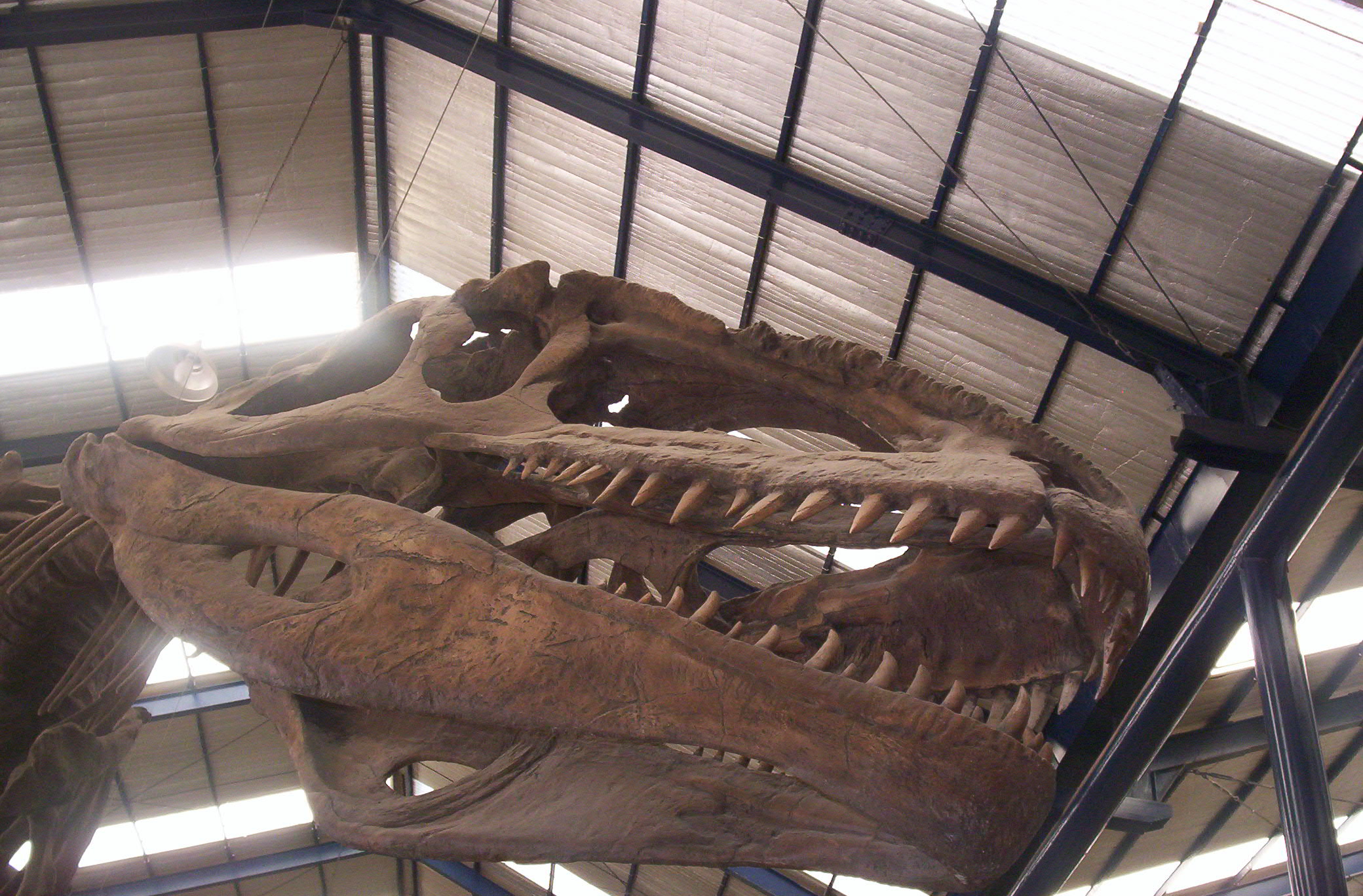
The physical presence of Giganotosaurus was nothing short of awe-inspiring, a testament to the upper limits of bipedal carnivorous life. Estimates based on the holotype specimen (MUCPv-Ch1) and a more fragmentary second specimen (MUCPv-95) place its total body length between 12 and 13 meters (approximately 40 to 43 feet). Its weight is estimated to have been between 6 and 8 metric tons, with some upper-end calculations suggesting it could have approached 13.8 tons, making it one of the heaviest theropods. Its most distinguishing feature was its enormous, yet relatively narrow, skull. Measuring up to 1.6 meters (5.2 feet) in length, the skull was proportionally longer than that of Tyrannosaurus, though less robustly built. It was fenestrated with large openings, which reduced its weight without compromising structural integrity. The jaws were lined with dozens of laterally compressed, blade-like teeth, each up to 20 centimeters long and finely serrated like a steak knife. These teeth were not designed for crushing bone but for inflicting deep, catastrophic slicing wounds. Giganotosaurus possessed powerful, muscular hindlimbs that supported its massive frame, while its forelimbs were relatively small but still robust, each bearing three sharp, recurved claws. A long, heavy, muscular tail acted as a crucial counterbalance to its massive head and torso, providing stability during locomotion.
The paleobiology of Giganotosaurus reveals a creature exquisitely adapted for hunting the giant herbivores of its environment. Its dental morphology strongly suggests a specialized feeding strategy distinct from that of tyrannosaurids. Instead of a bone-shattering bite, Giganotosaurus likely employed a "bite-and-slash" or "flesh-grazing" tactic. It would have used its formidable jaws to inflict deep, gaping wounds on the flanks and limbs of its prey, causing massive blood loss and shock. This method would have been particularly effective against the colossal titanosaurian sauropods that shared its habitat, as a single Giganotosaurus could wound an animal far too large to bring down with brute force alone, then wait for it to weaken from exsanguination. Biomechanical studies of its skull indicate it was well-suited to withstand the stresses of struggling prey but was not optimized for the torsional forces associated with bone-crushing. In terms of locomotion, its powerful hind legs suggest it was capable of moving at a respectable pace for its size, though it was certainly not a sprinter, likely achieving speeds of around 20 kilometers per hour (14 mph). Inferences about its behavior remain speculative, but the discovery of multiple associated carcharodontosaurid skeletons in other formations has led some paleontologists to hypothesize that Giganotosaurus may have engaged in cooperative hunting, a strategy that would have greatly increased its success rate against the truly gigantic sauropods of the region.
Giganotosaurus lived within the Candeleros Formation, a geological unit that depicts a rich and complex floodplain ecosystem. During the early Late Cretaceous, this part of South America was characterized by a warm, semi-arid climate with distinct wet and dry seasons. The landscape was a mosaic of braided river systems, meandering streams, and extensive floodplains, dotted with lakes and vegetated with conifers, ferns, and cycads. In this environment, Giganotosaurus occupied the absolute pinnacle of the food web. Its primary prey likely consisted of the enormous titanosaurian sauropods that were abundant in the region, most notably Andesaurus and Limaysaurus, herbivores that could reach lengths of over 18 meters. Attacking such prey, even juveniles or infirm adults, would have been a monumental undertaking. Giganotosaurus also would have preyed upon smaller, more agile ornithopods like Macrogryphosaurus and perhaps even other predators. It shared this world with a diverse array of other species, including the rebbachisaurid sauropod Cathartesaura, the predatory abelisauroid Ekrixinatosaurus, various crocodilians, turtles, and early snake species, creating a dynamic and competitive prehistoric ecosystem where its immense size and power secured its dominance.
The discovery of this remarkable dinosaur was made not by a professional paleontologist, but by an amateur fossil enthusiast. In 1993, Rubén Darío Carolini, a car mechanic from Villa El Chocón in Neuquén Province, Argentina, stumbled upon a massive tibia weathering out of the badlands just 15 kilometers south of the town. Recognizing the potential significance of his find, he alerted local paleontologists. A formal excavation was soon organized by the National University of Comahue, led by paleontologists Rodolfo Coria and Leonardo Salgado. The team unearthed a remarkably complete skeleton, estimated to be about 70 percent intact. The specimen, cataloged as MUCPv-Ch1, included most of the vertebral column, the pectoral and pelvic girdles, the hindlimbs, and a significant portion of the skull. In 1995, Coria and Salgado formally described the new genus and species, naming it Giganotosaurus carolinii. The generic name reflects its immense size, while the specific name honors its discoverer, Rubén Carolini. This holotype specimen remains the most complete individual of the species ever found and is housed at the Ernesto Bachmann Paleontological Museum in Villa El Chocón, which was founded in large part to display this incredible find.
The evolutionary significance of Giganotosaurus cannot be overstated. It belongs to the family Carcharodontosauridae, a clade of giant allosauroid theropods that flourished during the mid-Cretaceous. This family includes other colossal predators such as Carcharodontosaurus from North Africa and Mapusaurus, another giant from Argentina. The discovery of Giganotosaurus was a watershed moment, as it definitively proved that theropods of T. rex size and larger had evolved independently on the southern supercontinent of Gondwana. For decades, Tyrannosaurus had been viewed as the singular pinnacle of predatory dinosaur evolution, but Giganotosaurus demonstrated that different lineages on different continents had converged on similar gigantic body plans to fill the apex predator niche. This finding highlighted the profound effects of continental drift on dinosaur evolution, showing how isolated landmasses fostered unique and spectacular evolutionary radiations. The carcharodontosaurids, including Giganotosaurus, dominated the apex predator roles in the southern hemisphere for tens of millions of years before they were eventually supplanted by the abelisaurids and, in the north, the tyrannosaurids, in the final stages of the Cretaceous.
Despite its fame, Giganotosaurus is not without its scientific debates. One of the most prominent controversies revolves around its precise size relative to other giant theropods. While early estimates enthusiastically placed it as definitively larger than Tyrannosaurus, subsequent analyses have shown that the two were very closely matched in size, with different individuals of each species likely varying. Giganotosaurus was probably longer and had a larger skull, but T. rex was more robustly built and likely heavier on average. Another area of debate concerns its social behavior. The hypothesis of pack hunting, largely based on a bonebed of the closely related Mapusaurus, is compelling but remains unproven for Giganotosaurus itself, as no multiple-individual sites have been found. The exact mechanics of its bite and killing technique are also a subject of ongoing biomechanical research, with scientists using finite element analysis to model the stresses on its skull and better understand its predatory capabilities compared to the bone-crushing bite of tyrannosaurs.
The fossil record for Giganotosaurus carolinii is geographically restricted to the Candeleros Formation in Neuquén Province, Argentina, providing a specific snapshot of life in that region 97 million years ago. To date, the fossil evidence is based on only two known specimens. The first is the holotype, MUCPv-Ch1, which is approximately 70% complete and forms the basis for nearly all scientific understanding of the animal's anatomy and proportions. The second specimen, MUCPv-95, is far more fragmentary, consisting only of the anterior part of a left dentary (the tooth-bearing bone of the lower jaw). This second specimen is notable because it is about 8% larger than the corresponding bone in the holotype, suggesting the existence of individuals that were even larger than the one originally discovered. The preservation quality of the holotype is excellent, providing detailed anatomical information that has been crucial for comparative studies with other theropods. The Ernesto Bachmann Paleontological Museum in Villa El Chocón, near the discovery site, has become a world-renowned center for research on this dinosaur.
Since its discovery, Giganotosaurus has made a significant cultural impact, capturing the public imagination as one of the few predators capable of challenging the supremacy of Tyrannosaurus rex. It has been prominently featured in numerous documentaries, television series, and films, often depicted in epic battles with its giant herbivorous prey or rival carnivores. Its fossils, particularly the magnificent mounted skeleton of the holotype in Villa El Chocón, are a major tourist attraction and a source of regional pride. In the realm of video games and toys, Giganotosaurus is a popular figure, celebrated for its immense size and formidable appearance. This cultural presence serves an important educational role, introducing audiences worldwide to the incredible diversity of the dinosaur world beyond the familiar North American fauna and highlighting the groundbreaking paleontological discoveries emerging from South America.
Classification
Time Period
Discovery
Location
Patagonia, Argentina
Formation
Candeleros Formation
Frequently Asked Questions
What is Giganotosaurus?
Giganotosaurus carolinii, whose name translates to "giant southern lizard," was a colossal theropod dinosaur that inhabited the terrestrial ecosystems of what is now Patagonia, Argentina, during the early Cenomanian stage of the Late Cretaceous period, approximately 99.6 to 97 million years ago. As ...
When did Giganotosaurus live?
Giganotosaurus lived during the cretaceous period of the mesozoic era approximately 99.6-97 million years ago.
Where was Giganotosaurus discovered?
Fossils of Giganotosaurus were discovered in Patagonia, Argentina in the Candeleros Formation.
What did Giganotosaurus eat?
Giganotosaurus was a carnivore. It lived in terrestrial habitats.
What type of fossil is Giganotosaurus?
Giganotosaurus is preserved as a permineralized fossil. The preservation quality is good.
Related Specimens
From the mesozoic era · permineralized fossils