Euoplocephalus
Euoplocephalus tutus
Image: Image sourced via web search (Fair use / Educational)
About Euoplocephalus
Euoplocephalus tutus was a heavily armored, herbivorous dinosaur that roamed the floodplains of western North America during the Late Cretaceous Period. As one of the best-known members of the Ankylosauridae family, its extensive fossil record has provided paleontologists with a detailed understanding of ankylosaur anatomy and paleobiology. Its name, meaning 'well-armored head,' aptly describes one of its most formidable features in a life spent defending against some of the era's most powerful predators.
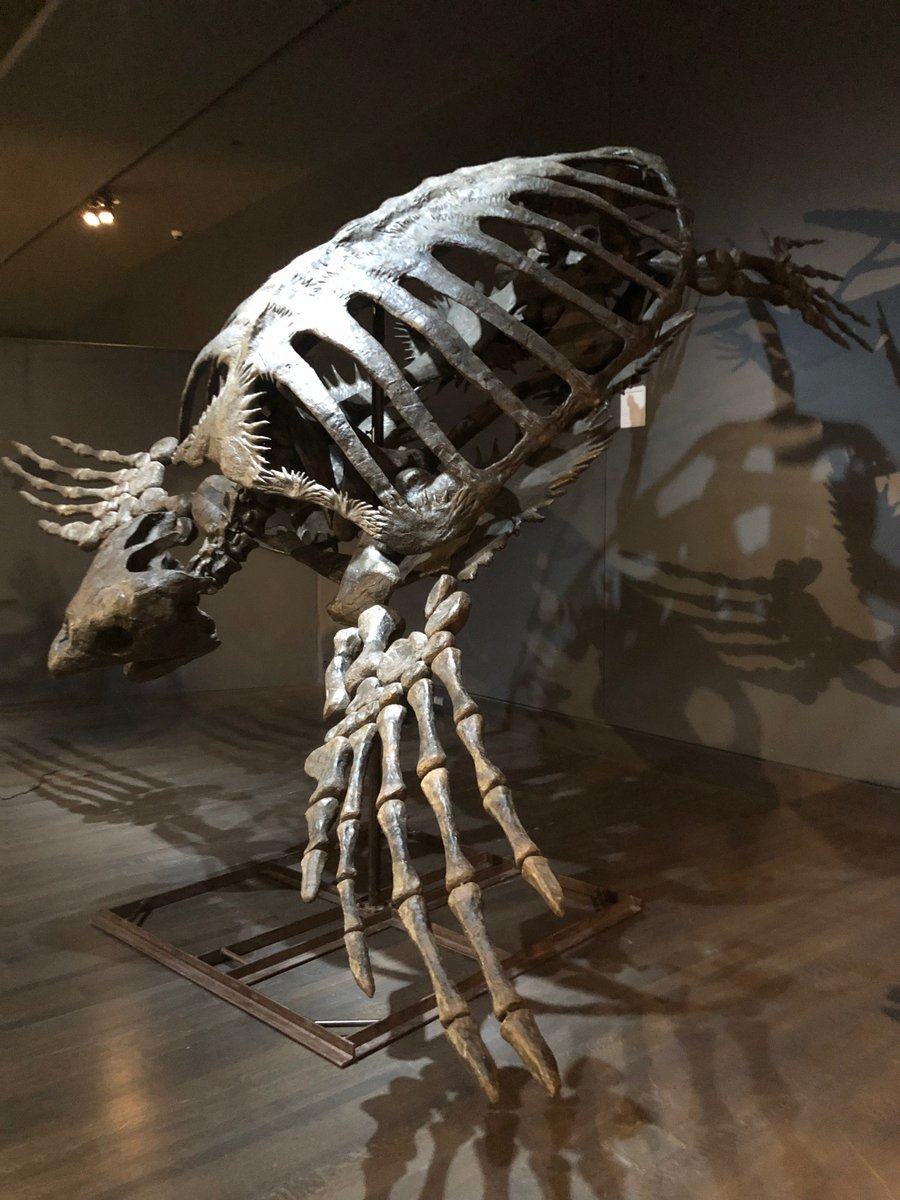
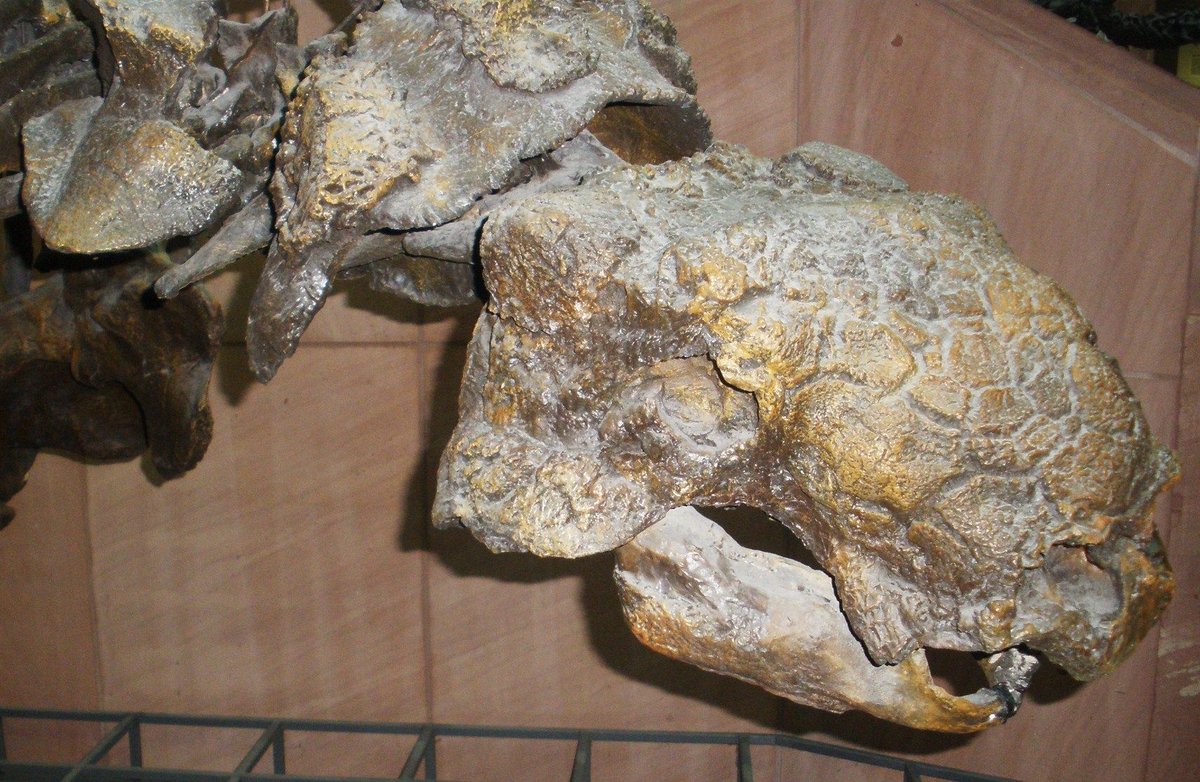
Euoplocephalus was a medium-sized ankylosaurid, reaching an estimated length of up to 6 meters (about 20 feet) and weighing around 2 to 2.5 metric tons (approximately 4,400 to 5,500 pounds). This makes it comparable in size to a large rhinoceros or a small hippopotamus. Its body was low-slung, wide, and tank-like, supported by four short, stout legs. The most striking feature was its comprehensive body armor, composed of osteoderms—bony plates and nodules embedded in the skin. These formed a mosaic-like shield across its back, neck, and tail, with larger, keeled scutes arranged in distinct transverse bands. Its head was a veritable fortress, short and wide, with fused bony plates covering the skull and even bony shutters that could slide down to protect its eyes. Two prominent horns projected backwards from the rear of its skull, and smaller horns adorned its cheeks. The snout was broad and toothless, covered by a keratinous beak, while small, leaf-shaped teeth lined the sides of its jaws, designed for shredding tough plant matter. The tail was a remarkable weapon, comprising the posterior half of the animal's length. The final third of the tail vertebrae were fused together by ossified tendons, forming a stiff, inflexible handle that supported a massive, bony club at its tip. This club, formed from several large, fused osteoderms, could be swung with considerable force, likely serving as a devastating defensive weapon against predators.
As a low-browsing herbivore, Euoplocephalus's diet likely consisted of ferns, cycads, and other ground-level vegetation. Its wide beak was well-suited for cropping large swaths of plants, which were then processed by its relatively weak, leaf-shaped teeth. The presence of a large, complex gut, inferred from its wide ribcage, suggests it was a hindgut fermenter, using microbial action to break down tough cellulose, similar to modern herbivorous mammals like horses and rhinos. Its short, powerful limbs and broad feet indicate it was a slow-moving, terrestrial quadruped. While not built for speed, its gait was likely steady and powerful. Analysis of its limb structure suggests it could not gallop but could move with a deliberate, shuffling walk. There is little direct fossil evidence for social behavior, and Euoplocephalus is often depicted as a solitary animal. However, the discovery of bonebeds containing multiple individuals of other ankylosaur species suggests that some level of gregariousness might have been possible, perhaps forming small, loose groups for foraging or defense. Growth studies based on bone histology are limited, but like other dinosaurs, it would have grown relatively quickly to reach its formidable adult size, a crucial strategy to outgrow its vulnerability to smaller predators.
Euoplocephalus lived in a warm, humid, subtropical environment on the western coastal plain of the Western Interior Seaway, a vast inland sea that split North America in two during the Late Cretaceous. This region, known as Laramidia, was a lush landscape of floodplains, deltas, and coastal swamps, crisscrossed by rivers and teeming with life. The flora was dominated by conifers, ferns, and early flowering plants. Euoplocephalus shared this ecosystem with a diverse array of other dinosaurs. Its fellow herbivores included numerous hadrosaurs like Lambeosaurus and Corythosaurus, and ceratopsians such as Centrosaurus and Styracosaurus. This placed Euoplocephalus in a competitive environment for low-browsing vegetation. Its primary predators were the formidable tyrannosaurids that patrolled this landscape. While the famous Tyrannosaurus rex appeared later, Euoplocephalus would have contended with its earlier, slightly smaller relatives, Gorgosaurus and Daspletosaurus. The dinosaur's extensive armor and powerful tail club were direct evolutionary responses to this intense predation pressure. An adult Euoplocephalus would have been a difficult target, with its low profile making it hard to flip over and its tail club capable of shattering the leg bones of an attacking theropod.
The history of Euoplocephalus is complex and intertwined with the early days of dinosaur paleontology in Alberta, Canada. The first specimen, a partial skull and the first tail club ever discovered, was found by Lawrence Lambe of the Geological Survey of Canada in 1897 near the Red Deer River. Lambe initially named the species Stereocephalus tutus in 1902. However, the genus name Stereocephalus was already in use for an insect, so Lambe renamed it Euoplocephalus in 1910. For much of the 20th century, Euoplocephalus became a 'wastebasket taxon.' Many ankylosaurid fossils from the Dinosaur Park and Horseshoe Canyon Formations, including those initially named Anodontosaurus, Dyoplosaurus, and Scolosaurus, were synonymized and lumped into the single species Euoplocephalus tutus. This was largely based on the work of paleontologist Walter P. Coombs Jr. in the 1970s, who conducted a comprehensive review of ankylosaurs. This consolidation made Euoplocephalus appear to have an unusually long temporal range and a high degree of anatomical variation. The most significant specimen is arguably AMNH 5404, a well-preserved skull and partial skeleton that has been central to many anatomical studies of the genus.
Euoplocephalus is a classic member of the Ankylosauridae, a family within the larger clade Ankylosauria, which belongs to the Ornithischia, or 'bird-hipped' dinosaurs. Ankylosaurids are distinguished from their relatives, the nodosaurids, by their wider skulls, the presence of large horns on the back of the skull, and, most famously, the evolution of a true, heavy tail club. Euoplocephalus represents a highly derived form of this lineage, showcasing the peak of ankylosaurid defensive adaptations. Its evolution demonstrates a clear arms race with the large theropod predators of its time. The development of increasingly robust armor and a more powerful tail club directly corresponds with the evolution of larger and more powerful tyrannosaurids. While ankylosaurs have no direct modern descendants, their evolutionary strategy of developing extreme defensive armor provides a fascinating case of convergent evolution with animals like glyptodonts, armadillos, and turtles. The study of its complex nasal passages, which may have been used for vocalization or thermoregulation, also provides valuable insights into the physiology and behavior of these heavily armored dinosaurs.
Recent scientific work has significantly revised our understanding of Euoplocephalus. The 'wastebasket' status it held for decades has been dismantled. In 2009, a major re-evaluation by Victoria Arbour and Philip Currie demonstrated that several of the genera previously synonymized with Euoplocephalus were, in fact, distinct. Fossils once assigned to Euoplocephalus have now been reclassified back to their original names, such as Anodontosaurus, Dyoplosaurus, and Scolosaurus. This taxonomic revision has restricted the genus Euoplocephalus tutus to fossils found primarily within the lower to middle parts of the Dinosaur Park Formation. This has shortened its geologic range and clarified its specific anatomical features, distinguishing it from its close relatives. Debates continue regarding the exact mechanics of its tail club swing and the function of its intricate nasal passages, with some researchers suggesting they were for sound resonance while others propose they acted as a heat-exchange system to cool the brain.
The fossil record of what is now strictly defined as Euoplocephalus is concentrated in the Dinosaur Park Formation of Alberta, Canada, a region renowned for its rich deposits of Late Cretaceous dinosaurs. While it was once thought to be one of the most abundant dinosaurs from this period, the recent taxonomic revisions have made it slightly less common than previously believed, though it is still known from at least a dozen skulls and several partial skeletons. The fossils are often disarticulated but generally show good preservation quality, allowing for detailed anatomical study. The most frequently preserved elements are the robust skull and the durable osteoderms, which often survive the fossilization process better than more delicate bones. The Royal Tyrrell Museum of Palaeontology in Drumheller, Alberta, and the American Museum of Natural History in New York hold some of the most important specimens that have defined our understanding of this iconic armored dinosaur.
Euoplocephalus, along with its more famous relative Ankylosaurus, has become a quintessential 'armored dinosaur' in the public imagination. It is frequently featured in dinosaur books, documentaries, and museum exhibits worldwide, often depicted in dramatic confrontations with tyrannosaurs. Its tank-like appearance and formidable tail club make it a subject of fascination for both children and adults. Notable skeletal mounts and reconstructions can be seen at major institutions, including the Canadian Museum of Nature and the Royal Tyrrell Museum, where it serves as a key educational tool to explain concepts of defense, adaptation, and predator-prey dynamics in the Mesozoic Era.
Classification
Time Period
Discovery
Location
Alberta, Canada
Formation
Dinosaur Park Formation, Horseshoe Canyon Formation
Frequently Asked Questions
What is Euoplocephalus?
Euoplocephalus tutus was a heavily armored, herbivorous dinosaur that roamed the floodplains of western North America during the Late Cretaceous Period. As one of the best-known members of the Ankylosauridae family, its extensive fossil record has provided paleontologists with a detailed understandi...
When did Euoplocephalus live?
Euoplocephalus lived during the cretaceous period of the mesozoic era approximately 76-67 million years ago.
Where was Euoplocephalus discovered?
Fossils of Euoplocephalus were discovered in Alberta, Canada in the Dinosaur Park Formation, Horseshoe Canyon Formation.
What did Euoplocephalus eat?
Euoplocephalus was a herbivore. It lived in terrestrial habitats.
What type of fossil is Euoplocephalus?
Euoplocephalus is preserved as a body fossil. The preservation quality is good.
Related Specimens
From the mesozoic era · body fossils
/cc86f4a1bc00.jpg)