Opabinia
Opabinia regalis
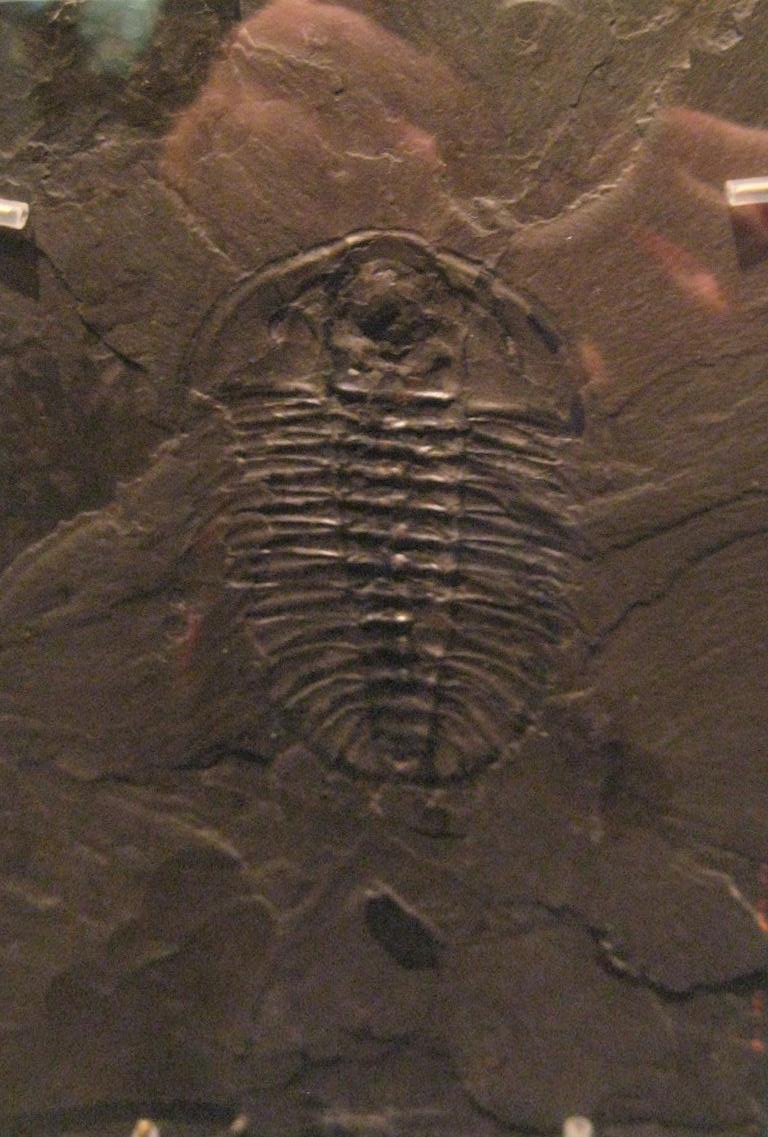
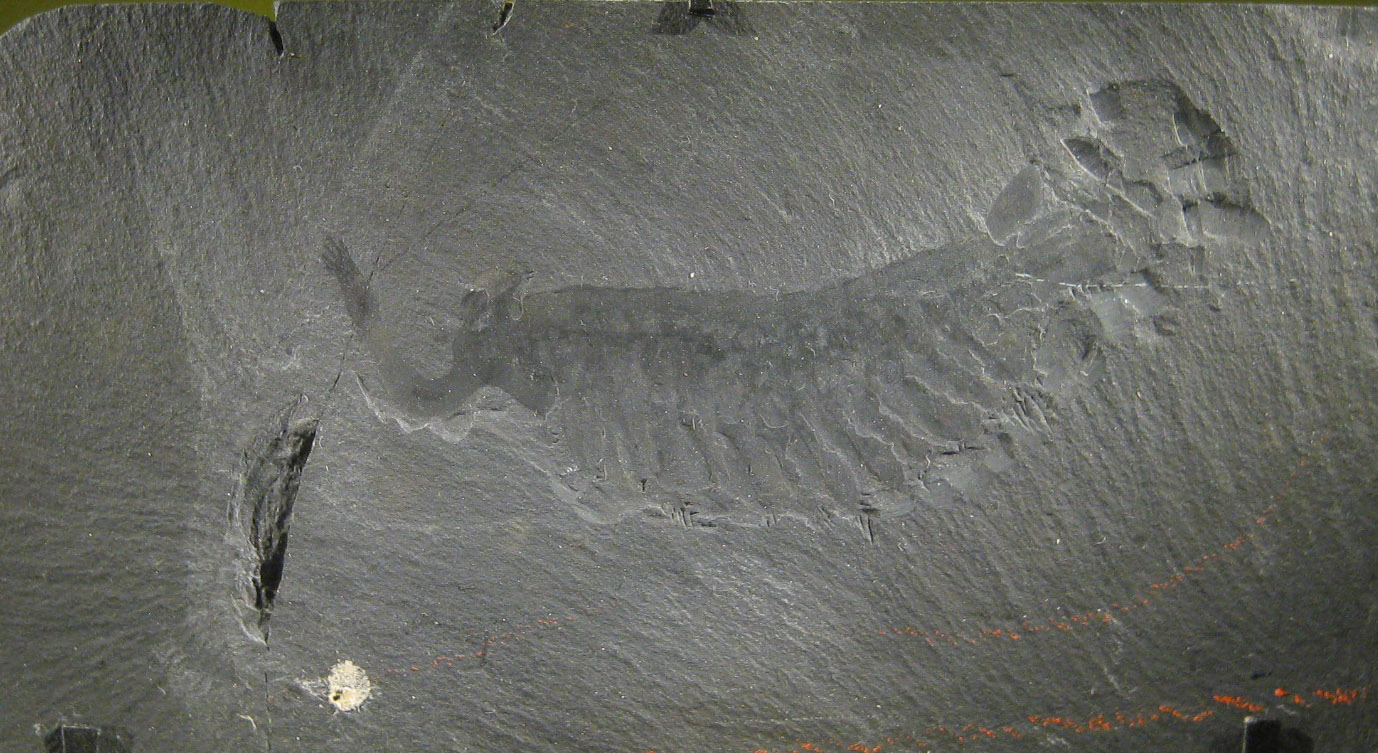
Image: Category:Opabinia fossils - Wikimedia Commons (CC BY-SA)
About Opabinia
Opabinia regalis is one of the most iconic and enigmatic creatures to have emerged from the Cambrian Explosion, a period of unparalleled evolutionary innovation that occurred approximately 505 million years ago. First discovered in the celebrated Burgess Shale fossil beds of British Columbia, Canada, this small marine animal is renowned for its utterly bizarre and alien-like anatomy, which for decades defied easy classification and challenged scientific understanding of early animal evolution. Its unique combination of features, including five eyes and a frontal proboscis, makes Opabinia a quintessential example of the morphological experimentation that characterized life in the Cambrian seas and serves as a crucial data point in understanding the origins of the arthropod lineage.
The physical appearance of Opabinia regalis is so far removed from any living animal that its initial reconstruction was met with disbelief. It was a relatively small, soft-bodied organism, with most specimens measuring between 4 and 7 centimeters in length, though some estimates suggest it could have reached up to 10 centimeters. Its bilaterally symmetrical body was elongated and segmented, composed of approximately 15 trunk segments. The most startling and famous feature was its head, which bore five prominent compound eyes mounted on short, flexible stalks. Four of these eyes were arranged in a quadrilateral pattern on the top of the head, while a fifth, centrally located eye pointed upwards, collectively providing a nearly 360-degree field of vision. This sophisticated visual system suggests Opabinia was a visually oriented predator, capable of detecting movement from multiple directions simultaneously. Extending from the front of the head was another extraordinary feature: a long, flexible, hose-like proboscis, which could be almost a third of the animal's total body length. This proboscis was hollow, ridged like a vacuum cleaner hose for flexibility, and terminated in a specialized grasping claw armed with paired spines. This entire apparatus was used to seek out and capture prey. The mouth of Opabinia was located ventrally, beneath the head and facing backwards, a highly unusual arrangement that required the proboscis to curl back on itself to deliver food. The body itself was flanked by a series of paired, downward-pointing lateral lobes, one pair per segment, which likely undulated in a wave-like motion for swimming. Overlapping these lobes were flap-like gills for respiration. The animal terminated in a distinctive tail fan, composed of three pairs of upward-curving flaps, which probably functioned as a stabilizer or rudder during locomotion.
The unique morphology of Opabinia provides significant clues into its paleobiology and behavior as an active predator in the benthic zone, the area just above the seafloor. Its five stalked eyes would have given it an exceptional awareness of its surroundings, allowing it to spot both potential prey and threats from nearly any angle. The long, prehensile proboscis was undoubtedly its primary feeding tool. Paleontologists theorize that Opabinia would have swum or hovered just above the soft muddy substrate, using its proboscis to probe the sediment for small, soft-bodied invertebrates like worms or other burrowing organisms. Once prey was detected, the terminal claw would have swiftly grasped it, and the proboscis would then retract and bend underneath the head to deliver the meal to its rear-facing mouth. This feeding strategy is unique in the known fossil record. Locomotion was achieved through the rhythmic, metachronal undulation of its lateral lobes, which would have propelled it through the water with considerable grace and control, while the tail fan provided stability and steering. Unlike many of its contemporaries, such as the heavily armored trilobites, Opabinia lacked any mineralized exoskeleton, making it a soft and vulnerable target. Its advanced visual system and agility were likely its primary defenses against larger predators of the time, such as the formidable apex predator Anomalocaris.
Opabinia lived in a warm, shallow marine environment on a submerged continental shelf off the coast of the ancient continent of Laurentia, which would later form the core of North America. The Burgess Shale fauna, of which Opabinia is a key member, represents a remarkably well-preserved snapshot of a complex marine ecosystem that thrived during the Middle Cambrian. This community was incredibly diverse, featuring a mix of organisms that are recognizable as early members of modern phyla alongside many strange "evolutionary experiments" that left no descendants. Opabinia shared its habitat with a host of other notable creatures, including the ubiquitous trilobites like Olenoides, the bizarre five-spined Hallucigenia, the worm-like Aysheaia, and the early chordate Pikaia. As a carnivore, Opabinia occupied a mid-level trophic position in the food web. It was a predator of smaller, soft-bodied benthic organisms, but it was, in turn, potential prey for the much larger Anomalocaris, the top predator of the Cambrian seas. The intricate interactions within this ecosystem, from predation to competition for resources, were a powerful engine for the evolutionary diversification that defined the Cambrian period, and Opabinia's specialized predatory niche highlights the complexity and sophistication that had already evolved in animal communities just a few tens of millions of years after the first complex animals appeared.
The discovery of Opabinia is intrinsically linked to the work of the renowned American paleontologist Charles Doolittle Walcott. While systematically quarrying the Burgess Shale on what is now known as Fossil Ridge in the Canadian Rockies, Walcott unearthed the first specimens of this peculiar animal between 1909 and 1912. He formally described the species in 1912, naming it Opabinia regalis. The genus name "Opabinia" is derived from Opabin Pass, a nearby landmark between Mount Hungabee and Mount Biddle, while the species name "regalis," meaning "royal" or "regal" in Latin, was likely chosen to reflect the exceptional quality and striking nature of the fossils. In his initial description, Walcott, attempting to fit the creature into a known group, classified it as a strange type of phyllocarid crustacean, a group of arthropods. He misinterpreted the proboscis as a fused pair of appendages and the tail as a crustacean-like telson. For over half a century, this interpretation stood, with Opabinia regarded as little more than an oddity within the arthropods. The true, far more bizarre nature of the animal would not be fully appreciated until decades later, when a comprehensive re-examination of Walcott's collection was undertaken.
The evolutionary significance of Opabinia cannot be overstated, as its study has profoundly shaped our understanding of the Cambrian Explosion and the origins of the arthropod phylum. For many years, its unique body plan made it a classic "problematica," a fossil of completely unknown affinity. This changed dramatically in 1975 with the groundbreaking redescription by paleontologist Harry B. Whittington. Using meticulous dissection of the fossil specimens and creating detailed models, Whittington revealed the five eyes, the frontal proboscis, and other features that made it clear Opabinia did not belong to any known animal phylum. At a now-famous presentation of his reconstruction in 1972, the audience reportedly broke into laughter at the sheer strangeness of the creature. Whittington initially concluded that Opabinia represented a failed evolutionary experiment, an extinct lineage with no connection to modern life. However, the subsequent discovery and study of other Cambrian animals, particularly Anomalocaris and its relatives, provided a new context. These creatures, collectively known as radiodonts, shared key features with Opabinia, including lateral swimming lobes and stalked compound eyes. This led to the realization that Opabinia was not an isolated oddity but part of a major extinct group, the dinocaridids (now more commonly placed within Radiodonta), that represents the stem-group of arthropods. It showcases a crucial evolutionary stage after the divergence from velvet worms but before the evolution of the fully hardened exoskeletons and jointed limbs that define true arthropods (Euarthropoda). Thus, Opabinia provides an invaluable window into the step-by-step assembly of the modern arthropod body plan.
Despite its now-established position as a stem-arthropod, Opabinia has been at the center of several scientific debates. Its precise placement within the radiodonts and the broader arthropod stem-group remains a subject of active research, with different phylogenetic analyses yielding slightly different results. Some studies place it as a sister taxon to the group containing Anomalocaris and Hurdia, while others suggest it represents an earlier, more basal offshoot of the radiodont lineage. The exact function of its body parts also continues to be discussed. While the proboscis is widely accepted as a feeding apparatus, the precise mechanics of its operation and the range of prey it could handle are still debated. Similarly, the hydrodynamic efficiency of its swimming lobes and tail fan has been a topic of biomechanical modeling, with scientists working to understand how this uniquely structured animal moved through the water. These ongoing discussions highlight how even a well-studied fossil like Opabinia continues to yield new insights and generate new questions as analytical techniques and our understanding of Cambrian ecosystems improve.
The fossil record of Opabinia regalis is exceptionally rare and geographically restricted, contributing to its mystique. To date, all known specimens have been recovered from a single location: the Burgess Shale formation in British Columbia, Canada, specifically from the Walcott Quarry and surrounding strata. Fewer than forty complete or near-complete specimens have been documented, making it a far less common fossil than many of its contemporaries like Marrella or Canadaspis. The reason for this rarity is likely tied to its entirely soft-bodied construction. Its preservation required the unique and extraordinary conditions of the Burgess Shale, where anoxic mudflows rapidly buried the marine community, preventing decay and allowing for the fossilization of soft tissues in exquisite detail as carbon films on the shale. Without these specific taphonomic circumstances, it is highly unlikely that any trace of Opabinia would have survived in the fossil record. The most significant collections of Opabinia fossils are housed at the Smithsonian National Museum of Natural History in Washington, D.C., where Walcott's original finds are curated, and at the Royal Ontario Museum in Toronto.
Although a rare and long-extinct creature, Opabinia regalis has achieved a notable cultural impact, primarily as a symbol of the strangeness and wonder of the Cambrian Explosion. Its otherworldly appearance has made it a favorite among paleo-artists and a staple in museum exhibits on early life, often featured alongside its equally bizarre contemporaries Hallucigenia and Anomalocaris. It played a starring role in Stephen Jay Gould's influential 1989 book "Wonderful Life," which used the story of the Burgess Shale's reinterpretation to explore themes of contingency and unpredictability in evolution. This book brought Opabinia to a wide public audience, cementing its status as an icon of evolutionary experimentation. Its image appears in documentaries, textbooks, and popular science media as a prime example of a body plan that is radically different from anything alive today, serving as a powerful educational tool for illustrating the vast scope of evolutionary possibility and the deep history of life on Earth.
Classification
Time Period
Discovery
Location
British Columbia, Canada
Formation
Burgess Shale
Frequently Asked Questions
What is Opabinia?
Opabinia regalis is one of the most iconic and enigmatic creatures to have emerged from the Cambrian Explosion, a period of unparalleled evolutionary innovation that occurred approximately 505 million years ago. First discovered in the celebrated Burgess Shale fossil beds of British Columbia, Canada...
When did Opabinia live?
Opabinia lived during the cambrian period of the paleozoic era approximately 505 million years ago.
Where was Opabinia discovered?
Fossils of Opabinia were discovered in British Columbia, Canada in the Burgess Shale.
What did Opabinia eat?
Opabinia was a carnivore. It lived in marine habitats.
What type of fossil is Opabinia?
Opabinia is preserved as a impression fossil. The preservation quality is exceptional.
Related Specimens
From the paleozoic era · impression fossils